Copysmith Review (2026): AI Copywriting Pricing, Limits & Alternatives
Bottom line
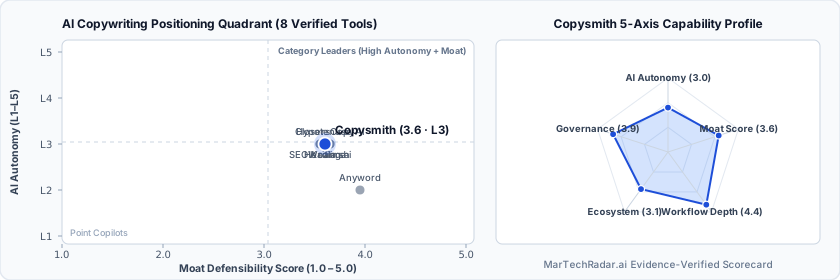
Copysmith is a Web SaaS tool for AI Copywriting (Direct-Response & eCommerce Copy) in Copy & Content. Pricing: Custom / enterprise pricing. Best suited to DTC / eCommerce and Enterprise Brands. Editor ratings: AI autonomy L3 (conditional automation); moat score 3.6/5.0 (Proprietary moat). Fact-checked by Jiacky Lee on Oct 6, 2026.
ECommerce content generation and generative engine optimization platform designed for catalog-scale product copy and digital merchandising workflows.
Copysmith buyer fit verdict: when to choose vs. when to walk away
Choose Copysmith if (Best Fit)
- Target ICP & Stack Fit: You operate as DTC / eCommerce and Enterprise Brands requiring a Web SaaS deployment for AI Copywriting.
- L3 Architecture & Defensibility: Moderate defensibility through its multi-brand ecosystem integrating Frase and Describely, creating structured product data pipelines and generative search visibility scoring across catalog-scale retail deployments.
- Commercial Model Fit: Your procurement budget aligns with Custom / enterprise pricing.
Walk away from Copysmith if (Deal-Breakers)
- Walk away if you require transparent self-serve monthly billing or your budget ceiling is under $1,000/mo (Copysmith requires sales-gated custom quoting).
- Walk away if your workflow cannot tolerate attribute mapping fragility: Ingestion pipelines falter when importing non-standardized or deeply nested product attributes, requiring manual schema mapping to prevent generation errors across high-SKU catalogs.
- Walk away if hallucination in complex technical specifications is a deal-breaker for your team: Autonomous generation loops can invent compliance or material metrics when source data lacks explicit values, demanding essential human-in-the-loop validation for regulated categories.
Copysmith key facts & scorecard
| Pricing | Custom / enterprise pricing |
|---|---|
| Free plan | No / not disclosed |
| Delivery | Web SaaS |
| Audience | DTC / eCommerce, Enterprise Brands |
| AI autonomy level | L3 · Conditional automationEditor-verified |
| Moat tier & score | 3.6 / 5.0 · Proprietary moatEditor-verified |
| Funding | Series A |
| Total funding | $10MBacked by PSG Equity, Harmony Venture Labs |
| Founders | Anna Wang |
| Company size | 11-50 employees |
| Governance & docs | Trust & Security ↗ · Terms ↗ · Privacy ↗ |
| Headquarters | Birmingham, Alabama |
| Founded | 2020 |
| Last verified |
Copysmith pros & cons: strengths vs. operational limitations
Pros: core strengths & capabilities
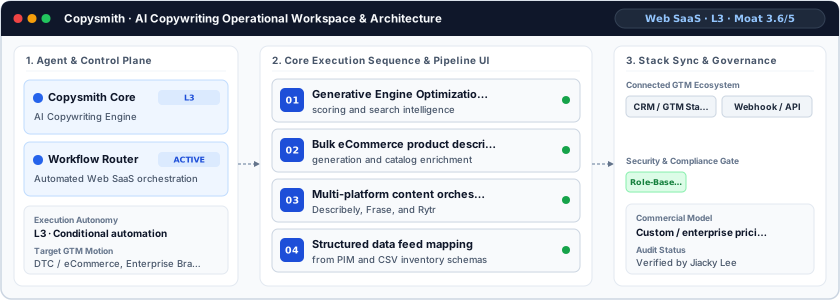
- Generative Engine Optimization (GEO): scoring and search intelligence
- Bulk eCommerce product description: generation and catalog enrichment
- Multi-platform content orchestration connecting: Describely, Frase, and Rytr
- Structured data feed mapping: from PIM and CSV inventory schemas
Cons: operational limitations & risks
- Attribute Mapping Fragility: Ingestion pipelines falter when importing non-standardized or deeply nested product attributes, requiring manual schema mapping to prevent generation errors across high-SKU catalogs.
- Hallucination in Complex Technical Specifications: Autonomous generation loops can invent compliance or material metrics when source data lacks explicit values, demanding essential human-in-the-loop validation for regulated categories.
- Cross-Platform Workflow Fragmentation: Operating distinct platforms like Frase, Describely, and Rytr introduces workflow boundaries, as unified identity management and centralized project state across products remain loosely coupled.
Copysmith TCO & deal-breaker stress test
Simulate 12-month stepped TCO, hidden cost multipliers, contract lock-in exposure, and stack failure modes using only facts verified by Jiacky Lee on · Capture SHA 88a860e8.
Copysmith triggers high-severity friction under your 5-seat / $800/mo constraints. Benchmark the verified subtrack alternatives below before committing.
| Plan / Tier | Verified Rate | Scale Fit | Scope & Quota Notes |
|---|---|---|---|
| Enterprise / Custom | Custom quote | 15–50+ seats (Enterprise SLA) | Sales-negotiated annual contract for custom volume, SSO/RBAC governance, and dedicated SLA. |
- Moat Score
- 3.6 / 5.0
- AI Autonomy
- L3
- Free Tier / Trial
- None disclosed
Triggered audit signals & failure modes
- Opaque Enterprise Quoting vs. SMB/Mid-Market BudgetVerified Pricing Ledger
Copysmith does not disclose a public self-serve floor (Custom / enterprise pricing). Buyers with a $800/mo cap face high sales-qualification friction.
- Sales-Gated Contract TermsFact-checked by Jiacky Lee
Copysmith delivers its software through custom enterprise licensing rather than published recurring tiers. Commercial pricing is available on request through tailored enterprise sales quotes based on organizational scale and seats.
- Primary Operational Bottleneck: Attribute Mapping FragilityAudit by Jiacky Lee
Ingestion pipelines falter when importing non-standardized or deeply nested product attributes, requiring manual schema mapping to prevent generation errors across high-SKU catalogs.
Hidden TCO Multipliers & Quota Gates
- Attribute Mapping Fragility: Ingestion pipelines falter when importing non-standardized or deeply nested product attributes, requiring manual schema mapping to prevent generation errors across high-SKU catalogs.
- Hallucination in Complex Technical Specifications: Autonomous generation loops can invent compliance or material metrics when source data lacks explicit values, demanding essential human-in-the-loop validation for regulated categories.
When to Walk Away & Negotiation Levers
- Walk away if you require transparent self-serve monthly billing or your budget ceiling is under $1,000/mo (Copysmith requires sales-gated custom quoting).
- Walk away if your workflow cannot tolerate attribute mapping fragility: Ingestion pipelines falter when importing non-standardized or deeply nested product attributes, requiring manual schema mapping to prevent generation errors across high-SKU catalogs.
- Walk away if hallucination in complex technical specifications is a deal-breaker for your team: Autonomous generation loops can invent compliance or material metrics when source data lacks explicit values, demanding essential human-in-the-loop validation for regulated categories.
- Demand a 30- to 60-day paid pilot opt-out clause in the Copysmith order form before signing a 12-month enterprise commitment.
- Require a sandbox proof-of-concept testing attribute mapping fragility against your live CRM/data schema before annual sign-off.
Ask a custom procurement or TCO stress-test question about Copysmith
Lower 5-seat floor (~$49/mo vs. Custom Quote) · Transparent self-serve entry without mandatory annual lock-in
Lower 5-seat floor (~$10/mo vs. Custom Quote) · Transparent self-serve entry without mandatory annual lock-in
Copysmith moat & subtrack positioning
Moderate defensibility through its multi-brand ecosystem integrating Frase and Describely, creating structured product data pipelines and generative search visibility scoring across catalog-scale retail deployments.
Editorial review
Fact-checked by Jiacky Lee (Managing Editor, AI Autonomy & Moat Methodology) on .
Background
Backed by $10M in venture funding and founded in 2020 in Birmingham, Alabama, Copysmith operates an eCommerce content generation and search intelligence infrastructure platform. Targeting enterprise catalog managers, digital merchandisers, and performance copywriters, the system resolves the manual bottleneck of writing thousands of product listings. Through its portfolio consolidation encompassing Frase, Describely, and Rytr, the software focuses on bulk asset creation alongside Generative Engine Optimization requirements.
How Copysmith works
The platform functions at Level 3 conditional autonomy by connecting structured inventory ingestion with generative language pipelines. Teams import product data via CSVs or catalog schemas, which the engine parses into field-level attributes such as materials, dimensions, and brand rules. Generative models translate these parameters into bulk product descriptions, metadata, and ad variants. The architecture incorporates search intelligence layers to analyze lexical coverage and optimize outputs for both conventional search indexing and generative AI answer engines.
Limitations
Operational considerations and platform boundaries include:
- Attribute Mapping Fragility: Ingestion pipelines falter when importing non-standardized or deeply nested product attributes, requiring manual schema mapping to prevent generation errors across high-SKU catalogs.
- Hallucination in Complex Technical Specifications: Autonomous generation loops can invent compliance or material metrics when source data lacks explicit values, demanding essential human-in-the-loop validation for regulated categories.
- Cross-Platform Workflow Fragmentation: Operating distinct platforms like Frase, Describely, and Rytr introduces workflow boundaries, as unified identity management and centralized project state across products remain loosely coupled.
Copysmith pricing
Copysmith delivers its software through custom enterprise licensing rather than published recurring tiers. Commercial pricing is available on request through tailored enterprise sales quotes based on organizational scale and seats. Deployments typically configure annual agreements factoring in overall catalog volume, API data consumption across associated platform tools, and dedicated integration support.
How Copysmith compares
Within the performance and direct-response generation sector, Copysmith competes with Anyword, ClosersCopy, and Headlime. While Anyword concentrates on predictive performance scores using consumer telemetry, ClosersCopy emphasizes manual sales frameworks for independent copywriters. Headlime prioritizes landing page generation over catalog infrastructure. Copysmith distinguishes itself through bulk eCommerce feed transformations and generative engine optimization scoring, making it best suited for enterprise retailers managing extensive product inventories requiring rapid catalog-level refreshes.
Direct competitors & market radar
Top algorithmic competitors based on category positioning, capability overlap, and ICP alignment.
Frequently asked questions about Copysmith
How much does Copysmith cost and does it require a custom enterprise quote?
Published pricing summary for Copysmith: Custom / enterprise pricing. A permanent free plan is not disclosed for Copysmith. Copysmith delivers its software through custom enterprise licensing rather than published recurring tiers. Commercial pricing is available on request through tailored enterprise sales quotes based on organizational scale and seats.
How does Copysmith work and how autonomous is its AI architecture?
ECommerce content generation and generative engine optimization platform designed for catalog-scale product copy and digital merchandising workflows. Within AI Copywriting (Direct-Response & eCommerce Copy), MarTechRadar rates its execution architecture at L3 · Conditional automation with a verified Moat Score of 3.6 / 5.0 (Proprietary moat). Moderate defensibility through its multi-brand ecosystem integrating Frase and Describely, creating structured product data pipelines and generative search visibility scoring across catalog-scale retail deployments. Corporate profile: Founded by Anna Wang, operating at 11-50 employees scale.
What are the main limitations of Copysmith and when should buyers walk away?
Based on our editorial technical audit, key operational considerations and boundaries for Copysmith include: (1) Attribute Mapping Fragility: Ingestion pipelines falter when importing non-standardized or deeply nested product attributes, requiring manual schema mapping to prevent generation errors across high-SKU catalogs. (2) Hallucination in Complex Technical Specifications: Autonomous generation loops can invent compliance or material metrics when source data lacks explicit values, demanding essential human-in-the-loop validation for regulated categories. (3) Cross-Platform Workflow Fragmentation: Operating distinct platforms like Frase, Describely, and Rytr introduces workflow boundaries, as unified identity management and centralized project state across products remain loosely coupled. Primary procurement walk-away rule: Walk away if you require transparent self-serve monthly billing or your budget ceiling is under $1,000/mo (Copysmith requires sales-gated custom quoting).
What integrations, compliance certifications, and contract terms apply to Copysmith?
First-party governance and developer endpoints verified on domain include: Trust/Security (https://trust.copysmith.ai). Key TCO multiplier to watch: Attribute Mapping Fragility (Ingestion pipelines falter when importing non-standardized or deeply nested product attributes, requiring manual schema mapping to prevent generation errors across high-SKU catalogs.) Before signing a contract, procurement teams should demand a 30- to 60-day paid pilot opt-out clause in the Copysmith order form before signing a 12-month enterprise commitment.
What are the best Copysmith alternatives and head-to-head competitors in 2026?
Top fact-checked alternatives to Copysmith in AI Copywriting (Direct-Response & eCommerce Copy) include Copy.ai (Workflows) ($49–$249/mo), Anyword ($49–$99/mo), Rytr (Free plan · $7.50–$24.16/mo), YAi Digital (Custom / enterprise pricing). Within the performance and direct-response generation sector, Copysmith competes with Anyword, ClosersCopy, and Headlime. While Anyword concentrates on predictive performance scores using consumer telemetry, ClosersCopy emphasizes manual sales frameworks for independent copywriters.
Verified sources & evidence trail
- Official product domain: https://copysmith.ai
- Commercial pricing verification: Verified against official vendor pricing policy (Custom / enterprise pricing)
- Verified corporate entity profiles (
sameAs): LinkedIn Company Profile · Crunchbase Entity Record - First-party governance & documentation links: Trust & Security · Terms · Privacy
- Editorial audit sign-off: Fact-checked by Jiacky Lee on under the MarTechRadar Evidence-Ledger Protocol.