Katteb Review (2026): AI Content Marketing Pricing, Limits & Alternatives
Bottom line
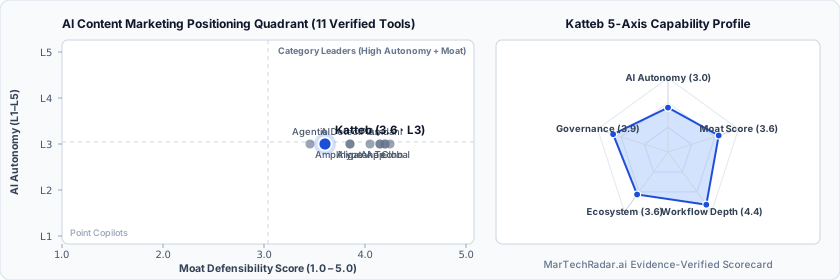
Katteb is a Web SaaS tool for AI Content Marketing (Enterprise & Long-Form Brand Content) in Copy & Content. Pricing: From $19/mo. Best suited to Creators / Solo. Editor ratings: AI autonomy L3 (conditional automation); moat score 3.6/5.0 (Proprietary moat). Fact-checked by Julie Brot on Oct 14, 2026.
Goal-driven autonomous AI agents executing recurrent long-form content generation, cross-platform data synchronization, and digital marketing workflows.
Katteb buyer fit verdict: when to choose vs. when to walk away
Choose Katteb if (Best Fit)
- Target ICP & Stack Fit: You operate as Creators / Solo requiring a Web SaaS deployment for AI Content Marketing, with verified ecosystem connectivity for Shopify.
- L3 Architecture & Defensibility: Katteb pairs continuous stateful agent execution with goal-based recurrent loops, differentiating its engine from single-turn generative content utilities.
- Commercial Model Fit: Your procurement budget aligns with From $19/mo.
Walk away from Katteb if (Deal-Breakers)
- Walk away if your workflow requires uncapped enterprise volume on the From $19/mo entry plan without upgrading tiers.
- Walk away if your workflow cannot tolerate agent execution caps: The entry configuration restricts autonomous execution to 30 agent hours per week, creating workflow queuing bottlenecks during high-volume publishing campaigns.
- Walk away if connector maintenance overhead is a deal-breaker for your team: Automated data retrieval depends on third-party SaaS authentication and schema stability, where unannounced API revisions break headless recurring runs.
Katteb key facts & scorecard
| Pricing | From $19/moVendor pricing page |
|---|---|
| Free plan | No / not disclosed |
| Delivery | Web SaaS |
| Audience | Creators / Solo |
| AI autonomy level | L3 · Conditional automationEditor-verified |
| Moat tier & score | 3.6 / 5.0 · Proprietary moatEditor-verified |
| Funding | Seed |
| Total funding | $100K |
| Founders | Abdelaziz Mohammed, Ahmed Ezat |
| Company size | 11-50 employees |
| Ecosystem integrations | Shopify |
| Governance & docs | Terms ↗ · Privacy ↗ |
| Headquarters | Dubai, AE |
| Founded | 2021 |
| Last verified |
Katteb pros & cons: strengths vs. operational limitations
Pros: core strengths & capabilities
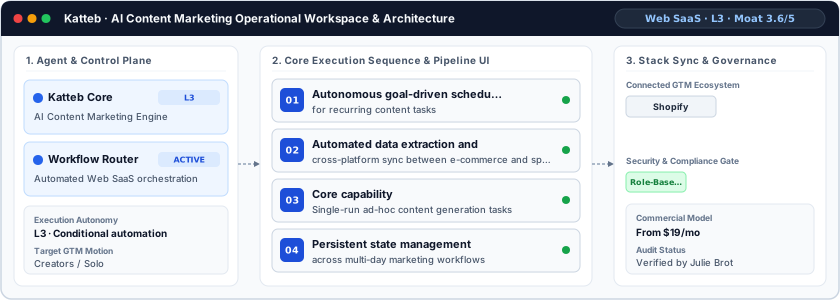
- Autonomous goal-driven scheduling engine: for recurring content tasks
- Automated data extraction and: cross-platform sync between e-commerce and spreadsheet endpoints
- Core capability: Single-run ad-hoc content generation tasks
- Persistent state management: across multi-day marketing workflows
Cons: operational limitations & risks
- Agent Execution Caps: The entry configuration restricts autonomous execution to 30 agent hours per week, creating workflow queuing bottlenecks during high-volume publishing campaigns.
- Connector Maintenance Overhead: Automated data retrieval depends on third-party SaaS authentication and schema stability, where unannounced API revisions break headless recurring runs.
- Editorial Alignment Drift: Autonomous recurring cycles run without essential per-post human checkpoints, risking progressive hallucination or voice drift across extended generation horizons.
Katteb TCO & deal-breaker stress test
Simulate 12-month stepped TCO, hidden cost multipliers, contract lock-in exposure, and stack failure modes using only facts verified by Julie Brot on · Capture SHA 79fb61aa.
Katteb aligns with your 5-seat / $800/mo profile. Review the walk-away triggers and contract levers below before deployment.
| Plan / Tier | Verified Rate | Scale Fit | Scope & Quota Notes |
|---|---|---|---|
| Lite | $19/mo | 1–2 seats | For anyone with one outcome to reach: leads, followers, sales |
| Growth / Professional | $99/mo | 5 seats | For a business running several goals and handing the agent tasks every day |
- Moat Score
- 3.6 / 5.0
- AI Autonomy
- L3
- Free Tier / Trial
- None disclosed
Triggered audit signals & failure modes
- Published Self-Serve Entry FloorVerified Pricing Ledger
Katteb publishes a transparent entry point (From $19/mo) for initial validation before committing.
- Tier Fit for 5-Seat Scale: Growth / Professional ($99/mo)Verified Tier Schedule
For a business running several goals and handing the agent tasks every day
- Primary Operational Bottleneck: Agent Execution CapsAudit by Julie Brot
The entry configuration restricts autonomous execution to 30 agent hours per week, creating workflow queuing bottlenecks during high-volume publishing campaigns.
Hidden TCO Multipliers & Quota Gates
- Credit & Usage Burn Multiplier: Automated workflows consume metered credits/usage quotas; multi-step enrichment, voice minutes, or high-frequency agent runs can trigger mid-cycle top-up packs.
- Agent Execution Caps: The entry configuration restricts autonomous execution to 30 agent hours per week, creating workflow queuing bottlenecks during high-volume publishing campaigns.
- Connector Maintenance Overhead: Automated data retrieval depends on third-party SaaS authentication and schema stability, where unannounced API revisions break headless recurring runs.
When to Walk Away & Negotiation Levers
- Walk away if your workflow requires uncapped enterprise volume on the From $19/mo entry plan without upgrading tiers.
- Walk away if your workflow cannot tolerate agent execution caps: The entry configuration restricts autonomous execution to 30 agent hours per week, creating workflow queuing bottlenecks during high-volume publishing campaigns.
- Walk away if connector maintenance overhead is a deal-breaker for your team: Automated data retrieval depends on third-party SaaS authentication and schema stability, where unannounced API revisions break headless recurring runs.
- Validate exact quota thresholds (seats, credits, or API calls) included in Katteb's From $19/mo tier before converting from monthly to annual billing.
- Require a sandbox proof-of-concept testing agent execution caps against your live CRM/data schema before annual sign-off.
Ask a custom procurement or TCO stress-test question about Katteb
Lower 5-seat floor (~$8/mo vs. $99 / mo)
Verified AI Content Marketing peer (From $900/mo · Moat 4.2/5.0)
Katteb key entities, modules & ecosystem stack
Katteb moat & subtrack positioning
Katteb pairs continuous stateful agent execution with goal-based recurrent loops, differentiating its engine from single-turn generative content utilities.
Editorial review
Fact-checked by Julie Brot (Enterprise SaaS Governance & Procurement Editor) on .
Background
To break past the constraints of static single-prompt text generators, Katteb restructures digital marketing production into persistent, autonomous execution cycles. Headquartered in Dubai, AE, and established in 2021 with $100K in venture funding, the company targets performance marketers, e-commerce operators, and editorial teams. Instead of stopping execution after producing an isolated text snippet, the platform provides continuous task runners that pursue long-term operational targets across digital channels.
How Katteb works
At the architectural layer, the system autonomy, Katteb bifurcates work into discrete tasks and recurring goals. Ad-hoc tasks execute single-instance jobs such as structured drafting or targeted content transformations. The recurring goal engine, by contrast, deploys an autonomous scheduling loop that maintains state over multi-day trajectories. The architecture orchestrates language models alongside external data pipelines, ingesting source metrics from endpoints like Shopify to compile structured reporting and generate contextual copy automatically without manual session restarts.
Limitations
Operational considerations and platform boundaries include:
- Agent Execution Caps: The entry configuration restricts autonomous execution to 30 agent hours per week, creating workflow queuing bottlenecks during high-volume publishing campaigns.
- Connector Maintenance Overhead: Automated data retrieval depends on third-party SaaS authentication and schema stability, where unannounced API revisions break headless recurring runs.
- Editorial Alignment Drift: Autonomous recurring cycles run without essential per-post human checkpoints, risking progressive hallucination or voice drift across extended generation horizons.
Katteb pricing
Commercial access operates on a tiered subscription framework structured around execution volume and concurrency limits. The Lite tier begins at $19 per month, which delivers 30 hours of agent compute per week, a single persistent goal-focused agent, and ad-hoc task generation. Higher operational tiers expand dedicated agent capacity, increase compute allocations, and support higher goal concurrency for complex digital operations.
How Katteb compares
Within enterprise content and digital asset automation, Katteb contrasts sharply with specialized tooling across adjacent categories. While Agentio targets creator sponsorship workflows, Aha Global addresses enterprise digital footprint deployment, and AIDetectPlus focuses on AI watermarking and detection assurance, Katteb emphasizes autonomous task execution. It serves mid-market brands seeking continuous content maintenance rather than manual, prompt-by-prompt editorial interfaces.
Direct competitors & market radar
Top algorithmic competitors based on category positioning, capability overlap, and ICP alignment.
Frequently asked questions about Katteb
How much does Katteb cost and what pricing tiers are available?
Published pricing summary for Katteb: From $19/mo. A permanent free plan is not disclosed for Katteb. Verified tier schedule: Lite ($19/mo for 1–2 seats); Growth / Professional ($99/mo for 5 seats). Commercial access operates on a tiered subscription framework structured around execution volume and concurrency limits. The Lite tier begins at $19 per month, which delivers 30 hours of agent compute per week, a single persistent goal-focused agent, and ad-hoc task generation.
How does Katteb work and how autonomous is its AI architecture?
Goal-driven autonomous AI agents executing recurrent long-form content generation, cross-platform data synchronization, and digital marketing workflows. Within AI Content Marketing (Enterprise & Long-Form Brand Content), MarTechRadar rates its execution architecture at L3 · Conditional automation with a verified Moat Score of 3.6 / 5.0 (Proprietary moat). Katteb pairs continuous stateful agent execution with goal-based recurrent loops, differentiating its engine from single-turn generative content utilities. Corporate profile: Founded by Abdelaziz Mohammed, Ahmed Ezat, operating at 11-50 employees scale.
What are the main limitations of Katteb and when should buyers walk away?
Based on our editorial technical audit, key operational considerations and boundaries for Katteb include: (1) Agent Execution Caps: The entry configuration restricts autonomous execution to 30 agent hours per week, creating workflow queuing bottlenecks during high-volume publishing campaigns. (2) Connector Maintenance Overhead: Automated data retrieval depends on third-party SaaS authentication and schema stability, where unannounced API revisions break headless recurring runs. (3) Editorial Alignment Drift: Autonomous recurring cycles run without essential per-post human checkpoints, risking progressive hallucination or voice drift across extended generation horizons. Primary procurement walk-away rule: Walk away if your workflow requires uncapped enterprise volume on the From $19/mo entry plan without upgrading tiers.
What integrations, compliance certifications, and contract terms apply to Katteb?
Verified ecosystem and stack integrations include Shopify. Key TCO multiplier to watch: Credit & Usage Burn Multiplier (Automated workflows consume metered credits/usage quotas; multi-step enrichment, voice minutes, or high-frequency agent runs can trigger mid-cycle top-up packs.) Before signing a contract, procurement teams should validate exact quota thresholds (seats, credits, or API calls) included in Katteb's From $19/mo tier before converting from monthly to annual billing.
What are the best Katteb alternatives and head-to-head competitors in 2026?
Top fact-checked alternatives to Katteb in AI Content Marketing (Enterprise & Long-Form Brand Content) include Rytr (Free plan · $7.50–$24.16/mo), Hootsuite OwlyWriter (Custom / enterprise pricing), Gushwork (From $900/mo), Contently (Custom / enterprise pricing). Within enterprise content and digital asset automation, Katteb contrasts sharply with specialized tooling across adjacent categories.
Verified sources & evidence trail
- Official product domain: https://katteb.com
- Commercial pricing verification: https://katteb.com/pricing
- Verified corporate entity profiles (
sameAs): LinkedIn Company Profile · Crunchbase Entity Record - First-party governance & documentation links: Terms · Privacy
- Editorial audit sign-off: Fact-checked by Julie Brot on under the MarTechRadar Evidence-Ledger Protocol.