Ada.cx Review (2026): eCommerce Chatbot Pricing, Limits & Alternatives
Bottom line
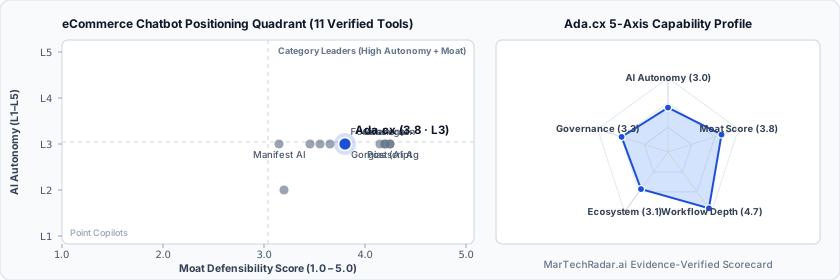
Ada.cx is a Web SaaS tool for eCommerce Chatbot (Conversational eCommerce & Support Bots) in Lifecycle & CDP. Pricing: Custom / enterprise pricing. Best suited to DTC / eCommerce and Enterprise Brands. Editor ratings: AI autonomy L3 (conditional automation); moat score 3.8/5.0 (Proprietary moat). Fact-checked by Sarah Per on Oct 12, 2026.
Agentic customer service platform utilizing Model Context Protocol and API tool-use to autonomously execute multi-step resolutions across channels.
Ada.cx buyer fit verdict: when to choose vs. when to walk away
Choose Ada.cx if (Best Fit)
- Target ICP & Stack Fit: You operate as DTC / eCommerce and Enterprise Brands requiring a Web SaaS deployment for eCommerce Chatbot.
- L3 Architecture & Defensibility: Proprietary execution environment (Ada Computer) combining Model Context Protocol support, deterministic guardrails, and bidirectional transactional integrations across enterprise systems of record.
- Commercial Model Fit: Your procurement budget aligns with Custom / enterprise pricing.
Walk away from Ada.cx if (Deal-Breakers)
- Walk away if you require transparent self-serve monthly billing or your budget ceiling is under $1,000/mo (Ada.cx requires sales-gated custom quoting).
- Walk away if your workflow cannot tolerate API rate limits and latency spikes: When executing downstream transactional writes across multiple legacy software tools, latency overhead or third-party API rate limits can stall conversational completion loops, forcing unexpected fallbacks to human queues.
- Walk away if schema maintenance burden is a deal-breaker for your team: Dynamic tool-use depends on strictly formatted API schemas; unannounced payload modifications or breaking changes in connected third-party endpoints degrade execution accuracy without proactive integration monitoring.
Ada.cx key facts & scorecard
| Pricing | Custom / enterprise pricing |
|---|---|
| Free plan | No / not disclosed |
| Delivery | Web SaaS |
| Audience | DTC / eCommerce, Enterprise Brands |
| AI autonomy level | L3 · Conditional automationEditor-verified |
| Moat tier & score | 3.8 / 5.0 · Proprietary moatEditor-verified |
| Funding | Venture-backed |
| Company size | 201-500 employees |
| Governance & docs | Trust & Security ↗ · API & Docs ↗ · Privacy ↗ |
| Headquarters | Toronto, Ontario |
| Founded | 2023 |
| Last verified |
Ada.cx pros & cons: strengths vs. operational limitations
Pros: core strengths & capabilities
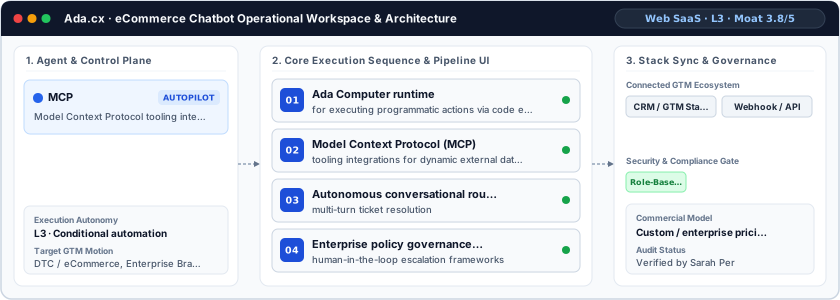
- Ada Computer runtime: for executing programmatic actions via code execution and APIs
- Model Context Protocol (MCP): tooling integrations for dynamic external data access
- Autonomous conversational routing and: multi-turn ticket resolution
- Enterprise policy governance and: human-in-the-loop escalation frameworks
Cons: operational limitations & risks
- API Rate Limits and Latency Spikes: When executing downstream transactional writes across multiple legacy software tools, latency overhead or third-party API rate limits can stall conversational completion loops, forcing unexpected fallbacks to human queues.
- Schema Maintenance Burden: Dynamic tool-use depends on strictly formatted API schemas; unannounced payload modifications or breaking changes in connected third-party endpoints degrade execution accuracy without proactive integration monitoring.
- Model Context Drift: In prolonged multi-turn exchanges spanning cross-functional requests, context window dilution can cause intent misalignment, requiring rigid boundary thresholds to mandate manual agent takeover.
Ada.cx TCO & deal-breaker stress test
Simulate 12-month stepped TCO, hidden cost multipliers, contract lock-in exposure, and stack failure modes using only facts verified by Sarah Per on · Capture SHA 39f61daa.
Ada.cx triggers high-severity friction under your 5-seat / $800/mo constraints. Benchmark the verified subtrack alternatives below before committing.
| Plan / Tier | Verified Rate | Scale Fit | Scope & Quota Notes |
|---|---|---|---|
| Enterprise / Custom | Custom quote | 15–50+ seats (Enterprise SLA) | Sales-negotiated annual contract for custom volume, SSO/RBAC governance, and dedicated SLA. |
- Moat Score
- 3.8 / 5.0
- AI Autonomy
- L3
- Free Tier / Trial
- None disclosed
Triggered audit signals & failure modes
- Opaque Enterprise Quoting vs. SMB/Mid-Market BudgetVerified Pricing Ledger
Ada.cx does not disclose a public self-serve floor (Custom / enterprise pricing). Buyers with a $800/mo cap face high sales-qualification friction.
- Sales-Gated Contract TermsFact-checked by Sarah Per
Commercial procurement for Ada.cx operates outside transparent off-the-shelf tiers. Commercial pricing is available on request through tailored enterprise sales quotes based on organizational scale and seats.
- Primary Operational Bottleneck: API Rate Limits and Latency SpikesAudit by Sarah Per
When executing downstream transactional writes across multiple legacy software tools, latency overhead or third-party API rate limits can stall conversational completion loops, forcing unexpected fallbacks to human queues.
Hidden TCO Multipliers & Quota Gates
- API Rate Limits and Latency Spikes: When executing downstream transactional writes across multiple legacy software tools, latency overhead or third-party API rate limits can stall conversational completion loops, forcing unexpected fallbacks to human queues.
- Schema Maintenance Burden: Dynamic tool-use depends on strictly formatted API schemas; unannounced payload modifications or breaking changes in connected third-party endpoints degrade execution accuracy without proactive integration monitoring.
When to Walk Away & Negotiation Levers
- Walk away if you require transparent self-serve monthly billing or your budget ceiling is under $1,000/mo (Ada.cx requires sales-gated custom quoting).
- Walk away if your workflow cannot tolerate API rate limits and latency spikes: When executing downstream transactional writes across multiple legacy software tools, latency overhead or third-party API rate limits can stall conversational completion loops, forcing unexpected fallbacks to human queues.
- Walk away if schema maintenance burden is a deal-breaker for your team: Dynamic tool-use depends on strictly formatted API schemas; unannounced payload modifications or breaking changes in connected third-party endpoints degrade execution accuracy without proactive integration monitoring.
- Demand a 30- to 60-day paid pilot opt-out clause in the Ada.cx order form before signing a 12-month enterprise commitment.
- Require a sandbox proof-of-concept testing API rate limits and latency spikes against your live CRM/data schema before annual sign-off.
Ask a custom procurement or TCO stress-test question about Ada.cx
Lower 5-seat floor (~$49/mo vs. Custom Quote) · Transparent self-serve entry without mandatory annual lock-in
Lower 5-seat floor (~$17/mo vs. Custom Quote) · Transparent self-serve entry without mandatory annual lock-in
Ada.cx key entities, modules & ecosystem stack
Model Context Protocol tooling integrations for dynamic external data access
Ada.cx moat & subtrack positioning
Proprietary execution environment (Ada Computer) combining Model Context Protocol support, deterministic guardrails, and bidirectional transactional integrations across enterprise systems of record.
Editorial review
Fact-checked by Sarah Per (Principal Content Systems & Generative Media Editor) on .
Background
Architected to transition automated customer support from passive text retrieval to deterministic system execution, Ada.cx provides an agentic customer experience platform established in 2023 in Toronto, Ontario. Designed for contact center directors, customer support architects, and digital operations executives, the platform addresses the operational bottlenecks of manual ticket triaging and repetitive issue remediation. Within the Conversational eCommerce & Support Bots category, the solution enables organizations to deploy autonomous digital agents capable of executing multi-step transactional actions across customer-facing channels.
How Ada.cx works
At the core of the technical architecture is Ada Computer, an agentic reasoning engine that operates at Level 3 autonomy. The platform coordinates between a foundational large language model orchestration layer, proprietary business logic, and backend systems of record. By implementing Model Context Protocol standards alongside direct API connectors and code execution sandboxes, the system translates conversational user requests into structured function calls. The pipeline ingests multi-channel inbound payloads, grounds context through semantic retrieval, evaluates conditional policies, and executes write operations directly inside external databases and software systems to resolve customer requests.
Limitations
Operational considerations and platform boundaries include:
- API Rate Limits and Latency Spikes: When executing downstream transactional writes across multiple legacy software tools, latency overhead or third-party API rate limits can stall conversational completion loops, forcing unexpected fallbacks to human queues.
- Schema Maintenance Burden: Dynamic tool-use depends on strictly formatted API schemas; unannounced payload modifications or breaking changes in connected third-party endpoints degrade execution accuracy without proactive integration monitoring.
- Model Context Drift: In prolonged multi-turn exchanges spanning cross-functional requests, context window dilution can cause intent misalignment, requiring rigid boundary thresholds to mandate manual agent takeover.
Ada.cx pricing
Commercial procurement for Ada.cx operates outside transparent off-the-shelf tiers. Commercial pricing is available on request through tailored enterprise sales quotes based on organizational scale and seats. Contracts typically align with resolution volume metrics, active integration endpoints, and dedicated service tiers. Prospective deployments require consultative scoping sessions with enterprise account teams to establish technical boundaries, system integration requirements, and customized service-level agreements.
How Ada.cx compares
Within the support automation ecosystem, Ada.cx differentiates itself through deep programmatic action execution via Ada Computer, whereas Forethought concentrates heavily on predictive triage and semantic search for established help desks. Manifest AI prioritizes fast, lightweight conversational commerce prompts specifically within eCommerce catalogs, and Postscript focuses on automated SMS marketing sequences rather than complex API-driven customer support resolutions. Ada.cx is optimal for mid-market to enterprise companies with mature REST APIs seeking autonomous, action-oriented support orchestration.
Direct competitors & market radar
Top algorithmic competitors based on category positioning, capability overlap, and ICP alignment.
Frequently asked questions about Ada.cx
How much does Ada.cx cost and does it require a custom enterprise quote?
Published pricing summary for Ada.cx: Custom / enterprise pricing. A permanent free plan is not disclosed for Ada.cx. Commercial procurement for Ada.cx operates outside transparent off-the-shelf tiers. Commercial pricing is available on request through tailored enterprise sales quotes based on organizational scale and seats.
How does Ada.cx work and how autonomous is its AI architecture?
Agentic customer service platform utilizing Model Context Protocol and API tool-use to autonomously execute multi-step resolutions across channels. Within eCommerce Chatbot (Conversational eCommerce & Support Bots), MarTechRadar rates its execution architecture at L3 · Conditional automation with a verified Moat Score of 3.8 / 5.0 (Proprietary moat). Proprietary execution environment (Ada Computer) combining Model Context Protocol support, deterministic guardrails, and bidirectional transactional integrations across enterprise systems of record. Corporate profile: operating at 201-500 employees scale.
What are the main limitations of Ada.cx and when should buyers walk away?
Based on our editorial technical audit, key operational considerations and boundaries for Ada.cx include: (1) API Rate Limits and Latency Spikes: When executing downstream transactional writes across multiple legacy software tools, latency overhead or third-party API rate limits can stall conversational completion loops, forcing unexpected fallbacks to human queues. (2) Schema Maintenance Burden: Dynamic tool-use depends on strictly formatted API schemas; unannounced payload modifications or breaking changes in connected third-party endpoints degrade execution accuracy without proactive integration monitoring. (3) Model Context Drift: In prolonged multi-turn exchanges spanning cross-functional requests, context window dilution can cause intent misalignment, requiring rigid boundary thresholds to mandate manual agent takeover. Primary procurement walk-away rule: Walk away if you require transparent self-serve monthly billing or your budget ceiling is under $1,000/mo (Ada.cx requires sales-gated custom quoting).
What integrations, compliance certifications, and contract terms apply to Ada.cx?
First-party governance and developer endpoints verified on domain include: Trust/Security (https://www.ada.cx/platform/trust), API Docs (https://docs.ada.cx). Key TCO multiplier to watch: API Rate Limits and Latency Spikes (When executing downstream transactional writes across multiple legacy software tools, latency overhead or third-party API rate limits can stall conversational completion loops, forcing unexpected fallbacks to human queues.) Before signing a contract, procurement teams should demand a 30- to 60-day paid pilot opt-out clause in the Ada.cx order form before signing a 12-month enterprise commitment.
What are the best Ada.cx alternatives and head-to-head competitors in 2026?
Top fact-checked alternatives to Ada.cx in eCommerce Chatbot (Conversational eCommerce & Support Bots) include Manifest AI (Custom / enterprise pricing), MoonAI Inc (Custom / enterprise pricing), Forethought (Custom / enterprise pricing), Postscript (From $49/mo). Within the support automation ecosystem, Ada.cx differentiates itself through deep programmatic action execution via Ada Computer, whereas Forethought concentrates heavily on predictive triage and semantic search for established help desks.
Verified sources & evidence trail
- Official product domain: https://ada.cx
- Commercial pricing verification: Verified against official vendor pricing policy (Custom / enterprise pricing)
- Verified corporate entity profiles (
sameAs): LinkedIn Company Profile · Crunchbase Entity Record - First-party governance & documentation links: Trust & Security · API & Docs · Privacy
- Editorial audit sign-off: Fact-checked by Sarah Per on under the MarTechRadar Evidence-Ledger Protocol.