Rep AI Review (2026): eCommerce Chatbot Pricing, Limits & Alternatives
Bottom line
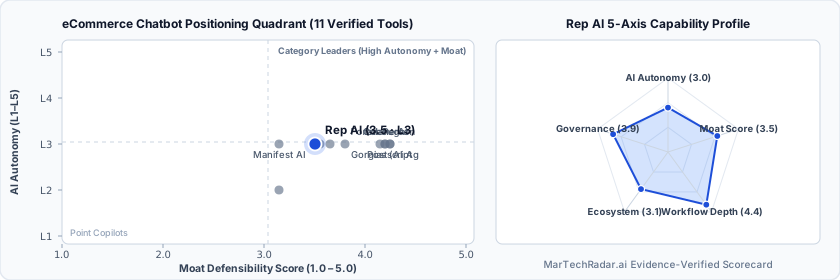
Rep AI is a Web SaaS tool for eCommerce Chatbot (Conversational eCommerce & Support Bots) in Lifecycle & CDP. Pricing: $20–$73/mo. Best suited to B2B SaaS and Marketing Agencies. Editor ratings: AI autonomy L3 (conditional automation); moat score 3.5/5.0 (Proprietary moat). Fact-checked by Anthony Hay on Oct 7, 2026.
Agentic conversational commerce platform utilizing real-time behavioral telemetry and proactive dialog to increase conversion rates across online storefronts.
Rep AI buyer fit verdict: when to choose vs. when to walk away
Choose Rep AI if (Best Fit)
- Target ICP & Stack Fit: You operate as B2B SaaS and Marketing Agencies requiring a Web SaaS deployment for eCommerce Chatbot.
- L3 Architecture & Defensibility: Rep AI combines client-side behavioral telemetry with automated intent inference to trigger contextual LLM sales conversations before cart abandonment occurs.
- Commercial Model Fit: Your procurement budget aligns with $20–$73/mo.
Walk away from Rep AI if (Deal-Breakers)
- Walk away if your workflow requires uncapped enterprise volume on the $20–$73/mo entry plan without upgrading tiers.
- Walk away if your workflow cannot tolerate telemetry latency & client-side script bloat: Aggressive front-end session monitoring introduces JavaScript payload weight that risks degrading core web vitals and mobile render speeds during complex product browsing.
- Walk away if catalog schema drift is a deal-breaker for your team: Rapid fluctuations in external inventory, discount tiers, and stockkeeping variants require persistent catalog sync cycles to prevent hallucinations regarding real-time availability.
Rep AI key facts & scorecard
| Pricing | $20–$73/moVendor pricing page |
|---|---|
| Free plan | No / not disclosed |
| Delivery | Web SaaS |
| Audience | B2B SaaS, Marketing Agencies |
| AI autonomy level | L3 · Conditional automationEditor-verified |
| Moat tier & score | 3.5 / 5.0 · Proprietary moatEditor-verified |
| Funding | Seed |
| Total funding | $14.4M |
| Founders | Shauli Mizrahi, Yoav Oz |
| Company size | 11-50 employees |
| Governance & docs | Trust & Security ↗ · System Status ↗ · Terms ↗ · Privacy ↗ |
| Headquarters | New York |
| Founded | 2020 |
| Last verified |
Rep AI pros & cons: strengths vs. operational limitations
Pros: core strengths & capabilities
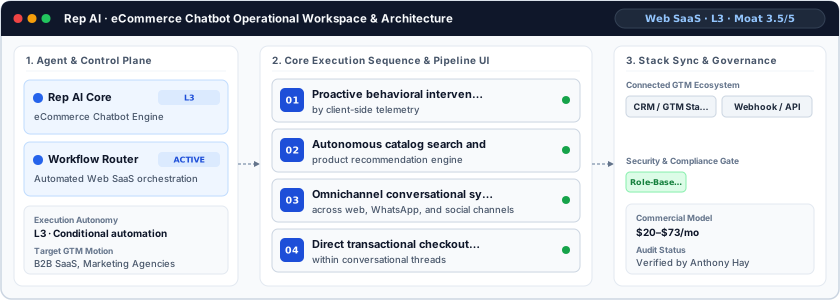
- Proactive behavioral intervention triggered: by client-side telemetry
- Autonomous catalog search and: product recommendation engine
- Omnichannel conversational synchronization: across web, WhatsApp, and social channels
- Direct transactional checkout support: within conversational threads
Cons: operational limitations & risks
- Telemetry Latency & Client-Side Script Bloat: Aggressive front-end session monitoring introduces JavaScript payload weight that risks degrading core web vitals and mobile render speeds during complex product browsing.
- Catalog Schema Drift: Rapid fluctuations in external inventory, discount tiers, and stockkeeping variants require persistent catalog sync cycles to prevent hallucinations regarding real-time availability.
- Attribution Window Ambiguity: Decoupling automated concierge nudges from concurrent retargeting campaigns makes structured margin attribution difficult without rigid multi-touch holdout tests.
Rep AI TCO & deal-breaker stress test
Simulate 12-month stepped TCO, hidden cost multipliers, contract lock-in exposure, and stack failure modes using only facts verified by Anthony Hay on · Capture SHA bb7bc008.
Rep AI aligns with your 5-seat / $800/mo profile. Review the walk-away triggers and contract levers below before deployment.
| Plan / Tier | Verified Rate | Scale Fit | Scope & Quota Notes |
|---|---|---|---|
| Entry / Starter | $20/mo | Unlimited seats (Entry credits) | Deep Research Add-on Add-on Add-on 10% of your Concierge price |
| Growth / Professional | $73/mo | Unlimited seats (Growth credits) | Verified $73/mo tier from vendor pricing schedule. |
- Moat Score
- 3.5 / 5.0
- AI Autonomy
- L3
- Free Tier / Trial
- None disclosed
Triggered audit signals & failure modes
- Published Self-Serve Entry FloorVerified Pricing Ledger
Rep AI publishes a transparent entry point ($20–$73/mo) for initial validation before committing.
- Tier Fit for 5-Seat Scale: Growth / Professional ($73/mo)Verified Tier Schedule
Verified $73/mo tier from vendor pricing schedule.
- Primary Operational Bottleneck: Telemetry Latency & Client-Side Script BloatAudit by Anthony Hay
Aggressive front-end session monitoring introduces JavaScript payload weight that risks degrading core web vitals and mobile render speeds during complex product browsing.
Hidden TCO Multipliers & Quota Gates
- Annual Billing Headline vs. Monthly Premium: Headline entry rates reflect annual billing commitments (save 20%); month-to-month flexibility carries a higher effective monthly rate or requires annual prepayment.
- Credit & Usage Burn Multiplier: Automated workflows consume metered credits/usage quotas; multi-step enrichment, voice minutes, or high-frequency agent runs can trigger mid-cycle top-up packs.
- Enterprise Governance & Add-On Gating: Advanced capabilities such as Single Sign-On (SSO), custom role permissions, or specialized analytics modules are gated behind upper tiers or paid add-ons.
When to Walk Away & Negotiation Levers
- Walk away if your workflow requires uncapped enterprise volume on the $20–$73/mo entry plan without upgrading tiers.
- Walk away if your workflow cannot tolerate telemetry latency & client-side script bloat: Aggressive front-end session monitoring introduces JavaScript payload weight that risks degrading core web vitals and mobile render speeds during complex product browsing.
- Walk away if catalog schema drift is a deal-breaker for your team: Rapid fluctuations in external inventory, discount tiers, and stockkeeping variants require persistent catalog sync cycles to prevent hallucinations regarding real-time availability.
- Validate exact quota thresholds (seats, credits, or API calls) included in Rep AI's $20–$73/mo tier before converting from monthly to annual billing.
- Require a sandbox proof-of-concept testing telemetry latency & client-side script bloat against your live CRM/data schema before annual sign-off.
Ask a custom procurement or TCO stress-test question about Rep AI
Lower 5-seat floor (~$43/mo vs. $73 / mo)
Lower 5-seat floor (~$49/mo vs. $73 / mo)
Rep AI moat & subtrack positioning
Rep AI combines client-side behavioral telemetry with automated intent inference to trigger contextual LLM sales conversations before cart abandonment occurs.
Editorial review
Fact-checked by Anthony Hay (Senior SEO, Search Intelligence & Content Operations Editor) on .
Background
Backed by $14.4M in venture capital, Rep AI was founded in 2020 in New York to replace static, passive web widgets with proactive sales concierges. The company targets growth-oriented eCommerce merchants, digital direct-to-consumer retailers, and performance marketing teams seeking to recover high-intent shoppers before checkout abandonment. Rep AI reframes conversational support from a reactive post-purchase triage center into an automated revenue-generating sales engine.
How Rep AI works
Operating at an autonomous L3 posture, the platform ingests live client-side telemetry directly from storefront sessions. Its analytics pipeline continuously monitors mouse movement, dwell time on technical product specifications, rapid scroll shifts, and exit-intent vectors to compute buyer hesitation indexes. When an intervention threshold triggers, an orchestration layer queries the indexed product catalog via retrieval-augmented generation and deploys a contextual dialog agent to answer domain queries, present variant options, and guide the shopper through cart completion.
Limitations
Operational considerations and platform boundaries include:
- Telemetry Latency & Client-Side Script Bloat: Aggressive front-end session monitoring introduces JavaScript payload weight that risks degrading core web vitals and mobile render speeds during complex product browsing.
- Catalog Schema Drift: Rapid fluctuations in external inventory, discount tiers, and stockkeeping variants require persistent catalog sync cycles to prevent hallucinations regarding real-time availability.
- Attribution Window Ambiguity: Decoupling automated concierge nudges from concurrent retargeting campaigns makes structured margin attribution difficult without rigid multi-touch holdout tests.
Rep AI pricing
Commercial pricing for early-tier deployments begins between $20 and $73 per month, scaling upward based on unique storefront traffic and monthly active visitor bands. Higher volume tiers transition into mid-tier packages and enterprise contracts reaching $578 per month or custom negotiated rates. Access includes core storefront conversational agents, with multi-channel routing options covering external messaging destinations.
How Rep AI compares
Rep AI competes against enterprise support platforms like Ada.cx and Forethought, alongside retail-specific solutions like Manifest AI. While Ada.cx and Forethought prioritize ticket resolution and omnichannel enterprise service desk automation, Rep AI prioritizes pre-purchase behavioral intervention. Manifest AI shares a conversational retail focus, but Rep AI differentiates through its granular client-side hesitation detection. It serves mid-market to high-volume eCommerce brands seeking proactive cart conversions over operational ticket deflection.
Direct competitors & market radar
Top algorithmic competitors based on category positioning, capability overlap, and ICP alignment.
Frequently asked questions about Rep AI
How much does Rep AI cost and what pricing tiers are available?
Published pricing summary for Rep AI: $20–$73/mo. A permanent free plan is not disclosed for Rep AI. Verified tier schedule: Entry / Starter ($20/mo for Unlimited seats (Entry credits)); Growth / Professional ($73/mo for Unlimited seats (Growth credits)). Commercial pricing for early-tier deployments begins between $20 and $73 per month, scaling upward based on unique storefront traffic and monthly active visitor bands. Higher volume tiers transition into mid-tier packages and enterprise contracts reaching $578 per month or custom negotiated rates.
How does Rep AI work and how autonomous is its AI architecture?
Agentic conversational commerce platform utilizing real-time behavioral telemetry and proactive dialog to increase conversion rates across online storefronts. Within eCommerce Chatbot (Conversational eCommerce & Support Bots), MarTechRadar rates its execution architecture at L3 · Conditional automation with a verified Moat Score of 3.5 / 5.0 (Proprietary moat). Rep AI combines client-side behavioral telemetry with automated intent inference to trigger contextual LLM sales conversations before cart abandonment occurs. Corporate profile: Founded by Shauli Mizrahi, Yoav Oz, operating at 11-50 employees scale.
What are the main limitations of Rep AI and when should buyers walk away?
Based on our editorial technical audit, key operational considerations and boundaries for Rep AI include: (1) Telemetry Latency & Client-Side Script Bloat: Aggressive front-end session monitoring introduces JavaScript payload weight that risks degrading core web vitals and mobile render speeds during complex product browsing. (2) Catalog Schema Drift: Rapid fluctuations in external inventory, discount tiers, and stockkeeping variants require persistent catalog sync cycles to prevent hallucinations regarding real-time availability. (3) Attribution Window Ambiguity: Decoupling automated concierge nudges from concurrent retargeting campaigns makes structured margin attribution difficult without rigid multi-touch holdout tests. Primary procurement walk-away rule: Walk away if your workflow requires uncapped enterprise volume on the $20–$73/mo entry plan without upgrading tiers.
What integrations, compliance certifications, and contract terms apply to Rep AI?
First-party governance and developer endpoints verified on domain include: Trust/Security (https://trust.hellorep.ai), Status (https://status.hellorep.ai). Key TCO multiplier to watch: Annual Billing Headline vs. Monthly Premium (Headline entry rates reflect annual billing commitments (save 20%); month-to-month flexibility carries a higher effective monthly rate or requires annual prepayment.) Before signing a contract, procurement teams should validate exact quota thresholds (seats, credits, or API calls) included in Rep AI's $20–$73/mo tier before converting from monthly to annual billing.
What are the best Rep AI alternatives and head-to-head competitors in 2026?
Top fact-checked alternatives to Rep AI in eCommerce Chatbot (Conversational eCommerce & Support Bots) include Covena (Custom / enterprise pricing), Manifest AI (Custom / enterprise pricing), Sierra AI (Custom / enterprise pricing), Closera (Pricing not disclosed). Rep AI competes against enterprise support platforms like Ada.cx and Forethought, alongside retail-specific solutions like Manifest AI. While Ada.cx and Forethought prioritize ticket resolution and omnichannel enterprise service desk automation, Rep AI prioritizes pre-purchase behavioral intervention.
Verified sources & evidence trail
- Official product domain: https://hellorep.ai
- Commercial pricing verification: https://www.hellorep.ai/pricing
- Verified corporate entity profiles (
sameAs): LinkedIn Company Profile · Crunchbase Entity Record - First-party governance & documentation links: Trust & Security · System Status · Terms · Privacy
- Editorial audit sign-off: Fact-checked by Anthony Hay on under the MarTechRadar Evidence-Ledger Protocol.