Braze AI Review (2026): CDP Pricing, Limits & Alternatives
Bottom line
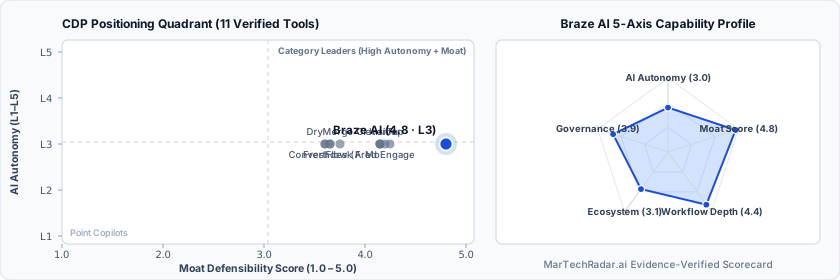
Braze AI is a Web SaaS tool for CDP (Customer Data Platform & Journey Orchestration) in Lifecycle & CDP. Pricing: Custom / enterprise pricing. Best suited to DTC / eCommerce and Enterprise Brands. Editor ratings: AI autonomy L3 (conditional automation); moat score 4.8/5.0 (Proprietary moat (category leader)). Fact-checked by Sarah Per on Oct 7, 2026.
Braze AI embeds predictive modeling, intelligent delivery optimization, and automated content generation directly into cross-channel customer engagement.
Braze AI buyer fit verdict: when to choose vs. when to walk away
Choose Braze AI if (Best Fit)
- Target ICP & Stack Fit: You operate as DTC / eCommerce and Enterprise Brands requiring a Web SaaS deployment for CDP.
- L3 Architecture & Defensibility: Combines a high-throughput event streaming infrastructure with proprietary predictive propensity scoring and native channel dispatch loops, reducing latency between user actions and personalized interventions.
- Commercial Model Fit: Your procurement budget aligns with Custom / enterprise pricing.
Walk away from Braze AI if (Deal-Breakers)
- Walk away if you require transparent self-serve monthly billing or your budget ceiling is under $1,000/mo (Braze AI requires sales-gated custom quoting).
- Walk away if your workflow cannot tolerate event consumption and data egress overhead: High-velocity streaming architectures incur significant data point consumption costs, requiring strict client-side event throttling and payload payload pruning to avoid budget exhaustion.
- Walk away if cold-start profile latency is a deal-breaker for your team: Intelligent Timing and predictive propensity algorithms degrade to default fallback schedules when operating on new users with fewer than several weeks of logged interaction histories.
Braze AI key facts & scorecard
| Pricing | Custom / enterprise pricing |
|---|---|
| Free plan | No / not disclosed |
| Delivery | Web SaaS |
| Audience | DTC / eCommerce, Enterprise Brands |
| AI autonomy level | L3 · Conditional automationEditor-verified |
| Moat tier & score | 4.8 / 5.0 · Proprietary moat (category leader)Editor-verified |
| Funding | Public company |
| Total funding | $314.3M |
| Founders | Bill Magnuson, Jonathan Hyman, Mark Ghermezian |
| Company size | 1,001-5,000 employees |
| Governance & docs | API & Docs ↗ · Privacy ↗ |
| Headquarters | New York |
| Founded | 2011 |
| Last verified |
Braze AI pros & cons: strengths vs. operational limitations
Pros: core strengths & capabilities
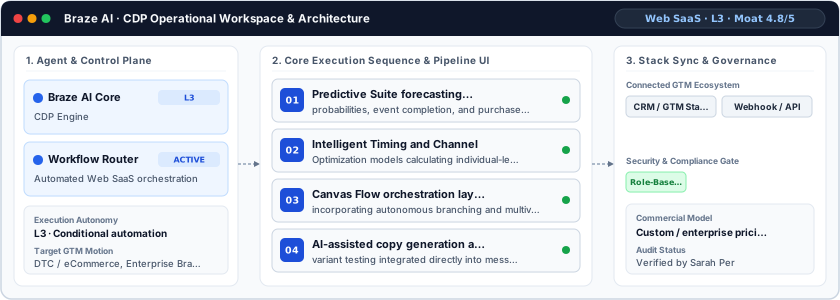
- Predictive Suite forecasting churn: probabilities, event completion, and purchase propensities
- Intelligent Timing and Channel: Optimization models calculating individual-level dispatch windows
- Canvas Flow orchestration layer: incorporating autonomous branching and multivariate decision nodes
- AI-assisted copy generation and: variant testing integrated directly into message composers
Cons: operational limitations & risks
- Event consumption and data egress overhead: High-velocity streaming architectures incur significant data point consumption costs, requiring strict client-side event throttling and payload payload pruning to avoid budget exhaustion.
- Cold-start profile latency: Intelligent Timing and predictive propensity algorithms degrade to default fallback schedules when operating on new users with fewer than several weeks of logged interaction histories.
- Complex multi-identifier reconciliation: Anonymous-to-identified profile mergers across web and native app runtimes require rigid alias-management configurations, where race conditions can split user state or misattribute downstream metrics.
Braze AI TCO & deal-breaker stress test
Simulate 12-month stepped TCO, hidden cost multipliers, contract lock-in exposure, and stack failure modes using only facts verified by Sarah Per on · Capture SHA de903007.
Braze AI triggers high-severity friction under your 5-seat / $800/mo constraints. Benchmark the verified subtrack alternatives below before committing.
| Plan / Tier | Verified Rate | Scale Fit | Scope & Quota Notes |
|---|---|---|---|
| Enterprise / Custom | Custom quote | 15–50+ seats (Enterprise SLA) | Sales-negotiated annual contract for custom volume, SSO/RBAC governance, and dedicated SLA. |
- Moat Score
- 4.8 / 5.0
- AI Autonomy
- L3
- Free Tier / Trial
- None disclosed
Triggered audit signals & failure modes
- Opaque Enterprise Quoting vs. SMB/Mid-Market BudgetVerified Pricing Ledger
Braze AI does not disclose a public self-serve floor (Custom / enterprise pricing). Buyers with a $800/mo cap face high sales-qualification friction.
- Sales-Gated Contract TermsFact-checked by Sarah Per
Braze packages its software through multi-tiered commercial editions, ranging from starter growth tiers like Braze Go to comprehensive enterprise agreements.
- Primary Operational Bottleneck: Event consumption and data egress overheadAudit by Sarah Per
High-velocity streaming architectures incur significant data point consumption costs, requiring strict client-side event throttling and payload payload pruning to avoid budget exhaustion.
Hidden TCO Multipliers & Quota Gates
- Credit & Usage Burn Multiplier: Automated workflows consume metered credits/usage quotas; multi-step enrichment, voice minutes, or high-frequency agent runs can trigger mid-cycle top-up packs.
- Enterprise Governance & Add-On Gating: Advanced capabilities such as Single Sign-On (SSO), custom role permissions, or specialized analytics modules are gated behind upper tiers or paid add-ons.
When to Walk Away & Negotiation Levers
- Walk away if you require transparent self-serve monthly billing or your budget ceiling is under $1,000/mo (Braze AI requires sales-gated custom quoting).
- Walk away if your workflow cannot tolerate event consumption and data egress overhead: High-velocity streaming architectures incur significant data point consumption costs, requiring strict client-side event throttling and payload payload pruning to avoid budget exhaustion.
- Walk away if cold-start profile latency is a deal-breaker for your team: Intelligent Timing and predictive propensity algorithms degrade to default fallback schedules when operating on new users with fewer than several weeks of logged interaction histories.
- Demand a 30- to 60-day paid pilot opt-out clause in the Braze AI order form before signing a 12-month enterprise commitment.
- Require a sandbox proof-of-concept testing event consumption and data egress overhead against your live CRM/data schema before annual sign-off.
Ask a custom procurement or TCO stress-test question about Braze AI
Lower 5-seat floor (~$85/mo vs. Custom Quote) · Transparent self-serve entry without mandatory annual lock-in
Lower 5-seat floor (~$10/mo vs. Custom Quote) · Transparent self-serve entry without mandatory annual lock-in
Braze AI moat & subtrack positioning
Combines a high-throughput event streaming infrastructure with proprietary predictive propensity scoring and native channel dispatch loops, reducing latency between user actions and personalized interventions.
Editorial review
Fact-checked by Sarah Per (Principal Content Systems & Generative Media Editor) on .
Background
Architected around a distributed, stream-processing event framework, Braze was founded in 2011 in New York to replace batch-oriented messaging systems with real-time lifecycle orchestration. Prior to its public listing, the company secured $314.3M in venture funding to construct a streaming infrastructure capable of ingesting high-velocity behavioral telemetry from mobile, web, and server-side endpoints. Engineered primarily for lifecycle marketing engineers, growth product managers, and enterprise retention teams, Braze AI operates as an embedded algorithmic intelligence layer within the broader customer engagement platform. It targets consumer enterprises across streaming, quick-service retail, fintech, and digital marketplace verticals that require sub-second dispatch decisions across high-volume interaction networks.
How Braze AI works
At its technical core, Braze AI executes an L3 automated decision loop directly atop incoming event streams without requiring offline batch synchronization. Incoming telemetry flows through ingest APIs into an in-memory session processor where the Predictive Suite evaluates user vectors against pre-trained churn, conversion, and likelihood-to-purchase models. Within the Canvas Flow orchestration engine, Intelligent Timing algorithms compute per-user engagement probability distributions over rolling multi-week lookback windows, triggering push, email, SMS, or in-app payloads at the exact predicted conversion moment. Concurrently, Intelligent Channel models dynamically reroute interactions toward each recipient's highest-converting path, while embedded generative models provide dynamic copy variations conditioned on catalog metadata and profile attributes.
Limitations
Operational considerations and platform boundaries include:
- Event consumption and data egress overhead: High-velocity streaming architectures incur significant data point consumption costs, requiring strict client-side event throttling and payload payload pruning to avoid budget exhaustion.
- Cold-start profile latency: Intelligent Timing and predictive propensity algorithms degrade to default fallback schedules when operating on new users with fewer than several weeks of logged interaction histories.
- Complex multi-identifier reconciliation: Anonymous-to-identified profile mergers across web and native app runtimes require rigid alias-management configurations, where race conditions can split user state or misattribute downstream metrics.
Braze AI pricing
Braze packages its software through multi-tiered commercial editions, ranging from starter growth tiers like Braze Go to comprehensive enterprise agreements. Commercial pricing is available on request through tailored enterprise sales quotes based on organizational scale and seats. Contracts primarily scale on overall monthly active users (MAU) alongside data point consumption volume and provisioned channel add-ons such as SMS and cloud data ingestion connectors.
How Braze AI compares
Within the journey orchestration landscape, Braze AI competes directly against CleverTap, Bloomreach Loomi, and Emarsys. While CleverTap specializes in native mobile app analytics and Bloomreach Loomi binds tightly to unified commerce search and product catalogs, Braze differentiates through its horizontal streaming throughput and cross-channel SDK execution speed. Conversely, Emarsys offers deeper turnkey vertical retail automations out of the box, whereas Braze requires dedicated engineering governance to build custom schemas.
Direct competitors & market radar
Top algorithmic competitors based on category positioning, capability overlap, and ICP alignment.
Frequently asked questions about Braze AI
How much does Braze AI cost and does it require a custom enterprise quote?
Published pricing summary for Braze AI: Custom / enterprise pricing. A permanent free plan is not disclosed for Braze AI. Braze packages its software through multi-tiered commercial editions, ranging from starter growth tiers like Braze Go to comprehensive enterprise agreements. Commercial pricing is available on request through tailored enterprise sales quotes based on organizational scale and seats.
How does Braze AI work and how autonomous is its AI architecture?
Braze AI embeds predictive modeling, intelligent delivery optimization, and automated content generation directly into cross-channel customer engagement. Within CDP (Customer Data Platform & Journey Orchestration), MarTechRadar rates its execution architecture at L3 · Conditional automation with a verified Moat Score of 4.8 / 5.0 (Proprietary moat (category leader)). Combines a high-throughput event streaming infrastructure with proprietary predictive propensity scoring and native channel dispatch loops, reducing latency between user actions and personalized interventions. Corporate profile: Founded by Bill Magnuson, Jonathan Hyman, Mark Ghermezian, operating at 1,001-5,000 employees scale.
What are the main limitations of Braze AI and when should buyers walk away?
Based on our editorial technical audit, key operational considerations and boundaries for Braze AI include: (1) Event consumption and data egress overhead: High-velocity streaming architectures incur significant data point consumption costs, requiring strict client-side event throttling and payload payload pruning to avoid budget exhaustion. (2) Cold-start profile latency: Intelligent Timing and predictive propensity algorithms degrade to default fallback schedules when operating on new users with fewer than several weeks of logged interaction histories. (3) Complex multi-identifier reconciliation: Anonymous-to-identified profile mergers across web and native app runtimes require rigid alias-management configurations, where race conditions can split user state or misattribute downstream metrics. Primary procurement walk-away rule: Walk away if you require transparent self-serve monthly billing or your budget ceiling is under $1,000/mo (Braze AI requires sales-gated custom quoting).
What integrations, compliance certifications, and contract terms apply to Braze AI?
First-party governance and developer endpoints verified on domain include: API Docs (https://www.braze.com/docs). Key TCO multiplier to watch: Credit & Usage Burn Multiplier (Automated workflows consume metered credits/usage quotas; multi-step enrichment, voice minutes, or high-frequency agent runs can trigger mid-cycle top-up packs.) Before signing a contract, procurement teams should demand a 30- to 60-day paid pilot opt-out clause in the Braze AI order form before signing a 12-month enterprise commitment.
What are the best Braze AI alternatives and head-to-head competitors in 2026?
Top fact-checked alternatives to Braze AI in CDP (Customer Data Platform & Journey Orchestration) include CleverTap (From $85/mo), Bloomreach Loomi (Custom / enterprise pricing), TruAgents (Custom / enterprise pricing), Emarsys (Custom / enterprise pricing). Within the journey orchestration landscape, Braze AI competes directly against CleverTap, Bloomreach Loomi, and Emarsys.
Verified sources & evidence trail
- Official product domain: https://braze.com
- Commercial pricing verification: Verified against official vendor pricing policy (Custom / enterprise pricing)
- Verified corporate entity profiles (
sameAs): LinkedIn Company Profile · Crunchbase Entity Record - First-party governance & documentation links: API & Docs · Privacy
- Editorial audit sign-off: Fact-checked by Sarah Per on under the MarTechRadar Evidence-Ledger Protocol.