Simon Data Review (2026): CDP Pricing, Limits & Alternatives
Bottom line
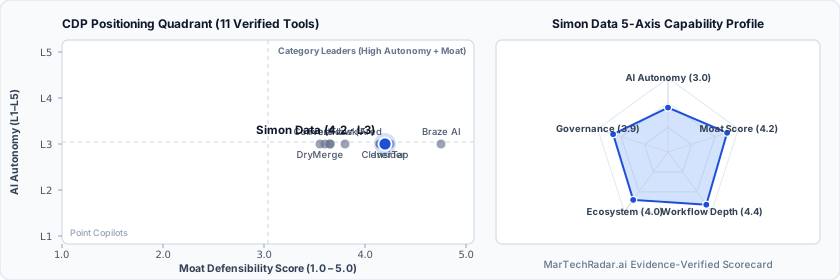
Simon Data is a Web SaaS tool for CDP (Customer Data Platform & Journey Orchestration) in Lifecycle & CDP. Pricing: Custom / enterprise pricing. Best suited to B2B SaaS, DTC / eCommerce and Enterprise Brands. Editor ratings: AI autonomy L3 (conditional automation); moat score 4.2/5.0 (Proprietary moat). Fact-checked by Sarah Per on Oct 14, 2026.
Composable customer data platform and agentic journey orchestration engine that translates natural language prompts into live cross-channel marketing.
Simon Data buyer fit verdict: when to choose vs. when to walk away
Choose Simon Data if (Best Fit)
- Target ICP & Stack Fit: You operate as B2B SaaS, DTC / eCommerce and Enterprise Brands requiring a Web SaaS deployment for CDP, with verified ecosystem connectivity for Twilio Segment, Braze.
- L3 Architecture & Defensibility: Native composable data warehouse integration combined with an agentic orchestration layer, accelerated by deep personalization integration through parent company Monetate.
- Commercial Model Fit: Your procurement budget aligns with Custom / enterprise pricing.
Walk away from Simon Data if (Deal-Breakers)
- Walk away if you require transparent self-serve monthly billing or your budget ceiling is under $1,000/mo (Simon Data requires sales-gated custom quoting).
- Walk away if your workflow cannot tolerate warehouse query latency: Because the platform relies heavily on direct warehouse queries, downstream activation speed is constrained by the performance, concurrency limits, and compute costs of the customer's cloud data warehouse.
- Walk away if agentic boundary hallucination is a deal-breaker for your team: Conversational campaign construction requires essential human governance to verify that inferred journey branches, message delays, and exclusion criteria align with strict operational compliance standards.
Simon Data key facts & scorecard
| Pricing | Custom / enterprise pricing |
|---|---|
| Free plan | No / not disclosed |
| Delivery | Web SaaS |
| Audience | B2B SaaS, DTC / eCommerce, Enterprise Brands |
| AI autonomy level | L3 · Conditional automationEditor-verified |
| Moat tier & score | 4.2 / 5.0 · Proprietary moatEditor-verified |
| Funding | AcquiredAcquired by Monetate |
| Total funding | $115.8M |
| Founders | Frank Harris, Jason Davis, Joshua Neckes, Matt Walker |
| Company size | 51-200 employees |
| Ecosystem integrations | Twilio Segment, Braze |
| Governance & docs | API & Docs ↗ · Terms ↗ · Privacy ↗ |
| Headquarters | New York, NY |
| Founded | 2015 |
| Last verified |
Simon Data pros & cons: strengths vs. operational limitations
Pros: core strengths & capabilities
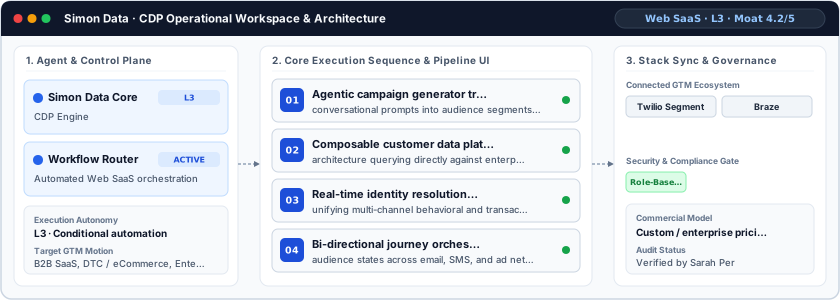
- Agentic campaign generator translating: conversational prompts into audience segments and journey logic
- Composable customer data platform: architecture querying directly against enterprise cloud data warehouses
- Real-time identity resolution graph: unifying multi-channel behavioral and transactional events
- Bi-directional journey orchestration synchronizing: audience states across email, SMS, and ad networks
Cons: operational limitations & risks
- Warehouse Query Latency: Because the platform relies heavily on direct warehouse queries, downstream activation speed is constrained by the performance, concurrency limits, and compute costs of the customer's cloud data warehouse.
- Agentic Boundary Hallucination: Conversational campaign construction requires essential human governance to verify that inferred journey branches, message delays, and exclusion criteria align with strict operational compliance standards.
- Schema Drift Sensitivity: Upstream data warehouse schema modifications or field deprecations can break segment definitions and halt live journey triggers until mappings are manually reconciled in the platform interface.
Simon Data TCO & deal-breaker stress test
Simulate 12-month stepped TCO, hidden cost multipliers, contract lock-in exposure, and stack failure modes using only facts verified by Sarah Per on · Capture SHA d2b14a00.
Simon Data triggers high-severity friction under your 5-seat / $800/mo constraints. Benchmark the verified subtrack alternatives below before committing.
| Plan / Tier | Verified Rate | Scale Fit | Scope & Quota Notes |
|---|---|---|---|
| Enterprise / Custom | Custom quote | 15–50+ seats (Enterprise SLA) | Sales-negotiated annual contract for custom volume, SSO/RBAC governance, and dedicated SLA. |
- Moat Score
- 4.2 / 5.0
- AI Autonomy
- L3
- Free Tier / Trial
- None disclosed
Triggered audit signals & failure modes
- Opaque Enterprise Quoting vs. SMB/Mid-Market BudgetVerified Pricing Ledger
Simon Data does not disclose a public self-serve floor (Custom / enterprise pricing). Buyers with a $800/mo cap face high sales-qualification friction.
- Sales-Gated Contract TermsFact-checked by Sarah Per
Commercial pricing is available on request through tailored enterprise sales quotes based on organizational scale and seats.
- Primary Operational Bottleneck: Warehouse Query LatencyAudit by Sarah Per
Because the platform relies heavily on direct warehouse queries, downstream activation speed is constrained by the performance, concurrency limits, and compute costs of the customer's cloud data warehouse.
Hidden TCO Multipliers & Quota Gates
- Profile / Workspace Quota Ceilings: Base tiers cap the number of connected profiles, workspaces, or contact records, forcing tier upgrades before seat limits are reached.
- Enterprise Governance & Add-On Gating: Advanced capabilities such as Single Sign-On (SSO), custom role permissions, or specialized analytics modules are gated behind upper tiers or paid add-ons.
When to Walk Away & Negotiation Levers
- Walk away if you require transparent self-serve monthly billing or your budget ceiling is under $1,000/mo (Simon Data requires sales-gated custom quoting).
- Walk away if your workflow cannot tolerate warehouse query latency: Because the platform relies heavily on direct warehouse queries, downstream activation speed is constrained by the performance, concurrency limits, and compute costs of the customer's cloud data warehouse.
- Walk away if agentic boundary hallucination is a deal-breaker for your team: Conversational campaign construction requires essential human governance to verify that inferred journey branches, message delays, and exclusion criteria align with strict operational compliance standards.
- Demand a 30- to 60-day paid pilot opt-out clause in the Simon Data order form before signing a 12-month enterprise commitment.
- Require a sandbox proof-of-concept testing warehouse query latency against your live CRM/data schema before annual sign-off.
Ask a custom procurement or TCO stress-test question about Simon Data
Lower 5-seat floor (~$85/mo vs. Custom Quote) · Transparent self-serve entry without mandatory annual lock-in
Lower 5-seat floor (~$19/mo vs. Custom Quote) · Transparent self-serve entry without mandatory annual lock-in
Simon Data key entities, modules & ecosystem stack
Simon Data moat & subtrack positioning
Native composable data warehouse integration combined with an agentic orchestration layer, accelerated by deep personalization integration through parent company Monetate.
Editorial review
Fact-checked by Sarah Per (Principal Content Systems & Generative Media Editor) on .
Background
Backed by $115.8M in aggregate funding before being acquired by Monetate, New York, NY-based Simon Data was founded in 2015 to bridge cloud data warehouses and downstream execution channels. Positioned within modern customer data platform and journey orchestration ecosystems, the platform caters to enterprise marketing directors and retention operations leaders. It operates as an agentic campaign environment that converts strategic natural-language directives directly into deployed multi-channel workflows without manual query authoring.
How Simon Data works
At its technical foundation, Simon Data utilizes a composable architecture that interfaces directly with underlying enterprise data warehouses rather than forcing redundant data duplication. Ingestion pipelines stream real-time behavioral signals alongside relational transactional tables into an identity resolution graph. The orchestration engine acts at an L3 conditional autonomy tier, running natural language models to parse operator intent—such as drafting win-back sequences or VIP audience tiers—into deterministic SQL segments, dynamic decision nodes, and multi-step payload dispatches across messaging endpoints.
Limitations
Operational considerations and platform boundaries include:
- Warehouse Query Latency: Because the platform relies heavily on direct warehouse queries, downstream activation speed is constrained by the performance, concurrency limits, and compute costs of the customer's cloud data warehouse.
- Agentic Boundary Hallucination: Conversational campaign construction requires essential human governance to verify that inferred journey branches, message delays, and exclusion criteria align with strict operational compliance standards.
- Schema Drift Sensitivity: Upstream data warehouse schema modifications or field deprecations can break segment definitions and halt live journey triggers until mappings are manually reconciled in the platform interface.
Simon Data pricing
Commercial pricing is available on request through tailored enterprise sales quotes based on organizational scale and seats. The licensing structure reflects its composable design, allowing buyers to select specific base packages and modular add-ons corresponding to tracked profile volumes, integration tiers, and operational throughput.
How Simon Data compares
Simon Data contends directly with Bloomreach Loomi, Braze AI, and CleverTap. While Bloomreach Loomi and CleverTap lean on unified commerce indices and mobile-first telemetry respectively, and Braze AI focuses on vertical message delivery infrastructure, Simon Data differentiates through its composable warehouse-first foundation and agentic campaign synthesis. It remains best suited for enterprise brands with established cloud data platforms seeking conversational orchestration without data migration overhead.
Frequently asked questions about Simon Data
How much does Simon Data cost and does it require a custom enterprise quote?
Published pricing summary for Simon Data: Custom / enterprise pricing. A permanent free plan is not disclosed for Simon Data. Commercial pricing is available on request through tailored enterprise sales quotes based on organizational scale and seats.
How does Simon Data work and how autonomous is its AI architecture?
Composable customer data platform and agentic journey orchestration engine that translates natural language prompts into live cross-channel marketing. Within CDP (Customer Data Platform & Journey Orchestration), MarTechRadar rates its execution architecture at L3 · Conditional automation with a verified Moat Score of 4.2 / 5.0 (Proprietary moat). Native composable data warehouse integration combined with an agentic orchestration layer, accelerated by deep personalization integration through parent company Monetate. Corporate profile: Founded by Frank Harris, Jason Davis, Joshua Neckes, Matt Walker, operating at 51-200 employees scale, acquired by Monetate.
What are the main limitations of Simon Data and when should buyers walk away?
Based on our editorial technical audit, key operational considerations and boundaries for Simon Data include: (1) Warehouse Query Latency: Because the platform relies heavily on direct warehouse queries, downstream activation speed is constrained by the performance, concurrency limits, and compute costs of the customer's cloud data warehouse. (2) Agentic Boundary Hallucination: Conversational campaign construction requires essential human governance to verify that inferred journey branches, message delays, and exclusion criteria align with strict operational compliance standards. (3) Schema Drift Sensitivity: Upstream data warehouse schema modifications or field deprecations can break segment definitions and halt live journey triggers until mappings are manually reconciled in the platform interface. Primary procurement walk-away rule: Walk away if you require transparent self-serve monthly billing or your budget ceiling is under $1,000/mo (Simon Data requires sales-gated custom quoting).
What integrations, compliance certifications, and contract terms apply to Simon Data?
Verified ecosystem and stack integrations include Twilio Segment, Braze. First-party governance and developer endpoints verified on domain include: API Docs (https://docs.simondata.com/docs/how-to-use-this-knowledge-base). Key TCO multiplier to watch: Profile / Workspace Quota Ceilings (Base tiers cap the number of connected profiles, workspaces, or contact records, forcing tier upgrades before seat limits are reached.) Before signing a contract, procurement teams should demand a 30- to 60-day paid pilot opt-out clause in the Simon Data order form before signing a 12-month enterprise commitment.
What are the best Simon Data alternatives and head-to-head competitors in 2026?
Top fact-checked alternatives to Simon Data in CDP (Customer Data Platform & Journey Orchestration) include Monetate (Custom / enterprise pricing), Insider (Custom / enterprise pricing), Ambral (Pricing not disclosed), Ergo (Pricing not disclosed). Simon Data contends directly with Bloomreach Loomi, Braze AI, and CleverTap.
Verified sources & evidence trail
- Official product domain: https://simondata.com
- Commercial pricing verification: Verified against official vendor pricing policy (Custom / enterprise pricing)
- Verified corporate entity profiles (
sameAs): LinkedIn Company Profile · Crunchbase Entity Record - First-party governance & documentation links: API & Docs · Terms · Privacy
- Editorial audit sign-off: Fact-checked by Sarah Per on under the MarTechRadar Evidence-Ledger Protocol.