Drift Review (2026): Email Marketing Pricing, Limits & Alternatives
Bottom line
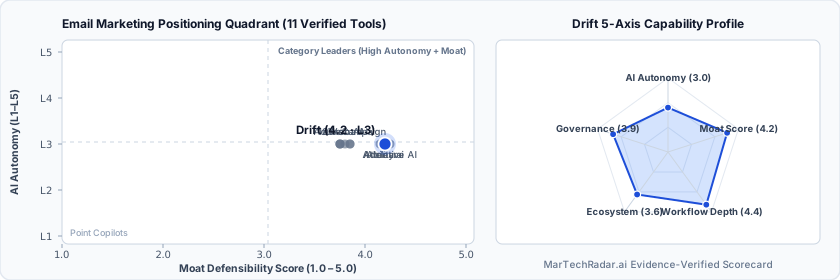
Drift is a Web SaaS tool for Email Marketing (AI Email Marketing & Lifecycle Journeys) in Lifecycle & CDP. Pricing: Custom / enterprise pricing. Best suited to B2B SaaS, DTC / eCommerce and Enterprise Brands. Editor ratings: AI autonomy L3 (conditional automation); moat score 4.2/5.0 (Proprietary moat). Fact-checked by Jiacky Lee on Oct 12, 2026.
B2B conversational marketing and inbound engagement platform leveraging AI chat agents to qualify web traffic and route buyer intent into pipeline.
Drift buyer fit verdict: when to choose vs. when to walk away
Choose Drift if (Best Fit)
- Target ICP & Stack Fit: You operate as B2B SaaS, DTC / eCommerce and Enterprise Brands requiring a Web SaaS deployment for Email Marketing, with verified ecosystem connectivity for Salesloft.
- L3 Architecture & Defensibility: Deep account-based intelligence integrations, proprietary conversational qualification trees, and unified alignment with Salesloft revenue execution infrastructure.
- Commercial Model Fit: Your procurement budget aligns with Custom / enterprise pricing.
Walk away from Drift if (Deal-Breakers)
- Walk away if you require transparent self-serve monthly billing or your budget ceiling is under $1,000/mo (Drift requires sales-gated custom quoting).
- Walk away if your workflow cannot tolerate firmographic match degradation: VPN adoption and remote-work IP sprawl frequently degrade reverse-IP identification accuracy, defaulting enterprise visitors to unsegmented fallback playbooks.
- Walk away if routing latency overhead is a deal-breaker for your team: Complex conditional routing rules across multiple CRM hierarchies can introduce connection latencies, causing prospective buyers to drop sessions prior to representative handoff.
Drift key facts & scorecard
| Pricing | Custom / enterprise pricing |
|---|---|
| Free plan | No / not disclosed |
| Delivery | Web SaaS |
| Audience | B2B SaaS, DTC / eCommerce, Enterprise Brands |
| AI autonomy level | L3 · Conditional automationEditor-verified |
| Moat tier & score | 4.2 / 5.0 · Proprietary moatEditor-verified |
| Funding | AcquiredAcquired by Salesloft |
| Total funding | $107MBacked by General Catalyst, Sequoia Capital, Founder Collective, CRV, Harmony Partners |
| Founders | David Cancel, Elias Torres, Sergey Gusev |
| Company size | 501-1000 employees |
| Ecosystem integrations | Salesloft |
| Governance & docs | Trust & Security ↗ · System Status ↗ · Changelog ↗ · Terms ↗ |
| Headquarters | Atlanta, GA |
| Founded | 2011 |
| Last verified |
Drift pros & cons: strengths vs. operational limitations
Pros: core strengths & capabilities
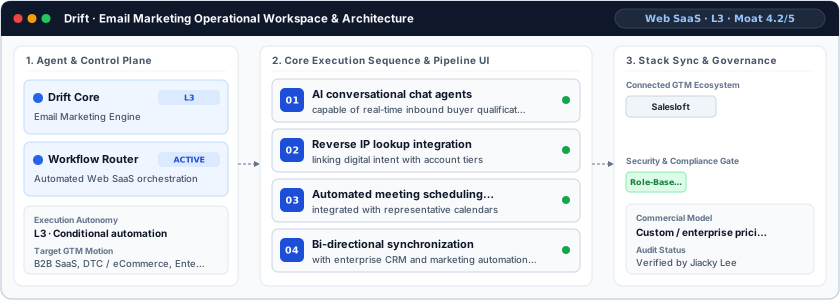
- AI conversational chat agents: capable of real-time inbound buyer qualification
- Reverse IP lookup integration: linking digital intent with account tiers
- Automated meeting scheduling directly: integrated with representative calendars
- Bi-directional synchronization: with enterprise CRM and marketing automation platforms
Cons: operational limitations & risks
- Firmographic Match Degradation: VPN adoption and remote-work IP sprawl frequently degrade reverse-IP identification accuracy, defaulting enterprise visitors to unsegmented fallback playbooks.
- Routing Latency Overhead: Complex conditional routing rules across multiple CRM hierarchies can introduce connection latencies, causing prospective buyers to drop sessions prior to representative handoff.
- Conversational Intent Hallucination: Open-ended natural language interactions without strictly constrained ontology boundaries occasionally misinterpret technical product inquiries, assigning incorrect qualification tags.
Drift TCO & deal-breaker stress test
Simulate 12-month stepped TCO, hidden cost multipliers, contract lock-in exposure, and stack failure modes using only facts verified by Jiacky Lee on · Capture SHA f078b5ed.
Drift triggers high-severity friction under your 5-seat / $800/mo constraints. Benchmark the verified subtrack alternatives below before committing.
| Plan / Tier | Verified Rate | Scale Fit | Scope & Quota Notes |
|---|---|---|---|
| Enterprise / Custom | Custom quote | 15–50+ seats (Enterprise SLA) | Sales-negotiated annual contract for custom volume, SSO/RBAC governance, and dedicated SLA. |
- Moat Score
- 4.2 / 5.0
- AI Autonomy
- L3
- Free Tier / Trial
- None disclosed
Triggered audit signals & failure modes
- Opaque Enterprise Quoting vs. SMB/Mid-Market BudgetVerified Pricing Ledger
Drift does not disclose a public self-serve floor (Custom / enterprise pricing). Buyers with a $800/mo cap face high sales-qualification friction.
- Sales-Gated Contract TermsFact-checked by Jiacky Lee
Commercial pricing is available on request through tailored enterprise sales quotes based on organizational scale and seats.
- Primary Operational Bottleneck: Firmographic Match DegradationAudit by Jiacky Lee
VPN adoption and remote-work IP sprawl frequently degrade reverse-IP identification accuracy, defaulting enterprise visitors to unsegmented fallback playbooks.
Hidden TCO Multipliers & Quota Gates
- Enterprise Governance & Add-On Gating: Advanced capabilities such as Single Sign-On (SSO), custom role permissions, or specialized analytics modules are gated behind upper tiers or paid add-ons.
- Firmographic Match Degradation: VPN adoption and remote-work IP sprawl frequently degrade reverse-IP identification accuracy, defaulting enterprise visitors to unsegmented fallback playbooks.
- Routing Latency Overhead: Complex conditional routing rules across multiple CRM hierarchies can introduce connection latencies, causing prospective buyers to drop sessions prior to representative handoff.
When to Walk Away & Negotiation Levers
- Walk away if you require transparent self-serve monthly billing or your budget ceiling is under $1,000/mo (Drift requires sales-gated custom quoting).
- Walk away if your workflow cannot tolerate firmographic match degradation: VPN adoption and remote-work IP sprawl frequently degrade reverse-IP identification accuracy, defaulting enterprise visitors to unsegmented fallback playbooks.
- Walk away if routing latency overhead is a deal-breaker for your team: Complex conditional routing rules across multiple CRM hierarchies can introduce connection latencies, causing prospective buyers to drop sessions prior to representative handoff.
- Demand a 30- to 60-day paid pilot opt-out clause in the Drift order form before signing a 12-month enterprise commitment.
- Require a sandbox proof-of-concept testing firmographic match degradation against your live CRM/data schema before annual sign-off.
Ask a custom procurement or TCO stress-test question about Drift
Lower 5-seat floor (~$39/mo vs. Custom Quote) · Transparent self-serve entry without mandatory annual lock-in
Lower 5-seat floor (~$599/mo vs. Custom Quote) · Transparent self-serve entry without mandatory annual lock-in
Drift key entities, modules & ecosystem stack
Drift moat & subtrack positioning
Deep account-based intelligence integrations, proprietary conversational qualification trees, and unified alignment with Salesloft revenue execution infrastructure.
Editorial review
Fact-checked by Jiacky Lee (Managing Editor, AI Autonomy & Moat Methodology) on .
Background
Architected as a real-time conversational qualification layer, Drift bridges anonymous website engagement with structured revenue workflows. Headquartered in Atlanta, GA, and established in 2011 with $107M in venture funding prior to joining Salesloft, the platform serves revenue operations, growth marketing, and sales development teams. By replacing static capture forms with interactive automated dialogues, Drift addresses inbound intent degradation, ensuring pipeline opportunities are qualified and routed during active sessions.
How Drift works
Drift deploys a client-side JavaScript runtime that pairs reverse-IP account resolution with real-time intent telemetry. The technical architecture maps incoming traffic against firmographic parameters and CRM records. Natural language processing models evaluate inbound prompts against predefined playbooks, scoring prospect fit and intent signals. The orchestration engine then automates scheduling workflows or routes active sessions directly to assigned account executives via webhook and calendar integrations.
Limitations
Operational considerations and platform boundaries include:
- Firmographic Match Degradation: VPN adoption and remote-work IP sprawl frequently degrade reverse-IP identification accuracy, defaulting enterprise visitors to unsegmented fallback playbooks.
- Routing Latency Overhead: Complex conditional routing rules across multiple CRM hierarchies can introduce connection latencies, causing prospective buyers to drop sessions prior to representative handoff.
- Conversational Intent Hallucination: Open-ended natural language interactions without strictly constrained ontology boundaries occasionally misinterpret technical product inquiries, assigning incorrect qualification tags.
Drift pricing
Commercial pricing is available on request through tailored enterprise sales quotes based on organizational scale and seats. Contracts typically require annual commitments structured around visitor traffic tiers, verified account volume, and enabled platform modules, with add-on fees applied for advanced conversational AI capabilities and premium CRM connectors.
How Drift compares
While competitors like 10Web AI concentrate on CMS generation, AB Tasty targets digital experimentation, and Ability.ai focuses on autonomous ad management, Drift specializes strictly in real-time inbound conversational qualification. The architecture delivers the highest ROI for mid-market and enterprise B2B organizations maintaining substantial inbound web traffic, dedicated account-based marketing motions, and existing CRM ecosystems requiring immediate sales routing.
Frequently asked questions about Drift
How much does Drift cost and does it require a custom enterprise quote?
Published pricing summary for Drift: Custom / enterprise pricing. A permanent free plan is not disclosed for Drift. Commercial pricing is available on request through tailored enterprise sales quotes based on organizational scale and seats.
How does Drift work and how autonomous is its AI architecture?
B2B conversational marketing and inbound engagement platform leveraging AI chat agents to qualify web traffic and route buyer intent into pipeline. Within Email Marketing (AI Email Marketing & Lifecycle Journeys), MarTechRadar rates its execution architecture at L3 · Conditional automation with a verified Moat Score of 4.2 / 5.0 (Proprietary moat). Deep account-based intelligence integrations, proprietary conversational qualification trees, and unified alignment with Salesloft revenue execution infrastructure. Corporate profile: Founded by David Cancel, Elias Torres, Sergey Gusev, operating at 501-1000 employees scale, acquired by Salesloft.
What are the main limitations of Drift and when should buyers walk away?
Based on our editorial technical audit, key operational considerations and boundaries for Drift include: (1) Firmographic Match Degradation: VPN adoption and remote-work IP sprawl frequently degrade reverse-IP identification accuracy, defaulting enterprise visitors to unsegmented fallback playbooks. (2) Routing Latency Overhead: Complex conditional routing rules across multiple CRM hierarchies can introduce connection latencies, causing prospective buyers to drop sessions prior to representative handoff. (3) Conversational Intent Hallucination: Open-ended natural language interactions without strictly constrained ontology boundaries occasionally misinterpret technical product inquiries, assigning incorrect qualification tags. Primary procurement walk-away rule: Walk away if you require transparent self-serve monthly billing or your budget ceiling is under $1,000/mo (Drift requires sales-gated custom quoting).
What integrations, compliance certifications, and contract terms apply to Drift?
Verified ecosystem and stack integrations include Salesloft. First-party governance and developer endpoints verified on domain include: Trust/Security (https://trust.salesloft.com), Status (https://status.salesloft.com). Key TCO multiplier to watch: Enterprise Governance & Add-On Gating (Advanced capabilities such as Single Sign-On (SSO), custom role permissions, or specialized analytics modules are gated behind upper tiers or paid add-ons.) Before signing a contract, procurement teams should demand a 30- to 60-day paid pilot opt-out clause in the Drift order form before signing a 12-month enterprise commitment.
What are the best Drift alternatives and head-to-head competitors in 2026?
Top fact-checked alternatives to Drift in Email Marketing (AI Email Marketing & Lifecycle Journeys) include 10Web AI (Custom / enterprise pricing), Userled (From $599/mo), Athena AI (Custom / enterprise pricing), Drip (From $39/mo). While competitors like 10Web AI concentrate on CMS generation, AB Tasty targets digital experimentation, and Ability.ai focuses on autonomous ad management, Drift specializes strictly in real-time inbound conversational qualification.
Verified sources & evidence trail
- Official product domain: https://drift.com
- Commercial pricing verification: Verified against official vendor pricing policy (Custom / enterprise pricing)
- Verified corporate entity profiles (
sameAs): LinkedIn Company Profile · Crunchbase Entity Record - First-party governance & documentation links: Trust & Security · System Status · Changelog · Terms
- Editorial audit sign-off: Fact-checked by Jiacky Lee on under the MarTechRadar Evidence-Ledger Protocol.