Backstroke Review (2026): Email Marketing Pricing, Limits & Alternatives
Bottom line
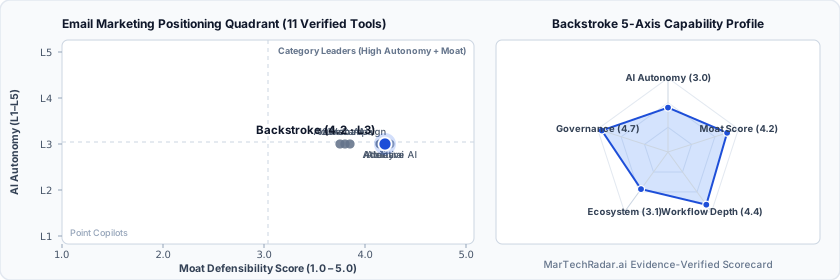
Backstroke is a Web SaaS tool for Email Marketing (AI Email Marketing & Lifecycle Journeys) in Lifecycle & CDP. Pricing: Custom / enterprise pricing. Best suited to CRM & Lifecycle Marketers, eCommerce Growth Teams and Customer Experience Directors. Editor ratings: AI autonomy L3 (conditional automation); moat score 4.2/5.0 (Proprietary moat). Fact-checked by Jagmeet Sine on Oct 12, 2026.
Generative AI messaging platform trained on retail interaction data to optimize email copy, layout variants, and revenue per send for e-commerce brands.
Backstroke buyer fit verdict: when to choose vs. when to walk away
Choose Backstroke if (Best Fit)
- Target ICP & Stack Fit: You operate as CRM & Lifecycle Marketers, eCommerce Growth Teams and Customer Experience Directors requiring a Web SaaS deployment for Email Marketing.
- L3 Architecture & Defensibility: Backstroke builds defensibility through verticalized generative models calibrated on historical retail email interaction telemetry, combining automated creative synthesis with SOC 2-compliant brand governance rails.
- Commercial Model Fit: Your procurement budget aligns with Custom / enterprise pricing.
Walk away from Backstroke if (Deal-Breakers)
- Walk away if you require transparent self-serve monthly billing or your budget ceiling is under $1,000/mo (Backstroke requires sales-gated custom quoting).
- Walk away if your workflow cannot tolerate catalog synchronization latency: Real-time merchandise changes and inventory depletion events can outpace generation workflows without continuous product feed synchronization hooks.
- Walk away if cross-client semantic homogenization is a deal-breaker for your team: Reliance on centralized retail training datasets risks producing stylized tropes across competing direct-to-consumer accounts within identical merchandising niches.
Backstroke key facts & scorecard
| Pricing | Custom / enterprise pricing |
|---|---|
| Free plan | No / not disclosed |
| Delivery | Web SaaS |
| Audience | CRM & Lifecycle Marketers, eCommerce Growth Teams, Customer Experience Directors |
| AI autonomy level | L3 · Conditional automationEditor-verified |
| Moat tier & score | 4.2 / 5.0 · Proprietary moatEditor-verified |
| Funding | Seed |
| Total funding | $7.6MBacked by High Alpha |
| Founders | Allyson Talyor, Tyler Hill |
| Company size | 2-10 employees |
| Compliance & governance | SOC 2 |
| Governance & docs | Trust & Security ↗ · Changelog ↗ · Terms ↗ · Privacy ↗ |
| Headquarters | Indianapolis, Indiana |
| Founded | 2024 |
| Last verified |
Backstroke pros & cons: strengths vs. operational limitations
Pros: core strengths & capabilities
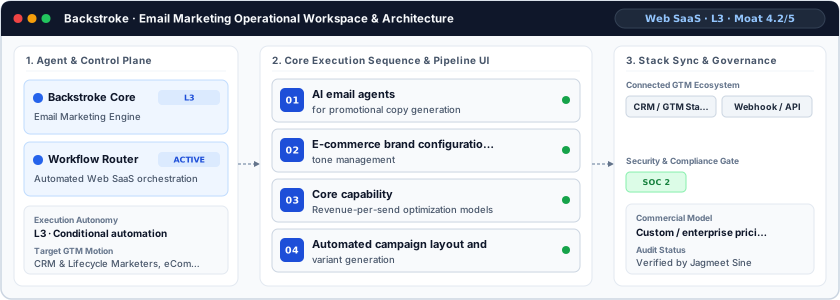
- AI email agents: for promotional copy generation
- E-commerce brand configuration and: tone management
- Core capability: Revenue-per-send optimization models
- Automated campaign layout and: variant generation
Cons: operational limitations & risks
- Catalog Synchronization Latency: Real-time merchandise changes and inventory depletion events can outpace generation workflows without continuous product feed synchronization hooks.
- Cross-Client Semantic Homogenization: Reliance on centralized retail training datasets risks producing stylized tropes across competing direct-to-consumer accounts within identical merchandising niches.
- ESP Delivery Pipeline Decoupling: The system relies on external mail transfer agents and ESP endpoints for dispatch, requiring separate monitoring of deliverability degradation and mailbox warming cycles.
Backstroke TCO & deal-breaker stress test
Simulate 12-month stepped TCO, hidden cost multipliers, contract lock-in exposure, and stack failure modes using only facts verified by Jagmeet Sine on · Capture SHA 18136ba1.
Backstroke triggers high-severity friction under your 5-seat / $800/mo constraints. Benchmark the verified subtrack alternatives below before committing.
| Plan / Tier | Verified Rate | Scale Fit | Scope & Quota Notes |
|---|---|---|---|
| Enterprise / Custom | Custom quote | 15–50+ seats (Enterprise SLA) | Sales-negotiated annual contract for custom volume, SSO/RBAC governance, and dedicated SLA. |
- Moat Score
- 4.2 / 5.0
- AI Autonomy
- L3
- Free Tier / Trial
- None disclosed
Triggered audit signals & failure modes
- Opaque Enterprise Quoting vs. SMB/Mid-Market BudgetVerified Pricing Ledger
Backstroke does not disclose a public self-serve floor (Custom / enterprise pricing). Buyers with a $800/mo cap face high sales-qualification friction.
- Sales-Gated Contract TermsFact-checked by Jagmeet Sine
Backstroke provisions its software under a custom enterprise licensing structure without public entry-level tiers.
- Primary Operational Bottleneck: Catalog Synchronization LatencyAudit by Jagmeet Sine
Real-time merchandise changes and inventory depletion events can outpace generation workflows without continuous product feed synchronization hooks.
Hidden TCO Multipliers & Quota Gates
- Catalog Synchronization Latency: Real-time merchandise changes and inventory depletion events can outpace generation workflows without continuous product feed synchronization hooks.
- Cross-Client Semantic Homogenization: Reliance on centralized retail training datasets risks producing stylized tropes across competing direct-to-consumer accounts within identical merchandising niches.
When to Walk Away & Negotiation Levers
- Walk away if you require transparent self-serve monthly billing or your budget ceiling is under $1,000/mo (Backstroke requires sales-gated custom quoting).
- Walk away if your workflow cannot tolerate catalog synchronization latency: Real-time merchandise changes and inventory depletion events can outpace generation workflows without continuous product feed synchronization hooks.
- Walk away if cross-client semantic homogenization is a deal-breaker for your team: Reliance on centralized retail training datasets risks producing stylized tropes across competing direct-to-consumer accounts within identical merchandising niches.
- Demand a 30- to 60-day paid pilot opt-out clause in the Backstroke order form before signing a 12-month enterprise commitment.
- Require a sandbox proof-of-concept testing catalog synchronization latency against your live CRM/data schema before annual sign-off.
Ask a custom procurement or TCO stress-test question about Backstroke
Lower 5-seat floor (~$7/mo vs. Custom Quote) · Transparent self-serve entry without mandatory annual lock-in
Lower 5-seat floor (~$15/mo vs. Custom Quote) · Transparent self-serve entry without mandatory annual lock-in
Backstroke key entities, modules & ecosystem stack
Backstroke moat & subtrack positioning
Backstroke builds defensibility through verticalized generative models calibrated on historical retail email interaction telemetry, combining automated creative synthesis with SOC 2-compliant brand governance rails.
Editorial review
Fact-checked by Jagmeet Sine (Senior MarTech Infrastructure & Agentic Workflow Architect) on .
Background
Capitalized with $7.6M in seed funding and established in 2024 in Indianapolis, Indiana, Backstroke delivers an autonomous content generation engine specifically targeted at retail lifecycle marketers. The platform addresses persistent creative bottlenecks in direct-to-consumer email operations by delegating copywriting, layout variation, and promotional cadence modeling to autonomous generative agents. Positioned within modern retention stacks, Backstroke provides digital marketing teams with a centralized workspace that aligns synthetic campaign generation with empirical revenue drivers.
How Backstroke works
Backstroke operates as an L3 autonomous email orchestration system powered by models trained on historical retail interaction datasets. Rather than utilizing uncalibrated foundational LLMs, the platform processes verticalized e-commerce engagement signals to correlate emotional syntax, promotional discount framing, and subject line taxonomy with historical conversion curves. Its generation pipeline ingests brand style guidelines, product catalogs, and scheduled promotional briefs to synthesize production-ready campaign drafts, subject line variants, and body content optimized for downstream email service provider ingestion.
Limitations
Operational considerations and platform boundaries include:
- Catalog Synchronization Latency: Real-time merchandise changes and inventory depletion events can outpace generation workflows without continuous product feed synchronization hooks.
- Cross-Client Semantic Homogenization: Reliance on centralized retail training datasets risks producing stylized tropes across competing direct-to-consumer accounts within identical merchandising niches.
- ESP Delivery Pipeline Decoupling: The system relies on external mail transfer agents and ESP endpoints for dispatch, requiring separate monitoring of deliverability degradation and mailbox warming cycles.
Backstroke pricing
Backstroke provisions its software under a custom enterprise licensing structure without public entry-level tiers. Commercial pricing is available on request through tailored enterprise sales quotes based on organizational scale and seats, campaign throughput requirements, and direct integration support. Enterprise subscriptions bundle brand configuration controls, SOC 2 compliance assurances, dedicated onboarding workflows, and customized ingestion pipelines for primary email service provider accounts.
How Backstroke compares
Within e-commerce optimization pipelines, Backstroke differentiates itself from adjacent platforms through vertical specialization in retention copy. Where 10Web AI targets generic web infrastructure generation and AB Tasty centers on client-side visual testing, Backstroke emphasizes predictive conversion writing. Unlike Ability.ai, which focuses on cross-channel agentic media workflows, Backstroke maintains tighter specialization in email mechanics, making it suitable for mid-market and enterprise retail brands aiming to increase send volume without expanding copywriting headcount.
Direct competitors & market radar
Top algorithmic competitors based on category positioning, capability overlap, and ICP alignment.
Frequently asked questions about Backstroke
How much does Backstroke cost and does it require a custom enterprise quote?
Published pricing summary for Backstroke: Custom / enterprise pricing. A permanent free plan is not disclosed for Backstroke. Backstroke provisions its software under a custom enterprise licensing structure without public entry-level tiers. Commercial pricing is available on request through tailored enterprise sales quotes based on organizational scale and seats, campaign throughput requirements, and direct integration support.
How does Backstroke work and how autonomous is its AI architecture?
Generative AI messaging platform trained on retail interaction data to optimize email copy, layout variants, and revenue per send for e-commerce brands. Within Email Marketing (AI Email Marketing & Lifecycle Journeys), MarTechRadar rates its execution architecture at L3 · Conditional automation with a verified Moat Score of 4.2 / 5.0 (Proprietary moat). Backstroke builds defensibility through verticalized generative models calibrated on historical retail email interaction telemetry, combining automated creative synthesis with SOC 2-compliant brand governance rails. Corporate profile: Founded by Allyson Talyor, Tyler Hill, operating at 2-10 employees scale.
What are the main limitations of Backstroke and when should buyers walk away?
Based on our editorial technical audit, key operational considerations and boundaries for Backstroke include: (1) Catalog Synchronization Latency: Real-time merchandise changes and inventory depletion events can outpace generation workflows without continuous product feed synchronization hooks. (2) Cross-Client Semantic Homogenization: Reliance on centralized retail training datasets risks producing stylized tropes across competing direct-to-consumer accounts within identical merchandising niches. (3) ESP Delivery Pipeline Decoupling: The system relies on external mail transfer agents and ESP endpoints for dispatch, requiring separate monitoring of deliverability degradation and mailbox warming cycles. Primary procurement walk-away rule: Walk away if you require transparent self-serve monthly billing or your budget ceiling is under $1,000/mo (Backstroke requires sales-gated custom quoting).
What integrations, compliance certifications, and contract terms apply to Backstroke?
Documented security and governance attestations include SOC 2. First-party governance and developer endpoints verified on domain include: Trust/Security (https://trust.backstroke.com). Key TCO multiplier to watch: Catalog Synchronization Latency (Real-time merchandise changes and inventory depletion events can outpace generation workflows without continuous product feed synchronization hooks.) Before signing a contract, procurement teams should demand a 30- to 60-day paid pilot opt-out clause in the Backstroke order form before signing a 12-month enterprise commitment.
What are the best Backstroke alternatives and head-to-head competitors in 2026?
Top fact-checked alternatives to Backstroke in Email Marketing (AI Email Marketing & Lifecycle Journeys) include Seventh Sense (Custom / enterprise pricing), Phrasee (Custom / enterprise pricing), Moosend (From $7/mo), rasa.io (Custom / enterprise pricing). Within e-commerce optimization pipelines, Backstroke differentiates itself from adjacent platforms through vertical specialization in retention copy. Where 10Web AI targets generic web infrastructure generation and AB Tasty centers on client-side visual testing, Backstroke emphasizes predictive conversion writing.
Verified sources & evidence trail
- Official product domain: https://www.backstroke.com/
- Commercial pricing verification: Verified against official vendor pricing policy (Custom / enterprise pricing)
- Verified corporate entity profiles (
sameAs): LinkedIn Company Profile · Crunchbase Entity Record - First-party governance & documentation links: Trust & Security · Changelog · Terms · Privacy
- Editorial audit sign-off: Fact-checked by Jagmeet Sine on under the MarTechRadar Evidence-Ledger Protocol.