Benchmark Email Review (2026): Email Marketing Pricing, Limits & Alternatives
Bottom line
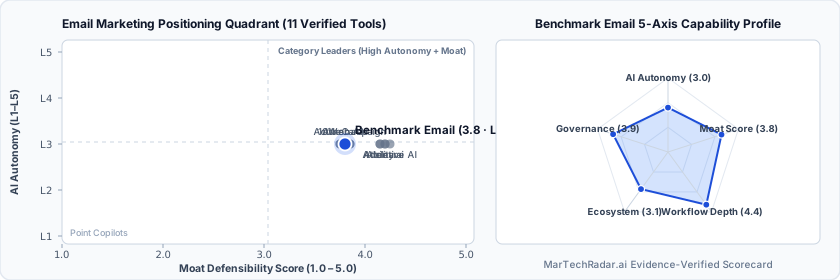
Benchmark Email is a Web SaaS tool for Email Marketing (AI Email Marketing & Lifecycle Journeys) in Lifecycle & CDP. Pricing: From $15/mo. Best suited to DTC / eCommerce and Enterprise Brands. Editor ratings: AI autonomy L3 (conditional automation); moat score 3.8/5.0 (Proprietary moat). Fact-checked by Tim Fenolz on Oct 12, 2026.
Email marketing automation and lifecycle communication platform combining visual campaign builders with embedded generative copy creation and contact.
Benchmark Email buyer fit verdict: when to choose vs. when to walk away
Choose Benchmark Email if (Best Fit)
- Target ICP & Stack Fit: You operate as DTC / eCommerce and Enterprise Brands requiring a Web SaaS deployment for Email Marketing.
- L3 Architecture & Defensibility: Two decades of ISP deliverability infrastructure, domain reputation monitoring, and simplified workflow orchestration tailored for resource-constrained operations.
- Commercial Model Fit: Your procurement budget aligns with From $15/mo.
Walk away from Benchmark Email if (Deal-Breakers)
- Walk away if your workflow requires uncapped enterprise volume on the From $15/mo entry plan without upgrading tiers.
- Walk away if your workflow cannot tolerate algorithmic orchestration depth: Automation paths rely on rigid deterministic branching rules rather than continuous dynamic cohort re-clustering or autonomous journey reconfiguration.
- Walk away if high-volume deliverability latency is a deal-breaker for your team: Sender domain reputations require manual warm-up pacing, leaving sender scores sensitive to sudden spikes in broadcast frequency.
Benchmark Email key facts & scorecard
| Pricing | From $15/moVendor pricing page |
|---|---|
| Free plan | No / not disclosed |
| Delivery | Web SaaS |
| Audience | DTC / eCommerce, Enterprise Brands |
| AI autonomy level | L3 · Conditional automationEditor-verified |
| Moat tier & score | 3.8 / 5.0 · Proprietary moatEditor-verified |
| Funding | Seed |
| Total funding | $3MBacked by Texas Capital Bank |
| Founders | Curt Keller, Denise Keller, Mohd Fairuz Razi bin Sharuddin |
| Company size | 51-200 employees |
| Governance & docs | System Status ↗ · Changelog ↗ · DPA ↗ · Terms ↗ · Privacy ↗ |
| Headquarters | Los Alamitos, California |
| Founded | 2004 |
| Last verified |
Benchmark Email pros & cons: strengths vs. operational limitations
Pros: core strengths & capabilities
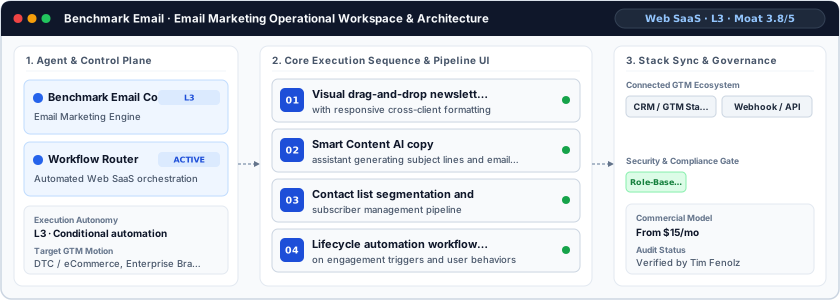
- Visual drag-and-drop newsletter builder: with responsive cross-client formatting
- Smart Content AI copy: assistant generating subject lines and email body text
- Contact list segmentation and: subscriber management pipeline
- Lifecycle automation workflows based: on engagement triggers and user behaviors
Cons: operational limitations & risks
- Algorithmic Orchestration Depth: Automation paths rely on rigid deterministic branching rules rather than continuous dynamic cohort re-clustering or autonomous journey reconfiguration.
- High-Volume Deliverability Latency: Sender domain reputations require manual warm-up pacing, leaving sender scores sensitive to sudden spikes in broadcast frequency.
- Data Pipeline Latency: Cross-system webhook synchronization and custom CRM attribute mapping experience synchronization lag during multi-thousand record bulk ingestion jobs.
Benchmark Email TCO & deal-breaker stress test
Simulate 12-month stepped TCO, hidden cost multipliers, contract lock-in exposure, and stack failure modes using only facts verified by Tim Fenolz on · Capture SHA e9a46125.
Benchmark Email aligns with your 5-seat / $800/mo profile. Review the walk-away triggers and contract levers below before deployment.
| Plan / Tier | Verified Rate | Scale Fit | Scope & Quota Notes |
|---|---|---|---|
| Entry / Starter | $15/mo | 1–2 seats | Domains 1 domain max 10 domains max |
- Moat Score
- 3.8 / 5.0
- AI Autonomy
- L3
- Free Tier / Trial
- None disclosed
Triggered audit signals & failure modes
- Published Self-Serve Entry FloorVerified Pricing Ledger
Benchmark Email publishes a transparent entry point (From $15/mo) for initial validation before committing.
- Primary Operational Bottleneck: Algorithmic Orchestration DepthAudit by Tim Fenolz
Automation paths rely on rigid deterministic branching rules rather than continuous dynamic cohort re-clustering or autonomous journey reconfiguration.
Hidden TCO Multipliers & Quota Gates
- Credit & Usage Burn Multiplier: Automated workflows consume metered credits/usage quotas; multi-step enrichment, voice minutes, or high-frequency agent runs can trigger mid-cycle top-up packs.
- Algorithmic Orchestration Depth: Automation paths rely on rigid deterministic branching rules rather than continuous dynamic cohort re-clustering or autonomous journey reconfiguration.
- High-Volume Deliverability Latency: Sender domain reputations require manual warm-up pacing, leaving sender scores sensitive to sudden spikes in broadcast frequency.
When to Walk Away & Negotiation Levers
- Walk away if your workflow requires uncapped enterprise volume on the From $15/mo entry plan without upgrading tiers.
- Walk away if your workflow cannot tolerate algorithmic orchestration depth: Automation paths rely on rigid deterministic branching rules rather than continuous dynamic cohort re-clustering or autonomous journey reconfiguration.
- Walk away if high-volume deliverability latency is a deal-breaker for your team: Sender domain reputations require manual warm-up pacing, leaving sender scores sensitive to sudden spikes in broadcast frequency.
- Validate exact quota thresholds (seats, credits, or API calls) included in Benchmark Email's From $15/mo tier before converting from monthly to annual billing.
- Require a sandbox proof-of-concept testing algorithmic orchestration depth against your live CRM/data schema before annual sign-off.
Ask a custom procurement or TCO stress-test question about Benchmark Email
Lower 5-seat floor (~$10/mo vs. From $15 / mo)
Fits within $800/mo budget (From $100/mo)
Benchmark Email moat & subtrack positioning
Two decades of ISP deliverability infrastructure, domain reputation monitoring, and simplified workflow orchestration tailored for resource-constrained operations.
Editorial review
Fact-checked by Tim Fenolz (Lead AdTech, Programmatic & Attribution Analyst) on .
Background
To execute lifecycle messaging without operational friction, growth teams prioritize execution speed and predictable deliverability over bloated configuration layers. Headquartered in Los Alamitos, California, Benchmark Email was founded in 2004 and has raised $3M in venture funding. Built for mid-market marketers, digital agencies, and lean commercial teams, the platform consolidates campaign drafting, contact hygiene, and outbound dispatch into a centralized operational surface.
How Benchmark Email works
The platform functions via an ingestion layer that parses contact records, custom subscriber attributes, and engagement triggers into segmented lists. Visual templates compile modular blocks into responsive HTML schemas compatible across major desktop and mobile email clients. For generative content creation, Benchmark Email incorporates OpenAI models via prompt-driven interfaces to draft subject lines and body copy directly within the authoring flow. Automated sequences execute through conditional branching routines triggered by subscriber interactions, click events, and time-based delays.
Limitations
Operational considerations and platform boundaries include:
- Algorithmic Orchestration Depth: Automation paths rely on rigid deterministic branching rules rather than continuous dynamic cohort re-clustering or autonomous journey reconfiguration.
- High-Volume Deliverability Latency: Sender domain reputations require manual warm-up pacing, leaving sender scores sensitive to sudden spikes in broadcast frequency.
- Data Pipeline Latency: Cross-system webhook synchronization and custom CRM attribute mapping experience synchronization lag during multi-thousand record bulk ingestion jobs.
Benchmark Email pricing
Benchmark Email structures licensing on tiered subscriber capacity. A functional entry tier starts at $0 for up to 500 contacts. Paid subscriptions operate from $15/month for entry-level operations, with standard monthly plans at $19 or discounted annual commitments equivalent to $16/month. Pricing scales upward based on database tiers up to 100,000 subscribers, above which custom enterprise contracts manage dedicated delivery infrastructure.
How Benchmark Email compares
Within the marketing optimization landscape, Benchmark Email contrasts with 10Web AI, AB Tasty, and Ability.ai by prioritizing dedicated email distribution rather than CMS site generation, web client experimentation, or autonomous conversion agents. While AB Tasty offers superior multivariate split-testing architectures and Ability.ai emphasizes predictive agent models, Benchmark Email serves organizations requiring reliable email distribution, fast execution, and predictable list-based economics without enterprise integration overhead.
Direct competitors & market radar
Top algorithmic competitors based on category positioning, capability overlap, and ICP alignment.
Frequently asked questions about Benchmark Email
How much does Benchmark Email cost and what pricing tiers are available?
Published pricing summary for Benchmark Email: From $15/mo. A permanent free plan is not disclosed for Benchmark Email. Benchmark Email structures licensing on tiered subscriber capacity. A functional entry tier starts at $0 for up to 500 contacts. Paid subscriptions operate from $15/month for entry-level operations, with standard monthly plans at $19 or discounted annual commitments equivalent to $16/month.
How does Benchmark Email work and how autonomous is its AI architecture?
Email marketing automation and lifecycle communication platform combining visual campaign builders with embedded generative copy creation and contact. Within Email Marketing (AI Email Marketing & Lifecycle Journeys), MarTechRadar rates its execution architecture at L3 · Conditional automation with a verified Moat Score of 3.8 / 5.0 (Proprietary moat). Two decades of ISP deliverability infrastructure, domain reputation monitoring, and simplified workflow orchestration tailored for resource-constrained operations. Corporate profile: Founded by Curt Keller, Denise Keller, Mohd Fairuz Razi bin Sharuddin, operating at 51-200 employees scale.
What are the main limitations of Benchmark Email and when should buyers walk away?
Based on our editorial technical audit, key operational considerations and boundaries for Benchmark Email include: (1) Algorithmic Orchestration Depth: Automation paths rely on rigid deterministic branching rules rather than continuous dynamic cohort re-clustering or autonomous journey reconfiguration. (2) High-Volume Deliverability Latency: Sender domain reputations require manual warm-up pacing, leaving sender scores sensitive to sudden spikes in broadcast frequency. (3) Data Pipeline Latency: Cross-system webhook synchronization and custom CRM attribute mapping experience synchronization lag during multi-thousand record bulk ingestion jobs. Primary procurement walk-away rule: Walk away if your workflow requires uncapped enterprise volume on the From $15/mo entry plan without upgrading tiers.
What integrations, compliance certifications, and contract terms apply to Benchmark Email?
First-party governance and developer endpoints verified on domain include: Status (https://www.benchmarkemail.com/status), DPA (https://www.benchmarkemail.com/data-processing-addendum). Key TCO multiplier to watch: Credit & Usage Burn Multiplier (Automated workflows consume metered credits/usage quotas; multi-step enrichment, voice minutes, or high-frequency agent runs can trigger mid-cycle top-up packs.) Before signing a contract, procurement teams should validate exact quota thresholds (seats, credits, or API calls) included in Benchmark Email's From $15/mo tier before converting from monthly to annual billing.
What are the best Benchmark Email alternatives and head-to-head competitors in 2026?
Top fact-checked alternatives to Benchmark Email in Email Marketing (AI Email Marketing & Lifecycle Journeys) include Dynamic Yield (Custom / enterprise pricing), Turgo AI (From $100/mo), Breakout (From $500/mo), Sendlane (From $10/mo). Within the marketing optimization landscape, Benchmark Email contrasts with 10Web AI, AB Tasty, and Ability.ai by prioritizing dedicated email distribution rather than CMS site generation, web client experimentation, or autonomous conversion agents.
Verified sources & evidence trail
- Official product domain: https://benchmarkemail.com
- Commercial pricing verification: https://www.benchmarkemail.com/pricing/
- Verified corporate entity profiles (
sameAs): LinkedIn Company Profile · Crunchbase Entity Record - First-party governance & documentation links: System Status · Changelog · DPA · Terms · Privacy
- Editorial audit sign-off: Fact-checked by Tim Fenolz on under the MarTechRadar Evidence-Ledger Protocol.