Iterable Review (2026): Email Marketing Pricing, Limits & Alternatives
Bottom line
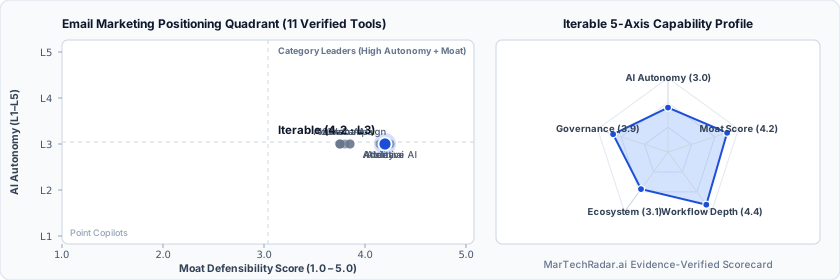
Iterable is a Web SaaS tool for Email Marketing (AI Email Marketing & Lifecycle Journeys) in Lifecycle & CDP. Pricing: Custom / enterprise pricing. Best suited to DTC / eCommerce and Enterprise Brands. Editor ratings: AI autonomy L3 (conditional automation); moat score 4.2/5.0 (Proprietary moat). Fact-checked by Sarah Per on Oct 12, 2026.
Enterprise customer engagement platform that orchestrates real-time, cross-channel lifecycle messaging using predictive intelligence and event-driven.
Iterable buyer fit verdict: when to choose vs. when to walk away
Choose Iterable if (Best Fit)
- Target ICP & Stack Fit: You operate as DTC / eCommerce and Enterprise Brands requiring a Web SaaS deployment for Email Marketing.
- L3 Architecture & Defensibility: High moat established via enterprise-scale distributed event ingestion infrastructure, integrated cross-channel delivery mechanics, and proprietary predictive machine learning models that optimize message timing, channel choice, and content variants across billions of touchpoints.
- Commercial Model Fit: Your procurement budget aligns with Custom / enterprise pricing.
Walk away from Iterable if (Deal-Breakers)
- Walk away if you require transparent self-serve monthly billing or your budget ceiling is under $1,000/mo (Iterable requires sales-gated custom quoting).
- Walk away if your workflow cannot tolerate event schema drift: Unstructured payload ingestion permits rapid implementation, but unmanaged schema changes from external applications can break downstream audience filters and dynamic message logic.
- Walk away if deliverability overhead is a deal-breaker for your team: High-throughput sending across custom subdomains requires continuous manual IP warming, reputation tracking, and DNS alignment across diverse mail service provider standards.
Iterable key facts & scorecard
| Pricing | Custom / enterprise pricing |
|---|---|
| Free plan | No / not disclosed |
| Delivery | Web SaaS |
| Audience | DTC / eCommerce, Enterprise Brands |
| AI autonomy level | L3 · Conditional automationEditor-verified |
| Moat tier & score | 4.2 / 5.0 · Proprietary moatEditor-verified |
| Funding | Series C+ |
| Total funding | $342.2MBacked by Silver Lake, Index Ventures |
| Founders | Andrew Boni, Justin Zhu |
| Company size | 501-1,000 employees |
| Governance & docs | Trust & Security ↗ · Changelog ↗ · Terms ↗ · Privacy ↗ |
| Headquarters | San Francisco, California |
| Founded | 2013 |
| Last verified |
Iterable pros & cons: strengths vs. operational limitations
Pros: core strengths & capabilities
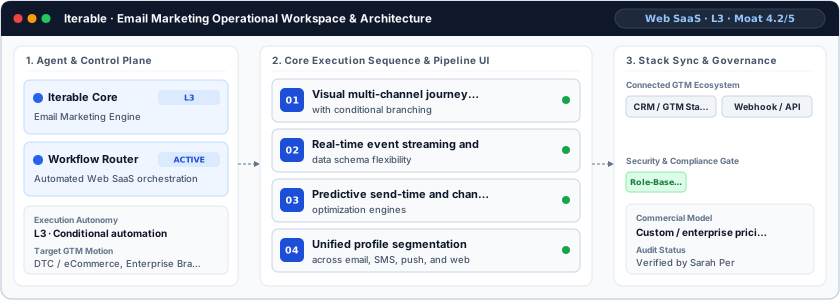
- Visual multi-channel journey builder: with conditional branching
- Real-time event streaming and: data schema flexibility
- Predictive send-time and channel: optimization engines
- Unified profile segmentation: across email, SMS, push, and web
Cons: operational limitations & risks
- Event Schema Drift: Unstructured payload ingestion permits rapid implementation, but unmanaged schema changes from external applications can break downstream audience filters and dynamic message logic.
- Deliverability Overhead: High-throughput sending across custom subdomains requires continuous manual IP warming, reputation tracking, and DNS alignment across diverse mail service provider standards.
- Attribution Latency: Complex multi-touch conversion attribution models experience data synchronization delays when integrating asynchronous offline transaction records or third-party attribution partners.
Iterable TCO & deal-breaker stress test
Simulate 12-month stepped TCO, hidden cost multipliers, contract lock-in exposure, and stack failure modes using only facts verified by Sarah Per on · Capture SHA ca943fdb.
Iterable triggers high-severity friction under your 5-seat / $800/mo constraints. Benchmark the verified subtrack alternatives below before committing.
| Plan / Tier | Verified Rate | Scale Fit | Scope & Quota Notes |
|---|---|---|---|
| Enterprise / Custom | Custom quote | 15–50+ seats (Enterprise SLA) | Sales-negotiated annual contract for custom volume, SSO/RBAC governance, and dedicated SLA. |
- Moat Score
- 4.2 / 5.0
- AI Autonomy
- L3
- Free Tier / Trial
- None disclosed
Triggered audit signals & failure modes
- Opaque Enterprise Quoting vs. SMB/Mid-Market BudgetVerified Pricing Ledger
Iterable does not disclose a public self-serve floor (Custom / enterprise pricing). Buyers with a $800/mo cap face high sales-qualification friction.
- Sales-Gated Contract TermsFact-checked by Sarah Per
Iterable structures its commercial model around custom annual enterprise contracts. Commercial pricing is available on request through tailored enterprise sales quotes based on organizational scale and seats.
- Primary Operational Bottleneck: Event Schema DriftAudit by Sarah Per
Unstructured payload ingestion permits rapid implementation, but unmanaged schema changes from external applications can break downstream audience filters and dynamic message logic.
Hidden TCO Multipliers & Quota Gates
- Event Schema Drift: Unstructured payload ingestion permits rapid implementation, but unmanaged schema changes from external applications can break downstream audience filters and dynamic message logic.
- Deliverability Overhead: High-throughput sending across custom subdomains requires continuous manual IP warming, reputation tracking, and DNS alignment across diverse mail service provider standards.
When to Walk Away & Negotiation Levers
- Walk away if you require transparent self-serve monthly billing or your budget ceiling is under $1,000/mo (Iterable requires sales-gated custom quoting).
- Walk away if your workflow cannot tolerate event schema drift: Unstructured payload ingestion permits rapid implementation, but unmanaged schema changes from external applications can break downstream audience filters and dynamic message logic.
- Walk away if deliverability overhead is a deal-breaker for your team: High-throughput sending across custom subdomains requires continuous manual IP warming, reputation tracking, and DNS alignment across diverse mail service provider standards.
- Demand a 30- to 60-day paid pilot opt-out clause in the Iterable order form before signing a 12-month enterprise commitment.
- Require a sandbox proof-of-concept testing event schema drift against your live CRM/data schema before annual sign-off.
Ask a custom procurement or TCO stress-test question about Iterable
Lower 5-seat floor (~$100/mo vs. Custom Quote) · Transparent self-serve entry without mandatory annual lock-in
Lower 5-seat floor (~$100/mo vs. Custom Quote) · Transparent self-serve entry without mandatory annual lock-in
Iterable moat & subtrack positioning
High moat established via enterprise-scale distributed event ingestion infrastructure, integrated cross-channel delivery mechanics, and proprietary predictive machine learning models that optimize message timing, channel choice, and content variants across billions of touchpoints.
Editorial review
Fact-checked by Sarah Per (Principal Content Systems & Generative Media Editor) on .
Background
Engineered around an event-driven data ingestion architecture, Iterable serves as an enterprise customer engagement platform that coordinates cross-channel communications. Established in 2013 in San Francisco, California, the company has secured $342.2M in total funding to support its lifecycle infrastructure. The platform targets growth marketers, product managers, and lifecycle operations specialists who require coordinated messaging across email, SMS, mobile push, and web interfaces.
How Iterable works
Iterable operates at an L3 conditional autonomy tier via its visual journey canvas and predictive intelligence engine. The platform ingests streaming first-party event data via REST APIs, webhooks, and modern data warehouse connectors without requiring rigid predefined schemas. Ingested events evaluate against nested audience segments, triggering automated logic branches in sub-second intervals. Machine learning layers analyze user-level interaction histories to automate send-time optimization, channel selection, and dynamic message personalization across high-volume delivery channels.
Limitations
Operational considerations and platform boundaries include:
- Event Schema Drift: Unstructured payload ingestion permits rapid implementation, but unmanaged schema changes from external applications can break downstream audience filters and dynamic message logic.
- Deliverability Overhead: High-throughput sending across custom subdomains requires continuous manual IP warming, reputation tracking, and DNS alignment across diverse mail service provider standards.
- Attribution Latency: Complex multi-touch conversion attribution models experience data synchronization delays when integrating asynchronous offline transaction records or third-party attribution partners.
Iterable pricing
Iterable structures its commercial model around custom annual enterprise contracts. Commercial pricing is available on request through tailored enterprise sales quotes based on organizational scale and seats. Contracts scale primarily on monthly active user volume, message delivery consumption across distinct communications channels, and specific enterprise additions like dedicated IP pools, premium support service levels, and custom data warehouse connectors.
How Iterable compares
Within customer messaging and optimization, Iterable differs significantly from specialized testing and creation tools. While AB Tasty targets front-end experimentation and client-side conversion rate testing, Iterable manages the underlying backend data ingestion and cross-channel transactional execution. In contrast to niche site builders like 10Web AI or autonomous media platforms like Ability.ai, Iterable focuses on high-volume user retention, making it best suited for consumer-facing brands with complex transactional data ecosystems.
Direct competitors & market radar
Top algorithmic competitors based on category positioning, capability overlap, and ICP alignment.
Frequently asked questions about Iterable
How much does Iterable cost and does it require a custom enterprise quote?
Published pricing summary for Iterable: Custom / enterprise pricing. A permanent free plan is not disclosed for Iterable. Iterable structures its commercial model around custom annual enterprise contracts. Commercial pricing is available on request through tailored enterprise sales quotes based on organizational scale and seats.
How does Iterable work and how autonomous is its AI architecture?
Enterprise customer engagement platform that orchestrates real-time, cross-channel lifecycle messaging using predictive intelligence and event-driven. Within Email Marketing (AI Email Marketing & Lifecycle Journeys), MarTechRadar rates its execution architecture at L3 · Conditional automation with a verified Moat Score of 4.2 / 5.0 (Proprietary moat). High moat established via enterprise-scale distributed event ingestion infrastructure, integrated cross-channel delivery mechanics, and proprietary predictive machine learning models that optimize message timing, channel choice, and content variants across billions of touchpoints. Corporate profile: Founded by Andrew Boni, Justin Zhu, operating at 501-1,000 employees scale.
What are the main limitations of Iterable and when should buyers walk away?
Based on our editorial technical audit, key operational considerations and boundaries for Iterable include: (1) Event Schema Drift: Unstructured payload ingestion permits rapid implementation, but unmanaged schema changes from external applications can break downstream audience filters and dynamic message logic. (2) Deliverability Overhead: High-throughput sending across custom subdomains requires continuous manual IP warming, reputation tracking, and DNS alignment across diverse mail service provider standards. (3) Attribution Latency: Complex multi-touch conversion attribution models experience data synchronization delays when integrating asynchronous offline transaction records or third-party attribution partners. Primary procurement walk-away rule: Walk away if you require transparent self-serve monthly billing or your budget ceiling is under $1,000/mo (Iterable requires sales-gated custom quoting).
What integrations, compliance certifications, and contract terms apply to Iterable?
First-party governance and developer endpoints verified on domain include: Trust/Security (https://trust.iterable.com). Key TCO multiplier to watch: Event Schema Drift (Unstructured payload ingestion permits rapid implementation, but unmanaged schema changes from external applications can break downstream audience filters and dynamic message logic.) Before signing a contract, procurement teams should demand a 30- to 60-day paid pilot opt-out clause in the Iterable order form before signing a 12-month enterprise commitment.
What are the best Iterable alternatives and head-to-head competitors in 2026?
Top fact-checked alternatives to Iterable in Email Marketing (AI Email Marketing & Lifecycle Journeys) include JustAI (Custom / enterprise pricing), DOJO AI (Custom / enterprise pricing), Customer.io AI (From $100/mo), TruAgents (Custom / enterprise pricing). Within customer messaging and optimization, Iterable differs significantly from specialized testing and creation tools. While AB Tasty targets front-end experimentation and client-side conversion rate testing, Iterable manages the underlying backend data ingestion and cross-channel transactional execution.
Verified sources & evidence trail
- Official product domain: https://iterable.com
- Commercial pricing verification: Verified against official vendor pricing policy (Custom / enterprise pricing)
- Verified corporate entity profiles (
sameAs): LinkedIn Company Profile · Crunchbase Entity Record - First-party governance & documentation links: Trust & Security · Changelog · Terms · Privacy
- Editorial audit sign-off: Fact-checked by Sarah Per on under the MarTechRadar Evidence-Ledger Protocol.