AWeber Review (2026): Email Marketing Pricing, Limits & Alternatives
Bottom line
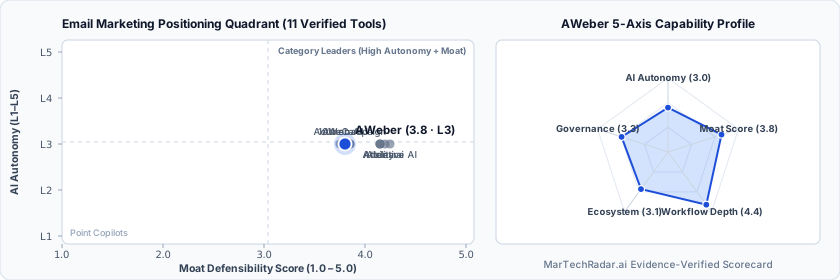
AWeber is a Web SaaS tool for Email Marketing (AI Email Marketing & Lifecycle Journeys) in Lifecycle & CDP. Pricing: From $79/mo. Best suited to Creators / Solo. Editor ratings: AI autonomy L3 (conditional automation); moat score 3.8/5.0 (Proprietary moat). Fact-checked by Jagmeet Sine on Oct 12, 2026.
Email marketing and lifecycle automation platform combining sequential autoresponders, dynamic tagging, and generative landing page creation for SMBs.
AWeber buyer fit verdict: when to choose vs. when to walk away
Choose AWeber if (Best Fit)
- Target ICP & Stack Fit: You operate as Creators / Solo requiring a Web SaaS deployment for Email Marketing.
- L3 Architecture & Defensibility: AWeber balances deep historical IP routing deliverability infrastructure with established sender reputations and turnkey drag-and-drop workflow execution for small-to-midscale audience operators.
- Commercial Model Fit: Your procurement budget aligns with From $79/mo.
Walk away from AWeber if (Deal-Breakers)
- Walk away if your workflow requires uncapped enterprise volume on the From $79/mo entry plan without upgrading tiers.
- Walk away if your workflow cannot tolerate multi-path journey branching: The automation engine prioritizes linear sequential flows, creating friction when orchestrating complex multivariate branching across multi-touch lifecycle graphs.
- Walk away if unified identity resolution is a deal-breaker for your team: Contact tracking relies heavily on single email addresses and explicit form events, lacking cross-device probabilistic identity stitching for unauthenticated visitor traffic.
AWeber key facts & scorecard
| Pricing | From $79/moVendor pricing page |
|---|---|
| Free plan | No / not disclosed |
| Delivery | Web SaaS |
| Audience | Creators / Solo |
| AI autonomy level | L3 · Conditional automationEditor-verified |
| Moat tier & score | 3.8 / 5.0 · Proprietary moatEditor-verified |
| Funding | Bootstrapped |
| Total funding | BootstrappedBacked by Founders |
| Founders | Tom Kulzer |
| Company size | 51-200 employees |
| Governance & docs | System Status ↗ · API & Docs ↗ |
| Headquarters | Doylestown, Pennsylvania |
| Founded | 1998 |
| Last verified |
AWeber pros & cons: strengths vs. operational limitations
Pros: core strengths & capabilities
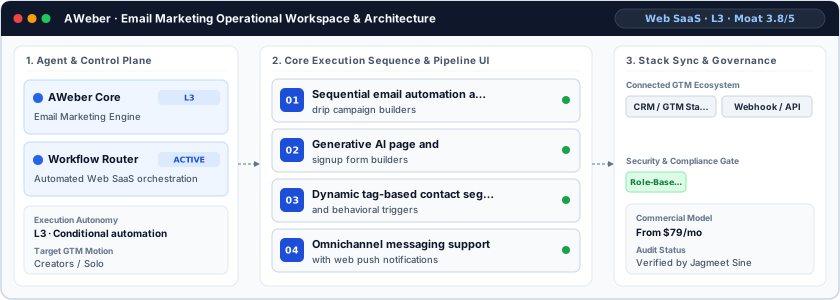
- Sequential email automation and: drip campaign builders
- Generative AI page and: signup form builders
- Dynamic tag-based contact segmentation: and behavioral triggers
- Omnichannel messaging support: with web push notifications
Cons: operational limitations & risks
- Multi-path journey branching: The automation engine prioritizes linear sequential flows, creating friction when orchestrating complex multivariate branching across multi-touch lifecycle graphs.
- Unified identity resolution: Contact tracking relies heavily on single email addresses and explicit form events, lacking cross-device probabilistic identity stitching for unauthenticated visitor traffic.
- Predictive audience modeling: Audience grouping requires deterministic tagging rules rather than autonomous, real-time ML-driven churn prediction or dynamic send-time clustering.
AWeber TCO & deal-breaker stress test
Simulate 12-month stepped TCO, hidden cost multipliers, contract lock-in exposure, and stack failure modes using only facts verified by Jagmeet Sine on · Capture SHA 9134de17.
AWeber aligns with your 5-seat / $800/mo profile. Review the walk-away triggers and contract levers below before deployment.
| Plan / Tier | Verified Rate | Scale Fit | Scope & Quota Notes |
|---|---|---|---|
| Entry / Starter | $79/mo | 1–2 seats | Verified $79/mo tier from vendor pricing schedule. |
| Growth / Professional | $599/mo | 5 seats | Verified $599/mo tier from vendor pricing schedule. |
- Moat Score
- 3.8 / 5.0
- AI Autonomy
- L3
- Free Tier / Trial
- None disclosed
Triggered audit signals & failure modes
- Published Self-Serve Entry FloorVerified Pricing Ledger
AWeber publishes a transparent entry point (From $79/mo) for initial validation before committing.
- Tier Fit for 5-Seat Scale: Growth / Professional ($599/mo)Verified Tier Schedule
Verified $599/mo tier from vendor pricing schedule.
- Primary Operational Bottleneck: Multi-path journey branchingAudit by Jagmeet Sine
The automation engine prioritizes linear sequential flows, creating friction when orchestrating complex multivariate branching across multi-touch lifecycle graphs.
Hidden TCO Multipliers & Quota Gates
- Multi-path journey branching: The automation engine prioritizes linear sequential flows, creating friction when orchestrating complex multivariate branching across multi-touch lifecycle graphs.
- Unified identity resolution: Contact tracking relies heavily on single email addresses and explicit form events, lacking cross-device probabilistic identity stitching for unauthenticated visitor traffic.
When to Walk Away & Negotiation Levers
- Walk away if your workflow requires uncapped enterprise volume on the From $79/mo entry plan without upgrading tiers.
- Walk away if your workflow cannot tolerate multi-path journey branching: The automation engine prioritizes linear sequential flows, creating friction when orchestrating complex multivariate branching across multi-touch lifecycle graphs.
- Walk away if unified identity resolution is a deal-breaker for your team: Contact tracking relies heavily on single email addresses and explicit form events, lacking cross-device probabilistic identity stitching for unauthenticated visitor traffic.
- Validate exact quota thresholds (seats, credits, or API calls) included in AWeber's From $79/mo tier before converting from monthly to annual billing.
- Require a sandbox proof-of-concept testing multi-path journey branching against your live CRM/data schema before annual sign-off.
Ask a custom procurement or TCO stress-test question about AWeber
Lower 5-seat floor (~$13/mo vs. $599 / mo)
Lower 5-seat floor (~$5/mo vs. $599 / mo)
AWeber moat & subtrack positioning
AWeber balances deep historical IP routing deliverability infrastructure with established sender reputations and turnkey drag-and-drop workflow execution for small-to-midscale audience operators.
Editorial review
Fact-checked by Jagmeet Sine (Senior MarTech Infrastructure & Agentic Workflow Architect) on .
Background
To execute audience monetization and programmatic customer retention without maintaining dedicated technical infrastructure, marketing teams rely on structured lifecycle delivery platforms. Headquartered in Doylestown, Pennsylvania, and founded in 1998, AWeber provides commercial email broadcast and lifecycle workflow services. Designed primarily for content creators, independent commerce operators, and growth marketers, the platform replaces manual batch messaging with rule-based autoresponders, web push channels, and hosted conversion endpoints. It addresses customer onboarding, periodic newsletters, and behavioral list nurturing.
How AWeber works
AWeber operates as a conditional autoresponder engine tied to a transactional subscriber database. Ingestion pipelines capture leads via hosted landing pages, native e-commerce webhooks, or embedded opt-in components built through its integrated AI form modules. Subscriber records are enriched with behavioral tags applied via message interactions, link redirects, and site activity. Operating at an L3 autonomy profile, the platform initiates multi-stage drip sequences based on deterministic routing schemas, executing scheduled cadence intervals and algorithmic MTA relay optimization without manual deployment per dispatch.
Limitations
Operational considerations and platform boundaries include:
- Multi-path journey branching: The automation engine prioritizes linear sequential flows, creating friction when orchestrating complex multivariate branching across multi-touch lifecycle graphs.
- Unified identity resolution: Contact tracking relies heavily on single email addresses and explicit form events, lacking cross-device probabilistic identity stitching for unauthenticated visitor traffic.
- Predictive audience modeling: Audience grouping requires deterministic tagging rules rather than autonomous, real-time ML-driven churn prediction or dynamic send-time clustering.
AWeber pricing
The commercial licensing structure operates on a tiered subscription framework tied to active subscriber inventory and execution volume. Standard tiers start from $79 per month, scaling upward alongside list depth and high-volume routing tiers. Promotional launch bundles discount baseline list packages from $599 down to $79, while entry-level experimentation remains accessible via functional freemium tiers that bundle foundational automation, push endpoints, and AI-assisted generation tools.
How AWeber compares
Within modern marketing stacks, AWeber competes alongside optimization and automation alternatives such as 10Web AI, AB Tasty, and Ability.ai. While 10Web AI focuses primarily on automated CMS architecture, and AB Tasty delivers enterprise client-side experimentation, AWeber emphasizes deterministic inbox placement and outbound retention pipelines. Conversely, Ability.ai explores agentic growth execution across diverse ad channels. AWeber fits mid-market and small business commerce operations requiring dependable, list-centric distribution without custom engineering overhead.
Frequently asked questions about AWeber
How much does AWeber cost and what pricing tiers are available?
Published pricing summary for AWeber: From $79/mo. A permanent free plan is not disclosed for AWeber. Verified tier schedule: Entry / Starter ($79/mo for 1–2 seats); Growth / Professional ($599/mo for 5 seats). The commercial licensing structure operates on a tiered subscription framework tied to active subscriber inventory and execution volume. Standard tiers start from $79 per month, scaling upward alongside list depth and high-volume routing tiers.
How does AWeber work and how autonomous is its AI architecture?
Email marketing and lifecycle automation platform combining sequential autoresponders, dynamic tagging, and generative landing page creation for SMBs. Within Email Marketing (AI Email Marketing & Lifecycle Journeys), MarTechRadar rates its execution architecture at L3 · Conditional automation with a verified Moat Score of 3.8 / 5.0 (Proprietary moat). AWeber balances deep historical IP routing deliverability infrastructure with established sender reputations and turnkey drag-and-drop workflow execution for small-to-midscale audience operators. Corporate profile: Founded by Tom Kulzer, operating at 51-200 employees scale.
What are the main limitations of AWeber and when should buyers walk away?
Based on our editorial technical audit, key operational considerations and boundaries for AWeber include: (1) Multi-path journey branching: The automation engine prioritizes linear sequential flows, creating friction when orchestrating complex multivariate branching across multi-touch lifecycle graphs. (2) Unified identity resolution: Contact tracking relies heavily on single email addresses and explicit form events, lacking cross-device probabilistic identity stitching for unauthenticated visitor traffic. (3) Predictive audience modeling: Audience grouping requires deterministic tagging rules rather than autonomous, real-time ML-driven churn prediction or dynamic send-time clustering. Primary procurement walk-away rule: Walk away if your workflow requires uncapped enterprise volume on the From $79/mo entry plan without upgrading tiers.
What integrations, compliance certifications, and contract terms apply to AWeber?
First-party governance and developer endpoints verified on domain include: Status (https://status.aweber.com), API Docs (https://docs.aweber.com). Key TCO multiplier to watch: Multi-path journey branching (The automation engine prioritizes linear sequential flows, creating friction when orchestrating complex multivariate branching across multi-touch lifecycle graphs.) Before signing a contract, procurement teams should validate exact quota thresholds (seats, credits, or API calls) included in AWeber's From $79/mo tier before converting from monthly to annual billing.
What are the best AWeber alternatives and head-to-head competitors in 2026?
Top fact-checked alternatives to AWeber in Email Marketing (AI Email Marketing & Lifecycle Journeys) include Athena AI (Custom / enterprise pricing), VerticalResponse (From $13/mo), clerk chat (From $5/mo), MadeThis (From $49/mo). Within modern marketing stacks, AWeber competes alongside optimization and automation alternatives such as 10Web AI, AB Tasty, and Ability.ai.
Verified sources & evidence trail
- Official product domain: https://aweber.com
- Commercial pricing verification: https://www.aweber.com/pricing
- Verified corporate entity profiles (
sameAs): LinkedIn Company Profile · Crunchbase Entity Record - First-party governance & documentation links: System Status · API & Docs
- Editorial audit sign-off: Fact-checked by Jagmeet Sine on under the MarTechRadar Evidence-Ledger Protocol.