Attentive AI Review (2026): Email Marketing Pricing, Limits & Alternatives
Bottom line
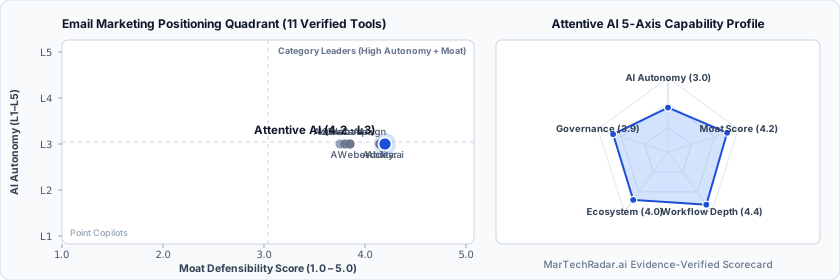
Attentive AI is a Web SaaS tool for Email Marketing (AI Email Marketing & Lifecycle Journeys) in Lifecycle & CDP. Pricing: Custom / enterprise pricing. Best suited to DTC / eCommerce and Enterprise Brands. Editor ratings: AI autonomy L3 (conditional automation); moat score 4.2/5.0 (Proprietary moat). Fact-checked by Anthony Hay on Oct 12, 2026.
Enterprise conversational messaging platform orchestrating automated SMS, MMS, RCS, and email journeys via real-time behavioral data and agentic AI.
Attentive AI buyer fit verdict: when to choose vs. when to walk away
Choose Attentive AI if (Best Fit)
- Target ICP & Stack Fit: You operate as DTC / eCommerce and Enterprise Brands requiring a Web SaaS deployment for Email Marketing, with verified ecosystem connectivity for Salesforce, Shopify.
- L3 Architecture & Defensibility: Proprietary carrier-grade SMS routing infrastructure coupled with high-volume transactional data pipelines, deep e-commerce identity resolution, and multi-channel generative messaging models.
- Commercial Model Fit: Your procurement budget aligns with Custom / enterprise pricing.
Walk away from Attentive AI if (Deal-Breakers)
- Walk away if you require transparent self-serve monthly billing or your budget ceiling is under $1,000/mo (Attentive AI requires sales-gated custom quoting).
- Walk away if your workflow cannot tolerate telephony compliance overhead: The architecture demands strict adherence to dynamic TCPA, CTIA, and 10DLC carrier throughput rules, causing message queues to throttle during carrier network congestion.
- Walk away if identity graph cold-start lag is a deal-breaker for your team: Predictive send-time and recommendation pipelines require substantial transactional and browsing histories, yielding suboptimal message variations for newly onboarded catalogs or cold visitor traffic.
Attentive AI key facts & scorecard
| Pricing | Custom / enterprise pricing |
|---|---|
| Free plan | No / not disclosed |
| Delivery | Web SaaS |
| Audience | DTC / eCommerce, Enterprise Brands |
| AI autonomy level | L3 · Conditional automationEditor-verified |
| Moat tier & score | 4.2 / 5.0 · Proprietary moatEditor-verified |
| Funding | Venture-backed |
| Total funding | $863MBacked by Wellington Management, Sequoia Capital, Base10 Partners, Sapphire Ventures, Coatue |
| Founders | Andrew Jones, Brian Long, Ethan Lo |
| Company size | 1,001-5,000 employees |
| Ecosystem integrations | Salesforce, Shopify |
| Governance & docs | Trust & Security ↗ · API & Docs ↗ · Changelog ↗ · Terms ↗ · Privacy ↗ |
| Headquarters | Hoboken, New Jersey, United States |
| Founded | 2016 |
| Last verified |
Attentive AI pros & cons: strengths vs. operational limitations
Pros: core strengths & capabilities
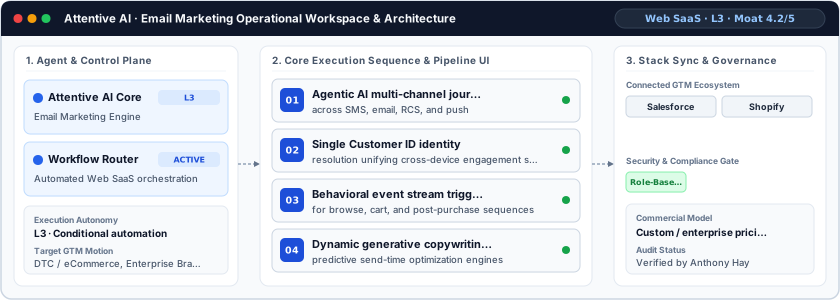
- Agentic AI multi-channel journey orchestration: across SMS, email, RCS, and push
- Single Customer ID identity: resolution unifying cross-device engagement signals
- Behavioral event stream triggers: for browse, cart, and post-purchase sequences
- Dynamic generative copywriting and: predictive send-time optimization engines
Cons: operational limitations & risks
- Telephony Compliance Overhead: The architecture demands strict adherence to dynamic TCPA, CTIA, and 10DLC carrier throughput rules, causing message queues to throttle during carrier network congestion.
- Identity Graph Cold-Start Lag: Predictive send-time and recommendation pipelines require substantial transactional and browsing histories, yielding suboptimal message variations for newly onboarded catalogs or cold visitor traffic.
- Multi-Channel Cannibalization Risks: In uncoordinated tech stacks, automated agentic triggers across SMS and email can execute concurrent outbound dispatches, increasing subscriber fatigue and unsubscribe frequency.
Attentive AI TCO & deal-breaker stress test
Simulate 12-month stepped TCO, hidden cost multipliers, contract lock-in exposure, and stack failure modes using only facts verified by Anthony Hay on · Capture SHA 649d0204.
Attentive AI triggers high-severity friction under your 5-seat / $800/mo constraints. Benchmark the verified subtrack alternatives below before committing.
| Plan / Tier | Verified Rate | Scale Fit | Scope & Quota Notes |
|---|---|---|---|
| Enterprise / Custom | Custom quote | 15–50+ seats (Enterprise SLA) | Sales-negotiated annual contract for custom volume, SSO/RBAC governance, and dedicated SLA. |
- Moat Score
- 4.2 / 5.0
- AI Autonomy
- L3
- Free Tier / Trial
- None disclosed
Triggered audit signals & failure modes
- Opaque Enterprise Quoting vs. SMB/Mid-Market BudgetVerified Pricing Ledger
Attentive AI does not disclose a public self-serve floor (Custom / enterprise pricing). Buyers with a $800/mo cap face high sales-qualification friction.
- Sales-Gated Contract TermsFact-checked by Anthony Hay
Attentive operates under a direct quote model where commercial pricing is available on request through tailored enterprise sales quotes based on organizational scale and seats.
- Primary Operational Bottleneck: Telephony Compliance OverheadAudit by Anthony Hay
The architecture demands strict adherence to dynamic TCPA, CTIA, and 10DLC carrier throughput rules, causing message queues to throttle during carrier network congestion.
Hidden TCO Multipliers & Quota Gates
- Credit & Usage Burn Multiplier: Automated workflows consume metered credits/usage quotas; multi-step enrichment, voice minutes, or high-frequency agent runs can trigger mid-cycle top-up packs.
- Telephony Compliance Overhead: The architecture demands strict adherence to dynamic TCPA, CTIA, and 10DLC carrier throughput rules, causing message queues to throttle during carrier network congestion.
- Identity Graph Cold-Start Lag: Predictive send-time and recommendation pipelines require substantial transactional and browsing histories, yielding suboptimal message variations for newly onboarded catalogs or cold visitor traffic.
When to Walk Away & Negotiation Levers
- Walk away if you require transparent self-serve monthly billing or your budget ceiling is under $1,000/mo (Attentive AI requires sales-gated custom quoting).
- Walk away if your workflow cannot tolerate telephony compliance overhead: The architecture demands strict adherence to dynamic TCPA, CTIA, and 10DLC carrier throughput rules, causing message queues to throttle during carrier network congestion.
- Walk away if identity graph cold-start lag is a deal-breaker for your team: Predictive send-time and recommendation pipelines require substantial transactional and browsing histories, yielding suboptimal message variations for newly onboarded catalogs or cold visitor traffic.
- Demand a 30- to 60-day paid pilot opt-out clause in the Attentive AI order form before signing a 12-month enterprise commitment.
- Require a sandbox proof-of-concept testing telephony compliance overhead against your live CRM/data schema before annual sign-off.
Ask a custom procurement or TCO stress-test question about Attentive AI
Lower 5-seat floor (~$9/mo vs. Custom Quote) · Transparent self-serve entry without mandatory annual lock-in
Lower 5-seat floor (~$15/mo vs. Custom Quote) · Transparent self-serve entry without mandatory annual lock-in
Attentive AI key entities, modules & ecosystem stack
Attentive AI moat & subtrack positioning
Proprietary carrier-grade SMS routing infrastructure coupled with high-volume transactional data pipelines, deep e-commerce identity resolution, and multi-channel generative messaging models.
Editorial review
Fact-checked by Anthony Hay (Senior SEO, Search Intelligence & Content Operations Editor) on .
Background
Backed by $863M in venture funding and founded in 2016 in Hoboken, New Jersey, Attentive AI operates as a conversational marketing and customer lifecycle orchestration platform. Built specifically for digital commerce operators, direct-to-consumer enterprises, and multichannel retail brands, the software coordinates subscriber communications across mobile and digital direct-response channels. Attentive positions its infrastructure around mobile identity graphs and real-time behavioral triggers to capture immediate intent signals across high-frequency purchase funnels.
How Attentive AI works
Attentive captures deterministic behavioral events by embedding telemetry across e-commerce storefronts, ingestion APIs, and webhooks from platforms such as Shopify and Salesforce Commerce Cloud. These events feed into a unified Single Customer ID identity engine that reconciles anonymous sessions with confirmed mobile numbers and email addresses. Operating at an L3 conditional autonomy tier, the system employs agentic AI models to analyze past purchasing recency, browsing cadence, and channel sensitivity. The platform then synthesizes hyper-personalized conversational copy, chooses the delivery channel—SMS, RCS, or email—and programmatically determines delivery windows without requiring manual campaign assembly.
Limitations
Operational considerations and platform boundaries include:
- Telephony Compliance Overhead: The architecture demands strict adherence to dynamic TCPA, CTIA, and 10DLC carrier throughput rules, causing message queues to throttle during carrier network congestion.
- Identity Graph Cold-Start Lag: Predictive send-time and recommendation pipelines require substantial transactional and browsing histories, yielding suboptimal message variations for newly onboarded catalogs or cold visitor traffic.
- Multi-Channel Cannibalization Risks: In uncoordinated tech stacks, automated agentic triggers across SMS and email can execute concurrent outbound dispatches, increasing subscriber fatigue and unsubscribe frequency.
Attentive AI pricing
Attentive operates under a direct quote model where commercial pricing is available on request through tailored enterprise sales quotes based on organizational scale and seats. Contracts are scoped modularly around monthly outbound message volume, tracked subscriber list tiers, integrated communication channels, and access to premium agentic AI modules. Support packages and dedicated deliverability consulting are negotiated directly within master service agreements.
How Attentive AI compares
While adjacent MarTech providers such as AB Tasty focus on client-side front-end experimentation, 10Web AI specializes in synthetic website generation, and Ability.ai emphasizes multi-agent campaign execution, Attentive AI concentrates specifically on retention and lifecycle messaging pipelines. The platform sacrifices horizontal CMS flexibility to secure specialized bidirectional telecom throughput and high-speed checkout abandonment workflows. It remains ideal for high-volume retail organizations requiring low-latency behavioral triggers tied directly to mobile revenue generation.
Direct competitors & market radar
Top algorithmic competitors based on category positioning, capability overlap, and ICP alignment.
Frequently asked questions about Attentive AI
How much does Attentive AI cost and does it require a custom enterprise quote?
Published pricing summary for Attentive AI: Custom / enterprise pricing. A permanent free plan is not disclosed for Attentive AI. Attentive operates under a direct quote model where commercial pricing is available on request through tailored enterprise sales quotes based on organizational scale and seats.
How does Attentive AI work and how autonomous is its AI architecture?
Enterprise conversational messaging platform orchestrating automated SMS, MMS, RCS, and email journeys via real-time behavioral data and agentic AI. Within Email Marketing (AI Email Marketing & Lifecycle Journeys), MarTechRadar rates its execution architecture at L3 · Conditional automation with a verified Moat Score of 4.2 / 5.0 (Proprietary moat). Proprietary carrier-grade SMS routing infrastructure coupled with high-volume transactional data pipelines, deep e-commerce identity resolution, and multi-channel generative messaging models. Corporate profile: Founded by Andrew Jones, Brian Long, Ethan Lo, operating at 1,001-5,000 employees scale.
What are the main limitations of Attentive AI and when should buyers walk away?
Based on our editorial technical audit, key operational considerations and boundaries for Attentive AI include: (1) Telephony Compliance Overhead: The architecture demands strict adherence to dynamic TCPA, CTIA, and 10DLC carrier throughput rules, causing message queues to throttle during carrier network congestion. (2) Identity Graph Cold-Start Lag: Predictive send-time and recommendation pipelines require substantial transactional and browsing histories, yielding suboptimal message variations for newly onboarded catalogs or cold visitor traffic. (3) Multi-Channel Cannibalization Risks: In uncoordinated tech stacks, automated agentic triggers across SMS and email can execute concurrent outbound dispatches, increasing subscriber fatigue and unsubscribe frequency. Primary procurement walk-away rule: Walk away if you require transparent self-serve monthly billing or your budget ceiling is under $1,000/mo (Attentive AI requires sales-gated custom quoting).
What integrations, compliance certifications, and contract terms apply to Attentive AI?
Verified ecosystem and stack integrations include Salesforce, Shopify. First-party governance and developer endpoints verified on domain include: Trust/Security (https://www.attentive.com/compliance), API Docs (https://www.attentive.com/developers). Key TCO multiplier to watch: Credit & Usage Burn Multiplier (Automated workflows consume metered credits/usage quotas; multi-step enrichment, voice minutes, or high-frequency agent runs can trigger mid-cycle top-up packs.) Before signing a contract, procurement teams should demand a 30- to 60-day paid pilot opt-out clause in the Attentive AI order form before signing a 12-month enterprise commitment.
What are the best Attentive AI alternatives and head-to-head competitors in 2026?
Top fact-checked alternatives to Attentive AI in Email Marketing (AI Email Marketing & Lifecycle Journeys) include Klaviyo (AI) (Custom / enterprise pricing), 10Web AI (Custom / enterprise pricing), Replenit (Custom / enterprise pricing), WATI (From $4.99/mo). While adjacent MarTech providers such as AB Tasty focus on client-side front-end experimentation, 10Web AI specializes in synthetic website generation, and Ability.ai emphasizes multi-agent campaign execution, Attentive AI concentrates specifically on retention and lifecycle messaging pipelines.
Verified sources & evidence trail
- Official product domain: https://attentive.com
- Commercial pricing verification: Verified against official vendor pricing policy (Custom / enterprise pricing)
- Verified corporate entity profiles (
sameAs): LinkedIn Company Profile · Crunchbase Entity Record - First-party governance & documentation links: Trust & Security · API & Docs · Changelog · Terms · Privacy
- Editorial audit sign-off: Fact-checked by Anthony Hay on under the MarTechRadar Evidence-Ledger Protocol.