Replenit Review (2026): Email Marketing Pricing, Limits & Alternatives
Bottom line
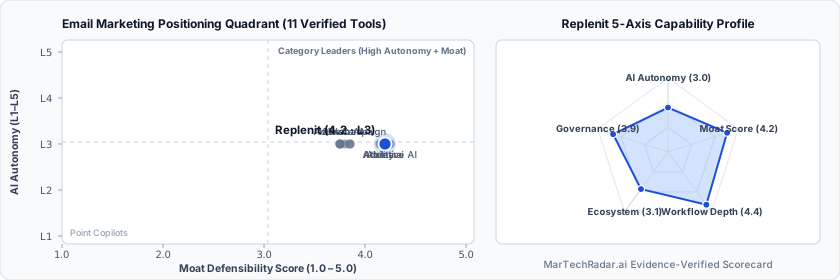
Replenit is a Web SaaS tool for Email Marketing (AI Email Marketing & Lifecycle Journeys) in Lifecycle & CDP. Pricing: Custom / enterprise pricing. Best suited to CRM & Lifecycle Marketers, eCommerce Growth Teams and Customer Experience Directors. Editor ratings: AI autonomy L3 (conditional automation); moat score 4.2/5.0 (Proprietary moat). Fact-checked by Jiacky Lee on Oct 12, 2026.
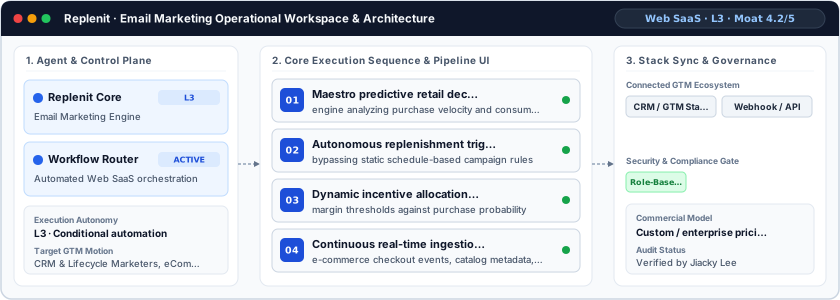
Predictive retail decision engine orchestrating autonomous replenishment timing, personalized product incentives, and dynamic customer lifecycle triggers.
Replenit buyer fit verdict: when to choose vs. when to walk away
Choose Replenit if (Best Fit)
- Target ICP & Stack Fit: You operate as CRM & Lifecycle Marketers, eCommerce Growth Teams and Customer Experience Directors requiring a Web SaaS deployment for Email Marketing.
- L3 Architecture & Defensibility: Algorithmic consumption decay modeling embedded within its proprietary Maestro decision engine, trained on multi-brand transactional intervals and consumer durability cycles to automate repeat-purchase dispatch schedules.
- Commercial Model Fit: Your procurement budget aligns with Custom / enterprise pricing.
Walk away from Replenit if (Deal-Breakers)
- Walk away if you require transparent self-serve monthly billing or your budget ceiling is under $1,000/mo (Replenit requires sales-gated custom quoting).
- Walk away if your workflow cannot tolerate cold-start sku modeling: The predictive engine requires dense historical transaction velocity to calibrate depletion models; newly introduced catalog items lacking purchase frequency suffer from extended calibration lags and fallback heuristic defaults.
- Walk away if irregular consumption volatility is a deal-breaker for your team: Household usage anomalies—such as bulk pantry loading, gifting, or seasonal pauses—distort baseline replenishment timelines, triggering out-of-context retention notifications unless manually adjusted.
Replenit key facts & scorecard
| Pricing | Custom / enterprise pricing |
|---|---|
| Free plan | No / not disclosed |
| Delivery | Web SaaS |
| Audience | CRM & Lifecycle Marketers, eCommerce Growth Teams, Customer Experience Directors |
| AI autonomy level | L3 · Conditional automationEditor-verified |
| Moat tier & score | 4.2 / 5.0 · Proprietary moatEditor-verified |
| Funding | Seed |
| Total funding | $2.5MBacked by Metis Ventures, Movens Capital, Digital Ocean Ventures Starter, Logo Ventures, Finberg |
| Founders | Alp Karacaev, Caner Demir, Cenk Karacaev, Egemen Akdan |
| Company size | 11-50 employees |
| Governance & docs | Trust & Security ↗ · API & Docs ↗ · Privacy ↗ |
| Headquarters | Warszawa, Poland |
| Founded | 2025 |
| Last verified |
Replenit pros & cons: strengths vs. operational limitations
Pros: core strengths & capabilities
- Maestro predictive retail decision: engine analyzing purchase velocity and consumable durability
- Autonomous replenishment trigger orchestration: bypassing static schedule-based campaign rules
- Dynamic incentive allocation optimizing: margin thresholds against purchase probability
- Continuous real-time ingestion of: e-commerce checkout events, catalog metadata, and user telemetry
Cons: operational limitations & risks
- Cold-Start SKU Modeling: The predictive engine requires dense historical transaction velocity to calibrate depletion models; newly introduced catalog items lacking purchase frequency suffer from extended calibration lags and fallback heuristic defaults.
- Irregular Consumption Volatility: Household usage anomalies—such as bulk pantry loading, gifting, or seasonal pauses—distort baseline replenishment timelines, triggering out-of-context retention notifications unless manually adjusted.
- Downstream ESP Sync Latency: Event orchestration depends on external marketing cloud API rate thresholds; webhook backpressure during high-concurrency dispatch windows can delay time-sensitive lifecycle communications.
Replenit TCO & deal-breaker stress test
Simulate 12-month stepped TCO, hidden cost multipliers, contract lock-in exposure, and stack failure modes using only facts verified by Jiacky Lee on · Capture SHA dd2b8596.
Replenit triggers high-severity friction under your 5-seat / $800/mo constraints. Benchmark the verified subtrack alternatives below before committing.
| Plan / Tier | Verified Rate | Scale Fit | Scope & Quota Notes |
|---|---|---|---|
| Enterprise / Custom | Custom quote | 15–50+ seats (Enterprise SLA) | Sales-negotiated annual contract for custom volume, SSO/RBAC governance, and dedicated SLA. |
- Moat Score
- 4.2 / 5.0
- AI Autonomy
- L3
- Free Tier / Trial
- None disclosed
Triggered audit signals & failure modes
- Opaque Enterprise Quoting vs. SMB/Mid-Market BudgetVerified Pricing Ledger
Replenit does not disclose a public self-serve floor (Custom / enterprise pricing). Buyers with a $800/mo cap face high sales-qualification friction.
- Sales-Gated Contract TermsFact-checked by Jiacky Lee
Replenit is distributed through an enterprise sales model.
- Primary Operational Bottleneck: Cold-Start SKU ModelingAudit by Jiacky Lee
The predictive engine requires dense historical transaction velocity to calibrate depletion models; newly introduced catalog items lacking purchase frequency suffer from extended calibration lags and fallback heuristic defaults.
Hidden TCO Multipliers & Quota Gates
- Cold-Start SKU Modeling: The predictive engine requires dense historical transaction velocity to calibrate depletion models; newly introduced catalog items lacking purchase frequency suffer from extended calibration lags and fallback heuristic defaults.
- Irregular Consumption Volatility: Household usage anomalies—such as bulk pantry loading, gifting, or seasonal pauses—distort baseline replenishment timelines, triggering out-of-context retention notifications unless manually adjusted.
When to Walk Away & Negotiation Levers
- Walk away if you require transparent self-serve monthly billing or your budget ceiling is under $1,000/mo (Replenit requires sales-gated custom quoting).
- Walk away if your workflow cannot tolerate cold-start sku modeling: The predictive engine requires dense historical transaction velocity to calibrate depletion models; newly introduced catalog items lacking purchase frequency suffer from extended calibration lags and fallback heuristic defaults.
- Walk away if irregular consumption volatility is a deal-breaker for your team: Household usage anomalies—such as bulk pantry loading, gifting, or seasonal pauses—distort baseline replenishment timelines, triggering out-of-context retention notifications unless manually adjusted.
- Demand a 30- to 60-day paid pilot opt-out clause in the Replenit order form before signing a 12-month enterprise commitment.
- Require a sandbox proof-of-concept testing cold-start sku modeling against your live CRM/data schema before annual sign-off.
Ask a custom procurement or TCO stress-test question about Replenit
Lower 5-seat floor (~$10/mo vs. Custom Quote) · Transparent self-serve entry without mandatory annual lock-in
Lower 5-seat floor (~$16/mo vs. Custom Quote) · Transparent self-serve entry without mandatory annual lock-in
Replenit moat & subtrack positioning
Algorithmic consumption decay modeling embedded within its proprietary Maestro decision engine, trained on multi-brand transactional intervals and consumer durability cycles to automate repeat-purchase dispatch schedules.
Editorial review
Fact-checked by Jiacky Lee (Managing Editor, AI Autonomy & Moat Methodology) on .
Background
To capture repeat consumer purchases without manual campaign orchestration, e-commerce retention leaders require algorithmic decisioning tied directly to individual consumption velocity. Founded in 2025 in Warszawa, Poland, with $2.5M in seed funding, Replenit addresses this operational gap through an artificial intelligence decision engine built for consumer retail brands, direct-to-consumer merchants, and appliance manufacturers. Positioned in the AI email marketing and lifecycle journey category, the platform targets lifecycle marketing directors and retention architects seeking to transition from static calendar sends to predictive replenishment triggers.
How Replenit works
At the architectural center of Replenit is Maestro, a specialized retail decision engine operating at an L3 conditional autonomy tier. Maestro ingests continuous transactional event streams, SKU catalog properties, and historical browsing telemetry to estimate product depletion curves across disparate product categories. Instead of deploying broad audience segments, the pipeline models individual consumption decay rates, identifying optimal delivery timing, product variations, and discount thresholds. The platform then outputs dispatch instructions via real-time webhooks into downstream enterprise delivery nodes, allowing systems to deliver contextual messages without human campaign authoring.
Limitations
Operational considerations and platform boundaries include:
- Cold-Start SKU Modeling: The predictive engine requires dense historical transaction velocity to calibrate depletion models; newly introduced catalog items lacking purchase frequency suffer from extended calibration lags and fallback heuristic defaults.
- Irregular Consumption Volatility: Household usage anomalies—such as bulk pantry loading, gifting, or seasonal pauses—distort baseline replenishment timelines, triggering out-of-context retention notifications unless manually adjusted.
- Downstream ESP Sync Latency: Event orchestration depends on external marketing cloud API rate thresholds; webhook backpressure during high-concurrency dispatch windows can delay time-sensitive lifecycle communications.
Replenit pricing
Replenit is distributed through an enterprise sales model. Commercial pricing is available on request through tailored enterprise sales quotes based on organizational scale and seats, with agreements structured around annual managed contracts, processed order volume, and custom integration requirements.
How Replenit compares
Within automated lifecycle tooling, 10Web AI addresses full-stack website generation rather than post-purchase retail orchestration, while AB Tasty prioritizes client-side experimentation over autonomous predictive replenishment. Ability.ai emphasizes cross-channel agentic media management instead of SKU depletion timing. Replenit differentiates through Maestro’s algorithmic consumption decay modeling, though it requires sufficient transaction history. Consequently, the software fits mid-market and enterprise retail organizations running high-velocity consumable product lines that seek to eliminate manual audience segmentation in favor of autonomous replenishment triggers.
Direct competitors & market radar
Top algorithmic competitors based on category positioning, capability overlap, and ICP alignment.
Frequently asked questions about Replenit
How much does Replenit cost and does it require a custom enterprise quote?
Published pricing summary for Replenit: Custom / enterprise pricing. A permanent free plan is not disclosed for Replenit. Replenit is distributed through an enterprise sales model. Commercial pricing is available on request through tailored enterprise sales quotes based on organizational scale and seats, with agreements structured around annual managed contracts, processed order volume, and custom integration requirements.
How does Replenit work and how autonomous is its AI architecture?
Predictive retail decision engine orchestrating autonomous replenishment timing, personalized product incentives, and dynamic customer lifecycle triggers. Within Email Marketing (AI Email Marketing & Lifecycle Journeys), MarTechRadar rates its execution architecture at L3 · Conditional automation with a verified Moat Score of 4.2 / 5.0 (Proprietary moat). Algorithmic consumption decay modeling embedded within its proprietary Maestro decision engine, trained on multi-brand transactional intervals and consumer durability cycles to automate repeat-purchase dispatch schedules. Corporate profile: Founded by Alp Karacaev, Caner Demir, Cenk Karacaev, Egemen Akdan, operating at 11-50 employees scale.
What are the main limitations of Replenit and when should buyers walk away?
Based on our editorial technical audit, key operational considerations and boundaries for Replenit include: (1) Cold-Start SKU Modeling: The predictive engine requires dense historical transaction velocity to calibrate depletion models; newly introduced catalog items lacking purchase frequency suffer from extended calibration lags and fallback heuristic defaults. (2) Irregular Consumption Volatility: Household usage anomalies—such as bulk pantry loading, gifting, or seasonal pauses—distort baseline replenishment timelines, triggering out-of-context retention notifications unless manually adjusted. (3) Downstream ESP Sync Latency: Event orchestration depends on external marketing cloud API rate thresholds; webhook backpressure during high-concurrency dispatch windows can delay time-sensitive lifecycle communications. Primary procurement walk-away rule: Walk away if you require transparent self-serve monthly billing or your budget ceiling is under $1,000/mo (Replenit requires sales-gated custom quoting).
What integrations, compliance certifications, and contract terms apply to Replenit?
First-party governance and developer endpoints verified on domain include: Trust/Security (https://replen.it/trust-center), API Docs (https://replen.it/docs). Key TCO multiplier to watch: Cold-Start SKU Modeling (The predictive engine requires dense historical transaction velocity to calibrate depletion models; newly introduced catalog items lacking purchase frequency suffer from extended calibration lags and fallback heuristic defaults.) Before signing a contract, procurement teams should demand a 30- to 60-day paid pilot opt-out clause in the Replenit order form before signing a 12-month enterprise commitment.
What are the best Replenit alternatives and head-to-head competitors in 2026?
Top fact-checked alternatives to Replenit in Email Marketing (AI Email Marketing & Lifecycle Journeys) include Attentive AI (Custom / enterprise pricing), Sendlane (From $10/mo), Pepr AI (Custom / enterprise pricing), GetResponse (From $15.58/mo). Within automated lifecycle tooling, 10Web AI addresses full-stack website generation rather than post-purchase retail orchestration, while AB Tasty prioritizes client-side experimentation over autonomous predictive replenishment.
Verified sources & evidence trail
- Official product domain: https://replen.it
- Commercial pricing verification: Verified against official vendor pricing policy (Custom / enterprise pricing)
- Verified corporate entity profiles (
sameAs): LinkedIn Company Profile · Crunchbase Entity Record - First-party governance & documentation links: Trust & Security · API & Docs · Privacy
- Editorial audit sign-off: Fact-checked by Jiacky Lee on under the MarTechRadar Evidence-Ledger Protocol.