VerticalResponse Review (2026): Email Marketing Pricing, Limits & Alternatives
Bottom line
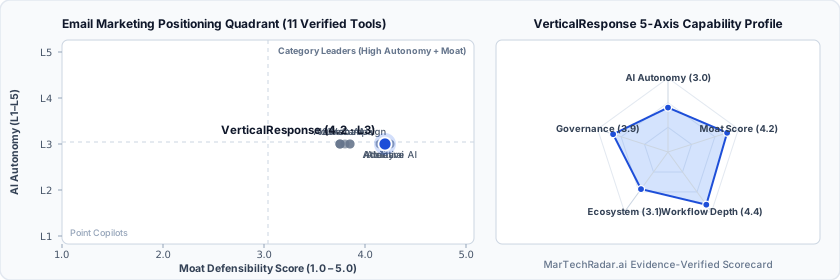
VerticalResponse is a Web SaaS tool for Email Marketing (AI Email Marketing & Lifecycle Journeys) in Lifecycle & CDP. Pricing: From $13/mo. Best suited to Creators / Solo. Editor ratings: AI autonomy L3 (conditional automation); moat score 4.2/5.0 (Proprietary moat). Fact-checked by Sarah Per on Oct 14, 2026.
Email marketing and lifecycle messaging platform enabling small businesses to build responsive campaigns, design custom landing pages, and schedule.
VerticalResponse buyer fit verdict: when to choose vs. when to walk away
Choose VerticalResponse if (Best Fit)
- Target ICP & Stack Fit: You operate as Creators / Solo requiring a Web SaaS deployment for Email Marketing.
- L3 Architecture & Defensibility: Maintains low architectural lock-in, functioning as a high-volume broadcast engine backed by established deliverability IP and the Deluxe small-business ecosystem.
- Commercial Model Fit: Your procurement budget aligns with From $13/mo.
Walk away from VerticalResponse if (Deal-Breakers)
- Walk away if your workflow requires uncapped enterprise volume on the From $13/mo entry plan without upgrading tiers.
- Walk away if your workflow cannot tolerate event-driven orchestration: The system lacks streaming behavioral webhooks, restricting automation sequences to linear time delays and static list membership rather than real-time product events.
- Walk away if schema extensibility is a deal-breaker for your team: Data models support minimal nested metadata, preventing complex omni-channel customer profile merging and programmatic multi-entity relational queries.
VerticalResponse key facts & scorecard
| Pricing | From $13/moVendor pricing page |
|---|---|
| Free plan | No / not disclosed |
| Delivery | Web SaaS |
| Audience | Creators / Solo |
| AI autonomy level | L3 · Conditional automationEditor-verified |
| Moat tier & score | 4.2 / 5.0 · Proprietary moatEditor-verified |
| Funding | AcquiredAcquired by Deluxe |
| Total funding | $4.9M |
| Founders | Janine Popick |
| Company size | 11-50 employees |
| Headquarters | St Petersburg, Florida |
| Founded | 2001 |
| Last verified |
VerticalResponse pros & cons: strengths vs. operational limitations
Pros: core strengths & capabilities
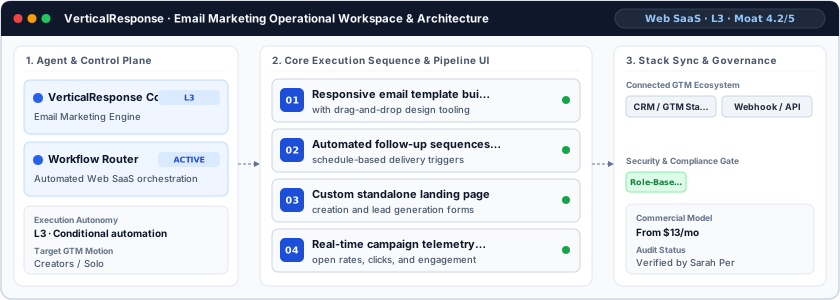
- Responsive email template builder: with drag-and-drop design tooling
- Automated follow-up sequences and: schedule-based delivery triggers
- Custom standalone landing page: creation and lead generation forms
- Real-time campaign telemetry tracking: open rates, clicks, and engagement
Cons: operational limitations & risks
- Event-Driven Orchestration: The system lacks streaming behavioral webhooks, restricting automation sequences to linear time delays and static list membership rather than real-time product events.
- Schema Extensibility: Data models support minimal nested metadata, preventing complex omni-channel customer profile merging and programmatic multi-entity relational queries.
- Deliverability Controls: Shared-pool routing limits domain-level IP reputation tuning, leaving senders vulnerable to third-party list hygiene fluctuations within identical tenant clusters.
VerticalResponse TCO & deal-breaker stress test
Simulate 12-month stepped TCO, hidden cost multipliers, contract lock-in exposure, and stack failure modes using only facts verified by Sarah Per on · Capture SHA c92d38ff.
VerticalResponse aligns with your 5-seat / $800/mo profile. Review the walk-away triggers and contract levers below before deployment.
| Plan / Tier | Verified Rate | Scale Fit | Scope & Quota Notes |
|---|---|---|---|
| Free | $13/mo | 1–2 seats | Price based on your email list size |
| Pro | $19/mo | 5 seats | Price based on your email list size |
- Moat Score
- 4.2 / 5.0
- AI Autonomy
- L3
- Free Tier / Trial
- None disclosed
Triggered audit signals & failure modes
- Published Self-Serve Entry FloorVerified Pricing Ledger
VerticalResponse publishes a transparent entry point (From $13/mo) for initial validation before committing.
- Tier Fit for 5-Seat Scale: Pro ($19/mo)Verified Tier Schedule
Price based on your email list size
- Primary Operational Bottleneck: Event-Driven OrchestrationAudit by Sarah Per
The system lacks streaming behavioral webhooks, restricting automation sequences to linear time delays and static list membership rather than real-time product events.
Hidden TCO Multipliers & Quota Gates
- Credit & Usage Burn Multiplier: Automated workflows consume metered credits/usage quotas; multi-step enrichment, voice minutes, or high-frequency agent runs can trigger mid-cycle top-up packs.
- Event-Driven Orchestration: The system lacks streaming behavioral webhooks, restricting automation sequences to linear time delays and static list membership rather than real-time product events.
- Schema Extensibility: Data models support minimal nested metadata, preventing complex omni-channel customer profile merging and programmatic multi-entity relational queries.
When to Walk Away & Negotiation Levers
- Walk away if your workflow requires uncapped enterprise volume on the From $13/mo entry plan without upgrading tiers.
- Walk away if your workflow cannot tolerate event-driven orchestration: The system lacks streaming behavioral webhooks, restricting automation sequences to linear time delays and static list membership rather than real-time product events.
- Walk away if schema extensibility is a deal-breaker for your team: Data models support minimal nested metadata, preventing complex omni-channel customer profile merging and programmatic multi-entity relational queries.
- Validate exact quota thresholds (seats, credits, or API calls) included in VerticalResponse's From $13/mo tier before converting from monthly to annual billing.
- Require a sandbox proof-of-concept testing event-driven orchestration against your live CRM/data schema before annual sign-off.
Ask a custom procurement or TCO stress-test question about VerticalResponse
Lower 5-seat floor (~$5/mo vs. $19 / mo)
Fits within $800/mo budget (From $49/mo)
VerticalResponse moat & subtrack positioning
Maintains low architectural lock-in, functioning as a high-volume broadcast engine backed by established deliverability IP and the Deluxe small-business ecosystem.
Editorial review
Fact-checked by Sarah Per (Principal Content Systems & Generative Media Editor) on .
Background
Within the small-business communication ecosystem, VerticalResponse serves as an entry-level platform for customer retention and outbound lifecycle messaging. Established in 2001 in St Petersburg, Florida, the company secured $4.9M in venture funding before being acquired by Deluxe. Engineered primarily for SMB marketing practitioners and lean operational teams seeking to bypass convoluted enterprise architectures, the system standardizes basic email broadcast and lead capture workflows across straightforward digital touchpoints.
How VerticalResponse works
Under the hood, VerticalResponse functions as a deterministic, rule-based message orchestration environment. Customer records are ingested through file uploads, native pop-up forms, and basic API integrations into relational list partitions. The execution pipeline employs a visual campaign designer paired with template rendering routines that compile dynamic fields into static HTML payloads. Message delivery is scheduled via cron-aligned batch dispatches, while event listeners record pixel firings and link redirects to populate performance dashboards.
Limitations
Operational considerations and platform boundaries include:
- Event-Driven Orchestration: The system lacks streaming behavioral webhooks, restricting automation sequences to linear time delays and static list membership rather than real-time product events.
- Schema Extensibility: Data models support minimal nested metadata, preventing complex omni-channel customer profile merging and programmatic multi-entity relational queries.
- Deliverability Controls: Shared-pool routing limits domain-level IP reputation tuning, leaving senders vulnerable to third-party list hygiene fluctuations within identical tenant clusters.
VerticalResponse pricing
Commercial access operates on a tiered monthly subscription linked to subscriber volume, starting with a Basic plan available from $13 per month. Higher service tiers expand administrative allowances to include automated follow-up cadences and the removal of vendor branding. Advanced testing features, such as rendering preview test kits, are metered separately via credit allocations, with contract scaling dictated strictly by active list size thresholds.
How VerticalResponse compares
Relative to AI-driven site builders like 10Web AI, dynamic experimentation platforms such as AB Tasty, and algorithmic attribution frameworks like Ability.ai, VerticalResponse maintains a deliberately restrained surface area focused entirely on baseline messaging deliverability. While advanced competitors emphasize autonomous conversion optimization and multivariate test loops, VerticalResponse is tailored for resource-constrained small businesses prioritizing operational reliability and straightforward broadcast mechanics over predictive machine learning pipelines.
Frequently asked questions about VerticalResponse
How much does VerticalResponse cost and what pricing tiers are available?
Published pricing summary for VerticalResponse: From $13/mo. A permanent free plan is not disclosed for VerticalResponse. Verified tier schedule: Free ($13/mo for 1–2 seats); Pro ($19/mo for 5 seats). Commercial access operates on a tiered monthly subscription linked to subscriber volume, starting with a Basic plan available from $13 per month. Higher service tiers expand administrative allowances to include automated follow-up cadences and the removal of vendor branding.
How does VerticalResponse work and how autonomous is its AI architecture?
Email marketing and lifecycle messaging platform enabling small businesses to build responsive campaigns, design custom landing pages, and schedule. Within Email Marketing (AI Email Marketing & Lifecycle Journeys), MarTechRadar rates its execution architecture at L3 · Conditional automation with a verified Moat Score of 4.2 / 5.0 (Proprietary moat). Maintains low architectural lock-in, functioning as a high-volume broadcast engine backed by established deliverability IP and the Deluxe small-business ecosystem. Corporate profile: Founded by Janine Popick, operating at 11-50 employees scale, acquired by Deluxe.
What are the main limitations of VerticalResponse and when should buyers walk away?
Based on our editorial technical audit, key operational considerations and boundaries for VerticalResponse include: (1) Event-Driven Orchestration: The system lacks streaming behavioral webhooks, restricting automation sequences to linear time delays and static list membership rather than real-time product events. (2) Schema Extensibility: Data models support minimal nested metadata, preventing complex omni-channel customer profile merging and programmatic multi-entity relational queries. (3) Deliverability Controls: Shared-pool routing limits domain-level IP reputation tuning, leaving senders vulnerable to third-party list hygiene fluctuations within identical tenant clusters. Primary procurement walk-away rule: Walk away if your workflow requires uncapped enterprise volume on the From $13/mo entry plan without upgrading tiers.
What integrations, compliance certifications, and contract terms apply to VerticalResponse?
Key TCO multiplier to watch: Credit & Usage Burn Multiplier (Automated workflows consume metered credits/usage quotas; multi-step enrichment, voice minutes, or high-frequency agent runs can trigger mid-cycle top-up packs.) Before signing a contract, procurement teams should validate exact quota thresholds (seats, credits, or API calls) included in VerticalResponse's From $13/mo tier before converting from monthly to annual billing.
What are the best VerticalResponse alternatives and head-to-head competitors in 2026?
Top fact-checked alternatives to VerticalResponse in Email Marketing (AI Email Marketing & Lifecycle Journeys) include Privy (Free plan · $0/mo · Enterprise plan), AWeber (From $79/mo), clerk chat (From $5/mo), MadeThis (From $49/mo). Relative to AI-driven site builders like 10Web AI, dynamic experimentation platforms such as AB Tasty, and algorithmic attribution frameworks like Ability.ai, VerticalResponse maintains a deliberately restrained surface area focused entirely on baseline messaging deliverability.
Verified sources & evidence trail
- Official product domain: https://verticalresponse.com
- Commercial pricing verification: https://verticalresponse.com/pricing/?non-profit-discount
- Verified corporate entity profiles (
sameAs): LinkedIn Company Profile · Crunchbase Entity Record - Editorial audit sign-off: Fact-checked by Sarah Per on under the MarTechRadar Evidence-Ledger Protocol.