DOJO AI Review (2026): AI Content Marketing Pricing, Limits & Alternatives
Bottom line
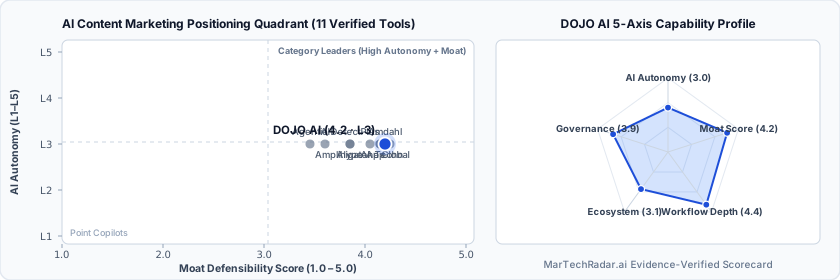
DOJO AI is a Web SaaS tool for AI Content Marketing (Enterprise & Long-Form Brand Content) in Copy & Content. Pricing: Custom / enterprise pricing. Best suited to Enterprise Content Teams, Brand Marketers and Global Copywriters. Editor ratings: AI autonomy L3 (conditional automation); moat score 4.2/5.0 (Proprietary moat). Fact-checked by Tim Fenolz on Oct 14, 2026.
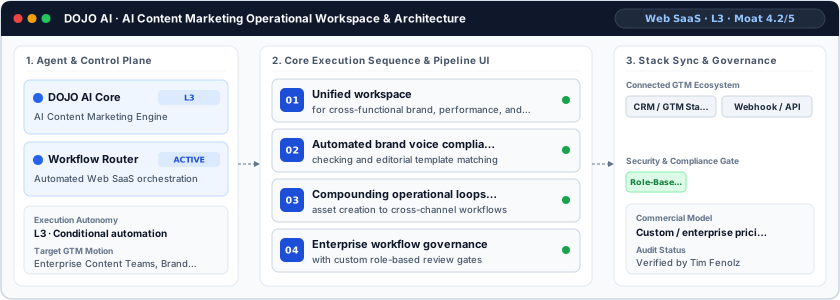
Unified marketing orchestration workspace combining brand, performance, and creative production through compounding automated workflows.
DOJO AI buyer fit verdict: when to choose vs. when to walk away
Choose DOJO AI if (Best Fit)
- Target ICP & Stack Fit: You operate as Enterprise Content Teams, Brand Marketers and Global Copywriters requiring a Web SaaS deployment for AI Content Marketing.
- L3 Architecture & Defensibility: Proprietary compounding feedback loops connecting brand governance with performance execution, backed by specialized enterprise editorial pipelines.
- Commercial Model Fit: Your procurement budget aligns with Custom / enterprise pricing.
Walk away from DOJO AI if (Deal-Breakers)
- Walk away if you require transparent self-serve monthly billing or your budget ceiling is under $1,000/mo (DOJO AI requires sales-gated custom quoting).
- Walk away if your workflow cannot tolerate integration latency: Synchronization delays between third-party marketing channels and the internal workspace can slow down immediate performance feedback iteration.
- Walk away if taxonomy adaptation overhead is a deal-breaker for your team: Ingesting complex, highly regulated enterprise brand guidelines requires manual schema structuring and prompt boundary calibration during deployment.
DOJO AI key facts & scorecard
| Pricing | Custom / enterprise pricing |
|---|---|
| Free plan | No / not disclosed |
| Delivery | Web SaaS |
| Audience | Enterprise Content Teams, Brand Marketers, Global Copywriters |
| AI autonomy level | L3 · Conditional automationEditor-verified |
| Moat tier & score | 4.2 / 5.0 · Proprietary moatEditor-verified |
| Funding | Seed |
| Total funding | $7.6M |
| Founders | Antonio Alegria, Duarte Garrido |
| Company size | 11-50 employees |
| Governance & docs | DPA ↗ · Terms ↗ · Privacy ↗ |
| Headquarters | London |
| Founded | 2024 |
| Last verified |
DOJO AI pros & cons: strengths vs. operational limitations
Pros: core strengths & capabilities
- Unified workspace: for cross-functional brand, performance, and creative teams
- Automated brand voice compliance: checking and editorial template matching
- Compounding operational loops connecting: asset creation to cross-channel workflows
- Enterprise workflow governance: with custom role-based review gates
Cons: operational limitations & risks
- Integration latency: Synchronization delays between third-party marketing channels and the internal workspace can slow down immediate performance feedback iteration.
- Taxonomy adaptation overhead: Ingesting complex, highly regulated enterprise brand guidelines requires manual schema structuring and prompt boundary calibration during deployment.
- Context boundary constraints: Extremely technical enterprise documentation can exceed model contextual bounds, resulting in flattened brand tone across deeply specialized long-form assets.
DOJO AI TCO & deal-breaker stress test
Simulate 12-month stepped TCO, hidden cost multipliers, contract lock-in exposure, and stack failure modes using only facts verified by Tim Fenolz on · Capture SHA 89e4ed0c.
DOJO AI triggers high-severity friction under your 5-seat / $800/mo constraints. Benchmark the verified subtrack alternatives below before committing.
| Plan / Tier | Verified Rate | Scale Fit | Scope & Quota Notes |
|---|---|---|---|
| Team | $999/mo | Unlimited seats (Entry credits) | For companies looking to grow through Marketing. |
| Enterprise / Custom | Custom quote | Unlimited seats (Enterprise SLA) | Sales-negotiated annual contract for custom volume, SSO/RBAC governance, and dedicated SLA. |
- Moat Score
- 4.2 / 5.0
- AI Autonomy
- L3
- Free Tier / Trial
- None disclosed
Triggered audit signals & failure modes
- Opaque Enterprise Quoting vs. SMB/Mid-Market BudgetVerified Pricing Ledger
DOJO AI does not disclose a public self-serve floor (Custom / enterprise pricing). Buyers with a $800/mo cap face high sales-qualification friction.
- Sales-Gated Contract TermsFact-checked by Tim Fenolz
Commercial procurement for DOJO AI operates via custom enterprise licensing determined by team size, operational scope, and administrative governance requirements.
- Primary Operational Bottleneck: Integration latencyAudit by Tim Fenolz
Synchronization delays between third-party marketing channels and the internal workspace can slow down immediate performance feedback iteration.
Hidden TCO Multipliers & Quota Gates
- Enterprise Governance & Add-On Gating: Advanced capabilities such as Single Sign-On (SSO), custom role permissions, or specialized analytics modules are gated behind upper tiers or paid add-ons.
- Integration latency: Synchronization delays between third-party marketing channels and the internal workspace can slow down immediate performance feedback iteration.
- Taxonomy adaptation overhead: Ingesting complex, highly regulated enterprise brand guidelines requires manual schema structuring and prompt boundary calibration during deployment.
When to Walk Away & Negotiation Levers
- Walk away if you require transparent self-serve monthly billing or your budget ceiling is under $1,000/mo (DOJO AI requires sales-gated custom quoting).
- Walk away if your workflow cannot tolerate integration latency: Synchronization delays between third-party marketing channels and the internal workspace can slow down immediate performance feedback iteration.
- Walk away if taxonomy adaptation overhead is a deal-breaker for your team: Ingesting complex, highly regulated enterprise brand guidelines requires manual schema structuring and prompt boundary calibration during deployment.
- Demand a 30- to 60-day paid pilot opt-out clause in the DOJO AI order form before signing a 12-month enterprise commitment.
- Require a sandbox proof-of-concept testing integration latency against your live CRM/data schema before annual sign-off.
Ask a custom procurement or TCO stress-test question about DOJO AI
Lower 5-seat floor (~$13/mo vs. Custom Quote) · Transparent self-serve entry without mandatory annual lock-in
Lower 5-seat floor (~$16/mo vs. Custom Quote) · Transparent self-serve entry without mandatory annual lock-in
DOJO AI moat & subtrack positioning
Proprietary compounding feedback loops connecting brand governance with performance execution, backed by specialized enterprise editorial pipelines.
Editorial review
Fact-checked by Tim Fenolz (Lead AdTech, Programmatic & Attribution Analyst) on .
Background
To unify fragmented creative operations and performance campaign delivery, DOJO AI operates as a centralized marketing operations workspace. Headquartered in London and founded in 2024, the company secured $7.6M in early-stage funding to address operational disconnects across enterprise marketing departments. Designed primarily for brand directors, creative leads, and performance marketing managers, DOJO AI consolidates brand governance, creative generation, and asset distribution into a single execution layer.
How DOJO AI works
Under the hood, DOJO AI coordinates cross-functional marketing tasks through a centralized workflow engine that utilizes domain-tuned language models and structured operational templates. The ingestion layer consumes creative briefs, performance parameters, and brand governance rules, parsing them into standardized production prompts. The platform executes conditional conditional generation of long-form brand drafts, creative variations, and performance copy, enforcing automated guardrails that benchmark outputs against organizational guidelines before routing assets to human approval checkpoints.
Limitations
Operational considerations and platform boundaries include:
- Integration latency: Synchronization delays between third-party marketing channels and the internal workspace can slow down immediate performance feedback iteration.
- Taxonomy adaptation overhead: Ingesting complex, highly regulated enterprise brand guidelines requires manual schema structuring and prompt boundary calibration during deployment.
- Context boundary constraints: Extremely technical enterprise documentation can exceed model contextual bounds, resulting in flattened brand tone across deeply specialized long-form assets.
DOJO AI pricing
Commercial procurement for DOJO AI operates via custom enterprise licensing determined by team size, operational scope, and administrative governance requirements. Prospective buyers engage through enterprise sales discovery to evaluate organizational scale and workspace capacity. Commercial agreements are structured through tailored enterprise contracts, with contract terms reflecting committed platform usage, custom integration support, and dedicated operational enablement.
How DOJO AI compares
Within enterprise content and digital asset orchestration, DOJO AI competes against specialized ecosystem players like Agentio, Aha Global, and AIDetectPlus. While Agentio focuses heavily on creator ad automation and AIDetectPlus targets content authenticity verification, DOJO AI differentiates itself through a unified execution workspace combining creative production with brand management. The platform is best suited for mid-market and enterprise marketing departments seeking to consolidate multi-channel asset creation under strict structural governance.
Direct competitors & market radar
Top algorithmic competitors based on category positioning, capability overlap, and ICP alignment.
Frequently asked questions about DOJO AI
How much does DOJO AI cost and does it require a custom enterprise quote?
Published pricing summary for DOJO AI: Custom / enterprise pricing. A permanent free plan is not disclosed for DOJO AI. Verified tier schedule: Team ($999/mo for Unlimited seats (Entry credits)); Enterprise / Custom (Custom quote for Unlimited seats (Enterprise SLA)). Commercial procurement for DOJO AI operates via custom enterprise licensing determined by team size, operational scope, and administrative governance requirements. Prospective buyers engage through enterprise sales discovery to evaluate organizational scale and workspace capacity.
How does DOJO AI work and how autonomous is its AI architecture?
Unified marketing orchestration workspace combining brand, performance, and creative production through compounding automated workflows. Within AI Content Marketing (Enterprise & Long-Form Brand Content), MarTechRadar rates its execution architecture at L3 · Conditional automation with a verified Moat Score of 4.2 / 5.0 (Proprietary moat). Proprietary compounding feedback loops connecting brand governance with performance execution, backed by specialized enterprise editorial pipelines. Corporate profile: Founded by Antonio Alegria, Duarte Garrido, operating at 11-50 employees scale.
What are the main limitations of DOJO AI and when should buyers walk away?
Based on our editorial technical audit, key operational considerations and boundaries for DOJO AI include: (1) Integration latency: Synchronization delays between third-party marketing channels and the internal workspace can slow down immediate performance feedback iteration. (2) Taxonomy adaptation overhead: Ingesting complex, highly regulated enterprise brand guidelines requires manual schema structuring and prompt boundary calibration during deployment. (3) Context boundary constraints: Extremely technical enterprise documentation can exceed model contextual bounds, resulting in flattened brand tone across deeply specialized long-form assets. Primary procurement walk-away rule: Walk away if you require transparent self-serve monthly billing or your budget ceiling is under $1,000/mo (DOJO AI requires sales-gated custom quoting).
What integrations, compliance certifications, and contract terms apply to DOJO AI?
First-party governance and developer endpoints verified on domain include: DPA (https://www.dojoai.com/data-processing-agreement). Key TCO multiplier to watch: Enterprise Governance & Add-On Gating (Advanced capabilities such as Single Sign-On (SSO), custom role permissions, or specialized analytics modules are gated behind upper tiers or paid add-ons.) Before signing a contract, procurement teams should demand a 30- to 60-day paid pilot opt-out clause in the DOJO AI order form before signing a 12-month enterprise commitment.
What are the best DOJO AI alternatives and head-to-head competitors in 2026?
Top fact-checked alternatives to DOJO AI in AI Content Marketing (Enterprise & Long-Form Brand Content) include Iterable (Custom / enterprise pricing), Post.ai (Free plan · $0/mo · Enterprise plan), Bloom ($16–$100/mo), Article Forge (From $13/mo). Within enterprise content and digital asset orchestration, DOJO AI competes against specialized ecosystem players like Agentio, Aha Global, and AIDetectPlus.
Verified sources & evidence trail
- Official product domain: http://dojoai.com
- Commercial pricing verification: Verified against official vendor pricing policy (Custom / enterprise pricing)
- Verified corporate entity profiles (
sameAs): LinkedIn Company Profile · Crunchbase Entity Record - First-party governance & documentation links: DPA · Terms · Privacy
- Editorial audit sign-off: Fact-checked by Tim Fenolz on under the MarTechRadar Evidence-Ledger Protocol.