Bloom Review (2026): AI Content Marketing Pricing, Limits & Alternatives
Bottom line
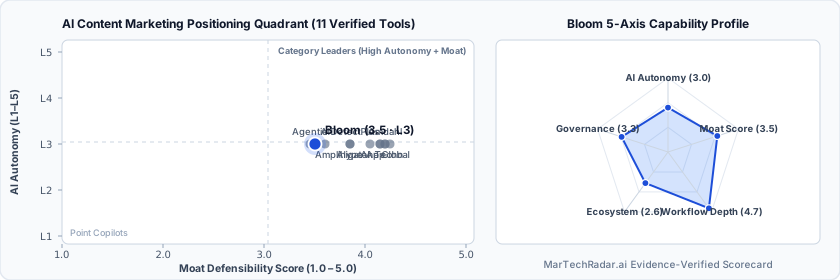
Bloom is a Web SaaS tool for AI Content Marketing (Enterprise & Long-Form Brand Content) in Copy & Content. Pricing: $16–$100/mo. Best suited to Growth Marketing Teams and Digital Marketing Leaders. Editor ratings: AI autonomy L3 (conditional automation); moat score 3.5/5.0 (Proprietary moat). Fact-checked by Jiacky Lee on Oct 10, 2026.
Developer-accessible brand governance layer enabling AI agents to programmatically generate on-brand campaign assets, vector illustrations, and collateral.
Bloom buyer fit verdict: when to choose vs. when to walk away
Choose Bloom if (Best Fit)
- Target ICP & Stack Fit: You operate as Growth Marketing Teams and Digital Marketing Leaders requiring a Web SaaS deployment for AI Content Marketing.
- L3 Architecture & Defensibility: Defensibility stems from its native Model Context Protocol (MCP) tool server implementation, bridging programmatic agent execution directly into deterministic brand design tokens and templates.
- Commercial Model Fit: Your procurement budget aligns with $16–$100/mo.
Walk away from Bloom if (Deal-Breakers)
- Walk away if your workflow requires uncapped enterprise volume on the $16–$100/mo entry plan without upgrading tiers.
- Walk away if your workflow cannot tolerate strict monthly asset volume caps: The entry tiers restrict teams to finite asset counts per billing cycle, which can choke high-frequency programmatic campaign generation without manual quota upgrades.
- Walk away if protocol-dependent agent integration is a deal-breaker for your team: Teams operating outside of Model Context Protocol (MCP) workflows face higher integration overhead to tie the generation service into legacy headless marketing pipelines.
Bloom key facts & scorecard
| Pricing | $16–$100/moVendor pricing page |
|---|---|
| Free plan | No / not disclosed |
| Delivery | Web SaaS |
| Audience | Growth Marketing Teams, Digital Marketing Leaders |
| AI autonomy level | L3 · Conditional automationEditor-verified |
| Moat tier & score | 3.5 / 5.0 · Proprietary moatEditor-verified |
| Funding | Pre-seed |
| Total funding | Pre-seedBacked by Y Combinator |
| Governance & docs | API & Docs ↗ · Terms ↗ · Privacy ↗ |
| Headquarters | San Francisco, California |
| Founded | 2025 |
| Last verified |
Bloom pros & cons: strengths vs. operational limitations
Pros: core strengths & capabilities
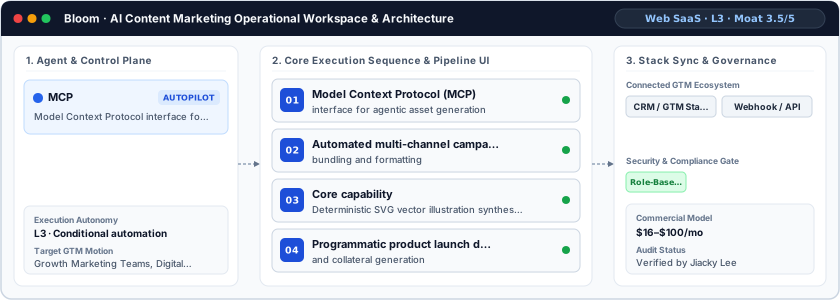
- Model Context Protocol (MCP): interface for agentic asset generation
- Automated multi-channel campaign asset: bundling and formatting
- Core capability: Deterministic SVG vector illustration synthesis
- Programmatic product launch decks: and collateral generation
Cons: operational limitations & risks
- Strict monthly asset volume caps: The entry tiers restrict teams to finite asset counts per billing cycle, which can choke high-frequency programmatic campaign generation without manual quota upgrades.
- Protocol-dependent agent integration: Teams operating outside of Model Context Protocol (MCP) workflows face higher integration overhead to tie the generation service into legacy headless marketing pipelines.
- Vector complexity rendering bounds: Procedural generation of complex SVG graphics can encounter fidelity issues or node bloat when interpreting intricate, non-standard visual design systems.
Bloom TCO & deal-breaker stress test
Simulate 12-month stepped TCO, hidden cost multipliers, contract lock-in exposure, and stack failure modes using only facts verified by Jiacky Lee on · Capture SHA 7afe3a5f.
Bloom aligns with your 5-seat / $800/mo profile. Review the walk-away triggers and contract levers below before deployment.
| Plan / Tier | Verified Rate | Scale Fit | Scope & Quota Notes |
|---|---|---|---|
| Free | $16/mo | 1–2 seats | Verified $16/mo tier from vendor pricing schedule. |
| Unlimited | $100/mo | 5 seats | Verified $100/mo tier from vendor pricing schedule. |
- Moat Score
- 3.5 / 5.0
- AI Autonomy
- L3
- Free Tier / Trial
- None disclosed
Triggered audit signals & failure modes
- Published Self-Serve Entry FloorVerified Pricing Ledger
Bloom publishes a transparent entry point ($16–$100/mo) for initial validation before committing.
- Tier Fit for 5-Seat Scale: Unlimited ($100/mo)Verified Tier Schedule
Verified $100/mo tier from vendor pricing schedule.
- Primary Operational Bottleneck: Strict monthly asset volume capsAudit by Jiacky Lee
The entry tiers restrict teams to finite asset counts per billing cycle, which can choke high-frequency programmatic campaign generation without manual quota upgrades.
Hidden TCO Multipliers & Quota Gates
- Credit & Usage Burn Multiplier: Automated workflows consume metered credits/usage quotas; multi-step enrichment, voice minutes, or high-frequency agent runs can trigger mid-cycle top-up packs.
- Strict monthly asset volume caps: The entry tiers restrict teams to finite asset counts per billing cycle, which can choke high-frequency programmatic campaign generation without manual quota upgrades.
- Protocol-dependent agent integration: Teams operating outside of Model Context Protocol (MCP) workflows face higher integration overhead to tie the generation service into legacy headless marketing pipelines.
When to Walk Away & Negotiation Levers
- Walk away if your workflow requires uncapped enterprise volume on the $16–$100/mo entry plan without upgrading tiers.
- Walk away if your workflow cannot tolerate strict monthly asset volume caps: The entry tiers restrict teams to finite asset counts per billing cycle, which can choke high-frequency programmatic campaign generation without manual quota upgrades.
- Walk away if protocol-dependent agent integration is a deal-breaker for your team: Teams operating outside of Model Context Protocol (MCP) workflows face higher integration overhead to tie the generation service into legacy headless marketing pipelines.
- Validate exact quota thresholds (seats, credits, or API calls) included in Bloom's $16–$100/mo tier before converting from monthly to annual billing.
- Require a sandbox proof-of-concept testing strict monthly asset volume caps against your live CRM/data schema before annual sign-off.
Ask a custom procurement or TCO stress-test question about Bloom
Lower 5-seat floor (~$13/mo vs. $100 / mo)
Lower 5-seat floor (~$49/mo vs. $100 / mo)
Bloom key entities, modules & ecosystem stack
Model Context Protocol interface for agentic asset generation
Bloom moat & subtrack positioning
Defensibility stems from its native Model Context Protocol (MCP) tool server implementation, bridging programmatic agent execution directly into deterministic brand design tokens and templates.
Editorial review
Fact-checked by Jiacky Lee (Managing Editor, AI Autonomy & Moat Methodology) on .
Background
Established in 2025 in San Francisco, California, Bloom positions itself as an infrastructure-level brand layer designed for programmatic agent workflows and creative production teams. Rather than treating content generation as disconnected chat prompts, the platform targets brand directors and growth engineers who need autonomous systems to produce brand-compliant collateral. The service operationalizes brand identity across multi-modal creative tasks, addressing the manual friction inherent in translating static brand guidelines into production-ready assets across marketing and sales channels.
How Bloom works
Architecturally, Bloom functions via an L3 autonomous engine supported by standard REST APIs and Model Context Protocol (MCP) endpoints. The system ingests structured style guides and asset schemas, mapping them against generative pipelines for vector graphics, slide decks, and copy templates. When an external autonomous agent or internal user initiates a request, the pipeline binds brand parameters to multi-modal generative models, enforcing style constraints across SVG illustrations, launch decks, and email sets before output delivery.
Limitations
Operational considerations and platform boundaries include:
- Strict monthly asset volume caps: The entry tiers restrict teams to finite asset counts per billing cycle, which can choke high-frequency programmatic campaign generation without manual quota upgrades.
- Protocol-dependent agent integration: Teams operating outside of Model Context Protocol (MCP) workflows face higher integration overhead to tie the generation service into legacy headless marketing pipelines.
- Vector complexity rendering bounds: Procedural generation of complex SVG graphics can encounter fidelity issues or node bloat when interpreting intricate, non-standard visual design systems.
Bloom pricing
Bloom utilizes a tiered self-serve subscription starting at $16 per month for base users needing fifty assets without seat sharing, scaling across intermediate tiers up to $100 for high-throughput demands. Mid-tier packages incorporate unlimited team seats and priority rendering pipelines, while top allocations support scaled multi-brand operations and broader monthly generation volumes.
How Bloom compares
Within Enterprise & Long-Form Brand Content, Bloom trades manual copy editor workflows for programmatic agent integrations. While Agentio focuses on creator ad placements, Aha Global targets regional agency workflows, and AIDetectPlus enforces content authenticity scanning, Bloom centers specifically on generative asset orchestration via MCP APIs. It is best suited for technical growth teams seeking automated, code-driven visual production.
Direct competitors & market radar
Top algorithmic competitors based on category positioning, capability overlap, and ICP alignment.
Frequently asked questions about Bloom
How much does Bloom cost and what pricing tiers are available?
Published pricing summary for Bloom: $16–$100/mo. A permanent free plan is not disclosed for Bloom. Verified tier schedule: Free ($16/mo for 1–2 seats); Unlimited ($100/mo for 5 seats). Bloom utilizes a tiered self-serve subscription starting at $16 per month for base users needing fifty assets without seat sharing, scaling across intermediate tiers up to $100 for high-throughput demands.
How does Bloom work and how autonomous is its AI architecture?
Developer-accessible brand governance layer enabling AI agents to programmatically generate on-brand campaign assets, vector illustrations, and collateral. Within AI Content Marketing (Enterprise & Long-Form Brand Content), MarTechRadar rates its execution architecture at L3 · Conditional automation with a verified Moat Score of 3.5 / 5.0 (Proprietary moat). Defensibility stems from its native Model Context Protocol (MCP) tool server implementation, bridging programmatic agent execution directly into deterministic brand design tokens and templates.
What are the main limitations of Bloom and when should buyers walk away?
Based on our editorial technical audit, key operational considerations and boundaries for Bloom include: (1) Strict monthly asset volume caps: The entry tiers restrict teams to finite asset counts per billing cycle, which can choke high-frequency programmatic campaign generation without manual quota upgrades. (2) Protocol-dependent agent integration: Teams operating outside of Model Context Protocol (MCP) workflows face higher integration overhead to tie the generation service into legacy headless marketing pipelines. (3) Vector complexity rendering bounds: Procedural generation of complex SVG graphics can encounter fidelity issues or node bloat when interpreting intricate, non-standard visual design systems. Primary procurement walk-away rule: Walk away if your workflow requires uncapped enterprise volume on the $16–$100/mo entry plan without upgrading tiers.
What integrations, compliance certifications, and contract terms apply to Bloom?
First-party governance and developer endpoints verified on domain include: API Docs (https://docs.trybloom.ai/api). Key TCO multiplier to watch: Credit & Usage Burn Multiplier (Automated workflows consume metered credits/usage quotas; multi-step enrichment, voice minutes, or high-frequency agent runs can trigger mid-cycle top-up packs.) Before signing a contract, procurement teams should validate exact quota thresholds (seats, credits, or API calls) included in Bloom's $16–$100/mo tier before converting from monthly to annual billing.
What are the best Bloom alternatives and head-to-head competitors in 2026?
Top fact-checked alternatives to Bloom in AI Content Marketing (Enterprise & Long-Form Brand Content) include Jasper (Enterprise) ($49–$69/seat/mo), Copy.ai (Workflows) ($49–$249/mo), Agentio (Custom / enterprise pricing), DOJO AI (Custom / enterprise pricing). Within Enterprise & Long-Form Brand Content, Bloom trades manual copy editor workflows for programmatic agent integrations.
Verified sources & evidence trail
- Official product domain: https://www.trybloom.ai/
- Commercial pricing verification: https://www.trybloom.ai/pricing
- First-party governance & documentation links: API & Docs · Terms · Privacy
- Editorial audit sign-off: Fact-checked by Jiacky Lee on under the MarTechRadar Evidence-Ledger Protocol.