Vector Review (2026): ABM Pricing, Limits & Alternatives
Bottom line
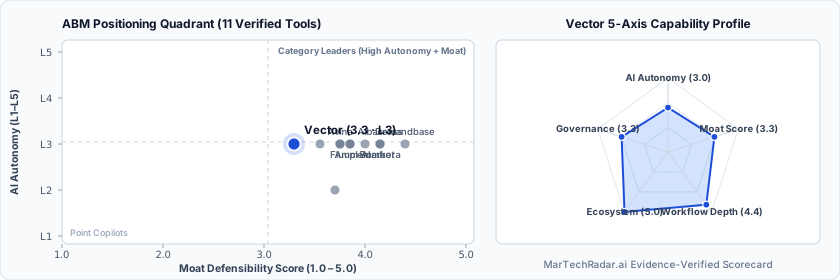
Vector is a Web SaaS tool for ABM (Buyer Intent Data & Account-Based Marketing) in AI SDR & Outbound. Pricing: Free plan · From $36,000/yr. Best suited to B2B SaaS and Growth Teams. Editor ratings: AI autonomy L3 (conditional automation); moat score 3.3/5.0 (Workflow-embedded (strong)). Fact-checked by Jagmeet Sine on Oct 16, 2026.
Contact-level B2B intent and ad audience platform resolving site visitors, ad engagers, and off-site researchers for paid media and outbound.
Vector buyer fit verdict: when to choose vs. when to walk away
Choose Vector if (Best Fit)
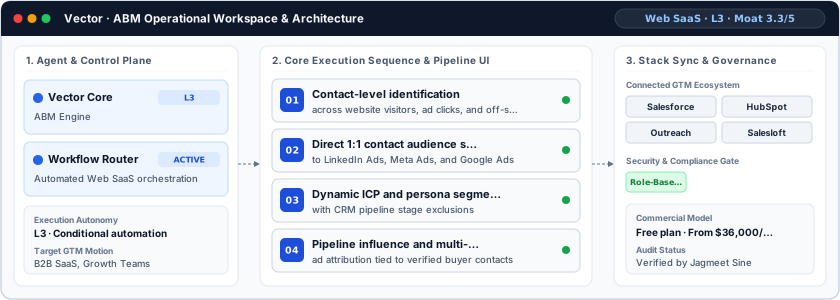
- Target ICP & Stack Fit: You operate as B2B SaaS and Growth Teams requiring a Web SaaS deployment for ABM, with verified ecosystem connectivity for Salesforce, HubSpot, Outreach, Salesloft.
- L3 Architecture & Defensibility: Combining person-level website de-anonymization with off-site competitor research signals and direct 1:1 ad network audience syncing creates a closed-loop paid and outbound workflow.
- Commercial Model Fit: Your procurement budget aligns with Free plan · From $36,000/yr and want a self-serve free tier for zero-cost initial validation.
Walk away from Vector if (Deal-Breakers)
- Walk away if your team is at early validation stage with a <$250/mo tool budget (Vector starts at Free plan · From $36,000/yr before seat or usage expansion).
- Walk away if your workflow cannot tolerate ad network match-rate bottleneck: Synchronizing B2B contact lists to consumer-indexed networks like Meta Ads or Google Ads can encounter match-rate friction when corporate email addresses do not map to personal social logins.
- Walk away if enterprise price governance barrier is a deal-breaker for your team: While a free entry tier exists for basic website visitor visibility, unlocking full off-site intent streams and multi-channel ad synchronization requires an annual commitment that is not built for early-stage startups with minimal paid media spend.
Vector key facts & scorecard
| Pricing | Free plan · From $36,000/yrVendor pricing page |
|---|---|
| Free plan | Yes |
| Delivery | Web SaaS |
| Audience | B2B SaaS, Growth Teams |
| AI autonomy level | L3 · Conditional automationEditor-verified |
| Moat tier & score | 3.3 / 5.0 · Workflow-embedded (strong)Editor-verified |
| Funding | Venture-backed |
| Company size | 11-50 employees |
| Ecosystem integrations | Salesforce, HubSpot, Outreach, Salesloft, Slack, LinkedIn |
| Governance & docs | Trust & Security ↗ · Terms ↗ · Privacy ↗ |
| Headquarters | Boston, MA |
| Founded | 2022 |
| Last verified |
Vector pros & cons: strengths vs. operational limitations
Pros: core strengths & capabilities
- Contact-level identification: across website visitors, ad clicks, and off-site research
- Direct 1:1 contact audience synchronization: to LinkedIn Ads, Meta Ads, and Google Ads
- Dynamic ICP and persona segmentation: with CRM pipeline stage exclusions
- Pipeline influence and multi-touch: ad attribution tied to verified buyer contacts
Cons: operational limitations & risks
- Ad Network Match-Rate Bottleneck: Synchronizing B2B contact lists to consumer-indexed networks like Meta Ads or Google Ads can encounter match-rate friction when corporate email addresses do not map to personal social logins.
- Enterprise Price Governance Barrier: While a free entry tier exists for basic website visitor visibility, unlocking full off-site intent streams and multi-channel ad synchronization requires an annual commitment that is not built for early-stage startups with minimal paid media spend.
- Geographic Identity Coverage Drawbacks: Contact-level de-anonymization achieves its highest resolution density in North America and struggles with stricter privacy jurisdictions where third-party cookie and device graph signals are suppressed.
Vector TCO & deal-breaker stress test
Simulate 12-month stepped TCO, hidden cost multipliers, contract lock-in exposure, and stack failure modes using only facts verified by Jagmeet Sine on · Capture SHA 7f76fb60.
Vector triggers high-severity friction under your 5-seat / $800/mo constraints. Benchmark the verified subtrack alternatives below before committing.
| Plan / Tier | Verified Rate | Scale Fit | Scope & Quota Notes |
|---|---|---|---|
| Free / Sandbox | $0 | 1–2 seats (Evaluation) | Entry free tier with capped usage or feature quotas for initial workflow testing. |
| Entry / Starter | $36000/yr | 1–2 seats | Verified $36000/yr published rate on vendor pricing schedule. |
- Moat Score
- 3.3 / 5.0
- AI Autonomy
- L3
- Free Tier / Trial
- Free plan
Triggered audit signals & failure modes
- Budget Ceiling Breached ($3,000/mo vs. $800/mo cap)Verified Pricing Ledger
At 5 seats, Vector's verified entry floor (Free plan · From $36,000/yr) exceeds your $800/mo budget before add-ons or overages.
- Annual Contract Lock-in Risk DetectedFact-checked by Jagmeet Sine
Vector offers a free forever entry plan for initial contact-level website visibility alongside annual enterprise tiers for full intent orchestration and paid media activation.
- Primary Operational Bottleneck: Enterprise Price Governance BarrierAudit by Jagmeet Sine
While a free entry tier exists for basic website visitor visibility, unlocking full off-site intent streams and multi-channel ad synchronization requires an annual commitment that is not built for early-stage startups with minimal paid media spend.
Hidden TCO Multipliers & Quota Gates
- Per-Seat Linear Scaling: Vector prices licenses on a per-user/seat basis (Free plan · From $36,000/yr); expanding from 2 to 15+ operators multiplies base recurring spend linearly.
- Profile / Workspace Quota Ceilings: Base tiers cap the number of connected profiles, workspaces, or contact records, forcing tier upgrades before seat limits are reached.
- Enterprise Governance & Add-On Gating: Advanced capabilities such as Single Sign-On (SSO), custom role permissions, or specialized analytics modules are gated behind upper tiers or paid add-ons.
When to Walk Away & Negotiation Levers
- Walk away if your team is at early validation stage with a <$250/mo tool budget (Vector starts at Free plan · From $36,000/yr before seat or usage expansion).
- Walk away if your workflow cannot tolerate ad network match-rate bottleneck: Synchronizing B2B contact lists to consumer-indexed networks like Meta Ads or Google Ads can encounter match-rate friction when corporate email addresses do not map to personal social logins.
- Walk away if enterprise price governance barrier is a deal-breaker for your team: While a free entry tier exists for basic website visitor visibility, unlocking full off-site intent streams and multi-channel ad synchronization requires an annual commitment that is not built for early-stage startups with minimal paid media spend.
- Negotiate price-lock protection on additional seats and overage credits above the Free plan · From $36,000/yr entry tier.
- Require a sandbox proof-of-concept testing ad network match-rate bottleneck against your live CRM/data schema before annual sign-off.
Ask a custom procurement or TCO stress-test question about Vector
Lower 5-seat floor (~$29/mo vs. $36,000 / yr upfront) · Transparent self-serve entry without mandatory annual lock-in
Lower 5-seat floor (~$259/mo vs. $36,000 / yr upfront) · Transparent self-serve entry without mandatory annual lock-in
Vector key entities, modules & ecosystem stack
Vector moat & subtrack positioning
Combining person-level website de-anonymization with off-site competitor research signals and direct 1:1 ad network audience syncing creates a closed-loop paid and outbound workflow.
Editorial review
Fact-checked by Jagmeet Sine (Senior MarTech Infrastructure & Agentic Workflow Architect) on .
Background
As B2B paid media and outbound teams shift away from opaque account-level intent scores toward deterministic contact-level activation, Vector provides a buyer-level de-anonymization and ad audience platform headquartered in Boston, MA. Founded in 2022 and operating with 11-50 employees, the company enables demand generation marketers, ABM leaders, and revenue operations teams to build dynamic audiences from real individuals who visit their website, click their paid ads, or research competitor topics across the web. Rather than serving impressions to entire corporate directories, teams use Vector to target verified decision-makers and prove pipeline progression.
How Vector works
Built around a contact-level identity graph, Vector operates at Level 3 conditional automation by unifying first-party website pixel telemetry, paid ad engagement signals, and third-party publisher intent feeds. When a prospect matches an organization's ideal customer profile and persona filters, the platform resolves the individual's identity and triggers automated plays. These workflows push matched contacts directly into LinkedIn Ads, Meta Ads, Google Ads, and Reddit Ads as custom retargeting segments while simultaneously routing buyer-level intent context to Salesforce, HubSpot, Slack, Clay, Outreach, and Salesloft.
Limitations
Technical trade-offs, operational limitations, and deployment boundaries include:
- Ad Network Match-Rate Bottleneck: Synchronizing B2B contact lists to consumer-indexed networks like Meta Ads or Google Ads can encounter match-rate friction when corporate email addresses do not map to personal social logins.
- Enterprise Price Governance Barrier: While a free entry tier exists for basic website visitor visibility, unlocking full off-site intent streams and multi-channel ad synchronization requires an annual commitment that is not built for early-stage startups with minimal paid media spend.
- Geographic Identity Coverage Drawbacks: Contact-level de-anonymization achieves its highest resolution density in North America and struggles with stricter privacy jurisdictions where third-party cookie and device graph signals are suppressed.
Vector pricing
Vector offers a free forever entry plan for initial contact-level website visibility alongside annual enterprise tiers for full intent orchestration and paid media activation. According to its published pricing schedule, full-platform commercial contracts start at $36,000/yr with custom volume scaling based on active contact audiences and connected ad channels.
How Vector compares
Vector competes directly against contact-level visitor identification tools such as RB2B, Warmly, and Trigify.io as well as legacy account-based marketing platforms like 6sense, Demandbase, and Metadata.io. While RB2B focuses primarily on pushing US website visitor alerts into Slack for SDR outreach, Vector differentiates itself by bridging contact-level intent directly into paid social and search ad audience synchronization alongside CRM pipeline attribution. Vector is best suited for mid-market and enterprise B2B demand generation teams running coordinated paid media and outbound plays.
Frequently asked questions about Vector
How much does Vector cost and what pricing tiers are available?
Published pricing summary for Vector: Free plan · From $36,000/yr. Vector includes a free tier or sandbox entry point. Verified tier schedule: Free / Sandbox ($0 for 1–2 seats (Evaluation)); Entry / Starter ($36000/yr for 1–2 seats). Vector offers a free forever entry plan for initial contact-level website visibility alongside annual enterprise tiers for full intent orchestration and paid media activation.
How does Vector work and how autonomous is its AI architecture?
Contact-level B2B intent and ad audience platform resolving site visitors, ad engagers, and off-site researchers for paid media and outbound. Within ABM (Buyer Intent Data & Account-Based Marketing), MarTechRadar rates its execution architecture at L3 · Conditional automation with a verified Moat Score of 3.3 / 5.0 (Workflow-embedded (strong)). Combining person-level website de-anonymization with off-site competitor research signals and direct 1:1 ad network audience syncing creates a closed-loop paid and outbound workflow. Corporate profile: operating at 11-50 employees scale.
What are the main limitations of Vector and when should buyers walk away?
Based on our editorial technical audit, key operational considerations and boundaries for Vector include: (1) Ad Network Match-Rate Bottleneck: Synchronizing B2B contact lists to consumer-indexed networks like Meta Ads or Google Ads can encounter match-rate friction when corporate email addresses do not map to personal social logins. (2) Enterprise Price Governance Barrier: While a free entry tier exists for basic website visitor visibility, unlocking full off-site intent streams and multi-channel ad synchronization requires an annual commitment that is not built for early-stage startups with minimal paid media spend. (3) Geographic Identity Coverage Drawbacks: Contact-level de-anonymization achieves its highest resolution density in North America and struggles with stricter privacy jurisdictions where third-party cookie and device graph signals are suppressed. Primary procurement walk-away rule: Walk away if your team is at early validation stage with a <$250/mo tool budget (Vector starts at Free plan · From $36,000/yr before seat or usage expansion).
What integrations, compliance certifications, and contract terms apply to Vector?
Verified ecosystem and stack integrations include Salesforce, HubSpot, Outreach, Salesloft, Slack, LinkedIn, Google Ads, Meta Ads, LinkedIn Ads. First-party governance and developer endpoints verified on domain include: Trust/Security (https://www.vector.co/security). Key TCO multiplier to watch: Per-Seat Linear Scaling (Vector prices licenses on a per-user/seat basis (Free plan · From $36,000/yr); expanding from 2 to 15+ operators multiplies base recurring spend linearly.) Before signing a contract, procurement teams should negotiate price-lock protection on additional seats and overage credits above the Free plan · From $36,000/yr entry tier.
What are the best Vector alternatives and head-to-head competitors in 2026?
Top fact-checked alternatives to Vector in ABM (Buyer Intent Data & Account-Based Marketing) include RB2B (Free plan · From $0/mo), Warmly (From $10,000/yr), Trigify.io (Custom / enterprise pricing), Dealfront (Free plan · From €79/mo). Vector competes directly against contact-level visitor identification tools such as RB2B, Warmly, and Trigify.io as well as legacy account-based marketing platforms like 6sense, Demandbase, and Metadata.io.
Verified sources & evidence trail
- Official product domain: https://vector.co
- Commercial pricing verification: https://www.vector.co/pricing
- Verified corporate entity profiles (
sameAs): LinkedIn Company Profile - First-party governance & documentation links: Trust & Security · Terms · Privacy
- Editorial audit sign-off: Fact-checked by Jagmeet Sine on under the MarTechRadar Evidence-Ledger Protocol.