Avina Review (2026): ABM Pricing, Limits & Alternatives
Bottom line
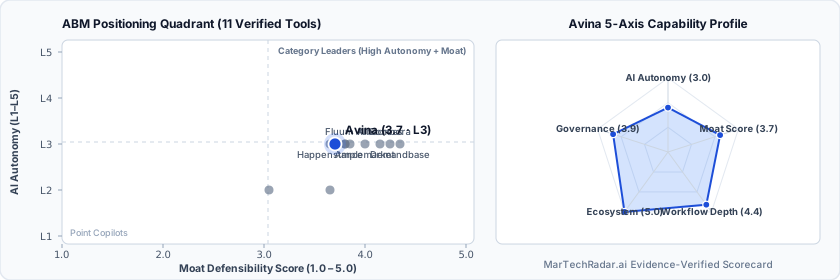
Avina is a Web SaaS tool for ABM (Buyer Intent Data & Account-Based Marketing) in AI SDR & Outbound. Pricing: $259/mo. Best suited to B2B SaaS and Marketing & Growth Teams. Editor ratings: AI autonomy L3 (conditional automation); moat score 3.7/5.0 (Proprietary moat). Fact-checked by Sarah Per on Oct 17, 2026.
AI buyer intent and account-based sales intelligence platform unifying first- and third-party signals into rep actions.
Avina buyer fit verdict: when to choose vs. when to walk away
Choose Avina if (Best Fit)
- Target ICP & Stack Fit: You operate as B2B SaaS and Marketing & Growth Teams requiring a Web SaaS deployment for ABM, with verified ecosystem connectivity for Salesforce, HubSpot, Outreach, Salesloft.
- L3 Architecture & Defensibility: Avina builds workflow lock-in by aggregating fragmented buyer signals across CRM history, website visits, product usage, and external intent feeds into automated account prioritization and personalized outreach.
- Commercial Model Fit: Your procurement budget aligns with $259/mo.
Walk away from Avina if (Deal-Breakers)
- Walk away if your team is at early validation stage with a <$250/mo tool budget (Avina starts at $259/mo before seat or usage expansion).
- Walk away if your workflow cannot tolerate credit consumption on high-traffic web domains: Because enrichment and AI account research consume monthly platform credits, organizations with high-volume anonymous web traffic can exhaust Starter credit pools rapidly without strict ICP domain filtering.
- Walk away if downstream sequencer dependency is a deal-breaker for your team: Avina focuses on signal unification, account scoring, and draft generation rather than operating as a standalone email infrastructure or dialer provider, requiring connection to Outreach, Salesloft, or Apollo.
Avina key facts & scorecard
| Pricing | $259/moVendor pricing page |
|---|---|
| Free plan | No / not disclosed |
| Delivery | Web SaaS |
| Audience | B2B SaaS, Marketing & Growth Teams |
| AI autonomy level | L3 · Conditional automationEditor-verified |
| Moat tier & score | 3.7 / 5.0 · Proprietary moatEditor-verified |
| Funding | Seed |
| Total funding | $6.8M |
| Founders | Michael Wang, Ron Fisher, Vivek Sudarsan |
| Company size | 2-10 employees |
| Ecosystem integrations | Salesforce, HubSpot, Outreach, Salesloft, Apollo.io, Gong |
| Governance & docs | API & Docs ↗ · Changelog ↗ · Terms ↗ |
| Headquarters | New York, New York |
| Founded | 2022 |
| Last verified |
Avina pros & cons: strengths vs. operational limitations
Pros: core strengths & capabilities
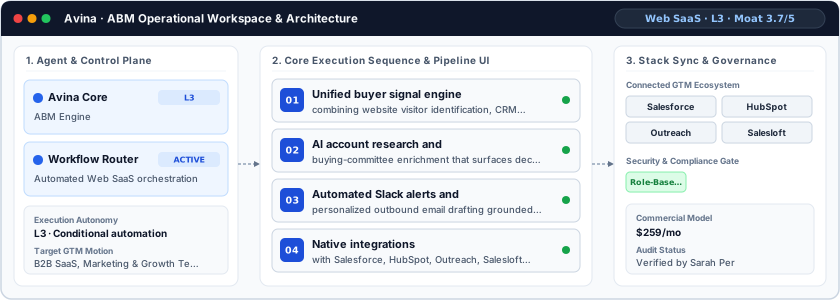
- Unified buyer signal engine: combining website visitor identification, CRM history, and third-party intent data
- AI account research and: buying-committee enrichment that surfaces decision-makers when accounts spike
- Automated Slack alerts and: personalized outbound email drafting grounded in live account triggers
- Native integrations: with Salesforce, HubSpot, Outreach, Salesloft, Gong, RB2B, and Clearbit
Cons: operational limitations & risks
- Credit Consumption on High-Traffic Web Domains: Because enrichment and AI account research consume monthly platform credits, organizations with high-volume anonymous web traffic can exhaust Starter credit pools rapidly without strict ICP domain filtering.
- Downstream Sequencer Dependency: Avina focuses on signal unification, account scoring, and draft generation rather than operating as a standalone email infrastructure or dialer provider, requiring connection to Outreach, Salesloft, or Apollo.
- Multi-Source Signal Calibration Curve: Tuning custom intent weighting across CRM historical data, product telemetry, and external signals requires initial revenue operations alignment to prevent noisy rep notifications.
Avina TCO & deal-breaker stress test
Simulate 12-month stepped TCO, hidden cost multipliers, contract lock-in exposure, and stack failure modes using only facts verified by Sarah Per on · Capture SHA d56ced1e.
Avina triggers high-severity friction under your 5-seat / $800/mo constraints. Benchmark the verified subtrack alternatives below before committing.
| Plan / Tier | Verified Rate | Scale Fit | Scope & Quota Notes |
|---|---|---|---|
| Starter | $259/mo | 1–2 seats | 1 credit per signal. |
| Team | $879/mo | 5 seats | 1 credit per signal. |
- Moat Score
- 3.7 / 5.0
- AI Autonomy
- L3
- Free Tier / Trial
- None disclosed
Triggered audit signals & failure modes
- Budget Ceiling Breached ($879/mo vs. $800/mo cap)Verified Pricing Ledger
At 5 seats, Avina's verified entry floor ($259/mo) exceeds your $800/mo budget before add-ons or overages.
- Published Self-Serve Entry FloorVerified Pricing Ledger
Avina publishes a transparent entry point ($259/mo) for initial validation before committing.
- Tier Fit for 5-Seat Scale: Team ($879/mo)Verified Tier Schedule
1 credit per signal.
- Primary Operational Bottleneck: Credit Consumption on High-Traffic Web DomainsAudit by Sarah Per
Because enrichment and AI account research consume monthly platform credits, organizations with high-volume anonymous web traffic can exhaust Starter credit pools rapidly without strict ICP domain filtering.
Hidden TCO Multipliers & Quota Gates
- Credit & Usage Burn Multiplier: Automated workflows consume metered credits/usage quotas; multi-step enrichment, voice minutes, or high-frequency agent runs can trigger mid-cycle top-up packs.
- Credit Consumption on High-Traffic Web Domains: Because enrichment and AI account research consume monthly platform credits, organizations with high-volume anonymous web traffic can exhaust Starter credit pools rapidly without strict ICP domain filtering.
- Downstream Sequencer Dependency: Avina focuses on signal unification, account scoring, and draft generation rather than operating as a standalone email infrastructure or dialer provider, requiring connection to Outreach, Salesloft, or Apollo.
When to Walk Away & Negotiation Levers
- Walk away if your team is at early validation stage with a <$250/mo tool budget (Avina starts at $259/mo before seat or usage expansion).
- Walk away if your workflow cannot tolerate credit consumption on high-traffic web domains: Because enrichment and AI account research consume monthly platform credits, organizations with high-volume anonymous web traffic can exhaust Starter credit pools rapidly without strict ICP domain filtering.
- Walk away if downstream sequencer dependency is a deal-breaker for your team: Avina focuses on signal unification, account scoring, and draft generation rather than operating as a standalone email infrastructure or dialer provider, requiring connection to Outreach, Salesloft, or Apollo.
- Negotiate price-lock protection on additional seats and overage credits above the $259/mo entry tier.
- Require a sandbox proof-of-concept testing credit consumption on high-traffic web domains against your live CRM/data schema before annual sign-off.
Ask a custom procurement or TCO stress-test question about Avina
Lower 5-seat floor (~$29/mo vs. $879 / mo)
Lower 5-seat floor (~$245/mo vs. $879 / mo)
Avina key entities, modules & ecosystem stack
Avina moat & subtrack positioning
Avina builds workflow lock-in by aggregating fragmented buyer signals across CRM history, website visits, product usage, and external intent feeds into automated account prioritization and personalized outreach.
Editorial review
Fact-checked by Sarah Per (Principal Content Systems & Generative Media Editor) on .
Background
Founded in 2022 by Michael Wang, Ron Fisher, and Vivek Sudarsan and headquartered in New York, New York, Avina (avina.io) is an AI-powered buyer intent and account-based sales intelligence platform built for B2B revenue, SDR, and account executive teams. Operating with a team of 2 to 10 employees and backed by $6.8M in Seed funding from Y Combinator, nvp capital, and RRE Ventures, the company helps go-to-market teams convert scattered account activity into prioritized pipeline actions before competitors engage.
How Avina works
Avina operates at Level 3 autonomy through a multi-source signal aggregation graph, AI account qualification engine, and automated outreach orchestrator. Most revenue teams suffer from signal fragmentation across website de-anonymization tools (such as RB2B or Clearbit), closed-lost CRM notes, call recordings in Gong, and external job-change or funding feeds. Avina ingests and correlates these first- and third-party signals at the account and contact level, scores accounts against custom ICP criteria, enriches missing buying-committee contacts, and pushes actionable Slack alerts along with context-grounded email drafts directly into Outreach, Salesloft, or HubSpot.
Limitations
Operational limitations and technical trade-offs include:
- Credit Consumption on High-Traffic Web Domains: Because enrichment and AI account research consume monthly platform credits, organizations with high-volume anonymous web traffic can exhaust Starter credit pools rapidly without strict ICP domain filtering.
- Downstream Sequencer Dependency: Avina focuses on signal unification, account scoring, and draft generation rather than operating as a standalone email infrastructure or dialer provider, requiring connection to Outreach, Salesloft, or Apollo.
- Multi-Source Signal Calibration Curve: Tuning custom intent weighting across CRM historical data, product telemetry, and external signals requires initial revenue operations alignment to prevent noisy rep notifications.
Avina pricing
Avina publishes transparent credit-based subscription tiers on its official pricing page (avina.io/pricing). Plans start with Starter at $259/mo (800 credits), scaling through Team at $879/mo (3,000 credits), Growth at $1,699/mo, and Scale at $2,999/mo for larger revenue organizations requiring expanded credit volumes and custom signal integrations.
How Avina compares
Within the Buyer Intent Data & Account-Based Marketing category, Avina competes against signal-based GTM alternatives such as Common Room, Koala, and Unify. Versus developer-community trackers like Common Room or heavyweight legacy ABM suites like 6sense, Avina differentiates itself through rapid self-serve onboarding, unified correlation of CRM call history with live web intent, and transparent credit tiers starting at $259/mo. Mid-market and high-growth B2B sales teams choose Avina to operationalize signal-led outbound.
Frequently asked questions about Avina
How much does Avina cost and what pricing tiers are available?
Published pricing summary for Avina: $259/mo. A permanent free plan is not disclosed for Avina. Verified tier schedule: Starter ($259/mo for 1–2 seats); Team ($879/mo for 5 seats). Avina publishes transparent credit-based subscription tiers on its official pricing page (`avina.io/pricing`).
How does Avina work and how autonomous is its AI architecture?
AI buyer intent and account-based sales intelligence platform unifying first- and third-party signals into rep actions. Within ABM (Buyer Intent Data & Account-Based Marketing), MarTechRadar rates its execution architecture at L3 · Conditional automation with a verified Moat Score of 3.7 / 5.0 (Proprietary moat). Avina builds workflow lock-in by aggregating fragmented buyer signals across CRM history, website visits, product usage, and external intent feeds into automated account prioritization and personalized outreach. Corporate profile: Founded by Michael Wang, Ron Fisher, Vivek Sudarsan, operating at 2-10 employees scale.
What are the main limitations of Avina and when should buyers walk away?
Based on our editorial technical audit, key operational considerations and boundaries for Avina include: (1) Credit Consumption on High-Traffic Web Domains: Because enrichment and AI account research consume monthly platform credits, organizations with high-volume anonymous web traffic can exhaust Starter credit pools rapidly without strict ICP domain filtering. (2) Downstream Sequencer Dependency: Avina focuses on signal unification, account scoring, and draft generation rather than operating as a standalone email infrastructure or dialer provider, requiring connection to Outreach, Salesloft, or Apollo. (3) Multi-Source Signal Calibration Curve: Tuning custom intent weighting across CRM historical data, product telemetry, and external signals requires initial revenue operations alignment to prevent noisy rep notifications. Primary procurement walk-away rule: Walk away if your team is at early validation stage with a <$250/mo tool budget (Avina starts at $259/mo before seat or usage expansion).
What integrations, compliance certifications, and contract terms apply to Avina?
Verified ecosystem and stack integrations include Salesforce, HubSpot, Outreach, Salesloft, Apollo.io, Gong, Slack. First-party governance and developer endpoints verified on domain include: API Docs (https://docs.avina.io). Key TCO multiplier to watch: Credit & Usage Burn Multiplier (Automated workflows consume metered credits/usage quotas; multi-step enrichment, voice minutes, or high-frequency agent runs can trigger mid-cycle top-up packs.) Before signing a contract, procurement teams should negotiate price-lock protection on additional seats and overage credits above the $259/mo entry tier.
What are the best Avina alternatives and head-to-head competitors in 2026?
Top fact-checked alternatives to Avina in ABM (Buyer Intent Data & Account-Based Marketing) include Common Room (From $2,500/mo), RB2B (Free plan · From $0/mo), Fluum AI (Custom / enterprise pricing), RollWorks (Custom / enterprise pricing). Within the Buyer Intent Data & Account-Based Marketing category, Avina competes against signal-based GTM alternatives such as Common Room, Koala, and Unify.
Verified sources & evidence trail
- Official product domain: https://avina.io
- Commercial pricing verification: https://avina.io/pricing
- Verified corporate entity profiles (
sameAs): LinkedIn Company Profile · Crunchbase Entity Record - First-party governance & documentation links: API & Docs · Changelog · Terms
- Editorial audit sign-off: Fact-checked by Sarah Per on under the MarTechRadar Evidence-Ledger Protocol.