Outreach Review (2026): Cold Email Pricing, Limits & Alternatives
Bottom line
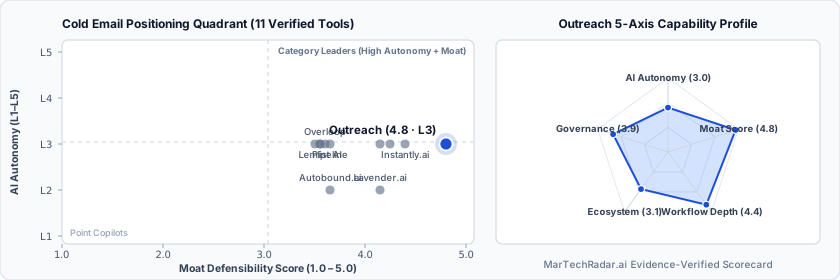
Outreach is a Web SaaS tool for Cold Email (Cold Email Sequences & Mailbox Infra) in AI SDR & Outbound. Pricing: Custom / enterprise pricing. Best suited to B2B SaaS, DTC / eCommerce and Enterprise Brands. Editor ratings: AI autonomy L3 (conditional automation); moat score 4.8/5.0 (Proprietary moat (category leader)). Fact-checked by Jiacky Lee on Oct 4, 2026.
Agentic AI revenue orchestration platform unifying multichannel sales sequences, conversation intelligence, and deal forecasting for enterprise revenue teams.
Outreach buyer fit verdict: when to choose vs. when to walk away
Choose Outreach if (Best Fit)
- Target ICP & Stack Fit: You operate as B2B SaaS, DTC / eCommerce and Enterprise Brands requiring a Web SaaS deployment for Cold Email.
- L3 Architecture & Defensibility: Outreach combines deep enterprise CRM synchronization, expansive telemetry datasets across global sales motions, and agentic execution layers that create high switching costs within enterprise revenue operations.
- Commercial Model Fit: Your procurement budget aligns with Custom / enterprise pricing.
Walk away from Outreach if (Deal-Breakers)
- Walk away if your outbound model depends on lightweight, horizontal mailbox rotation rather than enterprise CRM governance.
- Walk away if your organization cannot commit to annual enterprise seat agreements and requires month-to-month billing flexibility.
- Walk away if your team lacks dedicated RevOps resources to actively manage CRM schema mappings and monitor agentic message context drift.
Outreach key facts & scorecard
| Pricing | Custom / enterprise pricingVendor pricing page |
|---|---|
| Free plan | No / not disclosed |
| Delivery | Web SaaS |
| Audience | B2B SaaS, DTC / eCommerce, Enterprise Brands |
| AI autonomy level | L3 · Conditional automationEditor-verified |
| Moat tier & score | 4.8 / 5.0 · Proprietary moat (category leader)Editor-verified |
| Funding | Undisclosed |
| Total funding | $489.0MBacked by Sands Capital Ventures, Salesforce Ventures, Tiger Global Management |
| Founders | Andrew Kinzer, Gordon Hempton, Manny Medina, Wes Hather |
| Company size | 501-1,000 employees |
| Governance & docs | Trust & Security ↗ · System Status ↗ · Changelog ↗ · Terms ↗ · Privacy ↗ |
| Headquarters | Seattle, United States |
| Founded | 2014 |
| Last verified |
Outreach pros & cons: strengths vs. operational limitations
Pros: core strengths & capabilities
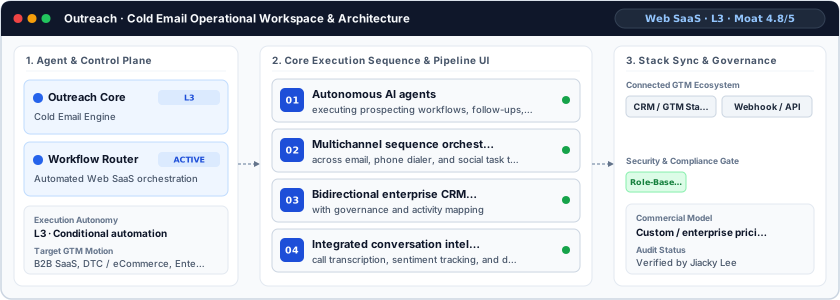
- Autonomous AI agents: executing prospecting workflows, follow-ups, and pipeline updates
- Multichannel sequence orchestration: across email, phone dialer, and social task touchpoints
- Bidirectional enterprise CRM synchronization: with governance and activity mapping
- Integrated conversation intelligence providing: call transcription, sentiment tracking, and deal risk detection
Cons: operational limitations & risks
- CRM Schema Maintenance: Bidirectional field synchronization demands continuous administrative overhead, frequently encountering conflict errors during complex custom object mappings or concurrent record writes.
- Mailbox Deliverability Sensitivity: High-volume outbound execution across shared domain infrastructures risks spam placement without external mailbox rotation and continuous domain health isolation.
- Agentic Oversight Overhead: Autonomous message generation introduces conversational latency and requires ongoing human review to prevent context drift in nuanced enterprise sales dialogues.
Outreach TCO & deal-breaker stress test
Simulate 12-month stepped TCO, hidden cost multipliers, contract lock-in exposure, and stack failure modes using only facts verified by Jiacky Lee on · Capture SHA 33b93fa7.
Outreach triggers high-severity friction under your 5-seat / $800/mo constraints. Benchmark the verified subtrack alternatives below before committing.
| Plan / Tier | Verified Rate | Scale Fit | Scope & Quota Notes |
|---|---|---|---|
| Enterprise / Custom | Custom quote | 15–50+ seats (Enterprise SLA) | Sales-negotiated annual contract for custom volume, SSO/RBAC governance, and dedicated SLA. |
- Moat Score
- 4.8 / 5.0
- AI Autonomy
- L3
- Free Tier / Trial
- None disclosed
Triggered audit signals & failure modes
- Opaque Enterprise Quoting vs. SMB/Mid-Market BudgetVerified Pricing Ledger
Outreach does not disclose a public self-serve floor (Custom / enterprise pricing). Buyers with a $800/mo cap face high sales-qualification friction.
- Annual Contract Lock-in Risk DetectedFact-checked by Jiacky Lee
Outreach distributes its software through direct procurement agreements. Commercial pricing is available on request through tailored enterprise sales quotes based on organizational scale and seats.
- Primary Operational Bottleneck: CRM Schema MaintenanceAudit by Jiacky Lee
Bidirectional field synchronization demands continuous administrative overhead, frequently encountering conflict errors during complex custom object mappings or concurrent record writes.
Hidden TCO Multipliers & Quota Gates
- Dual Seat and AI Credit Consumption Model: Outreach couples per-seat licensing with metered AI credit quotas, API call limits, and knowledge storage caps, requiring additional consumption spend as autonomous agent adoption expands.
- RevOps CRM Synchronization Overhead: Bidirectional field updates and complex custom object mappings demand ongoing technical administrative hours to troubleshoot sync conflicts and concurrent record write errors.
- External Deliverability and Mailbox Tooling: Executing high-volume outbound cadences creates spam risks on shared domains, requiring third-party mailbox rotation and domain isolation tools outside the platform.
When to Walk Away & Negotiation Levers
- Walk away if your outbound model depends on lightweight, horizontal mailbox rotation rather than enterprise CRM governance.
- Walk away if your organization cannot commit to annual enterprise seat agreements and requires month-to-month billing flexibility.
- Walk away if your team lacks dedicated RevOps resources to actively manage CRM schema mappings and monitor agentic message context drift.
- Demand an annual rollover provision or protective cap on AI credit overages to prevent penalty fees during high-volume outreach periods.
- Contractually secure higher API call limits and custom object allowances within lower tier packages to avoid forced upgrades to top tiers.
Ask a custom procurement or TCO stress-test question about Outreach
Lower 5-seat floor (~$38/mo vs. Custom Quote) · Transparent self-serve entry without mandatory annual lock-in
Lower 5-seat floor (~$205/mo vs. Custom Quote) · Transparent self-serve entry without mandatory annual lock-in
Outreach moat & subtrack positioning
Outreach combines deep enterprise CRM synchronization, expansive telemetry datasets across global sales motions, and agentic execution layers that create high switching costs within enterprise revenue operations.
Editorial review
Fact-checked by Jiacky Lee (Managing Editor, AI Autonomy & Moat Methodology) on .
Background
Established in 2014 in Seattle, United States, Outreach scaled through $489.0M in venture funding to evolve from a cadence execution tool into an agentic revenue platform. Engineered primarily for enterprise sales development representatives, account executives, and revenue operations leaders, the system unifies outbound interaction management with pipeline governance. Outreach replaces fragmented point utilities by consolidating mailbox execution, account engagement tracking, and conversation intelligence into a centralized interface designed for complex corporate sales cycles.
How Outreach works
At its architectural core, Outreach functions as a deterministic workflow engine augmented by autonomous task agents. The platform ingests engagement signals, meeting transcripts, and mailbox responses via direct OAuth and enterprise CRM connectors. These data streams feed machine learning loops that draft contextual replies, log pipeline state shifts, and schedule sequential touches across phone, email, and social channels. Rule-based safety controls govern sequence throttling, domain protection, and automated field reconciliation across enterprise databases.
Limitations
Operational considerations and platform boundaries include:
- CRM Schema Maintenance: Bidirectional field synchronization demands continuous administrative overhead, frequently encountering conflict errors during complex custom object mappings or concurrent record writes.
- Mailbox Deliverability Sensitivity: High-volume outbound execution across shared domain infrastructures risks spam placement without external mailbox rotation and continuous domain health isolation.
- Agentic Oversight Overhead: Autonomous message generation introduces conversational latency and requires ongoing human review to prevent context drift in nuanced enterprise sales dialogues.
Outreach pricing
Outreach distributes its software through direct procurement agreements. Commercial pricing is available on request through tailored enterprise sales quotes based on organizational scale and seats. Contracts typically require annual commitments structured around user licenses, with additional usage tiers allocated for conversational intelligence processing, integrated calling capacity, and automated agent execution.
How Outreach compares
Within outbound sales operations, Outreach occupies an enterprise-grade posture against lighter point solutions. Instantly.ai emphasizes distributed horizontal inbox rotation for high-volume cold outreach without enterprise CRM overhead. Lavender.ai and Autobound.ai focus on granular AI email generation and rep coaching extensions rather than holistic sales execution. Outreach remains the strategic choice for mid-market and enterprise revenue operations demanding centralized compliance, strict CRM synchronization, and multi-threaded agentic workflows across large sales fleets.
Direct competitors & market radar
Top algorithmic competitors based on category positioning, capability overlap, and ICP alignment.
Frequently asked questions about Outreach
How much does Outreach cost and does it require a custom enterprise quote?
Published pricing summary for Outreach: Custom / enterprise pricing. A permanent free plan is not disclosed for Outreach. Outreach distributes its software through direct procurement agreements. Commercial pricing is available on request through tailored enterprise sales quotes based on organizational scale and seats.
How does Outreach work and how autonomous is its AI architecture?
Agentic AI revenue orchestration platform unifying multichannel sales sequences, conversation intelligence, and deal forecasting for enterprise revenue teams. Within Cold Email (Cold Email Sequences & Mailbox Infra), MarTechRadar rates its execution architecture at L3 · Conditional automation with a verified Moat Score of 4.8 / 5.0 (Proprietary moat (category leader)). Outreach combines deep enterprise CRM synchronization, expansive telemetry datasets across global sales motions, and agentic execution layers that create high switching costs within enterprise revenue operations. Corporate profile: Founded by Andrew Kinzer, Gordon Hempton, Manny Medina, Wes Hather, operating at 501-1,000 employees scale.
What are the main limitations of Outreach and when should buyers walk away?
Based on our editorial technical audit, key operational considerations and boundaries for Outreach include: (1) CRM Schema Maintenance: Bidirectional field synchronization demands continuous administrative overhead, frequently encountering conflict errors during complex custom object mappings or concurrent record writes. (2) Mailbox Deliverability Sensitivity: High-volume outbound execution across shared domain infrastructures risks spam placement without external mailbox rotation and continuous domain health isolation. (3) Agentic Oversight Overhead: Autonomous message generation introduces conversational latency and requires ongoing human review to prevent context drift in nuanced enterprise sales dialogues. Primary procurement walk-away rule: Walk away if your outbound model depends on lightweight, horizontal mailbox rotation rather than enterprise CRM governance.
What integrations, compliance certifications, and contract terms apply to Outreach?
First-party governance and developer endpoints verified on domain include: Trust/Security (https://www.outreach.ai/platform/security), Status (https://status.outreach.io). Key TCO multiplier to watch: Dual Seat and AI Credit Consumption Model (Outreach couples per-seat licensing with metered AI credit quotas, API call limits, and knowledge storage caps, requiring additional consumption spend as autonomous agent adoption expands.) Before signing a contract, procurement teams should demand an annual rollover provision or protective cap on AI credit overages to prevent penalty fees during high-volume outreach periods.
What are the best Outreach alternatives and head-to-head competitors in 2026?
Top fact-checked alternatives to Outreach in Cold Email (Cold Email Sequences & Mailbox Infra) include Salesloft (Custom / enterprise pricing), 1mind (Custom / enterprise pricing), Amplemarket (From $2/mo), Rox ($100–$255/mo). Within outbound sales operations, Outreach occupies an enterprise-grade posture against lighter point solutions. Instantly.ai emphasizes distributed horizontal inbox rotation for high-volume cold outreach without enterprise CRM overhead.
Verified sources & evidence trail
- Official product domain: https://outreach.io
- Commercial pricing verification: https://www.outreach.ai/pricing
- Verified corporate entity profiles (
sameAs): LinkedIn Company Profile · Crunchbase Entity Record - First-party governance & documentation links: Trust & Security · System Status · Changelog · Terms · Privacy
- Editorial audit sign-off: Fact-checked by Jiacky Lee on under the MarTechRadar Evidence-Ledger Protocol.