Amplemarket Review (2026): ABM Pricing, Limits & Alternatives
Bottom line
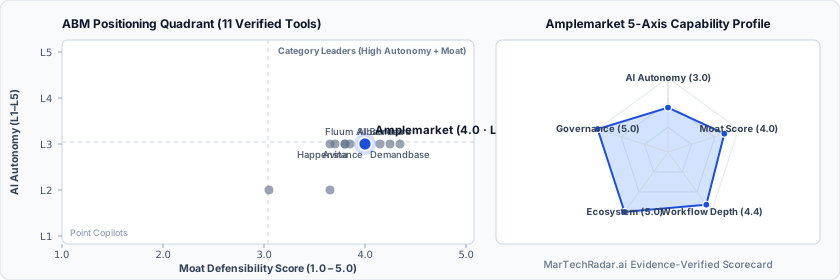
Amplemarket is a Web SaaS tool for ABM (Buyer Intent Data & Account-Based Marketing) in AI SDR & Outbound. Pricing: From $2/mo. Best suited to B2B SaaS, DTC / eCommerce and Enterprise Brands. Editor ratings: AI autonomy L3 (conditional automation); moat score 4.0/5.0 (Proprietary moat). Fact-checked by Vasilia Xia on Oct 4, 2026.
Amplemarket is an AI-powered sales platform unifying buyer intent signals, contact data, multi-channel sequences, and outbound dialers into a consolidated.
Amplemarket buyer fit verdict: when to choose vs. when to walk away
Choose Amplemarket if (Best Fit)
- Target ICP & Stack Fit: You operate as B2B SaaS, DTC / eCommerce and Enterprise Brands requiring a Web SaaS deployment for ABM, with verified ecosystem connectivity for HubSpot, Outreach, Salesloft, Slack.
- L3 Architecture & Defensibility: Consolidated proprietary intent listening paired directly with integrated contact graphs and automated multi-channel execution, bypassing synchronization friction typical of multi-vendor revenue stacks.
- Commercial Model Fit: Your procurement budget aligns with From $2/mo.
Walk away from Amplemarket if (Deal-Breakers)
- Walk away if your workflow requires uncapped enterprise volume on the From $2/mo entry plan without upgrading tiers.
- Walk away if your workflow cannot tolerate signal granularity and customization: Intent modeling relies primarily on native heuristics and preconfigured account actions, offering less bespoke topic modeling compared to standalone enterprise intent publishers.
- Walk away if mailbox infrastructure overhead is a deal-breaker for your team: Automated cross-domain deliverability requires ongoing domain rotation and manual configuration of sender records to maintain high inbox placement during scaled cadences.
Amplemarket key facts & scorecard
| Pricing | From $2/moVendor pricing page |
|---|---|
| Free plan | No / not disclosed |
| Delivery | Web SaaS |
| Audience | B2B SaaS, DTC / eCommerce, Enterprise Brands |
| AI autonomy level | L3 · Conditional automationEditor-verified |
| Moat tier & score | 4.0 / 5.0 · Proprietary moatEditor-verified |
| Funding | Series A |
| Total funding | $12MBacked by Comcast Ventures, Armilar Venture Partners |
| Founders | João Batalha, Luis Batalha, Micael Oliveira |
| Company size | 101-250 employees |
| Ecosystem integrations | HubSpot, Outreach, Salesloft, Slack, Webflow |
| Compliance & governance | GDPR, CCPA |
| Governance & docs | Trust & Security ↗ · Terms ↗ · Privacy ↗ |
| Headquarters | San Francisco, California, United States |
| Founded | 2018 |
| Last verified |
Amplemarket pros & cons: strengths vs. operational limitations
Pros: core strengths & capabilities
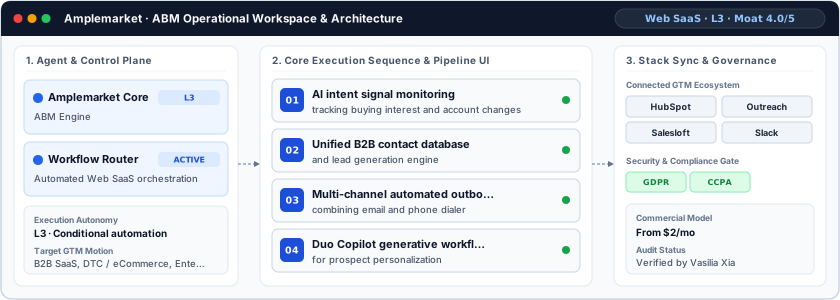
- AI intent signal monitoring: tracking buying interest and account changes
- Unified B2B contact database: and lead generation engine
- Multi-channel automated outbound sequences: combining email and phone dialer
- Duo Copilot generative workflow assistant: for prospect personalization
Cons: operational limitations & risks
- Signal Granularity and Customization: Intent modeling relies primarily on native heuristics and preconfigured account actions, offering less bespoke topic modeling compared to standalone enterprise intent publishers.
- Mailbox Infrastructure Overhead: Automated cross-domain deliverability requires ongoing domain rotation and manual configuration of sender records to maintain high inbox placement during scaled cadences.
- Enterprise CRM Sync Latency: High-volume bi-directional synchronizations with legacy enterprise CRMs encounter occasional API governance limits and latency spikes during bulk sequence updates.
Amplemarket TCO & deal-breaker stress test
Simulate 12-month stepped TCO, hidden cost multipliers, contract lock-in exposure, and stack failure modes using only facts verified by Vasilia Xia on · Capture SHA a52c876a.
Amplemarket is viable for 5 seats, but requires commercial or technical verification on the flagged items below.
| Plan / Tier | Verified Rate | Scale Fit | Scope & Quota Notes |
|---|---|---|---|
| Entry / Starter | $2/mo | 1–2 seats | Verified $2/mo published rate on vendor pricing schedule. |
- Moat Score
- 4.0 / 5.0
- AI Autonomy
- L3
- Free Tier / Trial
- None disclosed
Triggered audit signals & failure modes
- Published Self-Serve Entry FloorVerified Pricing Ledger
Amplemarket publishes a transparent entry point (From $2/mo) for initial validation before committing.
- Usage / Credit Burn VolatilityCommercial Model Audit
Amplemarket uses credit or usage-metered billing (From $2/mo). High-volume automated workflows across 5 seats can trigger mid-cycle overage charges.
- Primary Operational Bottleneck: Signal Granularity and CustomizationAudit by Vasilia Xia
Intent modeling relies primarily on native heuristics and preconfigured account actions, offering less bespoke topic modeling compared to standalone enterprise intent publishers.
Hidden TCO Multipliers & Quota Gates
- Credit & Usage Burn Multiplier: Automated workflows consume metered credits/usage quotas; multi-step enrichment, voice minutes, or high-frequency agent runs can trigger mid-cycle top-up packs.
- Enterprise Governance & Add-On Gating: Advanced capabilities such as Single Sign-On (SSO), custom role permissions, or specialized analytics modules are gated behind upper tiers or paid add-ons.
When to Walk Away & Negotiation Levers
- Walk away if your workflow requires uncapped enterprise volume on the From $2/mo entry plan without upgrading tiers.
- Walk away if your workflow cannot tolerate signal granularity and customization: Intent modeling relies primarily on native heuristics and preconfigured account actions, offering less bespoke topic modeling compared to standalone enterprise intent publishers.
- Walk away if mailbox infrastructure overhead is a deal-breaker for your team: Automated cross-domain deliverability requires ongoing domain rotation and manual configuration of sender records to maintain high inbox placement during scaled cadences.
- Validate exact quota thresholds (seats, credits, or API calls) included in Amplemarket's From $2/mo tier before converting from monthly to annual billing.
- Require a sandbox proof-of-concept testing signal granularity and customization against your live CRM/data schema before annual sign-off.
Ask a custom procurement or TCO stress-test question about Amplemarket
Lower 5-seat floor (~$29/mo vs. Usage-Metered)
Lower 5-seat floor (~$259/mo vs. Usage-Metered)
Amplemarket key entities, modules & ecosystem stack
Amplemarket moat & subtrack positioning
Consolidated proprietary intent listening paired directly with integrated contact graphs and automated multi-channel execution, bypassing synchronization friction typical of multi-vendor revenue stacks.
Editorial review
Fact-checked by Vasilia Xia (E-Commerce, Lifecycle & Retention Marketing Analyst) on .
Background
Headquartered in San Francisco, California, United States, Amplemarket was established in 2018 to consolidate fragmented sales engagement stacks into an integrated system. Backed by $12M in venture funding, the company targets revenue leaders, sales development representatives, and account executives seeking to consolidate disparate prospecting databases, engagement dialers, and signal aggregators. The platform integrates intent monitoring, data enrichment, and execution workflows into a single interface.
How Amplemarket works
Operating at an L3 autonomy level, Amplemarket synthesizes contact discovery, dynamic buying signals, and multi-channel outreach. The platform ingests behavioral indicators, job movement tracking, and firmographic updates across its identity graph to trigger outreach workflows. When accounts display qualifying purchase intent, the embedded Duo Copilot drafts contextual email touchpoints and queues tasks into unified multi-channel sequences, coordinating voice dialing alongside automated inbox delivery without requiring external integration connectors, alongside native workflow integrations for HubSpot, Slack, Salesloft, and Webflow under verified GDPR and CCPA governance controls.
Limitations
Operational considerations and platform boundaries include:
- Signal Granularity and Customization: Intent modeling relies primarily on native heuristics and preconfigured account actions, offering less bespoke topic modeling compared to standalone enterprise intent publishers.
- Mailbox Infrastructure Overhead: Automated cross-domain deliverability requires ongoing domain rotation and manual configuration of sender records to maintain high inbox placement during scaled cadences.
- Enterprise CRM Sync Latency: High-volume bi-directional synchronizations with legacy enterprise CRMs encounter occasional API governance limits and latency spikes during bulk sequence updates.
Amplemarket pricing
Amplemarket packages its platform through subscription tiers starting at $600/month on an annual term for its Startup plan, which includes two user seats, scaled onboarding, and an annual data allowance. Beyond foundational plan inclusions, consumption-based usage scales from $2/credit for incremental contact enrichment and verification, aligning platform expansion with operational outreach volume.
How Amplemarket compares
Within buyer intent and ABM acceleration, Amplemarket competes directly with 6sense, Albacross, and Bombora. While Bombora and 6sense emphasize enterprise-wide cooperative intent tracking and deep predictive scoring across substantial web networks, Amplemarket prioritizes immediate operational execution by embedding intent triggers directly into email and phone cadences. Albacross offers lightweight IP deanonymization for inbound web traffic, whereas Amplemarket provides a broader outbound pipeline architecture tailored for growth-oriented sales operations.
Direct competitors & market radar
Top algorithmic competitors based on category positioning, capability overlap, and ICP alignment.
Frequently asked questions about Amplemarket
How much does Amplemarket cost and what pricing tiers are available?
Published pricing summary for Amplemarket: From $2/mo. A permanent free plan is not disclosed for Amplemarket. Amplemarket packages its platform through subscription tiers starting at $600/month on an annual term for its Startup plan, which includes two user seats, scaled onboarding, and an annual data allowance.
How does Amplemarket work and how autonomous is its AI architecture?
Amplemarket is an AI-powered sales platform unifying buyer intent signals, contact data, multi-channel sequences, and outbound dialers into a consolidated. Within ABM (Buyer Intent Data & Account-Based Marketing), MarTechRadar rates its execution architecture at L3 · Conditional automation with a verified Moat Score of 4.0 / 5.0 (Proprietary moat). Consolidated proprietary intent listening paired directly with integrated contact graphs and automated multi-channel execution, bypassing synchronization friction typical of multi-vendor revenue stacks. Corporate profile: Founded by João Batalha, Luis Batalha, Micael Oliveira, operating at 101-250 employees scale.
What are the main limitations of Amplemarket and when should buyers walk away?
Based on our editorial technical audit, key operational considerations and boundaries for Amplemarket include: (1) Signal Granularity and Customization: Intent modeling relies primarily on native heuristics and preconfigured account actions, offering less bespoke topic modeling compared to standalone enterprise intent publishers. (2) Mailbox Infrastructure Overhead: Automated cross-domain deliverability requires ongoing domain rotation and manual configuration of sender records to maintain high inbox placement during scaled cadences. (3) Enterprise CRM Sync Latency: High-volume bi-directional synchronizations with legacy enterprise CRMs encounter occasional API governance limits and latency spikes during bulk sequence updates. Primary procurement walk-away rule: Walk away if your workflow requires uncapped enterprise volume on the From $2/mo entry plan without upgrading tiers.
What integrations, compliance certifications, and contract terms apply to Amplemarket?
Verified ecosystem and stack integrations include HubSpot, Outreach, Salesloft, Slack, Webflow. Documented security and governance attestations include GDPR, CCPA. First-party governance and developer endpoints verified on domain include: Trust/Security (https://www.amplemarket.com/legal/security). Key TCO multiplier to watch: Credit & Usage Burn Multiplier (Automated workflows consume metered credits/usage quotas; multi-step enrichment, voice minutes, or high-frequency agent runs can trigger mid-cycle top-up packs.) Before signing a contract, procurement teams should validate exact quota thresholds (seats, credits, or API calls) included in Amplemarket's From $2/mo tier before converting from monthly to annual billing.
What are the best Amplemarket alternatives and head-to-head competitors in 2026?
Top fact-checked alternatives to Amplemarket in ABM (Buyer Intent Data & Account-Based Marketing) include Outreach (Custom / enterprise pricing), 6sense (Custom / enterprise pricing), Salesloft (Custom / enterprise pricing), Landbase (Free plan · From $0/mo). Within buyer intent and ABM acceleration, Amplemarket competes directly with 6sense, Albacross, and Bombora.
Verified sources & evidence trail
- Official product domain: https://amplemarket.com
- Commercial pricing verification: https://www.amplemarket.com/pricing
- Verified corporate entity profiles (
sameAs): Crunchbase Entity Record - First-party governance & documentation links: Trust & Security · Terms · Privacy
- Editorial audit sign-off: Fact-checked by Vasilia Xia on under the MarTechRadar Evidence-Ledger Protocol.