Lavender.ai Review (2026): Cold Email Pricing, Limits & Alternatives
Bottom line
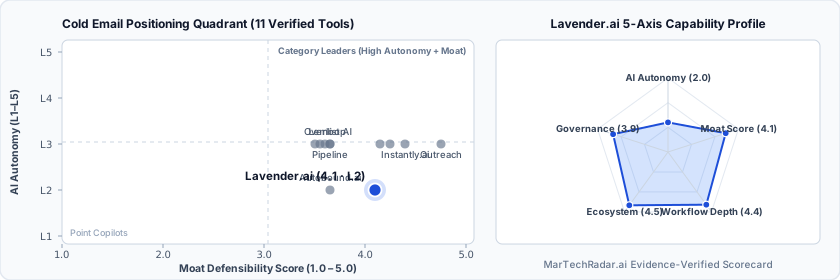
Lavender.ai is a Browser Extension tool for Cold Email (Cold Email Sequences & Mailbox Infra) in AI SDR & Outbound. Pricing: Custom / enterprise pricing. Best suited to B2B SaaS and Creators / Solo. Editor ratings: AI autonomy L2 (workflow copilot); moat score 4.1/5.0 (Proprietary moat). Fact-checked by Anna Xia on Oct 12, 2026.
Lavender.ai is an in-workflow sales email coaching and generation assistant that scores outbound copy and generates real-time revisions to improve reply.
Lavender.ai buyer fit verdict: when to choose vs. when to walk away
Choose Lavender.ai if (Best Fit)
- Target ICP & Stack Fit: You operate as B2B SaaS and Creators / Solo requiring a Browser Extension deployment for Cold Email, with verified ecosystem connectivity for Outreach, Gmail, Microsoft Outlook.
- L2 Architecture & Defensibility: Lavender's defensibility stems from its proprietary behavioral dataset on B2B email response patterns, deep workflow integration into webmail clients and sales execution platforms, and an embedded real-time scoring engine.
- Commercial Model Fit: Your procurement budget aligns with Custom / enterprise pricing.
Walk away from Lavender.ai if (Deal-Breakers)
- Walk away if you require transparent self-serve monthly billing or your budget ceiling is under $1,000/mo (Lavender.ai requires sales-gated custom quoting).
- Walk away if your workflow cannot tolerate mailbox infrastructure blindness: The engine focuses strictly on content syntax and lacks native capability to manage domain authentication records, DNS configurations, or automated mailbox warming schedules.
- Walk away if high-volume execution constraints is a deal-breaker for your team: Because the user interface is structured around rep-level drafting and manual review, the platform does not natively automate high-throughput programmatic batch dispatch.
Lavender.ai key facts & scorecard
| Pricing | Custom / enterprise pricing |
|---|---|
| Free plan | No / not disclosed |
| Delivery | Browser Extension |
| Audience | B2B SaaS, Creators / Solo |
| AI autonomy level | L2 · Workflow copilotEditor-verified |
| Moat tier & score | 4.1 / 5.0 · Proprietary moatEditor-verified |
| Funding | Series A |
| Total funding | $13.2MBacked by Norwest Venture Partners, Signia Venture Partners |
| Founders | Casey Corvino, Will Allred, William Ballance |
| Company size | 11-50 employees |
| Ecosystem integrations | Outreach, Gmail, Microsoft Outlook |
| Governance & docs | Terms ↗ · Privacy ↗ |
| Headquarters | New York, NY |
| Founded | 2020 |
| Last verified |
Lavender.ai pros & cons: strengths vs. operational limitations
Pros: core strengths & capabilities
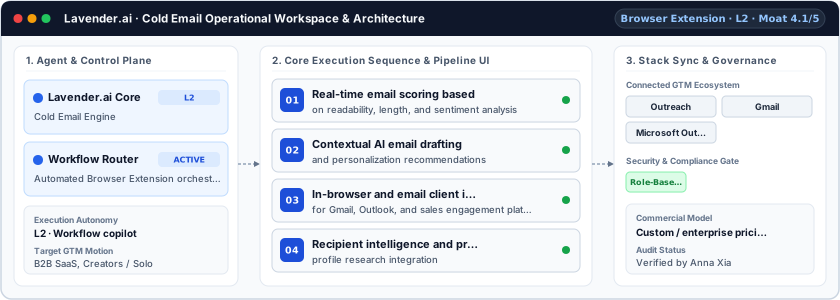
- Real-time email scoring based: on readability, length, and sentiment analysis
- Contextual AI email drafting: and personalization recommendations
- In-browser and email client integration: for Gmail, Outlook, and sales engagement platforms
- Recipient intelligence and prospect: profile research integration
Cons: operational limitations & risks
- Mailbox Infrastructure Blindness: The engine focuses strictly on content syntax and lacks native capability to manage domain authentication records, DNS configurations, or automated mailbox warming schedules.
- High-Volume Execution Constraints: Because the user interface is structured around rep-level drafting and manual review, the platform does not natively automate high-throughput programmatic batch dispatch.
- Contextual LLM Hallucinations: Dynamic personalization pulls prospect data that can occasionally hallucinate irrelevant biographical details, requiring manual rep verification prior to sending.
Lavender.ai TCO & deal-breaker stress test
Simulate 12-month stepped TCO, hidden cost multipliers, contract lock-in exposure, and stack failure modes using only facts verified by Anna Xia on · Capture SHA 331f9524.
Lavender.ai triggers high-severity friction under your 5-seat / $800/mo constraints. Benchmark the verified subtrack alternatives below before committing.
| Plan / Tier | Verified Rate | Scale Fit | Scope & Quota Notes |
|---|---|---|---|
| Enterprise / Custom | Custom quote | 15–50+ seats (Enterprise SLA) | Sales-negotiated annual contract for custom volume, SSO/RBAC governance, and dedicated SLA. |
- Moat Score
- 4.1 / 5.0
- AI Autonomy
- L2
- Free Tier / Trial
- None disclosed
Triggered audit signals & failure modes
- Opaque Enterprise Quoting vs. SMB/Mid-Market BudgetVerified Pricing Ledger
Lavender.ai does not disclose a public self-serve floor (Custom / enterprise pricing). Buyers with a $800/mo cap face high sales-qualification friction.
- Sales-Gated Contract TermsFact-checked by Anna Xia
Lavender operates under an enterprise licensing model where commercial pricing is available on request through tailored enterprise sales quotes based on organizational scale and seats.
- Primary Operational Bottleneck: Mailbox Infrastructure BlindnessAudit by Anna Xia
The engine focuses strictly on content syntax and lacks native capability to manage domain authentication records, DNS configurations, or automated mailbox warming schedules.
Hidden TCO Multipliers & Quota Gates
- Mailbox Infrastructure Blindness: The engine focuses strictly on content syntax and lacks native capability to manage domain authentication records, DNS configurations, or automated mailbox warming schedules.
- High-Volume Execution Constraints: Because the user interface is structured around rep-level drafting and manual review, the platform does not natively automate high-throughput programmatic batch dispatch.
When to Walk Away & Negotiation Levers
- Walk away if you require transparent self-serve monthly billing or your budget ceiling is under $1,000/mo (Lavender.ai requires sales-gated custom quoting).
- Walk away if your workflow cannot tolerate mailbox infrastructure blindness: The engine focuses strictly on content syntax and lacks native capability to manage domain authentication records, DNS configurations, or automated mailbox warming schedules.
- Walk away if high-volume execution constraints is a deal-breaker for your team: Because the user interface is structured around rep-level drafting and manual review, the platform does not natively automate high-throughput programmatic batch dispatch.
- Demand a 30- to 60-day paid pilot opt-out clause in the Lavender.ai order form before signing a 12-month enterprise commitment.
- Require a sandbox proof-of-concept testing mailbox infrastructure blindness against your live CRM/data schema before annual sign-off.
Ask a custom procurement or TCO stress-test question about Lavender.ai
Lower 5-seat floor (~$38/mo vs. Custom Quote) · Transparent self-serve entry without mandatory annual lock-in
Lower 5-seat floor (~$205/mo vs. Custom Quote) · Transparent self-serve entry without mandatory annual lock-in
Lavender.ai key entities, modules & ecosystem stack
Lavender.ai moat & subtrack positioning
Lavender's defensibility stems from its proprietary behavioral dataset on B2B email response patterns, deep workflow integration into webmail clients and sales execution platforms, and an embedded real-time scoring engine.
Editorial review
Fact-checked by Anna Xia (Senior B2B GTM & Revenue Systems Analyst) on .
Background
Architected as an embedded real-time coaching layer, Lavender.ai was established in 2020 in New York, NY, securing $13.2M in aggregate venture funding. The system is engineered specifically for sales development representatives, account executives, and outbound revenue leaders seeking to optimize individual message engagement. Operating directly within active email interfaces, Lavender intercepts cold outbound composition to eliminate low-performing communication patterns before transmission.
How Lavender.ai works
At an architectural level, Lavender functions as an L2 assistive co-pilot deployed via browser extensions and email client add-ins across environments like Gmail and Outlook. As an operator drafts message text, the system evaluates linguistic tokens against historical response heuristics, computing a dynamic readability and sentiment score. The inference pipeline highlights structural bottlenecks, such as excessive length or passive tone, while drawing upon integrated enrichment sources to suggest personalized adjustments using underlying large language models.
Limitations
Operational considerations and platform boundaries include:
- Mailbox Infrastructure Blindness: The engine focuses strictly on content syntax and lacks native capability to manage domain authentication records, DNS configurations, or automated mailbox warming schedules.
- High-Volume Execution Constraints: Because the user interface is structured around rep-level drafting and manual review, the platform does not natively automate high-throughput programmatic batch dispatch.
- Contextual LLM Hallucinations: Dynamic personalization pulls prospect data that can occasionally hallucinate irrelevant biographical details, requiring manual rep verification prior to sending.
Lavender.ai pricing
Lavender operates under an enterprise licensing model where commercial pricing is available on request through tailored enterprise sales quotes based on organizational scale and seats. The procurement structure accommodates mid-market and enterprise sales deployments with tiering driven by user counts and organizational coaching features. Central administrative dashboards allow revenue operations teams to monitor scoring compliance across all assigned user seats.
How Lavender.ai compares
Within outbound prospecting stacks, Lavender differentiates itself from infrastructure providers like Instantly.ai, which prioritizes mailbox pooling and multi-domain delivery rather than rep-facing syntax refinement. While platforms like Outreach provide comprehensive multi-channel cadence automation, Lavender acts as an in-line drafting enhancer rather than an execution backbone. Compared to Autobound.ai, which centers heavily on automated content assembly across broader CRM records, Lavender focuses on granular human-in-the-loop email coaching for enterprise sales development teams.
Direct competitors & market radar
Top algorithmic competitors based on category positioning, capability overlap, and ICP alignment.
Frequently asked questions about Lavender.ai
How much does Lavender.ai cost and does it require a custom enterprise quote?
Published pricing summary for Lavender.ai: Custom / enterprise pricing. A permanent free plan is not disclosed for Lavender.ai. Lavender operates under an enterprise licensing model where commercial pricing is available on request through tailored enterprise sales quotes based on organizational scale and seats.
How does Lavender.ai work and how autonomous is its AI architecture?
Lavender.ai is an in-workflow sales email coaching and generation assistant that scores outbound copy and generates real-time revisions to improve reply. Within Cold Email (Cold Email Sequences & Mailbox Infra), MarTechRadar rates its execution architecture at L2 · Workflow copilot with a verified Moat Score of 4.1 / 5.0 (Proprietary moat). Lavender's defensibility stems from its proprietary behavioral dataset on B2B email response patterns, deep workflow integration into webmail clients and sales execution platforms, and an embedded real-time scoring engine. Corporate profile: Founded by Casey Corvino, Will Allred, William Ballance, operating at 11-50 employees scale.
What are the main limitations of Lavender.ai and when should buyers walk away?
Based on our editorial technical audit, key operational considerations and boundaries for Lavender.ai include: (1) Mailbox Infrastructure Blindness: The engine focuses strictly on content syntax and lacks native capability to manage domain authentication records, DNS configurations, or automated mailbox warming schedules. (2) High-Volume Execution Constraints: Because the user interface is structured around rep-level drafting and manual review, the platform does not natively automate high-throughput programmatic batch dispatch. (3) Contextual LLM Hallucinations: Dynamic personalization pulls prospect data that can occasionally hallucinate irrelevant biographical details, requiring manual rep verification prior to sending. Primary procurement walk-away rule: Walk away if you require transparent self-serve monthly billing or your budget ceiling is under $1,000/mo (Lavender.ai requires sales-gated custom quoting).
What integrations, compliance certifications, and contract terms apply to Lavender.ai?
Verified ecosystem and stack integrations include Outreach, Gmail, Microsoft Outlook. Key TCO multiplier to watch: Mailbox Infrastructure Blindness (The engine focuses strictly on content syntax and lacks native capability to manage domain authentication records, DNS configurations, or automated mailbox warming schedules.) Before signing a contract, procurement teams should demand a 30- to 60-day paid pilot opt-out clause in the Lavender.ai order form before signing a 12-month enterprise commitment.
What are the best Lavender.ai alternatives and head-to-head competitors in 2026?
Top fact-checked alternatives to Lavender.ai in Cold Email (Cold Email Sequences & Mailbox Infra) include Regie.ai (Free plan · $41–$125/seat/mo), Outreach (Custom / enterprise pricing), Reply.io Jason AI (From $29/mo), Salesloft (Custom / enterprise pricing). Within outbound prospecting stacks, Lavender differentiates itself from infrastructure providers like Instantly.ai, which prioritizes mailbox pooling and multi-domain delivery rather than rep-facing syntax refinement.
Verified sources & evidence trail
- Official product domain: https://lavender.ai
- Commercial pricing verification: Verified against official vendor pricing policy (Custom / enterprise pricing)
- Verified corporate entity profiles (
sameAs): LinkedIn Company Profile · Crunchbase Entity Record - First-party governance & documentation links: Terms · Privacy
- Editorial audit sign-off: Fact-checked by Anna Xia on under the MarTechRadar Evidence-Ledger Protocol.