Clay Review (2026): Sales Intelligence Pricing, Limits & Alternatives
Bottom line
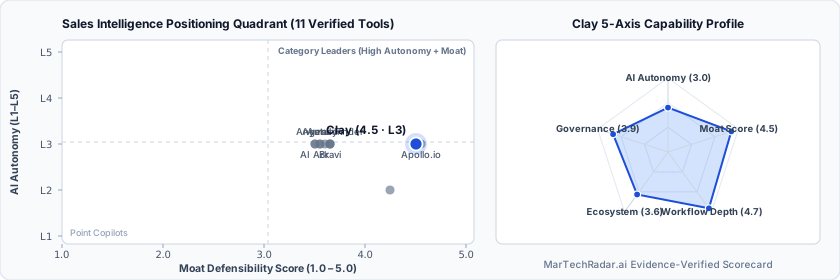
Clay is a Web SaaS tool for Sales Intelligence (Lead Enrichment & Waterfall Orchestration) in AI SDR & Outbound. Pricing: Free plan · $54–$180/mo. Best suited to B2B SaaS and Marketing Agencies. Editor ratings: AI autonomy L3 (conditional automation); moat score 4.5/5.0 (Proprietary moat (category leader)). Fact-checked by Sarah Per on Oct 7, 2026.
Data orchestration and enrichment workspace combining multi-vendor waterfalls, web research agents, and outbound pipeline automation.
Clay buyer fit verdict: when to choose vs. when to walk away
Choose Clay if (Best Fit)
- Target ICP & Stack Fit: You operate as B2B SaaS and Marketing Agencies requiring a Web SaaS deployment for Sales Intelligence, with verified ecosystem connectivity for Apollo.io.
- L3 Architecture & Defensibility: High moat established by proprietary waterfall query routing across 75+ data vendors, specialized web-browsing agent pipelines, and deep marketplace network effects.
- Commercial Model Fit: Your procurement budget aligns with Free plan · $54–$180/mo and want a self-serve free tier for zero-cost initial validation.
Walk away from Clay if (Deal-Breakers)
- Walk away if your team lacks technical RevOps or growth engineering resources to build and maintain custom waterfall logic and scraper selectors.
- Walk away if you need native CRM auto-sync or HTTP API steps on a sub-$185/mo budget (gated behind the Growth tier).
- Walk away if you need instantaneous batch enrichment across hundreds of thousands of rows where third-party API rate limits and AI inference introduce throughput bottlenecks.
Clay key facts & scorecard
| Pricing | Free plan · $54–$180/moVendor pricing page |
|---|---|
| Free plan | Yes |
| Delivery | Web SaaS |
| Audience | B2B SaaS, Marketing Agencies |
| AI autonomy level | L3 · Conditional automationEditor-verified |
| Moat tier & score | 4.5 / 5.0 · Proprietary moat (category leader)Editor-verified |
| Funding | Series B |
| Total funding | $392MBacked by Meritech Capital, Sequoia Capital |
| Founders | Kareem Amin, Nicolae Rusan, Varun Anand |
| Company size | 201-500 employees |
| Ecosystem integrations | Apollo.io |
| Governance & docs | System Status ↗ · API & Docs ↗ · Changelog ↗ · Terms ↗ · Privacy ↗ |
| Headquarters | New York, NY |
| Founded | 2017 |
| Last verified |
Clay pros & cons: strengths vs. operational limitations
Pros: core strengths & capabilities
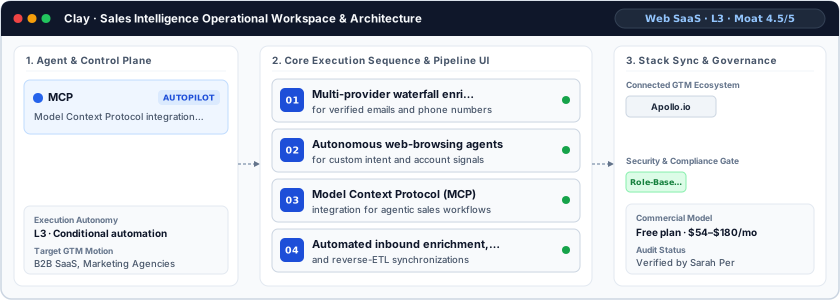
- Multi-provider waterfall enrichment: for verified emails and phone numbers
- Autonomous web-browsing agents: for custom intent and account signals
- Model Context Protocol (MCP): integration for agentic sales workflows
- Automated inbound enrichment, scoring,: and reverse-ETL synchronizations
Cons: operational limitations & risks
- Credit Consumption Volatility: Complex multi-step waterfalls combined with agent web navigation rapidly drain credit balances without predictable monthly consumption limits.
- Schema Maintenance Overhead: Dynamic third-party API schema updates and site structural modifications frequently break agent scraping selectors and downstream integration mappings.
- Throughput and Rate Limiting: Processing tables exceeding hundreds of thousands of rows induces latency bottlenecks due to external provider rate limits and synchronous AI inference steps.
Clay TCO & deal-breaker stress test
Simulate 12-month stepped TCO, hidden cost multipliers, contract lock-in exposure, and stack failure modes using only facts verified by Sarah Per on · Capture SHA 0ff7e365.
Clay aligns with your 5-seat / $800/mo profile. Review the walk-away triggers and contract levers below before deployment.
| Plan / Tier | Verified Rate | Scale Fit | Scope & Quota Notes |
|---|---|---|---|
| Free | $0/mo | Unlimited seats (6K actions/yr) | Unlimited seats and tables, multi-provider waterfalls, Claygent, BYO API key, capped at 200 rows/table. |
| Launch | $54–$185/mo | Unlimited seats (Prospecting) | Starts at $54/mo (180K actions/yr) or $167–$185/mo (30K data credits/yr); adds phone enrichment & job signals. |
| Growth | $185–$495/mo | Unlimited seats (CRM & API) | Starts at $185/mo (actions) or $446–$495/mo (72K data credits/yr); unlocks CRM auto-sync, HTTP API & webhooks. |
| Enterprise | Custom quote | Unlimited seats (SSO & RBAC) | Unlocks SSO, RBAC with workbook credit budgets, bulk enrichment, 15-min syncs, and dedicated Growth Strategist. |
- Moat Score
- 4.5 / 5.0
- AI Autonomy
- L3
- Free Tier / Trial
- Free plan
Triggered audit signals & failure modes
- Published Self-Serve Entry FloorVerified Pricing Ledger
Clay publishes a transparent entry point (Free plan · $54–$180/mo) with a free tier for initial validation before committing.
- Tier Fit for 5-Seat Scale: Growth ($185–$495/mo)Verified Tier Schedule
Starts at $185/mo (actions) or $446–$495/mo (72K data credits/yr); unlocks CRM auto-sync, HTTP API & webhooks.
- Primary Operational Bottleneck: Credit Consumption VolatilityAudit by Sarah Per
Complex multi-step waterfalls combined with agent web navigation rapidly drain credit balances without predictable monthly consumption limits.
Hidden TCO Multipliers & Quota Gates
- Dynamic Waterfall & Claygent Credit Burn (+30% Top-Up Premium): Multi-step waterfall enrichments and autonomous Claygent runs consume Data Credits ($0.05+) and Actions ($0.01) dynamically; mid-cycle credit top-ups carry a documented 30% price premium.
- CRM Auto-Sync, HTTP API & Governance Tier Gating: Although all tiers include unlimited seats, native CRM integrations, HTTP API steps, and webhooks require upgrading to Growth ($185 to $495/mo), while SSO and RBAC workbook credit budgets require Enterprise.
- Technical Schema Maintenance Overhead: Frequent third-party provider API schema modifications and website layout updates break scraping selectors and data mappings, requiring ongoing GTM engineering maintenance.
When to Walk Away & Negotiation Levers
- Walk away if your team lacks technical RevOps or growth engineering resources to build and maintain custom waterfall logic and scraper selectors.
- Walk away if you need native CRM auto-sync or HTTP API steps on a sub-$185/mo budget (gated behind the Growth tier).
- Walk away if you need instantaneous batch enrichment across hundreds of thousands of rows where third-party API rate limits and AI inference introduce throughput bottlenecks.
- Demand waiver of the 30% credit top-up premium and negotiate workbook-level spend caps to prevent unexpected billing surges from Claygent loops.
- Negotiate volume-tiered discounts on supplemental credit packs when scaling beyond the $54 to $495 per month self-serve brackets.
Ask a custom procurement or TCO stress-test question about Clay
Lower 5-seat floor (~$245/mo vs. $446 / mo)
Lower 5-seat floor (~$9/mo vs. $446 / mo)
Clay key entities, modules & ecosystem stack
Model Context Protocol integration for agentic sales workflows
Clay moat & subtrack positioning
High moat established by proprietary waterfall query routing across 75+ data vendors, specialized web-browsing agent pipelines, and deep marketplace network effects.
Editorial review
Fact-checked by Sarah Per (Principal Content Systems & Generative Media Editor) on .
Background
Clay operates as a programmable data orchestration layer designed to unify fragmented B2B prospecting sources into an automated computational canvas. Established in 2017 and headquartered in New York, NY, the platform has secured $392M in venture capital funding. Targeted at revenue operations leaders and technical growth engineers, the system replaces isolated data vendor subscriptions by bridging contact discovery, signal tracking, and automated enrichment into a central interface.
How Clay works
At its core, the platform operates a sequential waterfall routing engine across dozens of third-party data providers alongside autonomous web-scraping agents termed Claygents. Incoming entity records pass through user-defined logic branches that dynamically query external identity providers until valid attributes, such as verified corporate emails or direct dials, are resolved. LLMs synthesize unstructured web scrape data, job postings, and corporate reports into deterministic tabular outputs, exposing an internal Model Context Protocol interface for outbound pipeline workflows.
Limitations
Operational considerations and platform boundaries include:
- Credit Consumption Volatility: Complex multi-step waterfalls combined with agent web navigation rapidly drain credit balances without predictable monthly consumption limits.
- Schema Maintenance Overhead: Dynamic third-party API schema updates and site structural modifications frequently break agent scraping selectors and downstream integration mappings.
- Throughput and Rate Limiting: Processing tables exceeding hundreds of thousands of rows induces latency bottlenecks due to external provider rate limits and synchronous AI inference steps.
Clay pricing
Clay utilizes a credit-metered subscription model on top of an accessible entry tier. The vendor provides a Free plan for evaluation, with paid entry tiers starting at $54 per month and scaling to $180 per month for growing teams, alongside higher-volume bespoke tiers. Additional credit packs and premium provider lookups consume credits dynamically based on query depth.
How Clay compares
In contrast to monolithic contact databases like Apollo.io and Cognism, which bind buyers to proprietary data sets, Clay acts as a data-agnostic orchestration layer. While AI Ark concentrates on autonomous targeting heuristics, Clay grants direct programmatic control over waterfall hierarchies and customized agent prompts. The architecture best serves technical RevOps teams requiring fine-grained control over enrichment sequences rather than static data exports.
Direct competitors & market radar
Top algorithmic competitors based on category positioning, capability overlap, and ICP alignment.
Frequently asked questions about Clay
How much does Clay cost and what pricing tiers are available?
Published pricing summary for Clay: Free plan · $54–$180/mo. Clay includes a free tier or sandbox entry point. Verified tier schedule: Free ($0/mo for Unlimited seats (6K actions/yr)); Launch ($54–$185/mo for Unlimited seats (Prospecting)); Growth ($185–$495/mo for Unlimited seats (CRM & API)); Enterprise (Custom quote for Unlimited seats (SSO & RBAC)). Clay utilizes a credit-metered subscription model on top of an accessible entry tier. The vendor provides a Free plan for evaluation, with paid entry tiers starting at $54 per month and scaling to $180 per month for growing teams, alongside higher-volume bespoke tiers.
How does Clay work and how autonomous is its AI architecture?
Data orchestration and enrichment workspace combining multi-vendor waterfalls, web research agents, and outbound pipeline automation. Within Sales Intelligence (Lead Enrichment & Waterfall Orchestration), MarTechRadar rates its execution architecture at L3 · Conditional automation with a verified Moat Score of 4.5 / 5.0 (Proprietary moat (category leader)). High moat established by proprietary waterfall query routing across 75+ data vendors, specialized web-browsing agent pipelines, and deep marketplace network effects. Corporate profile: Founded by Kareem Amin, Nicolae Rusan, Varun Anand, operating at 201-500 employees scale.
What are the main limitations of Clay and when should buyers walk away?
Based on our editorial technical audit, key operational considerations and boundaries for Clay include: (1) Credit Consumption Volatility: Complex multi-step waterfalls combined with agent web navigation rapidly drain credit balances without predictable monthly consumption limits. (2) Schema Maintenance Overhead: Dynamic third-party API schema updates and site structural modifications frequently break agent scraping selectors and downstream integration mappings. (3) Throughput and Rate Limiting: Processing tables exceeding hundreds of thousands of rows induces latency bottlenecks due to external provider rate limits and synchronous AI inference steps. Primary procurement walk-away rule: Walk away if your team lacks technical RevOps or growth engineering resources to build and maintain custom waterfall logic and scraper selectors.
What integrations, compliance certifications, and contract terms apply to Clay?
Verified ecosystem and stack integrations include Apollo.io. First-party governance and developer endpoints verified on domain include: Status (https://status.clay.com), API Docs (https://university.clay.com/docs/actions-data-credits). Key TCO multiplier to watch: Dynamic Waterfall & Claygent Credit Burn (+30% Top-Up Premium) (Multi-step waterfall enrichments and autonomous Claygent runs consume Data Credits ($0.05+) and Actions ($0.01) dynamically; mid-cycle credit top-ups carry a documented 30% price premium.) Before signing a contract, procurement teams should demand waiver of the 30% credit top-up premium and negotiate workbook-level spend caps to prevent unexpected billing surges from Claygent loops.
What are the best Clay alternatives and head-to-head competitors in 2026?
Top fact-checked alternatives to Clay in Sales Intelligence (Lead Enrichment & Waterfall Orchestration) include Cognism (Custom / enterprise pricing), Apollo.io (Free plan · $49–$119/seat/mo · Enterprise plan), Copy.ai (Workflows) ($49–$249/mo), ZoomInfo (Copilot) (Custom / enterprise pricing). In contrast to monolithic contact databases like Apollo.io and Cognism, which bind buyers to proprietary data sets, Clay acts as a data-agnostic orchestration layer.
Verified sources & evidence trail
- Official product domain: https://clay.com
- Commercial pricing verification: https://www.clay.com/pricing
- Verified corporate entity profiles (
sameAs): LinkedIn Company Profile · Crunchbase Entity Record - First-party governance & documentation links: System Status · API & Docs · Changelog · Terms · Privacy
- Editorial audit sign-off: Fact-checked by Sarah Per on under the MarTechRadar Evidence-Ledger Protocol.