Cargo Review (2026): Sales Intelligence Pricing, Limits & Alternatives
Bottom line
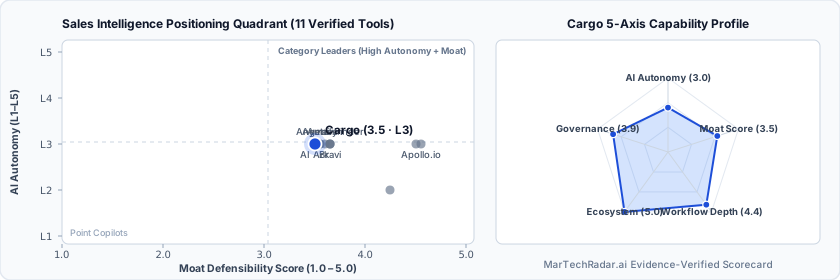
Cargo is a Web SaaS tool for Sales Intelligence (Lead Enrichment & Waterfall Orchestration) in AI SDR & Outbound. Pricing: From $0/mo. Best suited to B2B SaaS and Growth Teams. Editor ratings: AI autonomy L3 (conditional automation); moat score 3.5/5.0 (Proprietary moat). Fact-checked by Jagmeet Sine on Oct 16, 2026.
Code-first GTM data orchestration and waterfall enrichment infrastructure powered by git workflows, CDK primitives, and an MCP server.
Cargo buyer fit verdict: when to choose vs. when to walk away
Choose Cargo if (Best Fit)
- Target ICP & Stack Fit: You operate as B2B SaaS and Growth Teams requiring a Web SaaS deployment for Sales Intelligence, with verified ecosystem connectivity for Salesforce, HubSpot, Apollo.io, Slack.
- L3 Architecture & Defensibility: Code-first GTM infrastructure built on git repositories, CDK primitives, and 100+ native data connectors creates high technical switching costs for engineering-led revenue operations teams.
- Commercial Model Fit: Your procurement budget aligns with From $0/mo and want trial evaluation before contract sign-off.
Walk away from Cargo if (Deal-Breakers)
- Walk away if your workflow requires uncapped enterprise volume on the From $0/mo entry plan without upgrading tiers.
- Walk away if your workflow cannot tolerate engineering learning curve: A primary adoption limitation is that authoring git-backed workflows and CDK primitives struggles with non-technical marketing teams accustomed to visual drag-and-drop spreadsheets, creating an onboarding learning curve.
- Walk away if waterfall credit burn bottleneck is a deal-breaker for your team: A recurring operational trade-off involves multi-step waterfall queries across premium contact providers, which can create a credit consumption bottleneck and execution latency during large unthrottled batch runs.
Cargo key facts & scorecard
| Pricing | From $0/moVendor pricing page |
|---|---|
| Free plan | No / not disclosed |
| Delivery | Web SaaS |
| Audience | B2B SaaS, Growth Teams |
| AI autonomy level | L3 · Conditional automationEditor-verified |
| Moat tier & score | 3.5 / 5.0 · Proprietary moatEditor-verified |
| Funding | Pre-seed |
| Total funding | $500K |
| Founders | Aurelien Aubert, Maxence de Villepion |
| Company size | 2-10 employees |
| Ecosystem integrations | Salesforce, HubSpot, Apollo.io, Slack, Snowflake, Google BigQuery |
| Governance & docs | Trust & Security ↗ · API & Docs ↗ · DPA ↗ · Terms ↗ · Privacy ↗ |
| Headquarters | San Francisco, California |
| Founded | 2023 |
| Last verified |
Cargo pros & cons: strengths vs. operational limitations
Pros: core strengths & capabilities
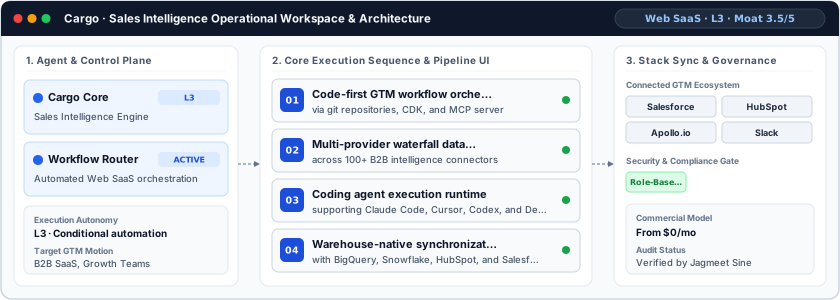
- Code-first GTM workflow orchestration: via git repositories, CDK, and MCP server
- Multi-provider waterfall data enrichment: across 100+ B2B intelligence connectors
- Coding agent execution runtime: supporting Claude Code, Cursor, Codex, and Devin
- Warehouse-native synchronization: with BigQuery, Snowflake, HubSpot, and Salesforce
Cons: operational limitations & risks
- Engineering Learning Curve: A primary adoption limitation is that authoring git-backed workflows and CDK primitives struggles with non-technical marketing teams accustomed to visual drag-and-drop spreadsheets, creating an onboarding learning curve.
- Waterfall Credit Burn Bottleneck: A recurring operational trade-off involves multi-step waterfall queries across premium contact providers, which can create a credit consumption bottleneck and execution latency during large unthrottled batch runs.
- Procurement Governance Barrier: While role-based access control and TLS encryption are enforced, enterprise procurement teams face a governance barrier when requiring public self-serve compliance audit certificates prior to contracting.
Cargo TCO & deal-breaker stress test
Simulate 12-month stepped TCO, hidden cost multipliers, contract lock-in exposure, and stack failure modes using only facts verified by Jagmeet Sine on · Capture SHA 40922bf2.
Cargo triggers high-severity friction under your 5-seat / $800/mo constraints. Benchmark the verified subtrack alternatives below before committing.
| Plan / Tier | Verified Rate | Scale Fit | Scope & Quota Notes |
|---|---|---|---|
| Entry / Starter | $165/mo | 1–2 seats | Verified $165/mo tier from vendor pricing schedule. |
| Growth / Professional | $250/mo | 5 seats | Verified $250/mo tier from vendor pricing schedule. |
- Moat Score
- 3.5 / 5.0
- AI Autonomy
- L3
- Free Tier / Trial
- Free trial
Triggered audit signals & failure modes
- Opaque Enterprise Quoting vs. SMB/Mid-Market BudgetVerified Pricing Ledger
Cargo does not disclose a public self-serve floor (From $0/mo). Buyers with a $800/mo cap face high sales-qualification friction.
- Published Self-Serve Entry FloorVerified Pricing Ledger
Cargo publishes a transparent entry point (From $0/mo) with a free trial for initial validation before committing.
- Usage / Credit Burn VolatilityCommercial Model Audit
Cargo uses credit or usage-metered billing (From $0/mo). High-volume automated workflows across 5 seats can trigger mid-cycle overage charges.
- Tier Fit for 5-Seat Scale: Entry / Starter ($165/mo)Verified Tier Schedule
Verified $165/mo tier from vendor pricing schedule.
Hidden TCO Multipliers & Quota Gates
- Credit & Usage Burn Multiplier: Automated workflows consume metered credits/usage quotas; multi-step enrichment, voice minutes, or high-frequency agent runs can trigger mid-cycle top-up packs.
- Enterprise Governance & Add-On Gating: Advanced capabilities such as Single Sign-On (SSO), custom role permissions, or specialized analytics modules are gated behind upper tiers or paid add-ons.
When to Walk Away & Negotiation Levers
- Walk away if your workflow requires uncapped enterprise volume on the From $0/mo entry plan without upgrading tiers.
- Walk away if your workflow cannot tolerate engineering learning curve: A primary adoption limitation is that authoring git-backed workflows and CDK primitives struggles with non-technical marketing teams accustomed to visual drag-and-drop spreadsheets, creating an onboarding learning curve.
- Walk away if waterfall credit burn bottleneck is a deal-breaker for your team: A recurring operational trade-off involves multi-step waterfall queries across premium contact providers, which can create a credit consumption bottleneck and execution latency during large unthrottled batch runs.
- Validate exact quota thresholds (seats, credits, or API calls) included in Cargo's From $0/mo tier before converting from monthly to annual billing.
- Require a sandbox proof-of-concept testing engineering learning curve against your live CRM/data schema before annual sign-off.
Ask a custom procurement or TCO stress-test question about Cargo
Lower 5-seat floor (~$500/mo vs. Custom Quote)
Lower 5-seat floor (~$99/mo vs. Custom Quote)
Cargo key entities, modules & ecosystem stack
Cargo moat & subtrack positioning
Code-first GTM infrastructure built on git repositories, CDK primitives, and 100+ native data connectors creates high technical switching costs for engineering-led revenue operations teams.
Editorial review
Fact-checked by Jagmeet Sine (Senior MarTech Infrastructure & Agentic Workflow Architect) on .
Background
Founded in 2023 by Aurelien Aubert and Maxence de Villepion and headquartered in San Francisco, California, Cargo is a code-first go-to-market data orchestration and waterfall enrichment platform built for GTM engineers, revenue operations architects, and technical growth teams. Operating with a core engineering team of 2 to 10 employees and backed by $500K in Pre-Seed funding led by Y Combinator, the company addresses a structural failure in spreadsheet-based enrichment tools that lack version control, CI/CD auditability, and high-concurrency execution. Cargo treats revenue workflows as software infrastructure, enabling technical operators and coding agents to author, version, and deploy lead enrichment, qualification, and routing pipelines directly through git repositories.
How Cargo works
Cargo operates at Level 3 autonomy by combining a programmatic Cloud Development Kit (CDK) and a Model Context Protocol (MCP) server with a dedicated execution runtime for coding agents including Claude Code, Cursor, Codex, Gemini CLI, and Devin. The infrastructure connects natively to more than 100 B2B intelligence providers and systems of record—spanning 6sense, Apollo.io, BetterContact, Clearbit, Cognism, Clay, BigQuery, Snowflake, Attio, Close, HubSpot, Salesforce, and Slack. Autonomous qualification agents equipped with persistent memory evaluate incoming account signals, execute multi-vendor waterfall contact lookups across its getcargo.io and getcargo.ai runtime endpoints, and write normalized schemas back to the warehouse and CRM.
Limitations
Operational limitations and technical trade-offs include:
- Engineering Learning Curve: A primary adoption limitation is that authoring git-backed workflows and CDK primitives struggles with non-technical marketing teams accustomed to visual drag-and-drop spreadsheets, creating an onboarding learning curve.
- Waterfall Credit Burn Bottleneck: A recurring operational trade-off involves multi-step waterfall queries across premium contact providers, which can create a credit consumption bottleneck and execution latency during large unthrottled batch runs.
- Procurement Governance Barrier: While role-based access control and TLS encryption are enforced, enterprise procurement teams face a governance barrier when requiring public self-serve compliance audit certificates prior to contracting.
Cargo pricing
Cargo utilizes a credit-based subscription structure starting with a free trial at $0 that includes 100 initial credits. Paid tiers begin at $165/mo for 1,500 credits and $250/mo for 2,500 credits, scaling through $1,190/mo for 17,000 credits up to $3,000/mo for 50,000+ monthly credits. Platform security controls include role-based access control, least-privilege permissioning, encryption in transit and at rest, and automated backup procedures.
How Cargo compares
Within the Sales Intelligence and Lead Enrichment & Waterfall Orchestration category, Cargo competes against visual enrichment workbooks and B2B contact databases such as Clay, Apollo.io, and Lusha. Where Clay centers on an interactive spreadsheet interface and Apollo.io focuses on a proprietary contact directory, Cargo differentiates itself through git-native workflow versioning, CDK primitives, and MCP exposure for coding agents. Technical revenue operations teams with warehouse-centric stacks favor Cargo for programmatic pipeline governance, whereas non-technical outbound SDR teams typically prefer browser-based table interfaces.
Frequently asked questions about Cargo
How much does Cargo cost and what pricing tiers are available?
Published pricing summary for Cargo: From $0/mo. Cargo does not list a permanent free tier, though trial evaluation options may be offered. Verified tier schedule: Entry / Starter ($165/mo for 1–2 seats); Growth / Professional ($250/mo for 5 seats). Cargo utilizes a credit-based subscription structure starting with a free trial at $0 that includes 100 initial credits. Paid tiers begin at $165/mo for 1,500 credits and $250/mo for 2,500 credits, scaling through $1,190/mo for 17,000 credits up to $3,000/mo for 50,000+ monthly credits.
How does Cargo work and how autonomous is its AI architecture?
Code-first GTM data orchestration and waterfall enrichment infrastructure powered by git workflows, CDK primitives, and an MCP server. Within Sales Intelligence (Lead Enrichment & Waterfall Orchestration), MarTechRadar rates its execution architecture at L3 · Conditional automation with a verified Moat Score of 3.5 / 5.0 (Proprietary moat). Code-first GTM infrastructure built on git repositories, CDK primitives, and 100+ native data connectors creates high technical switching costs for engineering-led revenue operations teams. Corporate profile: Founded by Aurelien Aubert, Maxence de Villepion, operating at 2-10 employees scale.
What are the main limitations of Cargo and when should buyers walk away?
Based on our editorial technical audit, key operational considerations and boundaries for Cargo include: (1) Engineering Learning Curve: A primary adoption limitation is that authoring git-backed workflows and CDK primitives struggles with non-technical marketing teams accustomed to visual drag-and-drop spreadsheets, creating an onboarding learning curve. (2) Waterfall Credit Burn Bottleneck: A recurring operational trade-off involves multi-step waterfall queries across premium contact providers, which can create a credit consumption bottleneck and execution latency during large unthrottled batch runs. (3) Procurement Governance Barrier: While role-based access control and TLS encryption are enforced, enterprise procurement teams face a governance barrier when requiring public self-serve compliance audit certificates prior to contracting. Primary procurement walk-away rule: Walk away if your workflow requires uncapped enterprise volume on the From $0/mo entry plan without upgrading tiers.
What integrations, compliance certifications, and contract terms apply to Cargo?
Verified ecosystem and stack integrations include Salesforce, HubSpot, Apollo.io, Slack, Snowflake, Google BigQuery. First-party governance and developer endpoints verified on domain include: Trust/Security (https://www.getcargo.ai/security), API Docs (https://docs.getcargo.ai), DPA (https://www.getcargo.ai/dpa). Key TCO multiplier to watch: Credit & Usage Burn Multiplier (Automated workflows consume metered credits/usage quotas; multi-step enrichment, voice minutes, or high-frequency agent runs can trigger mid-cycle top-up packs.) Before signing a contract, procurement teams should validate exact quota thresholds (seats, credits, or API calls) included in Cargo's From $0/mo tier before converting from monthly to annual billing.
What are the best Cargo alternatives and head-to-head competitors in 2026?
Top fact-checked alternatives to Cargo in Sales Intelligence (Lead Enrichment & Waterfall Orchestration) include Lusha (Free plan · $0/mo · Enterprise plan), Cognism (Custom / enterprise pricing), Champify ($500/mo · Enterprise plan), Databar.ai (From $99/mo). Within the Sales Intelligence and Lead Enrichment & Waterfall Orchestration category, Cargo competes against visual enrichment workbooks and B2B contact databases such as Clay, Apollo.io, and Lusha.
Verified sources & evidence trail
- Official product domain: https://getcargo.ai
- Commercial pricing verification: https://www.getcargo.ai/pricing
- Verified corporate entity profiles (
sameAs): LinkedIn Company Profile · Crunchbase Entity Record - First-party governance & documentation links: Trust & Security · API & Docs · DPA · Terms · Privacy
- Editorial audit sign-off: Fact-checked by Jagmeet Sine on under the MarTechRadar Evidence-Ledger Protocol.