Bravi Review (2026): Sales Intelligence Pricing, Limits & Alternatives
Bottom line
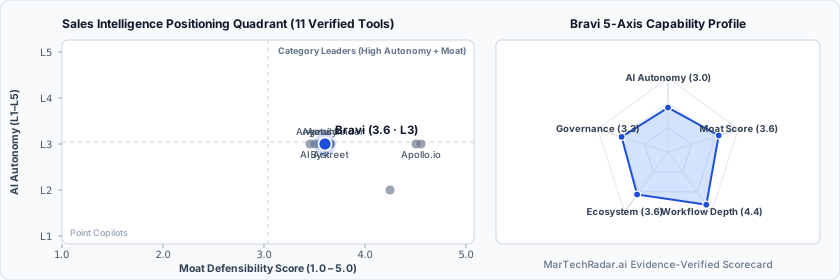
Bravi is a Web SaaS tool for Sales Intelligence (Lead Enrichment & Waterfall Orchestration) in AI SDR & Outbound. Pricing: Custom / enterprise pricing. Best suited to B2B Sales Leaders, SDR/BDR Teams and Revenue Operations (RevOps). Editor ratings: AI autonomy L3 (conditional automation); moat score 3.6/5.0 (Proprietary moat). Fact-checked by Jagmeet Sine on Oct 14, 2026.
Domain-specific AI copilot and enrichment engine equipping manufacturing field teams with automated technical answers and product specifications.
Bravi buyer fit verdict: when to choose vs. when to walk away
Choose Bravi if (Best Fit)
- Target ICP & Stack Fit: You operate as B2B Sales Leaders, SDR/BDR Teams and Revenue Operations (RevOps) requiring a Web SaaS deployment for Sales Intelligence, with verified ecosystem connectivity for Apollo.io.
- L3 Architecture & Defensibility: Deep domain grounding across complex manufacturing product documentation and field engineering specifications, paired with lead waterfall enrichment to resolve technical inquiries without tier-two engineering intervention.
- Commercial Model Fit: Your procurement budget aligns with Custom / enterprise pricing.
Walk away from Bravi if (Deal-Breakers)
- Walk away if you require transparent self-serve monthly billing or your budget ceiling is under $1,000/mo (Bravi requires sales-gated custom quoting).
- Walk away if your workflow cannot tolerate unstructured schematic ingestion latency: Complex CAD files, non-standard engineering blueprints, and rasterized legacy catalogs require labor-intensive schema alignment before semantic retrieval reliably avoids hallucinated dimensional tolerances.
- Walk away if enrichment coverage in niche industrial verticals is a deal-breaker for your team: Waterfall enrichment pipelines frequently encounter sparse B2B contact coverage and outdated firmographic datasets when targeting small regional contractors or specialized fabricators.
Bravi key facts & scorecard
| Pricing | Custom / enterprise pricing |
|---|---|
| Free plan | No / not disclosed |
| Delivery | Web SaaS |
| Audience | B2B Sales Leaders, SDR/BDR Teams, Revenue Operations (RevOps) |
| AI autonomy level | L3 · Conditional automationEditor-verified |
| Moat tier & score | 3.6 / 5.0 · Proprietary moatEditor-verified |
| Funding | Pre-seed |
| Company size | 11-50 employees |
| Ecosystem integrations | Apollo.io |
| Headquarters | Brooklyn, New York |
| Founded | 2025 |
| Last verified |
Bravi pros & cons: strengths vs. operational limitations
Pros: core strengths & capabilities
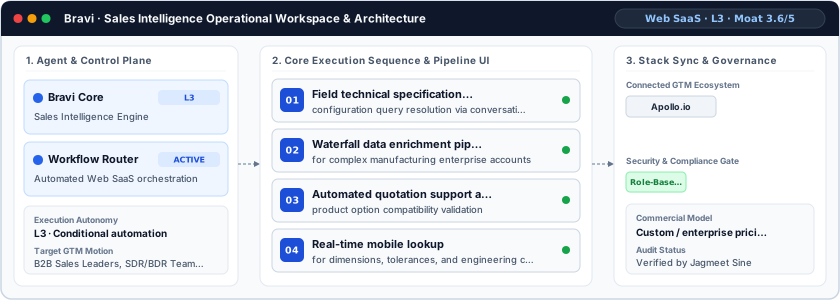
- Field technical specification and: configuration query resolution via conversational interface
- Waterfall data enrichment pipeline: for complex manufacturing enterprise accounts
- Automated quotation support and: product option compatibility validation
- Real-time mobile lookup: for dimensions, tolerances, and engineering constraints
Cons: operational limitations & risks
- Unstructured Schematic Ingestion Latency: Complex CAD files, non-standard engineering blueprints, and rasterized legacy catalogs require labor-intensive schema alignment before semantic retrieval reliably avoids hallucinated dimensional tolerances.
- Enrichment Coverage in Niche Industrial Verticals: Waterfall enrichment pipelines frequently encounter sparse B2B contact coverage and outdated firmographic datasets when targeting small regional contractors or specialized fabricators.
- Sync Latency with Disconnected ERP Schemas: On-premise enterprise resource planning databases introduce data currency lags, causing field agents to occasionally view stale inventory statuses or uncommitted pricing tables during off-network sessions.
Bravi TCO & deal-breaker stress test
Simulate 12-month stepped TCO, hidden cost multipliers, contract lock-in exposure, and stack failure modes using only facts verified by Jagmeet Sine on · Capture SHA ac1b545a.
Bravi triggers high-severity friction under your 5-seat / $800/mo constraints. Benchmark the verified subtrack alternatives below before committing.
| Plan / Tier | Verified Rate | Scale Fit | Scope & Quota Notes |
|---|---|---|---|
| Enterprise / Custom | Custom quote | 15–50+ seats (Enterprise SLA) | Sales-negotiated annual contract for custom volume, SSO/RBAC governance, and dedicated SLA. |
- Moat Score
- 3.6 / 5.0
- AI Autonomy
- L3
- Free Tier / Trial
- None disclosed
Triggered audit signals & failure modes
- Opaque Enterprise Quoting vs. SMB/Mid-Market BudgetVerified Pricing Ledger
Bravi does not disclose a public self-serve floor (Custom / enterprise pricing). Buyers with a $800/mo cap face high sales-qualification friction.
- Sales-Gated Contract TermsFact-checked by Jagmeet Sine
Commercial pricing for Bravi is available on request through tailored enterprise sales quotes based on organizational scale, active field seats, and platform integration requirements.
- Primary Operational Bottleneck: Unstructured Schematic Ingestion LatencyAudit by Jagmeet Sine
Complex CAD files, non-standard engineering blueprints, and rasterized legacy catalogs require labor-intensive schema alignment before semantic retrieval reliably avoids hallucinated dimensional tolerances.
Hidden TCO Multipliers & Quota Gates
- Credit & Usage Burn Multiplier: Automated workflows consume metered credits/usage quotas; multi-step enrichment, voice minutes, or high-frequency agent runs can trigger mid-cycle top-up packs.
- Unstructured Schematic Ingestion Latency: Complex CAD files, non-standard engineering blueprints, and rasterized legacy catalogs require labor-intensive schema alignment before semantic retrieval reliably avoids hallucinated dimensional tolerances.
- Enrichment Coverage in Niche Industrial Verticals: Waterfall enrichment pipelines frequently encounter sparse B2B contact coverage and outdated firmographic datasets when targeting small regional contractors or specialized fabricators.
When to Walk Away & Negotiation Levers
- Walk away if you require transparent self-serve monthly billing or your budget ceiling is under $1,000/mo (Bravi requires sales-gated custom quoting).
- Walk away if your workflow cannot tolerate unstructured schematic ingestion latency: Complex CAD files, non-standard engineering blueprints, and rasterized legacy catalogs require labor-intensive schema alignment before semantic retrieval reliably avoids hallucinated dimensional tolerances.
- Walk away if enrichment coverage in niche industrial verticals is a deal-breaker for your team: Waterfall enrichment pipelines frequently encounter sparse B2B contact coverage and outdated firmographic datasets when targeting small regional contractors or specialized fabricators.
- Demand a 30- to 60-day paid pilot opt-out clause in the Bravi order form before signing a 12-month enterprise commitment.
- Require a sandbox proof-of-concept testing unstructured schematic ingestion latency against your live CRM/data schema before annual sign-off.
Ask a custom procurement or TCO stress-test question about Bravi
Lower 5-seat floor (~$50/mo vs. Custom Quote) · Transparent self-serve entry without mandatory annual lock-in
Lower 5-seat floor (~$245/mo vs. Custom Quote) · Transparent self-serve entry without mandatory annual lock-in
Bravi key entities, modules & ecosystem stack
Bravi moat & subtrack positioning
Deep domain grounding across complex manufacturing product documentation and field engineering specifications, paired with lead waterfall enrichment to resolve technical inquiries without tier-two engineering intervention.
Editorial review
Fact-checked by Jagmeet Sine (Senior MarTech Infrastructure & Agentic Workflow Architect) on .
Background
Field sales engineering teams at industrial manufacturers struggle with elongated deal cycles whenever technical specification barriers stall negotiations on site. Headquartered in Brooklyn, New York, Bravi addresses this operational bottleneck by serving revenue practitioners and field representatives with real-time technical product verification alongside targeted pipeline intelligence. By coupling specialized industrial domain logic with lead enrichment and waterfall orchestration capabilities, the platform equips commercial operations to accelerate prospect qualification while eliminating manual back-and-forth handoffs with application engineering desks.
How Bravi works
At an architectural level, Bravi operates as an autonomous resolution pipeline combining proprietary retrieval mechanisms with structured pipeline enrichment. The system ingests disparate manufacturer catalogs, technical datasheets, and engineering schematics into an embedded semantic index. When an operational query or prospect touchpoint triggers the engine, it executes multi-tier waterfall queries to validate firmographic criteria while cross-referencing physical product tolerances, sizing constraints, and order statuses. This workflow decomposes sales inquiries into deterministic API calls, providing verifiable product parameters and enriched buyer context directly to field interfaces.
Limitations
Operational considerations and platform boundaries include:
- Unstructured Schematic Ingestion Latency: Complex CAD files, non-standard engineering blueprints, and rasterized legacy catalogs require labor-intensive schema alignment before semantic retrieval reliably avoids hallucinated dimensional tolerances.
- Enrichment Coverage in Niche Industrial Verticals: Waterfall enrichment pipelines frequently encounter sparse B2B contact coverage and outdated firmographic datasets when targeting small regional contractors or specialized fabricators.
- Sync Latency with Disconnected ERP Schemas: On-premise enterprise resource planning databases introduce data currency lags, causing field agents to occasionally view stale inventory statuses or uncommitted pricing tables during off-network sessions.
Bravi pricing
Commercial pricing for Bravi is available on request through tailored enterprise sales quotes based on organizational scale, active field seats, and platform integration requirements. Deployments are structured around enterprise licensing agreements that factor in dedicated catalog ingestion pipelines, data connector throughput, and administrative governance modules. Prospective manufacturing clients must contact sales to schedule an architectural assessment and receive custom terms suited to their operational volume.
How Bravi compares
Within the lead enrichment and waterfall orchestration category, Bravi occupies a specialized industrial posture compared to horizontal aggregators like Apollo.io, Clay, and AI Ark. While Apollo.io and Clay deliver broad multi-channel contact enrichment across standard technology and services sectors, they lack native ingestion models for manufacturing schematics and physical product configurations. AI Ark focuses heavily on autonomous account identification, whereas Bravi prioritizes field-level technical validation. Consequently, Bravi is best aligned with discrete manufacturers managing technical product catalogs and distributed on-site sales networks.
Direct competitors & market radar
Top algorithmic competitors based on category positioning, capability overlap, and ICP alignment.
Frequently asked questions about Bravi
How much does Bravi cost and does it require a custom enterprise quote?
Published pricing summary for Bravi: Custom / enterprise pricing. A permanent free plan is not disclosed for Bravi. Commercial pricing for Bravi is available on request through tailored enterprise sales quotes based on organizational scale, active field seats, and platform integration requirements.
How does Bravi work and how autonomous is its AI architecture?
Domain-specific AI copilot and enrichment engine equipping manufacturing field teams with automated technical answers and product specifications. Within Sales Intelligence (Lead Enrichment & Waterfall Orchestration), MarTechRadar rates its execution architecture at L3 · Conditional automation with a verified Moat Score of 3.6 / 5.0 (Proprietary moat). Deep domain grounding across complex manufacturing product documentation and field engineering specifications, paired with lead waterfall enrichment to resolve technical inquiries without tier-two engineering intervention. Corporate profile: operating at 11-50 employees scale.
What are the main limitations of Bravi and when should buyers walk away?
Based on our editorial technical audit, key operational considerations and boundaries for Bravi include: (1) Unstructured Schematic Ingestion Latency: Complex CAD files, non-standard engineering blueprints, and rasterized legacy catalogs require labor-intensive schema alignment before semantic retrieval reliably avoids hallucinated dimensional tolerances. (2) Enrichment Coverage in Niche Industrial Verticals: Waterfall enrichment pipelines frequently encounter sparse B2B contact coverage and outdated firmographic datasets when targeting small regional contractors or specialized fabricators. (3) Sync Latency with Disconnected ERP Schemas: On-premise enterprise resource planning databases introduce data currency lags, causing field agents to occasionally view stale inventory statuses or uncommitted pricing tables during off-network sessions. Primary procurement walk-away rule: Walk away if you require transparent self-serve monthly billing or your budget ceiling is under $1,000/mo (Bravi requires sales-gated custom quoting).
What integrations, compliance certifications, and contract terms apply to Bravi?
Verified ecosystem and stack integrations include Apollo.io. Key TCO multiplier to watch: Credit & Usage Burn Multiplier (Automated workflows consume metered credits/usage quotas; multi-step enrichment, voice minutes, or high-frequency agent runs can trigger mid-cycle top-up packs.) Before signing a contract, procurement teams should demand a 30- to 60-day paid pilot opt-out clause in the Bravi order form before signing a 12-month enterprise commitment.
What are the best Bravi alternatives and head-to-head competitors in 2026?
Top fact-checked alternatives to Bravi in Sales Intelligence (Lead Enrichment & Waterfall Orchestration) include telli (Custom / enterprise pricing), Revspot (Custom / enterprise pricing), Datanyze (Free plan · $0/mo · Enterprise plan), Fello (From $50/mo). Within the lead enrichment and waterfall orchestration category, Bravi occupies a specialized industrial posture compared to horizontal aggregators like Apollo.io, Clay, and AI Ark.
Verified sources & evidence trail
- Official product domain: https://www.bravi.app
- Commercial pricing verification: Verified against official vendor pricing policy (Custom / enterprise pricing)
- Verified corporate entity profiles (
sameAs): LinkedIn Company Profile - Editorial audit sign-off: Fact-checked by Jagmeet Sine on under the MarTechRadar Evidence-Ledger Protocol.