Lusha Review (2026): Sales Intelligence Pricing, Limits & Alternatives
Bottom line
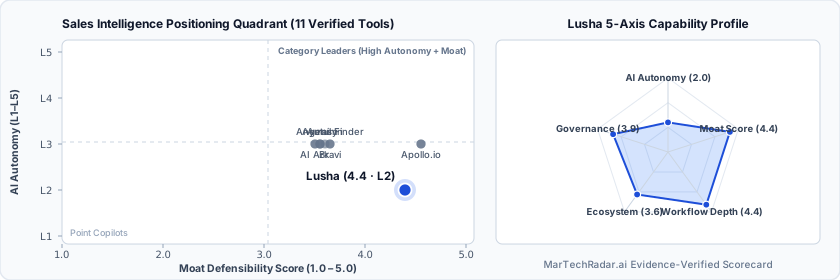
Lusha is a Browser Extension tool for Sales Intelligence (Lead Enrichment & Waterfall Orchestration) in AI SDR & Outbound. Pricing: Free plan · $0/mo · Enterprise plan. Best suited to B2B SaaS, DTC / eCommerce and Enterprise Brands. Editor ratings: AI autonomy L2 (workflow copilot); moat score 4.4/5.0 (Proprietary moat (category leader)). Fact-checked by Jiacky Lee on Oct 4, 2026.
B2B intelligence platform delivering verified direct dials, work emails, and firmographic enrichment via browser extensions, APIs, and AI integrations.
Lusha buyer fit verdict: when to choose vs. when to walk away
Choose Lusha if (Best Fit)
- Target ICP & Stack Fit: You operate as B2B SaaS, DTC / eCommerce and Enterprise Brands requiring a Browser Extension deployment for Sales Intelligence, with verified ecosystem connectivity for Apollo.io.
- L2 Architecture & Defensibility: Lusha maintains a crowdsourced and machine-verified database of over 515 million business profiles and direct-dial records, anchored by enterprise compliance certifications and native browser workflow capture.
- Commercial Model Fit: Your procurement budget aligns with Free plan · $0/mo · Enterprise plan and want a self-serve free tier for zero-cost initial validation.
Walk away from Lusha if (Deal-Breakers)
- Walk away if your workflow requires uncapped enterprise volume on the Free plan · $0/mo · Enterprise plan entry plan without upgrading tiers.
- Walk away if your workflow cannot tolerate direct-dial decay: Mobile number accuracy degrades rapidly in volatile turnover sectors, requiring manual validation when contact records drift past thirty-day refresh cycles.
- Walk away if bulk ingestion rate limits is a deal-breaker for your team: Mass enrichment jobs face strict hourly API throttling, creating processing bottlenecks when refreshing raw CRM datasets exceeding tens of thousands of records.
Lusha key facts & scorecard
| Pricing | Free plan · $0/mo · Enterprise planVendor pricing page |
|---|---|
| Free plan | Yes |
| Delivery | Browser Extension |
| Audience | B2B SaaS, DTC / eCommerce, Enterprise Brands |
| AI autonomy level | L2 · Workflow copilotEditor-verified |
| Moat tier & score | 4.4 / 5.0 · Proprietary moat (category leader)Editor-verified |
| Funding | Series B |
| Total funding | $245.0MBacked by PSG, ION Crossover Partners |
| Founders | Assaf Eisenstein, Yoni Tserruya |
| Company size | 201-500 employees |
| Ecosystem integrations | Apollo.io |
| Governance & docs | Trust & Security ↗ · API & Docs ↗ · Privacy ↗ |
| Headquarters | Tel Aviv, Israel |
| Founded | 2016 |
| Last verified |
Lusha pros & cons: strengths vs. operational limitations
Pros: core strengths & capabilities
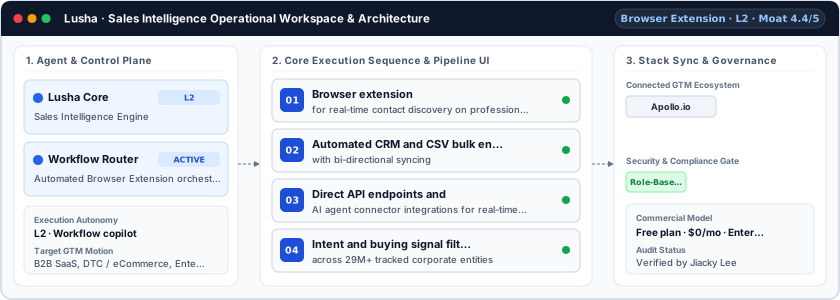
- Browser extension: for real-time contact discovery on professional networks and corporate websites
- Automated CRM and CSV bulk enrichment pipeline: with bi-directional syncing
- Direct API endpoints and: AI agent connector integrations for real-time contact validation
- Intent and buying signal filtering: across 29M+ tracked corporate entities
Cons: operational limitations & risks
- Direct-Dial Decay: Mobile number accuracy degrades rapidly in volatile turnover sectors, requiring manual validation when contact records drift past thirty-day refresh cycles.
- Bulk Ingestion Rate Limits: Mass enrichment jobs face strict hourly API throttling, creating processing bottlenecks when refreshing raw CRM datasets exceeding tens of thousands of records.
- Single-Source Waterfall Dependency: Lacking native multi-vendor waterfall orchestration, enrichment pipelines fail silently when a profile query misses Lusha's internal index without an external fallback.
Lusha TCO & deal-breaker stress test
Simulate 12-month stepped TCO, hidden cost multipliers, contract lock-in exposure, and stack failure modes using only facts verified by Jiacky Lee on · Capture SHA d5b48568.
Lusha is viable for 5 seats, but requires commercial or technical verification on the flagged items below.
| Plan / Tier | Verified Rate | Scale Fit | Scope & Quota Notes |
|---|---|---|---|
| Free / Sandbox | $0 | 1–2 seats (Evaluation) | Entry free tier with capped usage or feature quotas for initial workflow testing. |
| Entry / Starter | $37/mo | 1–2 seats | Verified $37/mo published rate on vendor pricing schedule. |
| Growth / Professional | $45/mo | 5 seats | Verified $45/mo published rate on vendor pricing schedule. |
| Scale / Advanced | $52/mo | 15 seats | Verified $52/mo published rate on vendor pricing schedule. |
- Moat Score
- 4.4 / 5.0
- AI Autonomy
- L2
- Free Tier / Trial
- Free plan
Triggered audit signals & failure modes
- Opaque Enterprise Quoting vs. SMB/Mid-Market BudgetVerified Pricing Ledger
Lusha does not disclose a public self-serve floor (Free plan · $0/mo · Enterprise plan). Buyers with a $800/mo cap face high sales-qualification friction.
- Published Self-Serve Entry FloorVerified Pricing Ledger
Lusha publishes a transparent entry point (Free plan · $0/mo · Enterprise plan) with a free tier for initial validation before committing.
- Tier Fit for 5-Seat Scale: Entry / Starter ($37/mo)Verified Tier Schedule
Verified $37/mo published rate on vendor pricing schedule.
- Primary Operational Bottleneck: Direct-Dial DecayAudit by Jiacky Lee
Mobile number accuracy degrades rapidly in volatile turnover sectors, requiring manual validation when contact records drift past thirty-day refresh cycles.
Hidden TCO Multipliers & Quota Gates
- Credit & Usage Burn Multiplier: Automated workflows consume metered credits/usage quotas; multi-step enrichment, voice minutes, or high-frequency agent runs can trigger mid-cycle top-up packs.
- Enterprise Governance & Add-On Gating: Advanced capabilities such as Single Sign-On (SSO), custom role permissions, or specialized analytics modules are gated behind upper tiers or paid add-ons.
When to Walk Away & Negotiation Levers
- Walk away if your workflow requires uncapped enterprise volume on the Free plan · $0/mo · Enterprise plan entry plan without upgrading tiers.
- Walk away if your workflow cannot tolerate direct-dial decay: Mobile number accuracy degrades rapidly in volatile turnover sectors, requiring manual validation when contact records drift past thirty-day refresh cycles.
- Walk away if bulk ingestion rate limits is a deal-breaker for your team: Mass enrichment jobs face strict hourly API throttling, creating processing bottlenecks when refreshing raw CRM datasets exceeding tens of thousands of records.
- Validate exact quota thresholds (seats, credits, or API calls) included in Lusha's Free plan · $0/mo · Enterprise plan tier before converting from monthly to annual billing.
- Require a sandbox proof-of-concept testing direct-dial decay against your live CRM/data schema before annual sign-off.
Ask a custom procurement or TCO stress-test question about Lusha
Lower 5-seat floor (~$245/mo vs. Custom Quote)
Lower 5-seat floor (~$55/mo vs. Custom Quote)
Lusha key entities, modules & ecosystem stack
Lusha moat & subtrack positioning
Lusha maintains a crowdsourced and machine-verified database of over 515 million business profiles and direct-dial records, anchored by enterprise compliance certifications and native browser workflow capture.
Editorial review
Fact-checked by Jiacky Lee (Managing Editor, AI Autonomy & Moat Methodology) on .
Background
Established in Tel Aviv, Israel, and founded in 2016, Lusha scaled its commercial footprint backed by $245.0M in aggregate venture funding. The platform serves sales development representatives, revenue operations leaders, and outbound growth teams requiring accurate decision-maker contact intelligence. Operating within the lead enrichment and waterfall orchestration sector, the system provides verified direct-dial telephone numbers, professional email addresses, and firmographic attributes to compress outbound sales cycles and eliminate manual lead sourcing friction across mid-market and enterprise go-to-market teams.
How Lusha works
Lusha pairs a deterministic identity graph with browser-level DOM extraction and API endpoints. When users browse professional networks or corporate web pages, the client parses profile identifiers and executes lookup queries against a core data lake housing 515 million contact records. The backend engine resolves entity ambiguities using algorithmic cross-referencing of corporate domain records, MX verification, and weekly refreshed buying signals. Data feeds pipe directly into integrated CRM repositories or LLM runtime environments via structured REST APIs, operating at Level 2 human-reviewed automation.
Limitations
Operational considerations and platform boundaries include:
- Direct-Dial Decay: Mobile number accuracy degrades rapidly in volatile turnover sectors, requiring manual validation when contact records drift past thirty-day refresh cycles.
- Bulk Ingestion Rate Limits: Mass enrichment jobs face strict hourly API throttling, creating processing bottlenecks when refreshing raw CRM datasets exceeding tens of thousands of records.
- Single-Source Waterfall Dependency: Lacking native multi-vendor waterfall orchestration, enrichment pipelines fail silently when a profile query misses Lusha's internal index without an external fallback.
Lusha pricing
The commercial framework employs credit-metered licensing based on contact reveals and export quotas. Lusha provides a permanent entry tier starting at $0 per month for basic individual evaluation with restricted monthly credits. Higher-volume requirements transition into structured annual plans starting at base credit tiers such as $37 or custom enterprise agreements featuring dedicated API limits, single sign-on security, team credit pooling, and bespoke CRM enrichment allowances.
How Lusha compares
Compared to Apollo.io, which integrates full outbound email sequence execution, Lusha maintains a narrower focus on raw contact accuracy and browser-based delivery. Against Clay, which specializes in complex multi-vendor waterfall enrichment chains across dozens of public data providers, Lusha functions as a proprietary data registry with lower configuration overhead. It is ideal for mid-market revenue organizations needing instant contact resolution without the overhead of architecting complex data orchestration pipelines.
Direct competitors & market radar
Top algorithmic competitors based on category positioning, capability overlap, and ICP alignment.
Frequently asked questions about Lusha
How much does Lusha cost and what pricing tiers are available?
Published pricing summary for Lusha: Free plan · $0/mo · Enterprise plan. Lusha includes a free tier or sandbox entry point. Verified tier schedule: Free / Sandbox ($0 for 1–2 seats (Evaluation)); Entry / Starter ($37/mo for 1–2 seats); Growth / Professional ($45/mo for 5 seats); Scale / Advanced ($52/mo for 15 seats). The commercial framework employs credit-metered licensing based on contact reveals and export quotas. Lusha provides a permanent entry tier starting at $0 per month for basic individual evaluation with restricted monthly credits.
How does Lusha work and how autonomous is its AI architecture?
B2B intelligence platform delivering verified direct dials, work emails, and firmographic enrichment via browser extensions, APIs, and AI integrations. Within Sales Intelligence (Lead Enrichment & Waterfall Orchestration), MarTechRadar rates its execution architecture at L2 · Workflow copilot with a verified Moat Score of 4.4 / 5.0 (Proprietary moat (category leader)). Lusha maintains a crowdsourced and machine-verified database of over 515 million business profiles and direct-dial records, anchored by enterprise compliance certifications and native browser workflow capture. Corporate profile: Founded by Assaf Eisenstein, Yoni Tserruya, operating at 201-500 employees scale.
What are the main limitations of Lusha and when should buyers walk away?
Based on our editorial technical audit, key operational considerations and boundaries for Lusha include: (1) Direct-Dial Decay: Mobile number accuracy degrades rapidly in volatile turnover sectors, requiring manual validation when contact records drift past thirty-day refresh cycles. (2) Bulk Ingestion Rate Limits: Mass enrichment jobs face strict hourly API throttling, creating processing bottlenecks when refreshing raw CRM datasets exceeding tens of thousands of records. (3) Single-Source Waterfall Dependency: Lacking native multi-vendor waterfall orchestration, enrichment pipelines fail silently when a profile query misses Lusha's internal index without an external fallback. Primary procurement walk-away rule: Walk away if your workflow requires uncapped enterprise volume on the Free plan · $0/mo · Enterprise plan entry plan without upgrading tiers.
What integrations, compliance certifications, and contract terms apply to Lusha?
Verified ecosystem and stack integrations include Apollo.io. First-party governance and developer endpoints verified on domain include: Trust/Security (https://www.lusha.com/trust-center), API Docs (https://docs.lusha.com/user-guide). Key TCO multiplier to watch: Credit & Usage Burn Multiplier (Automated workflows consume metered credits/usage quotas; multi-step enrichment, voice minutes, or high-frequency agent runs can trigger mid-cycle top-up packs.) Before signing a contract, procurement teams should validate exact quota thresholds (seats, credits, or API calls) included in Lusha's Free plan · $0/mo · Enterprise plan tier before converting from monthly to annual billing.
What are the best Lusha alternatives and head-to-head competitors in 2026?
Top fact-checked alternatives to Lusha in Sales Intelligence (Lead Enrichment & Waterfall Orchestration) include Apollo.io (Free plan · $49–$119/seat/mo · Enterprise plan), Enginy (Custom / enterprise pricing), Leadbay (Custom / enterprise pricing), AI Ark ($49/mo). Compared to Apollo.io, which integrates full outbound email sequence execution, Lusha maintains a narrower focus on raw contact accuracy and browser-based delivery.
Verified sources & evidence trail
- Official product domain: https://lusha.com
- Commercial pricing verification: https://www.lusha.com/pricing/
- Verified corporate entity profiles (
sameAs): LinkedIn Company Profile · Crunchbase Entity Record - First-party governance & documentation links: Trust & Security · API & Docs · Privacy
- Editorial audit sign-off: Fact-checked by Jiacky Lee on under the MarTechRadar Evidence-Ledger Protocol.