Apollo.io Review (2026): Sales Intelligence Pricing, Limits & Alternatives
Bottom line
Apollo.io is a Web SaaS tool for Sales Intelligence (Lead Enrichment & Waterfall Orchestration) in AI SDR & Outbound. Pricing: Free plan · $49–$119/seat/mo · Enterprise plan. Best suited to B2B SaaS. Editor ratings: AI autonomy L3 (conditional automation); moat score 4.6/5.0 (Proprietary moat (category leader)). Fact-checked by Jiacky Lee on Oct 6, 2026.
B2B sales intelligence and engagement platform combining a 275M+ contact database with built-in multi-channel sequencing and enrichment workflows.
Apollo.io buyer fit verdict: when to choose vs. when to walk away
Choose Apollo.io if (Best Fit)
- Target ICP & Stack Fit: You operate as B2B SaaS requiring a Web SaaS deployment for Sales Intelligence, with verified ecosystem connectivity for Salesforce, HubSpot, Outreach, Snowflake.
- L3 Architecture & Defensibility: Substantial proprietary B2B contact graph continuously verified via contributor networks, paired with integrated execution tooling that captures down-funnel engagement signals.
- Commercial Model Fit: Your procurement budget aligns with Free plan · $49–$119/seat/mo · Enterprise plan and want a self-serve free tier for zero-cost initial validation.
Walk away from Apollo.io if (Deal-Breakers)
- Walk away if your workflow requires uncapped enterprise volume on the Free plan · $49–$119/seat/mo · Enterprise plan entry plan without upgrading tiers.
- Walk away if your workflow cannot tolerate direct-dial data freshness: Mobile direct-dial accuracy degrades in specialized technical verticals, requiring third-party verification to avoid high bounce rates.
- Walk away if CRM schema drift is a deal-breaker for your team: High-velocity bidirectional synchronization creates field overwrites and deduplication bottlenecks when mapped against complex custom Salesforce schemas.
Apollo.io key facts & scorecard
| Pricing | Free plan · $49–$119/seat/mo · Enterprise planVendor pricing page |
|---|---|
| Free plan | Yes |
| Delivery | Web SaaS |
| Audience | B2B SaaS |
| AI autonomy level | L3 · Conditional automationEditor-verified |
| Moat tier & score | 4.6 / 5.0 · Proprietary moat (category leader)Editor-verified |
| Funding | Series C+ |
| Total funding | $251.0MBacked by Bain Capital Ventures, Sequoia Capital |
| Founders | Ray Li, Roy Chung, Tim Zheng |
| Company size | 501-1,000 employees |
| Ecosystem integrations | Salesforce, HubSpot, Outreach, Snowflake, Shopify |
| Compliance & governance | GDPR |
| Governance & docs | API & Docs ↗ · Terms ↗ · Privacy ↗ |
| Headquarters | San Francisco, United States |
| Founded | 2015 |
| Last verified |
Apollo.io pros & cons: strengths vs. operational limitations
Pros: core strengths & capabilities
- Proprietary B2B database indexing: over 275 million business contacts and firmographic records
- Automated multi-step outbound sequencing: across email, dialer, and social touchpoints
- Bi-directional CRM synchronization: with native field mapping for Salesforce and HubSpot
- Real-time contact enrichment, intent: signal tracking, and domain deliverability monitoring
Cons: operational limitations & risks
- Direct-Dial Data Freshness: Mobile direct-dial accuracy degrades in specialized technical verticals, requiring third-party verification to avoid high bounce rates.
- CRM Schema Drift: High-velocity bidirectional synchronization creates field overwrites and deduplication bottlenecks when mapped against complex custom Salesforce schemas.
- Outbound Throttle Limits: Shared IP dispatch pools risk spam reputation decay if users deploy high-volume campaigns without manual domain throttling.
Apollo.io TCO & deal-breaker stress test
Simulate 12-month stepped TCO, hidden cost multipliers, contract lock-in exposure, and stack failure modes using only facts verified by Jiacky Lee on · Capture SHA 0d328954.
Apollo.io aligns with your 5-seat / $800/mo profile. Review the walk-away triggers and contract levers below before deployment.
| Plan / Tier | Verified Rate | Scale Fit | Scope & Quota Notes |
|---|---|---|---|
| Free / Sandbox | $0 | 1–2 seats (Evaluation) | Entry free tier with capped usage or feature quotas for initial workflow testing. |
| Basic | $49/seat/mo | 1–2 seats | Take prospecting, outreach & deal management to the next level. |
| Professional | $79/seat/mo | 5 seats | Optimize your sales process with multi-touch outreach, AI & automation. |
| Scale / Advanced | $119/seat/mo | 15 seats | Per seat per month, (min 3 seats) |
- Moat Score
- 4.6 / 5.0
- AI Autonomy
- L3
- Free Tier / Trial
- Free plan
Triggered audit signals & failure modes
- Published Self-Serve Entry FloorVerified Pricing Ledger
Apollo.io publishes a transparent entry point (Free plan · $49–$119/seat/mo · Enterprise plan) with a free tier for initial validation before committing.
- Linear Per-Seat Scaling (5 Seats × $49/seat/mo)Commercial Model Audit
Base license scales linearly with operator headcount ($245/mo for 5 seats on Basic).
- Primary Operational Bottleneck: Direct-Dial Data FreshnessAudit by Jiacky Lee
Mobile direct-dial accuracy degrades in specialized technical verticals, requiring third-party verification to avoid high bounce rates.
Hidden TCO Multipliers & Quota Gates
- Per-Seat Linear Scaling: Apollo.io prices licenses on a per-user/seat basis (Free plan · $49–$119/seat/mo · Enterprise plan); expanding from 2 to 15+ operators multiplies base recurring spend linearly.
- Annual Billing Headline vs. Monthly Premium: Headline entry rates reflect annual billing commitments (SAVE 24%); month-to-month flexibility carries a higher effective monthly rate or requires annual prepayment.
- Credit & Usage Burn Multiplier: Automated workflows consume metered credits/usage quotas; multi-step enrichment, voice minutes, or high-frequency agent runs can trigger mid-cycle top-up packs.
When to Walk Away & Negotiation Levers
- Walk away if your workflow requires uncapped enterprise volume on the Free plan · $49–$119/seat/mo · Enterprise plan entry plan without upgrading tiers.
- Walk away if your workflow cannot tolerate direct-dial data freshness: Mobile direct-dial accuracy degrades in specialized technical verticals, requiring third-party verification to avoid high bounce rates.
- Walk away if CRM schema drift is a deal-breaker for your team: High-velocity bidirectional synchronization creates field overwrites and deduplication bottlenecks when mapped against complex custom Salesforce schemas.
- Validate exact quota thresholds (seats, credits, or API calls) included in Apollo.io's Free plan · $49–$119/seat/mo · Enterprise plan tier before converting from monthly to annual billing.
- Require a sandbox proof-of-concept testing direct-dial data freshness against your live CRM/data schema before annual sign-off.
Ask a custom procurement or TCO stress-test question about Apollo.io
Lower 5-seat floor (~$54/mo vs. $245 / mo)
Lower 5-seat floor (~$9/mo vs. $245 / mo)
Apollo.io key entities, modules & ecosystem stack
Apollo.io moat & subtrack positioning
Substantial proprietary B2B contact graph continuously verified via contributor networks, paired with integrated execution tooling that captures down-funnel engagement signals.
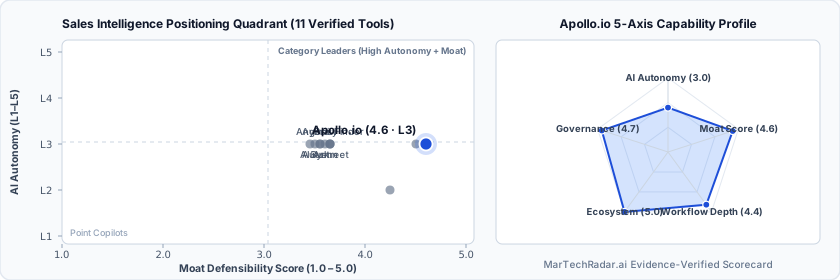
Editorial review
Fact-checked by Jiacky Lee (Managing Editor, AI Autonomy & Moat Methodology) on .
Background
Backed by $251.0M in equity funding and established in 2015 in San Francisco, United States, Apollo.io consolidates B2B contact data and sales engagement into a unified execution workspace. The platform targets growth-focused revenue operations leaders, sales development representatives, and pipeline generation teams seeking to collapse the distance between data acquisition and cold outreach. By collocating an index of over 275 million business profiles with outbound sequencing tools, the system serves as an operational hub for go-to-market execution.
How Apollo.io works
Apollo.io operates via a proprietary data graph fed by continuous web crawlers, public records parsing, and participatory data exchange networks. Ingestion pipelines normalize firmographic attributes, job changes, and verified email syntaxes into an indexed search architecture. Users apply multi-parameter boolean queries to isolate target buyer cohorts and ingest them directly into conditional execution sequences. Outbound modules govern email dispatch cadence, automated mailbox rotation, and call scheduling, writing activity logs back to connected customer relationship management instances via bi-directional sync pipelines, alongside native workflow integrations for Snowflake and Shopify under verified GDPR governance controls.
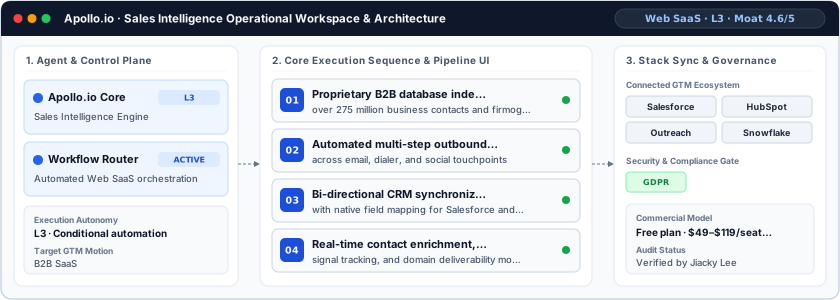
Limitations
Operational considerations and platform boundaries include:
- Direct-Dial Data Freshness: Mobile direct-dial accuracy degrades in specialized technical verticals, requiring third-party verification to avoid high bounce rates.
- CRM Schema Drift: High-velocity bidirectional synchronization creates field overwrites and deduplication bottlenecks when mapped against complex custom Salesforce schemas.
- Outbound Throttle Limits: Shared IP dispatch pools risk spam reputation decay if users deploy high-volume campaigns without manual domain throttling.
Apollo.io pricing
Apollo.io structures its commercial tiers through a per-seat subscription model paired with export credit allocations. Entry-level paid access begins at $49 per user monthly, providing sequence automation and baseline contact credits. Scaled outbound operations deploy the Professional tier at $119 per seat monthly to access advanced dialer functionality, uncapped email sequences, and expanded export thresholds, while enterprise agreements govern custom data governance and API volume.
How Apollo.io compares
Within the enrichment and execution landscape, Apollo.io balances native data coverage against Clay, which focuses on multi-provider waterfall orchestration rather than built-in dialers. It counters Cognism, which emphasizes phone-verified European compliance data, by delivering lower per-seat acquisition costs across North American profiles. Against AI Ark, Apollo.io prioritizes integrated pipeline engagement over autonomous research agents, making it optimal for mid-market revenue teams standardizing on an integrated outbound engine.
Direct competitors & market radar
Top algorithmic competitors based on category positioning, capability overlap, and ICP alignment.
Frequently asked questions about Apollo.io
How much does Apollo.io cost per seat and does it have a free plan?
Published pricing summary for Apollo.io: Free plan · $49–$119/seat/mo · Enterprise plan. Apollo.io includes a free tier or sandbox entry point. Verified tier schedule: Free / Sandbox ($0 for 1–2 seats (Evaluation)); Basic ($49/seat/mo for 1–2 seats); Professional ($79/seat/mo for 5 seats); Scale / Advanced ($119/seat/mo for 15 seats). Apollo.io structures its commercial tiers through a per-seat subscription model paired with export credit allocations. Entry-level paid access begins at $49 per user monthly, providing sequence automation and baseline contact credits.
How does Apollo.io work and how autonomous is its AI architecture?
B2B sales intelligence and engagement platform combining a 275M+ contact database with built-in multi-channel sequencing and enrichment workflows. Within Sales Intelligence (Lead Enrichment & Waterfall Orchestration), MarTechRadar rates its execution architecture at L3 · Conditional automation with a verified Moat Score of 4.6 / 5.0 (Proprietary moat (category leader)). Substantial proprietary B2B contact graph continuously verified via contributor networks, paired with integrated execution tooling that captures down-funnel engagement signals. Corporate profile: Founded by Ray Li, Roy Chung, Tim Zheng, operating at 501-1,000 employees scale.
What are the main limitations of Apollo.io and when should buyers walk away?
Based on our editorial technical audit, key operational considerations and boundaries for Apollo.io include: (1) Direct-Dial Data Freshness: Mobile direct-dial accuracy degrades in specialized technical verticals, requiring third-party verification to avoid high bounce rates. (2) CRM Schema Drift: High-velocity bidirectional synchronization creates field overwrites and deduplication bottlenecks when mapped against complex custom Salesforce schemas. (3) Outbound Throttle Limits: Shared IP dispatch pools risk spam reputation decay if users deploy high-volume campaigns without manual domain throttling. Primary procurement walk-away rule: Walk away if your workflow requires uncapped enterprise volume on the Free plan · $49–$119/seat/mo · Enterprise plan entry plan without upgrading tiers.
What integrations, compliance certifications, and contract terms apply to Apollo.io?
Verified ecosystem and stack integrations include Salesforce, HubSpot, Outreach, Snowflake, Shopify. Documented security and governance attestations include GDPR. First-party governance and developer endpoints verified on domain include: API Docs (https://www.apollo.io/developers). Key TCO multiplier to watch: Per-Seat Linear Scaling (Apollo.io prices licenses on a per-user/seat basis (Free plan · $49–$119/seat/mo · Enterprise plan); expanding from 2 to 15+ operators multiplies base recurring spend linearly.) Before signing a contract, procurement teams should validate exact quota thresholds (seats, credits, or API calls) included in Apollo.io's Free plan · $49–$119/seat/mo · Enterprise plan tier before converting from monthly to annual billing.
What are the best Apollo.io alternatives and head-to-head competitors in 2026?
Top fact-checked alternatives to Apollo.io in Sales Intelligence (Lead Enrichment & Waterfall Orchestration) include Clay (Free plan · $54–$180/mo), AI Ark ($49/mo), Cognism (Custom / enterprise pricing), ZoomInfo (Copilot) (Custom / enterprise pricing). Within the enrichment and execution landscape, Apollo.io balances native data coverage against Clay, which focuses on multi-provider waterfall orchestration rather than built-in dialers.
Verified sources & evidence trail
- Official product domain: https://apollo.io
- Commercial pricing verification: https://www.apollo.io/pricing
- Verified corporate entity profiles (
sameAs): LinkedIn Company Profile · Crunchbase Entity Record - First-party governance & documentation links: API & Docs · Terms · Privacy
- Editorial audit sign-off: Fact-checked by Jiacky Lee on under the MarTechRadar Evidence-Ledger Protocol.