Attio Review (2026): AI SDR Pricing, Limits & Alternatives
Bottom line
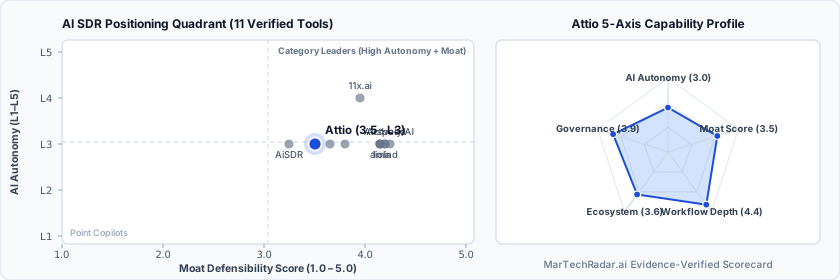
Attio is a Web SaaS tool for AI SDR (Autonomous B2B Sales Agents & AI BDRs) in AI SDR & Outbound. Pricing: $44–$99/seat/mo. Best suited to B2B Sales Leaders, SDR/BDR Teams and Revenue Operations (RevOps). Editor ratings: AI autonomy L3 (conditional automation); moat score 3.5/5.0 (Proprietary moat). Fact-checked by Jiacky Lee on Oct 10, 2026.
AI-native CRM and agentic revenue orchestration platform combining dynamic data modeling with automated outbound and inbound sales workflows.
Attio buyer fit verdict: when to choose vs. when to walk away
Choose Attio if (Best Fit)
- Target ICP & Stack Fit: You operate as B2B Sales Leaders, SDR/BDR Teams and Revenue Operations (RevOps) requiring a Web SaaS deployment for AI SDR, with verified ecosystem connectivity for Outreach.
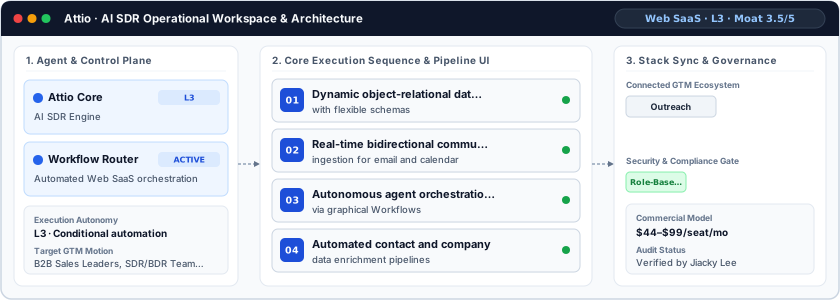
- L3 Architecture & Defensibility: Proprietary real-time communication stream indexing paired with a composable, object-relational data layer that triggers autonomous agentic revenue workflows without third-party integration middleware.
- Commercial Model Fit: Your procurement budget aligns with $44–$99/seat/mo.
Walk away from Attio if (Deal-Breakers)
- Walk away if your workflow requires uncapped enterprise volume on the $44–$99/seat/mo entry plan without upgrading tiers.
- Walk away if your workflow cannot tolerate API ingestion limits: High-volume external API syncing faces throughput throttling during bulk backfills, delaying historical message indexing across substantial legacy inboxes.
- Walk away if schema maintenance complexity is a deal-breaker for your team: Unconstrained custom object models demand strict governance, frequently leading to orphaned relationships if internal schema rules are modified without validation.
Attio key facts & scorecard
| Pricing | $44–$99/seat/moVendor pricing page |
|---|---|
| Free plan | No / not disclosed |
| Delivery | Web SaaS |
| Audience | B2B Sales Leaders, SDR/BDR Teams, Revenue Operations (RevOps) |
| AI autonomy level | L3 · Conditional automationEditor-verified |
| Moat tier & score | 3.5 / 5.0 · Proprietary moatEditor-verified |
| Funding | Series B |
| Total funding | $116.2MBacked by Redpoint, Balderton Capital, Headline |
| Founders | Alexander Christie, Nicolas Sharp |
| Company size | 51-200 employees |
| Ecosystem integrations | Outreach |
| Governance & docs | Trust & Security ↗ · System Status ↗ · API & Docs ↗ · Changelog ↗ · Privacy ↗ |
| Headquarters | London, United Kingdom |
| Founded | 2019 |
| Last verified |
Attio pros & cons: strengths vs. operational limitations
Pros: core strengths & capabilities
- Dynamic object-relational data model: with flexible schemas
- Real-time bidirectional communication stream: ingestion for email and calendar
- Autonomous agent orchestration engine: via graphical Workflows
- Automated contact and company: data enrichment pipelines
Cons: operational limitations & risks
- API Ingestion Limits: High-volume external API syncing faces throughput throttling during bulk backfills, delaying historical message indexing across substantial legacy inboxes.
- Schema Maintenance Complexity: Unconstrained custom object models demand strict governance, frequently leading to orphaned relationships if internal schema rules are modified without validation.
- Mailbox Deliverability Exposure: Automated workflow-driven email execution lacks native multi-domain rotational warmups, increasing deliverability risk without dedicated third-party outbound routing.
Attio TCO & deal-breaker stress test
Simulate 12-month stepped TCO, hidden cost multipliers, contract lock-in exposure, and stack failure modes using only facts verified by Jiacky Lee on · Capture SHA 77acde3c.
Attio aligns with your 5-seat / $800/mo profile. Review the walk-away triggers and contract levers below before deployment.
| Plan / Tier | Verified Rate | Scale Fit | Scope & Quota Notes |
|---|---|---|---|
| Entry / Starter | $44/seat/mo | 1–2 seats | Verified $44/seat/mo published rate on vendor pricing schedule. |
| Growth / Professional | $99/seat/mo | 5 seats | Verified $99/seat/mo published rate on vendor pricing schedule. |
- Moat Score
- 3.5 / 5.0
- AI Autonomy
- L3
- Free Tier / Trial
- None disclosed
Triggered audit signals & failure modes
- Published Self-Serve Entry FloorVerified Pricing Ledger
Attio publishes a transparent entry point ($44–$99/seat/mo) for initial validation before committing.
- Linear Per-Seat Scaling (5 Seats × $44/seat/mo)Commercial Model Audit
Base license scales linearly with operator headcount ($220/mo for 5 seats on Entry / Starter).
- Primary Operational Bottleneck: API Ingestion LimitsAudit by Jiacky Lee
High-volume external API syncing faces throughput throttling during bulk backfills, delaying historical message indexing across substantial legacy inboxes.
Hidden TCO Multipliers & Quota Gates
- Per-Seat Linear Scaling: Attio prices licenses on a per-user/seat basis ($44–$99/seat/mo); expanding from 2 to 15+ operators multiplies base recurring spend linearly.
- Annual Billing Headline vs. Monthly Premium: Headline entry rates reflect annual billing commitments (Save 20%); month-to-month flexibility carries a higher effective monthly rate or requires annual prepayment.
- Credit & Usage Burn Multiplier: Automated workflows consume metered credits/usage quotas; multi-step enrichment, voice minutes, or high-frequency agent runs can trigger mid-cycle top-up packs.
When to Walk Away & Negotiation Levers
- Walk away if your workflow requires uncapped enterprise volume on the $44–$99/seat/mo entry plan without upgrading tiers.
- Walk away if your workflow cannot tolerate API ingestion limits: High-volume external API syncing faces throughput throttling during bulk backfills, delaying historical message indexing across substantial legacy inboxes.
- Walk away if schema maintenance complexity is a deal-breaker for your team: Unconstrained custom object models demand strict governance, frequently leading to orphaned relationships if internal schema rules are modified without validation.
- Validate exact quota thresholds (seats, credits, or API calls) included in Attio's $44–$99/seat/mo tier before converting from monthly to annual billing.
- Require a sandbox proof-of-concept testing API ingestion limits against your live CRM/data schema before annual sign-off.
Ask a custom procurement or TCO stress-test question about Attio
Lower 5-seat floor (~$20/mo vs. $220 / mo)
Lower 5-seat floor (~$20/mo vs. $220 / mo)
Attio key entities, modules & ecosystem stack
Attio moat & subtrack positioning
Proprietary real-time communication stream indexing paired with a composable, object-relational data layer that triggers autonomous agentic revenue workflows without third-party integration middleware.
Editorial review
Fact-checked by Jiacky Lee (Managing Editor, AI Autonomy & Moat Methodology) on .
Background
Architectured as a flexible, AI-native CRM foundation, Attio was established in 2019 in London, United Kingdom, to resolve the rigid data schemas and manual maintenance inherent to conventional customer relationship systems. Backed by $116.2M in venture funding, the company engineers a composable data layer for technical revenue operations and modern go-to-market teams. The platform refactors the revenue stack by transforming static customer records into an active, event-driven graph capable of coordinating autonomous agent workflows across the sales pipeline.
How Attio works
Attio functions through an object-relational database engine that continuously ingests metadata across email and calendar providers. Instead of requiring manual record entry, the system synchronizes interaction histories in real time, calculating relationship strength signals and mapping cross-entity connections. Revenue operations teams leverage its Workflows module to orchestrate autonomous execution at Level 3 autonomy: incoming events, webhooks, or schema modifications trigger automated multi-step logic paths, programmatic enrichment, and autonomous communication routing without requiring intermediate integration middleware.
Limitations
Operational considerations and platform boundaries include:
- API Ingestion Limits: High-volume external API syncing faces throughput throttling during bulk backfills, delaying historical message indexing across substantial legacy inboxes.
- Schema Maintenance Complexity: Unconstrained custom object models demand strict governance, frequently leading to orphaned relationships if internal schema rules are modified without validation.
- Mailbox Deliverability Exposure: Automated workflow-driven email execution lacks native multi-domain rotational warmups, increasing deliverability risk without dedicated third-party outbound routing.
Attio pricing
Attio utilizes a tiered seat-based subscription model. A free tier is offered at $0 per user/month for individuals exploring core capabilities. Scaled commercial access starts with the Plus tier at $44 per user/month for growing teams requiring private lists and expanded email volume. Advanced agentic orchestration and enriched operational limits are packaged in the Pro tier at $99 per user/month, with custom enterprise commitments negotiated separately.
How Attio compares
While autonomous outbound solutions like 11x.ai, 1mind, and Actively AI function as specialized execution point agents for cold outreach, Attio serves as the structural system of record that houses both dynamic relational data and agentic execution logic. Dedicated AI BDR platforms deliver pre-packaged outbound conversational cadences, but Attio provides superior architectural flexibility, allowing engineering-centric GTM teams to design custom autonomous triggers directly inside their operational core.
Direct competitors & market radar
Top algorithmic competitors based on category positioning, capability overlap, and ICP alignment.
Frequently asked questions about Attio
How much does Attio cost per seat and does it have a free plan?
Published pricing summary for Attio: $44–$99/seat/mo. A permanent free plan is not disclosed for Attio. Verified tier schedule: Entry / Starter ($44/seat/mo for 1–2 seats); Growth / Professional ($99/seat/mo for 5 seats). Attio utilizes a tiered seat-based subscription model. A free tier is offered at $0 per user/month for individuals exploring core capabilities. Scaled commercial access starts with the Plus tier at $44 per user/month for growing teams requiring private lists and expanded email volume.
How does Attio work and how autonomous is its AI architecture?
AI-native CRM and agentic revenue orchestration platform combining dynamic data modeling with automated outbound and inbound sales workflows. Within AI SDR (Autonomous B2B Sales Agents & AI BDRs), MarTechRadar rates its execution architecture at L3 · Conditional automation with a verified Moat Score of 3.5 / 5.0 (Proprietary moat). Proprietary real-time communication stream indexing paired with a composable, object-relational data layer that triggers autonomous agentic revenue workflows without third-party integration middleware. Corporate profile: Founded by Alexander Christie, Nicolas Sharp, operating at 51-200 employees scale.
What are the main limitations of Attio and when should buyers walk away?
Based on our editorial technical audit, key operational considerations and boundaries for Attio include: (1) API Ingestion Limits: High-volume external API syncing faces throughput throttling during bulk backfills, delaying historical message indexing across substantial legacy inboxes. (2) Schema Maintenance Complexity: Unconstrained custom object models demand strict governance, frequently leading to orphaned relationships if internal schema rules are modified without validation. (3) Mailbox Deliverability Exposure: Automated workflow-driven email execution lacks native multi-domain rotational warmups, increasing deliverability risk without dedicated third-party outbound routing. Primary procurement walk-away rule: Walk away if your workflow requires uncapped enterprise volume on the $44–$99/seat/mo entry plan without upgrading tiers.
What integrations, compliance certifications, and contract terms apply to Attio?
Verified ecosystem and stack integrations include Outreach. First-party governance and developer endpoints verified on domain include: Trust/Security (https://trust.attio.com), Status (https://status.attio.com), API Docs (https://attio.com/platform/developers). Key TCO multiplier to watch: Per-Seat Linear Scaling (Attio prices licenses on a per-user/seat basis ($44–$99/seat/mo); expanding from 2 to 15+ operators multiplies base recurring spend linearly.) Before signing a contract, procurement teams should validate exact quota thresholds (seats, credits, or API calls) included in Attio's $44–$99/seat/mo tier before converting from monthly to annual billing.
What are the best Attio alternatives and head-to-head competitors in 2026?
Top fact-checked alternatives to Attio in AI SDR (Autonomous B2B Sales Agents & AI BDRs) include Salesforce Agentforce (Free plan · $0/mo · Enterprise plan), HubSpot Breeze (Free plan · $0/mo · Enterprise plan), Vivun (From $20/mo), Octolane AI (From $20/mo). While autonomous outbound solutions like 11x.ai, 1mind, and Actively AI function as specialized execution point agents for cold outreach, Attio serves as the structural system of record that houses both dynamic relational data and agentic execution logic.
Verified sources & evidence trail
- Official product domain: https://attio.com
- Commercial pricing verification: https://attio.com/pricing
- Verified corporate entity profiles (
sameAs): LinkedIn Company Profile · Crunchbase Entity Record - First-party governance & documentation links: Trust & Security · System Status · API & Docs · Changelog · Privacy
- Editorial audit sign-off: Fact-checked by Jiacky Lee on under the MarTechRadar Evidence-Ledger Protocol.