Salesforce Agentforce Review (2026): Enterprise AI Marketing Pricing, Limits & Alternatives
Bottom line
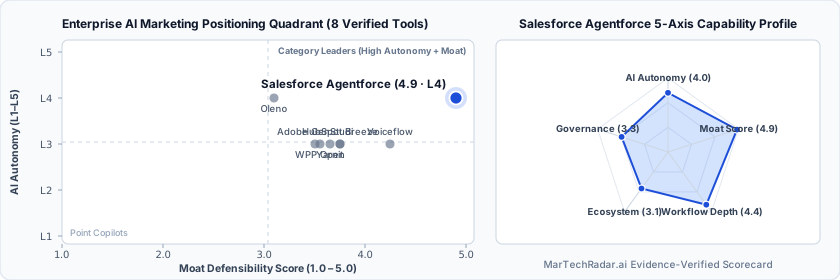
Salesforce Agentforce is a Web SaaS tool for Enterprise AI Marketing (Enterprise Marketing OS & Ecosystem Agents) in Agent & Marketing Ops. Pricing: Free plan · $0/mo · Enterprise plan. Best suited to B2B SaaS, DTC / eCommerce and Enterprise Brands. Editor ratings: AI autonomy L4 (autonomous agent); moat score 4.9/5.0 (Proprietary moat (category leader)). Fact-checked by Sarah Per on Oct 7, 2026.
Autonomous enterprise AI agent platform integrated into Customer 360 to orchestrate multi-step business logic across service, sales, and marketing.
Salesforce Agentforce buyer fit verdict: when to choose vs. when to walk away
Choose Salesforce Agentforce if (Best Fit)
- Target ICP & Stack Fit: You operate as B2B SaaS, DTC / eCommerce and Enterprise Brands requiring a Web SaaS deployment for Enterprise AI Marketing, with verified ecosystem connectivity for HubSpot.
- L4 Architecture & Defensibility: Deep integration with the proprietary Salesforce metadata architecture, unified Data Cloud access, and the Atlas Reasoning Engine providing grounded multi-step workflow execution.
- Commercial Model Fit: Your procurement budget aligns with Free plan · $0/mo · Enterprise plan and want a self-serve free tier for zero-cost initial validation.
Walk away from Salesforce Agentforce if (Deal-Breakers)
- Walk away if your workflow requires uncapped enterprise volume on the Free plan · $0/mo · Enterprise plan entry plan without upgrading tiers.
- Walk away if your workflow cannot tolerate data cloud schema dependency: Agent accuracy and execution reliability degrade when enterprise data is fragmented outside Salesforce Data Cloud or lacks rigorous entity resolution.
- Walk away if action boundary drift is a deal-breaker for your team: Orchestrating autonomous logic through complex custom Flows requires exhaustive guardrail configuration to prevent unwanted updates across production transactional records.
Salesforce Agentforce key facts & scorecard
| Pricing | Free plan · $0/mo · Enterprise planVendor pricing page |
|---|---|
| Free plan | Yes |
| Delivery | Web SaaS |
| Audience | B2B SaaS, DTC / eCommerce, Enterprise Brands |
| AI autonomy level | L4 · Autonomous agentEditor-verified |
| Moat tier & score | 4.9 / 5.0 · Proprietary moat (category leader)Editor-verified |
| Funding | Public company |
| Ecosystem integrations | HubSpot |
| Governance & docs | Privacy ↗ |
| Headquarters | San Francisco, United States |
| Founded | 1999 |
| Last verified |
Salesforce Agentforce pros & cons: strengths vs. operational limitations
Pros: core strengths & capabilities
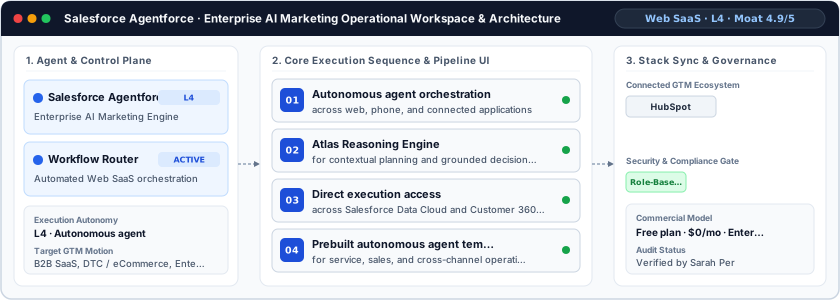
- Autonomous agent orchestration: across web, phone, and connected applications
- Atlas Reasoning Engine: for contextual planning and grounded decision cycles
- Direct execution access: across Salesforce Data Cloud and Customer 360 records
- Prebuilt autonomous agent templates: for service, sales, and cross-channel operations
Cons: operational limitations & risks
- Data Cloud Schema Dependency: Agent accuracy and execution reliability degrade when enterprise data is fragmented outside Salesforce Data Cloud or lacks rigorous entity resolution.
- Action Boundary Drift: Orchestrating autonomous logic through complex custom Flows requires exhaustive guardrail configuration to prevent unwanted updates across production transactional records.
- Latency Overhead: Multi-hop reasoning cycles introduce measurable response lag during real-time voice and high-throughput telephony interactions.
Salesforce Agentforce TCO & deal-breaker stress test
Simulate 12-month stepped TCO, hidden cost multipliers, contract lock-in exposure, and stack failure modes using only facts verified by Sarah Per on · Capture SHA 6c9e6243.
Salesforce Agentforce is viable for 5 seats, but requires commercial or technical verification on the flagged items below.
| Plan / Tier | Verified Rate | Scale Fit | Scope & Quota Notes |
|---|---|---|---|
| Free / Sandbox | $0 | 1–2 seats (Evaluation) | Entry free tier with capped usage or feature quotas for initial workflow testing. |
| Entry / Starter | $0.15/mo | 1–2 seats | 120 Flex Credits X 300 calls per month Agentforce Voice actions per call = $180 per month |
| Enterprise / Custom | Custom quote | 15–50+ seats (Enterprise SLA) | Sales-negotiated annual contract for custom volume, SSO/RBAC governance, and dedicated SLA. |
- Moat Score
- 4.9 / 5.0
- AI Autonomy
- L4
- Free Tier / Trial
- Free plan
Triggered audit signals & failure modes
- Opaque Enterprise Quoting vs. SMB/Mid-Market BudgetVerified Pricing Ledger
Salesforce Agentforce does not disclose a public self-serve floor (Free plan · $0/mo · Enterprise plan). Buyers with a $800/mo cap face high sales-qualification friction.
- Published Self-Serve Entry FloorVerified Pricing Ledger
Salesforce Agentforce publishes a transparent entry point (Free plan · $0/mo · Enterprise plan) with a free tier for initial validation before committing.
- Primary Operational Bottleneck: Data Cloud Schema DependencyAudit by Sarah Per
Agent accuracy and execution reliability degrade when enterprise data is fragmented outside Salesforce Data Cloud or lacks rigorous entity resolution.
Hidden TCO Multipliers & Quota Gates
- Credit & Usage Burn Multiplier: Automated workflows consume metered credits/usage quotas; multi-step enrichment, voice minutes, or high-frequency agent runs can trigger mid-cycle top-up packs.
- Enterprise Governance & Add-On Gating: Advanced capabilities such as Single Sign-On (SSO), custom role permissions, or specialized analytics modules are gated behind upper tiers or paid add-ons.
When to Walk Away & Negotiation Levers
- Walk away if your workflow requires uncapped enterprise volume on the Free plan · $0/mo · Enterprise plan entry plan without upgrading tiers.
- Walk away if your workflow cannot tolerate data cloud schema dependency: Agent accuracy and execution reliability degrade when enterprise data is fragmented outside Salesforce Data Cloud or lacks rigorous entity resolution.
- Walk away if action boundary drift is a deal-breaker for your team: Orchestrating autonomous logic through complex custom Flows requires exhaustive guardrail configuration to prevent unwanted updates across production transactional records.
- Validate exact quota thresholds (seats, credits, or API calls) included in Salesforce Agentforce's Free plan · $0/mo · Enterprise plan tier before converting from monthly to annual billing.
- Require a sandbox proof-of-concept testing data cloud schema dependency against your live CRM/data schema before annual sign-off.
Ask a custom procurement or TCO stress-test question about Salesforce Agentforce
Lower 5-seat floor (~$220/mo vs. Custom Quote)
Lower 5-seat floor (~$300/mo vs. Custom Quote)
Salesforce Agentforce key entities, modules & ecosystem stack
Salesforce Agentforce moat & subtrack positioning
Deep integration with the proprietary Salesforce metadata architecture, unified Data Cloud access, and the Atlas Reasoning Engine providing grounded multi-step workflow execution.
Editorial review
Fact-checked by Sarah Per (Principal Content Systems & Generative Media Editor) on .
Background
Operating from San Francisco, United States, Salesforce was established in 1999, evolving from a multi-tenant cloud CRM pioneer into a comprehensive enterprise operational suite. Within this environment, Salesforce Agentforce functions as an autonomous system designed to transition enterprise organizations from static copilots to proactive digital workers. Targeted at enterprise revenue operations, customer support organizations, and marketing leaders, the platform embeds autonomous decision-making directly into the broader Customer 360 surface.
How Salesforce Agentforce works
At its technical core, Agentforce utilizes the proprietary Atlas Reasoning Engine to evaluate multi-step objectives against live context retrieved from Salesforce Data Cloud. The engine continuously parses inbound user actions across web, telephony, or mobile endpoints, grounds incoming requests within unified metadata schemas, and generates execution plans. Rather than generating simple text replies, it executes autonomous business processes through Flow actions and platform APIs, maintaining bounded state tracking throughout complex workflows.
Limitations
Operational considerations and platform boundaries include:
- Data Cloud Schema Dependency: Agent accuracy and execution reliability degrade when enterprise data is fragmented outside Salesforce Data Cloud or lacks rigorous entity resolution.
- Action Boundary Drift: Orchestrating autonomous logic through complex custom Flows requires exhaustive guardrail configuration to prevent unwanted updates across production transactional records.
- Latency Overhead: Multi-hop reasoning cycles introduce measurable response lag during real-time voice and high-throughput telephony interactions.
Salesforce Agentforce pricing
Salesforce provides an entry tier starting at $0 for initial evaluation via foundation tiers, alongside custom enterprise plans governed by consumption units such as conversations or flex credits. Production deployments scale through modular usage contracts tailored to organizational volume and per-agent computational overhead.
How Salesforce Agentforce compares
In contrast to Adobe GenStudio, which focuses heavily on content supply chains, and HubSpot Breeze, which targets mid-market inbound automation, Agentforce relies on unified enterprise metadata to support autonomous execution across deep core CRM records. It remains best suited for large enterprises deeply invested in Salesforce infrastructure requiring structured, autonomous workflow execution. Enterprise procurement teams evaluating deployment readiness should assess API webhook throughput, role-based access governance, and bilateral data synchronization latency against existing marketing technology infrastructure before committing to multi-year production rollouts.
Direct competitors & market radar
Top algorithmic competitors based on category positioning, capability overlap, and ICP alignment.
Frequently asked questions about Salesforce Agentforce
How much does Salesforce Agentforce cost and what pricing tiers are available?
Published pricing summary for Salesforce Agentforce: Free plan · $0/mo · Enterprise plan. Salesforce Agentforce includes a free tier or sandbox entry point. Verified tier schedule: Free / Sandbox ($0 for 1–2 seats (Evaluation)); Entry / Starter ($0.15/mo for 1–2 seats); Enterprise / Custom (Custom quote for 15–50+ seats (Enterprise SLA)). Salesforce provides an entry tier starting at $0 for initial evaluation via foundation tiers, alongside custom enterprise plans governed by consumption units such as conversations or flex credits.
How does Salesforce Agentforce work and how autonomous is its AI architecture?
Autonomous enterprise AI agent platform integrated into Customer 360 to orchestrate multi-step business logic across service, sales, and marketing. Within Enterprise AI Marketing (Enterprise Marketing OS & Ecosystem Agents), MarTechRadar rates its execution architecture at L4 · Autonomous agent with a verified Moat Score of 4.9 / 5.0 (Proprietary moat (category leader)). Deep integration with the proprietary Salesforce metadata architecture, unified Data Cloud access, and the Atlas Reasoning Engine providing grounded multi-step workflow execution.
What are the main limitations of Salesforce Agentforce and when should buyers walk away?
Based on our editorial technical audit, key operational considerations and boundaries for Salesforce Agentforce include: (1) Data Cloud Schema Dependency: Agent accuracy and execution reliability degrade when enterprise data is fragmented outside Salesforce Data Cloud or lacks rigorous entity resolution. (2) Action Boundary Drift: Orchestrating autonomous logic through complex custom Flows requires exhaustive guardrail configuration to prevent unwanted updates across production transactional records. (3) Latency Overhead: Multi-hop reasoning cycles introduce measurable response lag during real-time voice and high-throughput telephony interactions. Primary procurement walk-away rule: Walk away if your workflow requires uncapped enterprise volume on the Free plan · $0/mo · Enterprise plan entry plan without upgrading tiers.
What integrations, compliance certifications, and contract terms apply to Salesforce Agentforce?
Verified ecosystem and stack integrations include HubSpot. Key TCO multiplier to watch: Credit & Usage Burn Multiplier (Automated workflows consume metered credits/usage quotas; multi-step enrichment, voice minutes, or high-frequency agent runs can trigger mid-cycle top-up packs.) Before signing a contract, procurement teams should validate exact quota thresholds (seats, credits, or API calls) included in Salesforce Agentforce's Free plan · $0/mo · Enterprise plan tier before converting from monthly to annual billing.
What are the best Salesforce Agentforce alternatives and head-to-head competitors in 2026?
Top fact-checked alternatives to Salesforce Agentforce in Enterprise AI Marketing (Enterprise Marketing OS & Ecosystem Agents) include Attio ($44–$99/seat/mo), HubSpot Breeze (Free plan · $0/mo · Enterprise plan), Reevo (Custom / enterprise pricing), Adobe GenStudio (Custom / enterprise pricing). In contrast to Adobe GenStudio, which focuses heavily on content supply chains, and HubSpot Breeze, which targets mid-market inbound automation, Agentforce relies on unified enterprise metadata to support autonomous execution across deep core CRM records.
Verified sources & evidence trail
- Official product domain: https://salesforce.com/agentforce
- Commercial pricing verification: https://www.salesforce.com/agentforce/pricing/
- First-party governance & documentation links: Privacy
- Editorial audit sign-off: Fact-checked by Sarah Per on under the MarTechRadar Evidence-Ledger Protocol.