Yarnit Review (2026): Enterprise AI Marketing Pricing, Limits & Alternatives
Bottom line
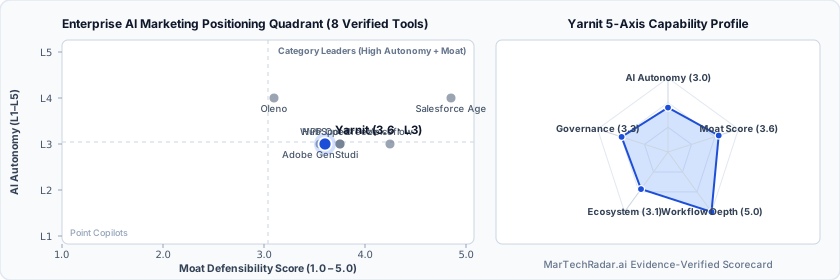
Yarnit is a Web SaaS tool for Enterprise AI Marketing (Enterprise Marketing OS & Ecosystem Agents) in Agent & Marketing Ops. Pricing: Pricing not disclosed. Best suited to B2B SaaS and Marketing & Growth Teams. Editor ratings: AI autonomy L3 (conditional automation); moat score 3.6/5.0 (Proprietary moat). Fact-checked by Jiacky Lee on Oct 17, 2026.
Enterprise agentic marketing operating system unifying campaign strategy, multimodal content, and brand memory.
Yarnit buyer fit verdict: when to choose vs. when to walk away
Choose Yarnit if (Best Fit)
- Target ICP & Stack Fit: You operate as B2B SaaS and Marketing & Growth Teams requiring a Web SaaS deployment for Enterprise AI Marketing.
- L3 Architecture & Defensibility: Yarnit builds an enterprise marketing orchestration moat through its YaOS multi-agent runtime and Memora contextual memory architecture, connecting audience research, creative generation, and publishing.
- Commercial Model Fit: Your procurement budget aligns with Pricing not disclosed.
Walk away from Yarnit if (Deal-Breakers)
- Walk away if you require transparent self-serve monthly billing or your budget ceiling is under $1,000/mo (Yarnit requires sales-gated custom quoting).
- Walk away if your workflow cannot tolerate brand memory & catalog onboarding curve: Unlocking high-precision autonomous output from Memora and YaOS requires marketing operations teams to upload structured brand books, visual templates, and clean product feeds upfront, creating an initial setup bottleneck.
- Walk away if enterprise demo-gated commercial access is a deal-breaker for your team: Because Yarnit transitioned from self-serve creator plans to an enterprise Marketing OS licensing model without public flat-rate pricing on its homepage, small teams must go through a sales consultation to evaluate cost.
Yarnit key facts & scorecard
| Pricing | Pricing not disclosed |
|---|---|
| Free plan | No / not disclosed |
| Delivery | Web SaaS |
| Audience | B2B SaaS, Marketing & Growth Teams |
| AI autonomy level | L3 · Conditional automationEditor-verified |
| Moat tier & score | 3.6 / 5.0 · Proprietary moatEditor-verified |
| Funding | Undisclosed |
| Founders | Akash Jain, Jyotirmoy Dutta |
| Company size | 11-50 employees |
| Governance & docs | Terms ↗ · Privacy ↗ |
| Headquarters | Bangalore, India |
| Founded | 2021 |
| Last verified |
Yarnit pros & cons: strengths vs. operational limitations
Pros: core strengths & capabilities
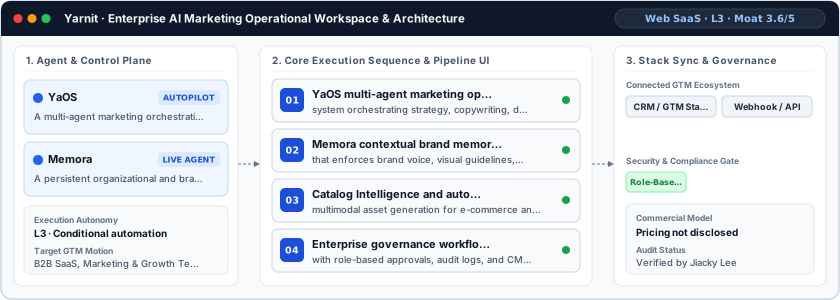
- YaOS multi-agent marketing operating: system orchestrating strategy, copywriting, design, and publishing agents
- Memora contextual brand memory layer: that enforces brand voice, visual guidelines, and product catalog accuracy
- Catalog Intelligence and automated: multimodal asset generation for e-commerce and enterprise B2B campaigns
- Enterprise governance workflows: with role-based approvals, audit logs, and CMS/social channel integrations
Cons: operational limitations & risks
- Brand Memory & Catalog Onboarding Curve: Unlocking high-precision autonomous output from Memora and YaOS requires marketing operations teams to upload structured brand books, visual templates, and clean product feeds upfront, creating an initial setup bottleneck.
- Enterprise Demo-Gated Commercial Access: Because Yarnit transitioned from self-serve creator plans to an enterprise Marketing OS licensing model without public flat-rate pricing on its homepage, small teams must go through a sales consultation to evaluate cost.
- Downstream Paid Media Bidding Scope: Yarnit specializes in campaign strategy, catalog intelligence, and multimodal content orchestration rather than real-time programmatic DSP bidding or econometric MMM attribution.
Yarnit TCO & deal-breaker stress test
Simulate 12-month stepped TCO, hidden cost multipliers, contract lock-in exposure, and stack failure modes using only facts verified by Jiacky Lee on · Capture SHA 56a49421.
Yarnit triggers high-severity friction under your 5-seat / $800/mo constraints. Benchmark the verified subtrack alternatives below before committing.
| Plan / Tier | Verified Rate | Scale Fit | Scope & Quota Notes |
|---|---|---|---|
| Enterprise / Custom | Custom quote | 15–50+ seats (Enterprise SLA) | Sales-negotiated annual contract for custom volume, SSO/RBAC governance, and dedicated SLA. |
- Moat Score
- 3.6 / 5.0
- AI Autonomy
- L3
- Free Tier / Trial
- None disclosed
Triggered audit signals & failure modes
- Opaque Enterprise Quoting vs. SMB/Mid-Market BudgetVerified Pricing Ledger
Yarnit does not disclose a public self-serve floor (Pricing not disclosed). Buyers with a $800/mo cap face high sales-qualification friction.
- Sales-Gated Contract TermsFact-checked by Jiacky Lee
Pricing is available on request through custom enterprise quotes tailored to active marketing seats, brand workspaces, catalog SKU volume, and custom agent workflow integrations.
- Primary Operational Bottleneck: Enterprise Demo-Gated Commercial AccessAudit by Jiacky Lee
Because Yarnit transitioned from self-serve creator plans to an enterprise Marketing OS licensing model without public flat-rate pricing on its homepage, small teams must go through a sales consultation to evaluate cost.
Hidden TCO Multipliers & Quota Gates
- Profile / Workspace Quota Ceilings: Base tiers cap the number of connected profiles, workspaces, or contact records, forcing tier upgrades before seat limits are reached.
- Brand Memory & Catalog Onboarding Curve: Unlocking high-precision autonomous output from Memora and YaOS requires marketing operations teams to upload structured brand books, visual templates, and clean product feeds upfront, creating an initial setup bottleneck.
- Enterprise Demo-Gated Commercial Access: Because Yarnit transitioned from self-serve creator plans to an enterprise Marketing OS licensing model without public flat-rate pricing on its homepage, small teams must go through a sales consultation to evaluate cost.
When to Walk Away & Negotiation Levers
- Walk away if you require transparent self-serve monthly billing or your budget ceiling is under $1,000/mo (Yarnit requires sales-gated custom quoting).
- Walk away if your workflow cannot tolerate brand memory & catalog onboarding curve: Unlocking high-precision autonomous output from Memora and YaOS requires marketing operations teams to upload structured brand books, visual templates, and clean product feeds upfront, creating an initial setup bottleneck.
- Walk away if enterprise demo-gated commercial access is a deal-breaker for your team: Because Yarnit transitioned from self-serve creator plans to an enterprise Marketing OS licensing model without public flat-rate pricing on its homepage, small teams must go through a sales consultation to evaluate cost.
- Demand a 30- to 60-day paid pilot opt-out clause in the Yarnit order form before signing a 12-month enterprise commitment.
- Require a sandbox proof-of-concept testing brand memory & catalog onboarding curve against your live CRM/data schema before annual sign-off.
Ask a custom procurement or TCO stress-test question about Yarnit
Lower 5-seat floor (~$299/mo vs. Custom Quote)
Offers a free tier (Free plan · $0/mo · Enterprise plan) · Transparent self-serve entry without mandatory annual lock-in
Yarnit key entities, modules & ecosystem stack
A multi-agent marketing orchestration runtime
A persistent organizational and brand memory graph
Yarnit moat & subtrack positioning
Yarnit builds an enterprise marketing orchestration moat through its YaOS multi-agent runtime and Memora contextual memory architecture, connecting audience research, creative generation, and publishing.
Editorial review
Fact-checked by Jiacky Lee (Managing Editor, AI Autonomy & Moat Methodology) on .
Background
Founded in 2021 by Akash Jain and Jyotirmoy Dutta and headquartered in Bangalore, India (with US presence in Delaware), Yarnit (yarnit.app) is an enterprise agentic marketing operating system built for brand marketing teams, e-commerce merchandisers, and digital agencies. Operating with a team of 11 to 50 employees, the company replaces disconnected prompt writing and graphic design point tools with a unified multi-agent platform that takes marketing campaigns from audience research to localized, brand-compliant asset execution.
How Yarnit works
Yarnit operates at Level 3 autonomy through two core architectural layers: YaOS (a multi-agent marketing orchestration runtime) and Memora (a persistent organizational and brand memory graph). Traditional generative AI tools lose context between campaign briefs, copywriting, and visual layout. Memora ingests an enterprise's brand guidelines, historical high-performing campaigns, audience personas, and live e-commerce product catalogs, while YaOS dispatches specialized autonomous agents to plan campaign calendars, generate multimodal copy and visual creatives, localize assets across channels, and route deliverables through human approval workflows.
Limitations
Operational limitations and technical trade-offs include:
- Brand Memory & Catalog Onboarding Curve: Unlocking high-precision autonomous output from Memora and YaOS requires marketing operations teams to upload structured brand books, visual templates, and clean product feeds upfront, creating an initial setup bottleneck.
- Enterprise Demo-Gated Commercial Access: Because Yarnit transitioned from self-serve creator plans to an enterprise Marketing OS licensing model without public flat-rate pricing on its homepage, small teams must go through a sales consultation to evaluate cost.
- Downstream Paid Media Bidding Scope: Yarnit specializes in campaign strategy, catalog intelligence, and multimodal content orchestration rather than real-time programmatic DSP bidding or econometric MMM attribution.
Yarnit pricing
Pricing is available on request through custom enterprise quotes tailored to active marketing seats, brand workspaces, catalog SKU volume, and custom agent workflow integrations. Enterprise marketing and e-commerce leaders can book a tailored platform walkthrough via the Yarnit website.
How Yarnit compares
Within the Enterprise Marketing OS & Ecosystem Agents category, Yarnit competes against multi-agent marketing workspace alternatives such as Jasper, Typeface, and Writer. Versus text-heavy enterprise assistants like Writer that lack integrated visual layout and e-commerce catalog intelligence, Yarnit differentiates itself through its Memora contextual memory graph and end-to-end multimodal design-plus-copy agent orchestration. Enterprise marketing and retail teams choose Yarnit to scale brand-consistent campaign production.
Frequently asked questions about Yarnit
How much does Yarnit cost and does it require a custom enterprise quote?
Published pricing summary for Yarnit: Pricing not disclosed. A permanent free plan is not disclosed for Yarnit. Pricing is available on request through custom enterprise quotes tailored to active marketing seats, brand workspaces, catalog SKU volume, and custom agent workflow integrations. Enterprise marketing and e-commerce leaders can book a tailored platform walkthrough via the Yarnit website.
How does Yarnit work and how autonomous is its AI architecture?
Enterprise agentic marketing operating system unifying campaign strategy, multimodal content, and brand memory. Within Enterprise AI Marketing (Enterprise Marketing OS & Ecosystem Agents), MarTechRadar rates its execution architecture at L3 · Conditional automation with a verified Moat Score of 3.6 / 5.0 (Proprietary moat). Yarnit builds an enterprise marketing orchestration moat through its YaOS multi-agent runtime and Memora contextual memory architecture, connecting audience research, creative generation, and publishing. Corporate profile: Founded by Akash Jain, Jyotirmoy Dutta, operating at 11-50 employees scale.
What are the main limitations of Yarnit and when should buyers walk away?
Based on our editorial technical audit, key operational considerations and boundaries for Yarnit include: (1) Brand Memory & Catalog Onboarding Curve: Unlocking high-precision autonomous output from Memora and YaOS requires marketing operations teams to upload structured brand books, visual templates, and clean product feeds upfront, creating an initial setup bottleneck. (2) Enterprise Demo-Gated Commercial Access: Because Yarnit transitioned from self-serve creator plans to an enterprise Marketing OS licensing model without public flat-rate pricing on its homepage, small teams must go through a sales consultation to evaluate cost. (3) Downstream Paid Media Bidding Scope: Yarnit specializes in campaign strategy, catalog intelligence, and multimodal content orchestration rather than real-time programmatic DSP bidding or econometric MMM attribution. Primary procurement walk-away rule: Walk away if you require transparent self-serve monthly billing or your budget ceiling is under $1,000/mo (Yarnit requires sales-gated custom quoting).
What integrations, compliance certifications, and contract terms apply to Yarnit?
Key TCO multiplier to watch: Profile / Workspace Quota Ceilings (Base tiers cap the number of connected profiles, workspaces, or contact records, forcing tier upgrades before seat limits are reached.) Before signing a contract, procurement teams should demand a 30- to 60-day paid pilot opt-out clause in the Yarnit order form before signing a 12-month enterprise commitment.
What are the best Yarnit alternatives and head-to-head competitors in 2026?
Top fact-checked alternatives to Yarnit in Enterprise AI Marketing (Enterprise Marketing OS & Ecosystem Agents) include Oleno (From $299/mo), Voiceflow (Custom / enterprise pricing), Sedric AI (Pricing not disclosed), WPP Open (Custom / enterprise pricing). Within the Enterprise Marketing OS & Ecosystem Agents category, Yarnit competes against multi-agent marketing workspace alternatives such as Jasper, Typeface, and Writer.
Verified sources & evidence trail
- Official product domain: https://yarnit.app
- Commercial pricing verification: Verified against official vendor pricing policy (Pricing not disclosed)
- Verified corporate entity profiles (
sameAs): LinkedIn Company Profile · Crunchbase Entity Record - First-party governance & documentation links: Terms · Privacy
- Editorial audit sign-off: Fact-checked by Jiacky Lee on under the MarTechRadar Evidence-Ledger Protocol.