Agents Review (2026): ChatGPT for Marketing Pricing, Limits & Alternatives
Bottom line
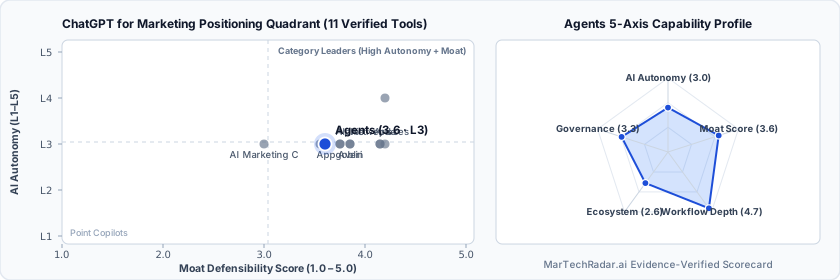
Agents is a Web SaaS tool for ChatGPT for Marketing (Open-Source Marketing Agents & Prompts) in Agent & Marketing Ops. Pricing: From $0.01/mo. Best suited to B2B SaaS. Editor ratings: AI autonomy L3 (conditional automation); moat score 3.6/5.0 (Proprietary moat). Fact-checked by Vasilia Xia on Oct 15, 2026.
Marketing agent orchestration layer exposing multi-platform MCP servers and programmatic data tools directly within ChatGPT, Claude, and developer.
Agents buyer fit verdict: when to choose vs. when to walk away
Choose Agents if (Best Fit)
- Target ICP & Stack Fit: You operate as B2B SaaS requiring a Web SaaS deployment for ChatGPT for Marketing.
- L3 Architecture & Defensibility: Standardized Model Context Protocol (MCP) server distribution connecting conversational LLM interfaces to live social data endpoints without requiring external user API keys.
- Commercial Model Fit: Your procurement budget aligns with From $0.01/mo.
Walk away from Agents if (Deal-Breakers)
- Walk away if your workflow requires uncapped enterprise volume on the From $0.01/mo entry plan without upgrading tiers.
- Walk away if your workflow cannot tolerate mcp context overhead: Registering dozens of tool schemas across an active MCP session consumes substantial prompt token allocations, degrading available context capacity for multi-turn conversational history.
- Walk away if third-party scraper fragility is a deal-breaker for your team: Data extraction endpoints targeting social platforms operate without official developer keys, rendering downstream ingestion susceptible to upstream DOM structural changes and IP rate throttling.
Agents key facts & scorecard
| Pricing | From $0.01/moVendor pricing page |
|---|---|
| Free plan | No / not disclosed |
| Delivery | Web SaaS |
| Audience | B2B SaaS |
| AI autonomy level | L3 · Conditional automationEditor-verified |
| Moat tier & score | 3.6 / 5.0 · Proprietary moatEditor-verified |
| Funding | Open source |
| Governance & docs | System Status ↗ · API & Docs ↗ · DPA ↗ · Terms ↗ · Privacy ↗ |
| Headquarters | United States |
| Last verified |
Agents pros & cons: strengths vs. operational limitations
Pros: core strengths & capabilities
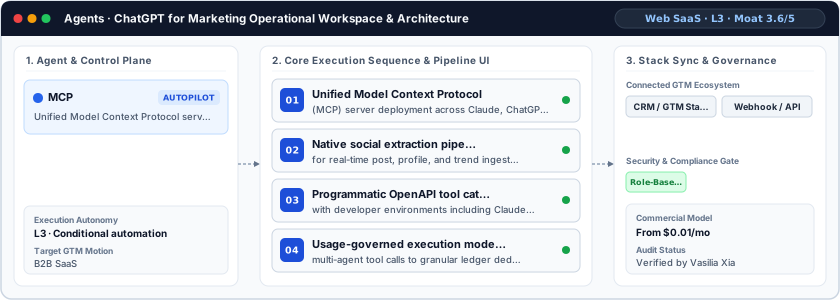
- Unified Model Context Protocol: (MCP) server deployment across Claude, ChatGPT, and Codex
- Native social extraction pipelines: for real-time post, profile, and trend ingestion without individual API keys
- Programmatic OpenAPI tool catalog compatible: with developer environments including Claude Code and Cherry Studio
- Usage-governed execution model binding: multi-agent tool calls to granular ledger deductions
Cons: operational limitations & risks
- MCP Context Overhead: Registering dozens of tool schemas across an active MCP session consumes substantial prompt token allocations, degrading available context capacity for multi-turn conversational history.
- Third-Party Scraper Fragility: Data extraction endpoints targeting social platforms operate without official developer keys, rendering downstream ingestion susceptible to upstream DOM structural changes and IP rate throttling.
- Deterministic Execution Variance: Autonomous tool calling depends entirely on the host client's parameter-parsing fidelity, resulting in intermittent call failures or malformed query payloads during complex nested workflows.
Agents TCO & deal-breaker stress test
Simulate 12-month stepped TCO, hidden cost multipliers, contract lock-in exposure, and stack failure modes using only facts verified by Vasilia Xia on · Capture SHA e36a6d64.
Agents is viable for 5 seats, but requires commercial or technical verification on the flagged items below.
| Plan / Tier | Verified Rate | Scale Fit | Scope & Quota Notes |
|---|---|---|---|
| Entry / Starter | $0.01/mo | 1–2 seats | A call that returns fewer records than the minimum is floored to it; records above the minimum |
| Growth / Professional | $0.03/mo | 5 seats | A call that returns fewer records than the minimum is floored to it; records above the minimum |
| Scale / Advanced | $0.05/mo | 15 seats | Operation credit minimums |
- Moat Score
- 3.6 / 5.0
- AI Autonomy
- L3
- Free Tier / Trial
- None disclosed
Triggered audit signals & failure modes
- Published Self-Serve Entry FloorVerified Pricing Ledger
Agents publishes a transparent entry point (From $0.01/mo) for initial validation before committing.
- Usage / Credit Burn VolatilityCommercial Model Audit
Agents uses credit or usage-metered billing (From $0.01/mo). High-volume automated workflows across 5 seats can trigger mid-cycle overage charges.
- Tier Fit for 5-Seat Scale: Entry / Starter ($0.01/mo)Verified Tier Schedule
A call that returns fewer records than the minimum is floored to it; records above the minimum
- Primary Operational Bottleneck: MCP Context OverheadAudit by Vasilia Xia
Registering dozens of tool schemas across an active MCP session consumes substantial prompt token allocations, degrading available context capacity for multi-turn conversational history.
Hidden TCO Multipliers & Quota Gates
- Credit & Usage Burn Multiplier: Automated workflows consume metered credits/usage quotas; multi-step enrichment, voice minutes, or high-frequency agent runs can trigger mid-cycle top-up packs.
- Enterprise Governance & Add-On Gating: Advanced capabilities such as Single Sign-On (SSO), custom role permissions, or specialized analytics modules are gated behind upper tiers or paid add-ons.
When to Walk Away & Negotiation Levers
- Walk away if your workflow requires uncapped enterprise volume on the From $0.01/mo entry plan without upgrading tiers.
- Walk away if your workflow cannot tolerate mcp context overhead: Registering dozens of tool schemas across an active MCP session consumes substantial prompt token allocations, degrading available context capacity for multi-turn conversational history.
- Walk away if third-party scraper fragility is a deal-breaker for your team: Data extraction endpoints targeting social platforms operate without official developer keys, rendering downstream ingestion susceptible to upstream DOM structural changes and IP rate throttling.
- Validate exact quota thresholds (seats, credits, or API calls) included in Agents's From $0.01/mo tier before converting from monthly to annual billing.
- Require a sandbox proof-of-concept testing mcp context overhead against your live CRM/data schema before annual sign-off.
Ask a custom procurement or TCO stress-test question about Agents
Lower 5-seat floor (~$99/mo vs. Usage-Metered)
Lower 5-seat floor (~$99/mo vs. Usage-Metered)
Agents key entities, modules & ecosystem stack
Unified Model Context Protocol server deployment across Claude, ChatGPT, and Codex
Agents moat & subtrack positioning
Standardized Model Context Protocol (MCP) server distribution connecting conversational LLM interfaces to live social data endpoints without requiring external user API keys.
Editorial review
Fact-checked by Vasilia Xia (E-Commerce, Lifecycle & Retention Marketing Analyst) on .
Background
Architectured as a distributed agent gateway, Agents (via Unif API) bridges runtime client interfaces with specialized marketing execution tools. Headquartered in the United States, the platform targets technical growth engineers and marketing technologists seeking to operationalize autonomous tooling directly inside large language model workspaces. By abstracting third-party data retrieval into unified endpoint schemas, the system equips conversational clients like Claude and ChatGPT with functional marketing utilities without requiring custom local wrappers.
How Agents works
At its technical foundation, the platform operates as a centralized Model Context Protocol (MCP) server exposing over 27 specialized assistants and functional endpoints. The architecture routes queries from environments such as Claude Code, Codex, and Perplexity into standardized OpenAPI tool definitions. Inbound prompts trigger structured external calls that ingest social engagement records, profile metrics, and audience trends via pre-configured scraper proxies. Operating at Level 3 conditional autonomy, the orchestration engine parses tool arguments, verifies remote payload schemas, and formats extracted unstructured data back into LLM memory context windows for contextual downstream execution.
Limitations
Operational considerations and platform boundaries include:
- MCP Context Overhead: Registering dozens of tool schemas across an active MCP session consumes substantial prompt token allocations, degrading available context capacity for multi-turn conversational history.
- Third-Party Scraper Fragility: Data extraction endpoints targeting social platforms operate without official developer keys, rendering downstream ingestion susceptible to upstream DOM structural changes and IP rate throttling.
- Deterministic Execution Variance: Autonomous tool calling depends entirely on the host client's parameter-parsing fidelity, resulting in intermittent call failures or malformed query payloads during complex nested workflows.
Agents pricing
Commercial procurement follows a usage-based consumption framework starting From $0.01/month for base access allocations. Infrastructure resources are metered via granular task credits, where transactional operations draw against pre-funded balances calibrated through an OpenAPI billing contract. Team accounts deploy credit bundles across connected MCP runtimes, eliminating rigid software seats while tying recurring infrastructure costs directly to data extraction frequency.
How Agents compares
Within the marketing automation domain, Agents diverges from workflow-builder architectures by acting strictly as an agentic tool provider. While Alphie emphasizes curated prompt repositories and Appgoblin focuses on raw mobile attribution datasets, Agents leverages native protocol integrations to bring data directly into existing conversational clients. Additionally, compared to Arda's managed multi-agent dashboards, Agents relinquishes proprietary UI ownership to prioritize high-extensibility developer runtimes, delivering an optimal configuration for technical marketing operations that require programmatic data tools embedded in standard engineering environments.
Frequently asked questions about Agents
How much does Agents cost and what pricing tiers are available?
Published pricing summary for Agents: From $0.01/mo. A permanent free plan is not disclosed for Agents. Verified tier schedule: Entry / Starter ($0.01/mo for 1–2 seats); Growth / Professional ($0.03/mo for 5 seats); Scale / Advanced ($0.05/mo for 15 seats). Commercial procurement follows a usage-based consumption framework starting From $0.01/month for base access allocations. Infrastructure resources are metered via granular task credits, where transactional operations draw against pre-funded balances calibrated through an OpenAPI billing contract.
How does Agents work and how autonomous is its AI architecture?
Marketing agent orchestration layer exposing multi-platform MCP servers and programmatic data tools directly within ChatGPT, Claude, and developer. Within ChatGPT for Marketing (Open-Source Marketing Agents & Prompts), MarTechRadar rates its execution architecture at L3 · Conditional automation with a verified Moat Score of 3.6 / 5.0 (Proprietary moat). Standardized Model Context Protocol (MCP) server distribution connecting conversational LLM interfaces to live social data endpoints without requiring external user API keys.
What are the main limitations of Agents and when should buyers walk away?
Based on our editorial technical audit, key operational considerations and boundaries for Agents include: (1) MCP Context Overhead: Registering dozens of tool schemas across an active MCP session consumes substantial prompt token allocations, degrading available context capacity for multi-turn conversational history. (2) Third-Party Scraper Fragility: Data extraction endpoints targeting social platforms operate without official developer keys, rendering downstream ingestion susceptible to upstream DOM structural changes and IP rate throttling. (3) Deterministic Execution Variance: Autonomous tool calling depends entirely on the host client's parameter-parsing fidelity, resulting in intermittent call failures or malformed query payloads during complex nested workflows. Primary procurement walk-away rule: Walk away if your workflow requires uncapped enterprise volume on the From $0.01/mo entry plan without upgrading tiers.
What integrations, compliance certifications, and contract terms apply to Agents?
First-party governance and developer endpoints verified on domain include: Status (https://unifapi.com/status), API Docs (https://unifapi.com/developers), DPA (https://unifapi.com/legal/data-processing-agreement). Key TCO multiplier to watch: Credit & Usage Burn Multiplier (Automated workflows consume metered credits/usage quotas; multi-step enrichment, voice minutes, or high-frequency agent runs can trigger mid-cycle top-up packs.) Before signing a contract, procurement teams should validate exact quota thresholds (seats, credits, or API calls) included in Agents's From $0.01/mo tier before converting from monthly to annual billing.
What are the best Agents alternatives and head-to-head competitors in 2026?
Top fact-checked alternatives to Agents in ChatGPT for Marketing (Open-Source Marketing Agents & Prompts) include Arda ($99/mo), AutoGPT (Custom / enterprise pricing), Langflow (Custom / enterprise pricing), Apextools (Custom / enterprise pricing). Within the marketing automation domain, Agents diverges from workflow-builder architectures by acting strictly as an agentic tool provider.
Verified sources & evidence trail
- Official product domain: https://unifapi.com
- Commercial pricing verification: https://unifapi.com/pricing
- First-party governance & documentation links: System Status · API & Docs · DPA · Terms · Privacy
- Editorial audit sign-off: Fact-checked by Vasilia Xia on under the MarTechRadar Evidence-Ledger Protocol.