Activepieces Review (2026): ChatGPT for Marketing Pricing, Limits & Alternatives
Bottom line
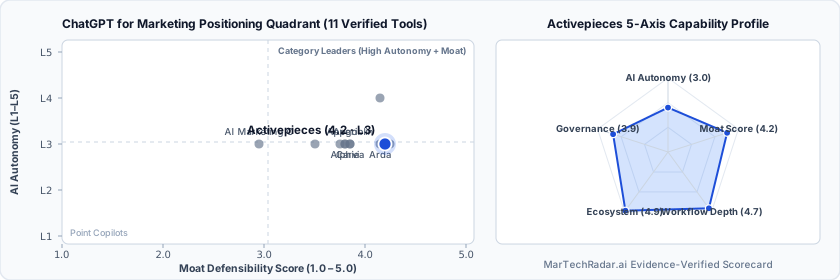
Activepieces is a Web SaaS tool for ChatGPT for Marketing (Open-Source Marketing Agents & Prompts) in Agent & Marketing Ops. Pricing: Free plan · $0/mo · Enterprise plan. Best suited to B2B SaaS. Editor ratings: AI autonomy L3 (conditional automation); moat score 4.2/5.0 (Proprietary moat). Fact-checked by Tim Fenolz on Oct 14, 2026.
Open-source automation and agent orchestration engine connecting AI workflows, internal tables, and 760+ application endpoints with native MCP server support.
Activepieces buyer fit verdict: when to choose vs. when to walk away
Choose Activepieces if (Best Fit)
- Target ICP & Stack Fit: You operate as B2B SaaS requiring a Web SaaS deployment for ChatGPT for Marketing, with verified ecosystem connectivity for HubSpot, Slack, Snowflake, Zapier.
- L3 Architecture & Defensibility: Open-source codebase with strong developer adoption, extensible piece ecosystem covering 760+ integrations, native Model Context Protocol (MCP) server capabilities, and self-hosted control architecture.
- Commercial Model Fit: Your procurement budget aligns with Free plan · $0/mo · Enterprise plan and want a self-serve free tier for zero-cost initial validation.
Walk away from Activepieces if (Deal-Breakers)
- Walk away if your workflow requires uncapped enterprise volume on the Free plan · $0/mo · Enterprise plan entry plan without upgrading tiers.
- Walk away if your workflow cannot tolerate self-hosted maintenance overhead: Deploying the open-source instance requires internal management of Redis queues, PostgreSQL databases, and worker container scaling, shifting infrastructure reliability onto internal engineering teams.
- Walk away if third-party schema drift is a deal-breaker for your team: Community-developed application connectors frequently experience breakage when upstream API providers alter authentication schemes or deprecate specific payload endpoints without notice.
Activepieces key facts & scorecard
| Pricing | Free plan · $0/mo · Enterprise planVendor pricing page |
|---|---|
| Free plan | Yes |
| Delivery | Web SaaS |
| Audience | B2B SaaS |
| AI autonomy level | L3 · Conditional automationEditor-verified |
| Moat tier & score | 4.2 / 5.0 · Proprietary moatEditor-verified |
| Funding | Undisclosed |
| Total funding | $1.6M |
| Founders | Ashraf Samhouri, Mohammad AbuAboud |
| Company size | 11-50 employees |
| Ecosystem integrations | HubSpot, Slack, Snowflake, Zapier |
| Governance & docs | Trust & Security ↗ · API & Docs ↗ · Terms ↗ · Privacy ↗ |
| Headquarters | San Francisco, California |
| Founded | 2022 |
| Last verified |
Activepieces pros & cons: strengths vs. operational limitations
Pros: core strengths & capabilities
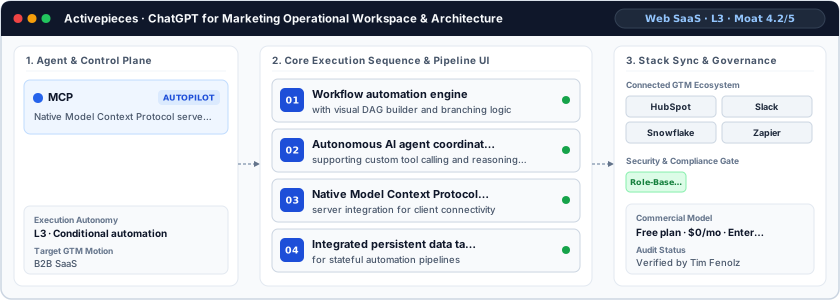
- Workflow automation engine: with visual DAG builder and branching logic
- Autonomous AI agent coordination: supporting custom tool calling and reasoning steps
- Native Model Context Protocol (MCP): server integration for client connectivity
- Integrated persistent data tables: for stateful automation pipelines
Cons: operational limitations & risks
- Self-Hosted Maintenance Overhead: Deploying the open-source instance requires internal management of Redis queues, PostgreSQL databases, and worker container scaling, shifting infrastructure reliability onto internal engineering teams.
- Third-Party Schema Drift: Community-developed application connectors frequently experience breakage when upstream API providers alter authentication schemes or deprecate specific payload endpoints without notice.
- Autonomous Token Budget Exhaustion: Autonomous agent steps executing open-ended tool loops risk draining downstream API quotas or rate limits if maximum iteration thresholds and fallback timeouts are unconfigured.
Activepieces TCO & deal-breaker stress test
Simulate 12-month stepped TCO, hidden cost multipliers, contract lock-in exposure, and stack failure modes using only facts verified by Tim Fenolz on · Capture SHA 5b4c9b92.
Activepieces is viable for 5 seats, but requires commercial or technical verification on the flagged items below.
| Plan / Tier | Verified Rate | Scale Fit | Scope & Quota Notes |
|---|---|---|---|
| Free / Sandbox | $0 | 1–2 seats (Evaluation) | Entry free tier with capped usage or feature quotas for initial workflow testing. |
| Plus | $20/mo | 1–2 seats | For daily builders |
| Team | $200/mo | 5 seats | For growing teams |
| Enterprise / Custom | Custom quote | 15–50+ seats (Enterprise SLA) | Sales-negotiated annual contract for custom volume, SSO/RBAC governance, and dedicated SLA. |
- Moat Score
- 4.2 / 5.0
- AI Autonomy
- L3
- Free Tier / Trial
- Free plan
Triggered audit signals & failure modes
- Opaque Enterprise Quoting vs. SMB/Mid-Market BudgetVerified Pricing Ledger
Activepieces does not disclose a public self-serve floor (Free plan · $0/mo · Enterprise plan). Buyers with a $800/mo cap face high sales-qualification friction.
- Published Self-Serve Entry FloorVerified Pricing Ledger
Activepieces publishes a transparent entry point (Free plan · $0/mo · Enterprise plan) with a free tier for initial validation before committing.
- Tier Fit for 5-Seat Scale: Plus ($20/mo)Verified Tier Schedule
For daily builders
- Primary Operational Bottleneck: Autonomous Token Budget ExhaustionAudit by Tim Fenolz
Autonomous agent steps executing open-ended tool loops risk draining downstream API quotas or rate limits if maximum iteration thresholds and fallback timeouts are unconfigured.
Hidden TCO Multipliers & Quota Gates
- Credit & Usage Burn Multiplier: Automated workflows consume metered credits/usage quotas; multi-step enrichment, voice minutes, or high-frequency agent runs can trigger mid-cycle top-up packs.
- Enterprise Governance & Add-On Gating: Advanced capabilities such as Single Sign-On (SSO), custom role permissions, or specialized analytics modules are gated behind upper tiers or paid add-ons.
When to Walk Away & Negotiation Levers
- Walk away if your workflow requires uncapped enterprise volume on the Free plan · $0/mo · Enterprise plan entry plan without upgrading tiers.
- Walk away if your workflow cannot tolerate self-hosted maintenance overhead: Deploying the open-source instance requires internal management of Redis queues, PostgreSQL databases, and worker container scaling, shifting infrastructure reliability onto internal engineering teams.
- Walk away if third-party schema drift is a deal-breaker for your team: Community-developed application connectors frequently experience breakage when upstream API providers alter authentication schemes or deprecate specific payload endpoints without notice.
- Validate exact quota thresholds (seats, credits, or API calls) included in Activepieces's Free plan · $0/mo · Enterprise plan tier before converting from monthly to annual billing.
- Require a sandbox proof-of-concept testing self-hosted maintenance overhead against your live CRM/data schema before annual sign-off.
Ask a custom procurement or TCO stress-test question about Activepieces
Lower 5-seat floor (~$49/mo vs. Custom Quote)
Lower 5-seat floor (~$99/mo vs. Custom Quote)
Activepieces key entities, modules & ecosystem stack
Native Model Context Protocol server integration for client connectivity
Activepieces moat & subtrack positioning
Open-source codebase with strong developer adoption, extensible piece ecosystem covering 760+ integrations, native Model Context Protocol (MCP) server capabilities, and self-hosted control architecture.
Editorial review
Fact-checked by Tim Fenolz (Lead AdTech, Programmatic & Attribution Analyst) on .
Background
Architectural fragmentation across proprietary integration platforms frequently restricts programmatic governance over AI agents. Established in 2022 and headquartered in San Francisco, California, Activepieces provides an open-source workflow orchestration engine designed to anchor automated marketing processes within verifiable system boundaries. Supported by $1.6M in venture backing, the platform targets technical marketing operations and solutions engineers who require direct source-code access and self-hosted deployment options, avoiding the architectural constraints common to closed-source enterprise integration software.
How Activepieces works
At its operational core, Activepieces runs an event-driven runtime that executes asynchronous DAG pipelines across 760+ prebuilt application connectors. Inbound webhooks or scheduled triggers initialize sandboxed worker nodes that process task states against persistent operational tables. The platform operates at Level 3 conditional autonomy by executing multi-step conversational flows, autonomous tool calling, and deterministic conditional branches. Notably, native Model Context Protocol (MCP) server capabilities expose pipeline actions as modular tool registries, allowing local LLMs and external clients to orchestrate enterprise subtasks safely, alongside native workflow integrations for HubSpot, Slack, Snowflake, and Zapier.
Limitations
Operational considerations and platform boundaries include:
- Self-Hosted Maintenance Overhead: Deploying the open-source instance requires internal management of Redis queues, PostgreSQL databases, and worker container scaling, shifting infrastructure reliability onto internal engineering teams.
- Third-Party Schema Drift: Community-developed application connectors frequently experience breakage when upstream API providers alter authentication schemes or deprecate specific payload endpoints without notice.
- Autonomous Token Budget Exhaustion: Autonomous agent steps executing open-ended tool loops risk draining downstream API quotas or rate limits if maximum iteration thresholds and fallback timeouts are unconfigured.
Activepieces pricing
Commercial procurement is divided across self-hosted open-source software, multi-tenant cloud tiers, and managed enterprise installations. The public cloud offering begins with a Free tier at $0 per month, which supplies 1,000 baseline credits and support for up to five team members. Usage expands through intermediate paid self-serve plans at $20 and $200 per month for builders requiring higher task concurrency and custom API key integration, alongside custom enterprise contracts covering single sign-on, audit logs, and on-premises licensing.
How Activepieces compares
Within the ChatGPT for Marketing and open-source automation landscape, Activepieces competes against agent platforms such as Alphie, Appgoblin, and Arda. While specialized agents like Alphie and Appgoblin focus on niche analytical prompts or mobile-centric automation tasks, and Arda emphasizes dedicated data orchestration, Activepieces distinguishes itself through its dual execution of standard DAG automations and MCP-enabled autonomous agents. It serves best as an architectural standard for mid-market engineering teams requiring deep connector breadth and strict hosting sovereignty.
Frequently asked questions about Activepieces
How much does Activepieces cost and what pricing tiers are available?
Published pricing summary for Activepieces: Free plan · $0/mo · Enterprise plan. Activepieces includes a free tier or sandbox entry point. Verified tier schedule: Free / Sandbox ($0 for 1–2 seats (Evaluation)); Plus ($20/mo for 1–2 seats); Team ($200/mo for 5 seats); Enterprise / Custom (Custom quote for 15–50+ seats (Enterprise SLA)). Commercial procurement is divided across self-hosted open-source software, multi-tenant cloud tiers, and managed enterprise installations. The public cloud offering begins with a Free tier at $0 per month, which supplies 1,000 baseline credits and support for up to five team members.
How does Activepieces work and how autonomous is its AI architecture?
Open-source automation and agent orchestration engine connecting AI workflows, internal tables, and 760+ application endpoints with native MCP server support. Within ChatGPT for Marketing (Open-Source Marketing Agents & Prompts), MarTechRadar rates its execution architecture at L3 · Conditional automation with a verified Moat Score of 4.2 / 5.0 (Proprietary moat). Open-source codebase with strong developer adoption, extensible piece ecosystem covering 760+ integrations, native Model Context Protocol (MCP) server capabilities, and self-hosted control architecture. Corporate profile: Founded by Ashraf Samhouri, Mohammad AbuAboud, operating at 11-50 employees scale.
What are the main limitations of Activepieces and when should buyers walk away?
Based on our editorial technical audit, key operational considerations and boundaries for Activepieces include: (1) Self-Hosted Maintenance Overhead: Deploying the open-source instance requires internal management of Redis queues, PostgreSQL databases, and worker container scaling, shifting infrastructure reliability onto internal engineering teams. (2) Third-Party Schema Drift: Community-developed application connectors frequently experience breakage when upstream API providers alter authentication schemes or deprecate specific payload endpoints without notice. (3) Autonomous Token Budget Exhaustion: Autonomous agent steps executing open-ended tool loops risk draining downstream API quotas or rate limits if maximum iteration thresholds and fallback timeouts are unconfigured. Primary procurement walk-away rule: Walk away if your workflow requires uncapped enterprise volume on the Free plan · $0/mo · Enterprise plan entry plan without upgrading tiers.
What integrations, compliance certifications, and contract terms apply to Activepieces?
Verified ecosystem and stack integrations include HubSpot, Slack, Snowflake, Zapier. First-party governance and developer endpoints verified on domain include: Trust/Security (https://www.activepieces.com/security), API Docs (https://www.activepieces.com/docs). Key TCO multiplier to watch: Credit & Usage Burn Multiplier (Automated workflows consume metered credits/usage quotas; multi-step enrichment, voice minutes, or high-frequency agent runs can trigger mid-cycle top-up packs.) Before signing a contract, procurement teams should validate exact quota thresholds (seats, credits, or API calls) included in Activepieces's Free plan · $0/mo · Enterprise plan tier before converting from monthly to annual billing.
What are the best Activepieces alternatives and head-to-head competitors in 2026?
Top fact-checked alternatives to Activepieces in ChatGPT for Marketing (Open-Source Marketing Agents & Prompts) include Dify (Free plan · $0/mo · Enterprise plan), Averi (From $99/mo), KS-Agents (From $49/mo), Geocitation (From $2.90/mo). Within the ChatGPT for Marketing and open-source automation landscape, Activepieces competes against agent platforms such as Alphie, Appgoblin, and Arda.
Verified sources & evidence trail
- Official product domain: https://activepieces.com
- Commercial pricing verification: https://www.activepieces.com/pricing
- Verified corporate entity profiles (
sameAs): LinkedIn Company Profile · Crunchbase Entity Record - First-party governance & documentation links: Trust & Security · API & Docs · Terms · Privacy
- Editorial audit sign-off: Fact-checked by Tim Fenolz on under the MarTechRadar Evidence-Ledger Protocol.