Arda Review (2026): ChatGPT for Marketing Pricing, Limits & Alternatives
Bottom line
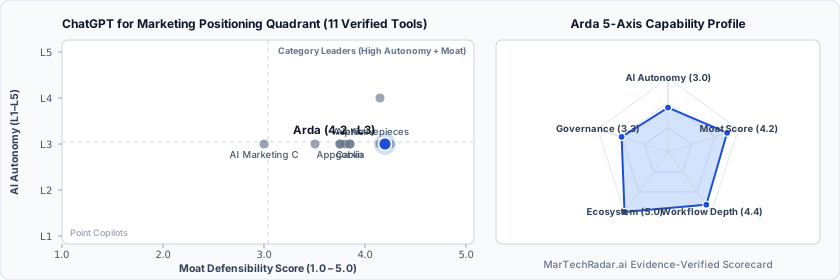
Arda is a Web SaaS tool for ChatGPT for Marketing (Open-Source Marketing Agents & Prompts) in Agent & Marketing Ops. Pricing: $99/mo. Best suited to B2B SaaS. Editor ratings: AI autonomy L3 (conditional automation); moat score 4.2/5.0 (Proprietary moat). Fact-checked by Anthony Hay on Oct 11, 2026.
Agentic marketing software executing automated search and answer engine optimization through continuous citation monitoring and technical remediations.
Arda buyer fit verdict: when to choose vs. when to walk away
Choose Arda if (Best Fit)
- Target ICP & Stack Fit: You operate as B2B SaaS requiring a Web SaaS deployment for ChatGPT for Marketing, with verified ecosystem connectivity for Slack, Shopify, WordPress, Webflow.
- L3 Architecture & Defensibility: Defensibility hinges on closed-loop discovery agents that reconcile traditional crawler indexes with generative answer engines, though it remains exposed to platform API volatility and citation scraping counter-measures.
- Commercial Model Fit: Your procurement budget aligns with $99/mo.
Walk away from Arda if (Deal-Breakers)
- Walk away if your workflow requires uncapped enterprise volume on the $99/mo entry plan without upgrading tiers.
- Walk away if your workflow cannot tolerate answer engine volatility: Unannounced algorithmic revisions and latent cache refreshes within LLM providers make dynamic citation tracking prone to attribution lag.
- Walk away if CMS integration fragility is a deal-breaker for your team: Automated technical repairs depend heavily on clean headless CMS webhooks, risking broken layouts if custom schemas deviate from standard definitions.
Arda key facts & scorecard
| Pricing | $99/moVendor pricing page |
|---|---|
| Free plan | No / not disclosed |
| Delivery | Web SaaS |
| Audience | B2B SaaS |
| AI autonomy level | L3 · Conditional automationEditor-verified |
| Moat tier & score | 4.2 / 5.0 · Proprietary moatEditor-verified |
| Funding | Seed |
| Company size | 2-10 employees |
| Ecosystem integrations | Slack, Shopify, WordPress, Webflow, Twilio Segment |
| Governance & docs | Terms ↗ · Privacy ↗ |
| Headquarters | San Francisco, CA |
| Founded | 2026 |
| Last verified |
Arda pros & cons: strengths vs. operational limitations
Pros: core strengths & capabilities
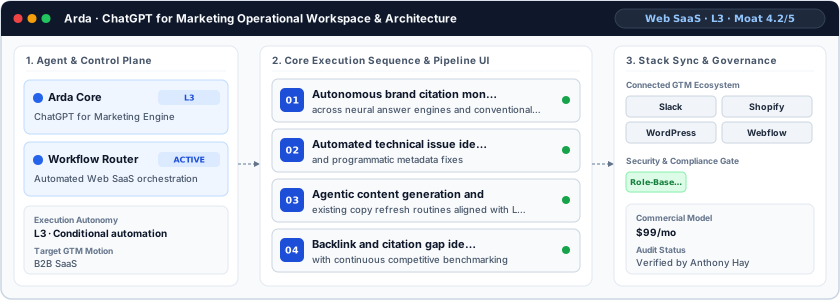
- Autonomous brand citation monitoring: across neural answer engines and conventional search results
- Automated technical issue identification: and programmatic metadata fixes
- Agentic content generation and: existing copy refresh routines aligned with LLM retrieval patterns
- Backlink and citation gap identification: with continuous competitive benchmarking
Cons: operational limitations & risks
- Answer Engine Volatility: Unannounced algorithmic revisions and latent cache refreshes within LLM providers make dynamic citation tracking prone to attribution lag.
- CMS Integration Fragility: Automated technical repairs depend heavily on clean headless CMS webhooks, risking broken layouts if custom schemas deviate from standard definitions.
- Credit Allocation Caps: Agent operations consume discrete execution credits, causing deep diagnostic crawling to throttle when enterprise domains trigger unexpected recursive fixes.
Arda TCO & deal-breaker stress test
Simulate 12-month stepped TCO, hidden cost multipliers, contract lock-in exposure, and stack failure modes using only facts verified by Anthony Hay on · Capture SHA 7bc75a47.
Arda aligns with your 5-seat / $800/mo profile. Review the walk-away triggers and contract levers below before deployment.
| Plan / Tier | Verified Rate | Scale Fit | Scope & Quota Notes |
|---|---|---|---|
| Starter | $99/mo | 1–2 seats | For teams starting their SEO and AEO journey |
- Moat Score
- 4.2 / 5.0
- AI Autonomy
- L3
- Free Tier / Trial
- None disclosed
Triggered audit signals & failure modes
- Published Self-Serve Entry FloorVerified Pricing Ledger
Arda publishes a transparent entry point ($99/mo) for initial validation before committing.
- Primary Operational Bottleneck: Credit Allocation CapsAudit by Anthony Hay
Agent operations consume discrete execution credits, causing deep diagnostic crawling to throttle when enterprise domains trigger unexpected recursive fixes.
Hidden TCO Multipliers & Quota Gates
- Credit & Usage Burn Multiplier: Automated workflows consume metered credits/usage quotas; multi-step enrichment, voice minutes, or high-frequency agent runs can trigger mid-cycle top-up packs.
- Enterprise Governance & Add-On Gating: Advanced capabilities such as Single Sign-On (SSO), custom role permissions, or specialized analytics modules are gated behind upper tiers or paid add-ons.
When to Walk Away & Negotiation Levers
- Walk away if your workflow requires uncapped enterprise volume on the $99/mo entry plan without upgrading tiers.
- Walk away if your workflow cannot tolerate answer engine volatility: Unannounced algorithmic revisions and latent cache refreshes within LLM providers make dynamic citation tracking prone to attribution lag.
- Walk away if CMS integration fragility is a deal-breaker for your team: Automated technical repairs depend heavily on clean headless CMS webhooks, risking broken layouts if custom schemas deviate from standard definitions.
- Validate exact quota thresholds (seats, credits, or API calls) included in Arda's $99/mo tier before converting from monthly to annual billing.
- Require a sandbox proof-of-concept testing answer engine volatility against your live CRM/data schema before annual sign-off.
Ask a custom procurement or TCO stress-test question about Arda
Fits within $800/mo budget (From $99/mo)
Offers a free tier (Free plan · $0/mo · Enterprise plan)
Arda key entities, modules & ecosystem stack
Arda moat & subtrack positioning
Defensibility hinges on closed-loop discovery agents that reconcile traditional crawler indexes with generative answer engines, though it remains exposed to platform API volatility and citation scraping counter-measures.
Editorial review
Fact-checked by Anthony Hay (Senior SEO, Search Intelligence & Content Operations Editor) on .
Background
Modern search discovery requires marketing teams to defend real estate across traditional search indexes as well as conversational response engines. Founded in 2026 in San Francisco, CA, Arda operates an agentic marketing platform built to address this transition. The software serves digital marketing directors, SEO managers, and growth strategists tasked with maintaining corporate visibility across algorithmic recommendation surfaces. By deploying autonomous agents directly against digital presence gaps, the platform unifies conventional technical audits with synthetic search tracking.
How Arda works
At an architectural level, Arda functions as an L3 autonomous execution pipeline. Its ingestion framework submits targeted synthetic prompts across LLM answer interfaces and traditional crawlers to quantify citation frequencies and competitor share of voice. When discovery blind spots appear, the system triggers decoupled agent workflows: one routine formulates content updates targeting retrieval-augmented generation patterns, while another prepares schema adjustments and structural repairs. These outputs are validated against deterministic guardrails before pushing updates through connected content management APIs, minimizing manual copy revisions, alongside native workflow integrations for Slack, Shopify, WordPress, and Webflow.
Limitations
Operational considerations and platform boundaries include:
- Answer Engine Volatility: Unannounced algorithmic revisions and latent cache refreshes within LLM providers make dynamic citation tracking prone to attribution lag.
- CMS Integration Fragility: Automated technical repairs depend heavily on clean headless CMS webhooks, risking broken layouts if custom schemas deviate from standard definitions.
- Credit Allocation Caps: Agent operations consume discrete execution credits, causing deep diagnostic crawling to throttle when enterprise domains trigger unexpected recursive fixes.
Arda pricing
Commercial access operates on a subscription and usage model tied to computational task volume. The entry-level Starter tier costs $99 per month and provides 150 agent credits alongside core search tracking, automated technical remedies, and baseline content creation workflows. Larger organizations and multi-client agencies require custom enterprise agreements that expand credit pools and unlock specialized deployment parameters.
How Arda compares
Within the subtrack of autonomous marketing infrastructure, Arda competes alongside systems like AutoGPT, Alphie, and Appgoblin within the ChatGPT for Marketing segment. While open-source agent runtimes like AutoGPT require extensive infrastructure configuration and prompt engineering to monitor discovery channels, Arda delivers an opinionated, hosted answer-engine stack. Unlike developer-centric agents that risk hallucinated execution paths, Arda suits brand-led enterprises seeking deterministic constraints across brand citations, technical fixes, and programmatic content workflows.
Frequently asked questions about Arda
How much does Arda cost and what pricing tiers are available?
Published pricing summary for Arda: $99/mo. A permanent free plan is not disclosed for Arda. Commercial access operates on a subscription and usage model tied to computational task volume. The entry-level Starter tier costs $99 per month and provides 150 agent credits alongside core search tracking, automated technical remedies, and baseline content creation workflows.
How does Arda work and how autonomous is its AI architecture?
Agentic marketing software executing automated search and answer engine optimization through continuous citation monitoring and technical remediations. Within ChatGPT for Marketing (Open-Source Marketing Agents & Prompts), MarTechRadar rates its execution architecture at L3 · Conditional automation with a verified Moat Score of 4.2 / 5.0 (Proprietary moat). Defensibility hinges on closed-loop discovery agents that reconcile traditional crawler indexes with generative answer engines, though it remains exposed to platform API volatility and citation scraping counter-measures. Corporate profile: operating at 2-10 employees scale.
What are the main limitations of Arda and when should buyers walk away?
Based on our editorial technical audit, key operational considerations and boundaries for Arda include: (1) Answer Engine Volatility: Unannounced algorithmic revisions and latent cache refreshes within LLM providers make dynamic citation tracking prone to attribution lag. (2) CMS Integration Fragility: Automated technical repairs depend heavily on clean headless CMS webhooks, risking broken layouts if custom schemas deviate from standard definitions. (3) Credit Allocation Caps: Agent operations consume discrete execution credits, causing deep diagnostic crawling to throttle when enterprise domains trigger unexpected recursive fixes. Primary procurement walk-away rule: Walk away if your workflow requires uncapped enterprise volume on the $99/mo entry plan without upgrading tiers.
What integrations, compliance certifications, and contract terms apply to Arda?
Verified ecosystem and stack integrations include Slack, Shopify, WordPress, Webflow, Twilio Segment. Key TCO multiplier to watch: Credit & Usage Burn Multiplier (Automated workflows consume metered credits/usage quotas; multi-step enrichment, voice minutes, or high-frequency agent runs can trigger mid-cycle top-up packs.) Before signing a contract, procurement teams should validate exact quota thresholds (seats, credits, or API calls) included in Arda's $99/mo tier before converting from monthly to annual billing.
What are the best Arda alternatives and head-to-head competitors in 2026?
Top fact-checked alternatives to Arda in ChatGPT for Marketing (Open-Source Marketing Agents & Prompts) include Alphie (Free plan · $0/mo · Enterprise plan), Appgoblin (From $99/mo), AutoGPT (Custom / enterprise pricing), CrewAI (Custom / enterprise pricing). Within the subtrack of autonomous marketing infrastructure, Arda competes alongside systems like AutoGPT, Alphie, and Appgoblin within the ChatGPT for Marketing segment.
Verified sources & evidence trail
- Official product domain: https://www.ardainc.com
- Commercial pricing verification: https://www.ardainc.com/pricing
- Verified corporate entity profiles (
sameAs): LinkedIn Company Profile - First-party governance & documentation links: Terms · Privacy
- Editorial audit sign-off: Fact-checked by Anthony Hay on under the MarTechRadar Evidence-Ledger Protocol.