AutoGPT Review (2026): ChatGPT for Marketing Pricing, Limits & Alternatives
Bottom line
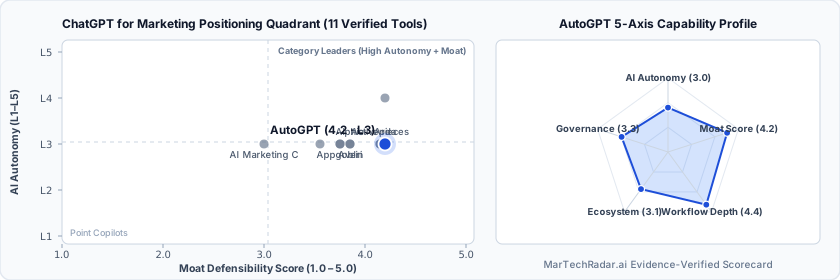
AutoGPT is a Web SaaS tool for ChatGPT for Marketing (Open-Source Marketing Agents & Prompts) in Agent & Marketing Ops. Pricing: Custom / enterprise pricing. Best suited to Creators / Solo. Editor ratings: AI autonomy L3 (conditional automation); moat score 4.2/5.0 (Proprietary moat). Fact-checked by Julie Brot on Oct 11, 2026.
Open-source autonomous agent framework that decomposes complex goals into self-directed execution loops using recursive planning and external tools.
AutoGPT buyer fit verdict: when to choose vs. when to walk away
Choose AutoGPT if (Best Fit)
- Target ICP & Stack Fit: You operate as Creators / Solo requiring a Web SaaS deployment for ChatGPT for Marketing.
- L3 Architecture & Defensibility: Moat derives from its open-source adoption, community developer ecosystem, and standardized agent orchestration architecture rather than proprietary model weights.
- Commercial Model Fit: Your procurement budget aligns with Custom / enterprise pricing.
Walk away from AutoGPT if (Deal-Breakers)
- Walk away if you require transparent self-serve monthly billing or your budget ceiling is under $1,000/mo (AutoGPT requires sales-gated custom quoting).
- Walk away if your workflow cannot tolerate token exhaustion & recursive deadlocks: Agents frequently encounter logic recursion loops when task verification criteria remain ambiguous, causing rapid API token consumption and unexpected budget spikes.
- Walk away if browser automation fragility is a deal-breaker for your team: Dynamic DOM mutations, anti-bot mechanisms, and strict CAPTCHA barriers routinely disrupt headless scraping agents during unmonitored external data-gathering runs.
AutoGPT key facts & scorecard
| Pricing | Custom / enterprise pricing |
|---|---|
| Free plan | No / not disclosed |
| Delivery | Web SaaS |
| Audience | Creators / Solo |
| AI autonomy level | L3 · Conditional automationEditor-verified |
| Moat tier & score | 4.2 / 5.0 · Proprietary moatEditor-verified |
| Funding | Seed |
| Total funding | SeedBacked by Open Source Community |
| Headquarters | United States |
| Founded | 2023 |
| Last verified |
AutoGPT pros & cons: strengths vs. operational limitations
Pros: core strengths & capabilities
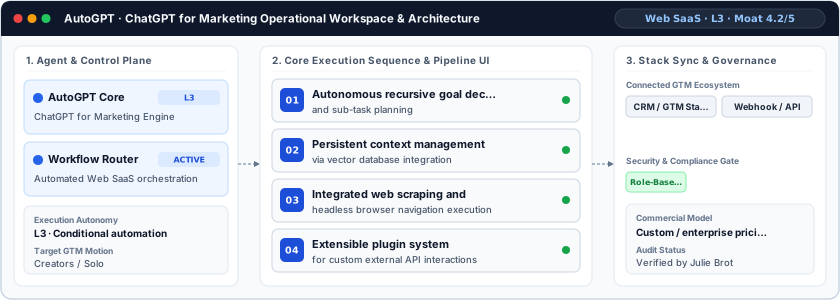
- Autonomous recursive goal decomposition: and sub-task planning
- Persistent context management: via vector database integration
- Integrated web scraping and: headless browser navigation execution
- Extensible plugin system: for custom external API interactions
Cons: operational limitations & risks
- Token Exhaustion & Recursive Deadlocks: Agents frequently encounter logic recursion loops when task verification criteria remain ambiguous, causing rapid API token consumption and unexpected budget spikes.
- Browser Automation Fragility: Dynamic DOM mutations, anti-bot mechanisms, and strict CAPTCHA barriers routinely disrupt headless scraping agents during unmonitored external data-gathering runs.
- State Desynchronization: Context fragmentation between vector retrieval layers and ongoing short-term memory introduces hallucinated steps during prolonged, multi-stage analytical workflows.
AutoGPT TCO & deal-breaker stress test
Simulate 12-month stepped TCO, hidden cost multipliers, contract lock-in exposure, and stack failure modes using only facts verified by Julie Brot on · Capture SHA 7205fe80.
AutoGPT triggers high-severity friction under your 5-seat / $800/mo constraints. Benchmark the verified subtrack alternatives below before committing.
| Plan / Tier | Verified Rate | Scale Fit | Scope & Quota Notes |
|---|---|---|---|
| Enterprise / Custom | Custom quote | 15–50+ seats (Enterprise SLA) | Sales-negotiated annual contract for custom volume, SSO/RBAC governance, and dedicated SLA. |
- Moat Score
- 4.2 / 5.0
- AI Autonomy
- L3
- Free Tier / Trial
- None disclosed
Triggered audit signals & failure modes
- Opaque Enterprise Quoting vs. SMB/Mid-Market BudgetVerified Pricing Ledger
AutoGPT does not disclose a public self-serve floor (Custom / enterprise pricing). Buyers with a $800/mo cap face high sales-qualification friction.
- Sales-Gated Contract TermsFact-checked by Julie Brot
The underlying orchestration engine remains accessible as an open-source codebase for self-hosted deployments.
- Usage / Credit Burn VolatilityCommercial Model Audit
AutoGPT uses credit or usage-metered billing (Custom / enterprise pricing). High-volume automated workflows across 5 seats can trigger mid-cycle overage charges.
- Primary Operational Bottleneck: Token Exhaustion & Recursive DeadlocksAudit by Julie Brot
Agents frequently encounter logic recursion loops when task verification criteria remain ambiguous, causing rapid API token consumption and unexpected budget spikes.
Hidden TCO Multipliers & Quota Gates
- Credit & Usage Burn Multiplier: Automated workflows consume metered credits/usage quotas; multi-step enrichment, voice minutes, or high-frequency agent runs can trigger mid-cycle top-up packs.
- Token Exhaustion & Recursive Deadlocks: Agents frequently encounter logic recursion loops when task verification criteria remain ambiguous, causing rapid API token consumption and unexpected budget spikes.
- Browser Automation Fragility: Dynamic DOM mutations, anti-bot mechanisms, and strict CAPTCHA barriers routinely disrupt headless scraping agents during unmonitored external data-gathering runs.
When to Walk Away & Negotiation Levers
- Walk away if you require transparent self-serve monthly billing or your budget ceiling is under $1,000/mo (AutoGPT requires sales-gated custom quoting).
- Walk away if your workflow cannot tolerate token exhaustion & recursive deadlocks: Agents frequently encounter logic recursion loops when task verification criteria remain ambiguous, causing rapid API token consumption and unexpected budget spikes.
- Walk away if browser automation fragility is a deal-breaker for your team: Dynamic DOM mutations, anti-bot mechanisms, and strict CAPTCHA barriers routinely disrupt headless scraping agents during unmonitored external data-gathering runs.
- Demand a 30- to 60-day paid pilot opt-out clause in the AutoGPT order form before signing a 12-month enterprise commitment.
- Require a sandbox proof-of-concept testing token exhaustion & recursive deadlocks against your live CRM/data schema before annual sign-off.
Ask a custom procurement or TCO stress-test question about AutoGPT
Lower 5-seat floor (~$99/mo vs. Custom Quote) · Transparent self-serve entry without mandatory annual lock-in
Lower 5-seat floor (~$99/mo vs. Custom Quote) · Transparent self-serve entry without mandatory annual lock-in
AutoGPT moat & subtrack positioning
Moat derives from its open-source adoption, community developer ecosystem, and standardized agent orchestration architecture rather than proprietary model weights.
Editorial review
Fact-checked by Julie Brot (Enterprise SaaS Governance & Procurement Editor) on .
Background
Architected as a recursive execution engine, AutoGPT establishes an autonomous framework that decomposes high-level marketing objectives into self-directed operational tasks. Founded in 2023 in the United States by Toran Bruce Richards, the system emerged as an open-source initiative under Significant Gravitas to transcend single-turn prompting architectures. Designed primarily for technical marketing architects, research engineers, and RevOps builders, the platform orchestrates external tool execution and continuous research tasks without requiring perpetual user intervention for every operational sub-task.
How AutoGPT works
At its technical foundation, the framework operates an iterative thought-plan-execute cycle paired with short-term context windows and long-term vector database storage. Ingesting goals via natural language, the core reasoning model parses commands into granular sequential actions, validating intermediate output before triggering downstream sub-routines. The runtime leverages local sandboxes, headless browsing hooks, and external API interfaces to collect unstructured web data, synthesize competitive insights, and update local persistence stores, running at an L3 autonomy profile where agents manage complete operational sequences autonomously once initialized.
Limitations
Operational considerations and platform boundaries include:
- Token Exhaustion & Recursive Deadlocks: Agents frequently encounter logic recursion loops when task verification criteria remain ambiguous, causing rapid API token consumption and unexpected budget spikes.
- Browser Automation Fragility: Dynamic DOM mutations, anti-bot mechanisms, and strict CAPTCHA barriers routinely disrupt headless scraping agents during unmonitored external data-gathering runs.
- State Desynchronization: Context fragmentation between vector retrieval layers and ongoing short-term memory introduces hallucinated steps during prolonged, multi-stage analytical workflows.
AutoGPT pricing
The underlying orchestration engine remains accessible as an open-source codebase for self-hosted deployments. Commercial support and managed cloud provisioning are structured through custom enterprise sales agreements tailored to organizational infrastructure scale and computational footprint. Prospective enterprise accounts must contact the sales team directly for bespoke quotes, with infrastructure hosting and underlying LLM token costs managed independently by the client organization.
How AutoGPT compares
Compared to specialized workflow platforms like Alphie, Appgoblin, and Arda, AutoGPT trades turn-key interface conveniences for unconstrained execution breadth and modular open-source customization. While Arda focuses on targeted integration paths and Appgoblin emphasizes specific domain scrapers, AutoGPT provides an extensible, code-level execution substrate. It remains best suited for enterprise engineering teams possessing internal Python expertise to configure rigorous guardrails around autonomous marketing research workflows.
Frequently asked questions about AutoGPT
How much does AutoGPT cost and does it require a custom enterprise quote?
Published pricing summary for AutoGPT: Custom / enterprise pricing. A permanent free plan is not disclosed for AutoGPT. The underlying orchestration engine remains accessible as an open-source codebase for self-hosted deployments. Commercial support and managed cloud provisioning are structured through custom enterprise sales agreements tailored to organizational infrastructure scale and computational footprint.
How does AutoGPT work and how autonomous is its AI architecture?
Open-source autonomous agent framework that decomposes complex goals into self-directed execution loops using recursive planning and external tools. Within ChatGPT for Marketing (Open-Source Marketing Agents & Prompts), MarTechRadar rates its execution architecture at L3 · Conditional automation with a verified Moat Score of 4.2 / 5.0 (Proprietary moat). Moat derives from its open-source adoption, community developer ecosystem, and standardized agent orchestration architecture rather than proprietary model weights.
What are the main limitations of AutoGPT and when should buyers walk away?
Based on our editorial technical audit, key operational considerations and boundaries for AutoGPT include: (1) Token Exhaustion & Recursive Deadlocks: Agents frequently encounter logic recursion loops when task verification criteria remain ambiguous, causing rapid API token consumption and unexpected budget spikes. (2) Browser Automation Fragility: Dynamic DOM mutations, anti-bot mechanisms, and strict CAPTCHA barriers routinely disrupt headless scraping agents during unmonitored external data-gathering runs. (3) State Desynchronization: Context fragmentation between vector retrieval layers and ongoing short-term memory introduces hallucinated steps during prolonged, multi-stage analytical workflows. Primary procurement walk-away rule: Walk away if you require transparent self-serve monthly billing or your budget ceiling is under $1,000/mo (AutoGPT requires sales-gated custom quoting).
What integrations, compliance certifications, and contract terms apply to AutoGPT?
Key TCO multiplier to watch: Credit & Usage Burn Multiplier (Automated workflows consume metered credits/usage quotas; multi-step enrichment, voice minutes, or high-frequency agent runs can trigger mid-cycle top-up packs.) Before signing a contract, procurement teams should demand a 30- to 60-day paid pilot opt-out clause in the AutoGPT order form before signing a 12-month enterprise commitment.
What are the best AutoGPT alternatives and head-to-head competitors in 2026?
Top fact-checked alternatives to AutoGPT in ChatGPT for Marketing (Open-Source Marketing Agents & Prompts) include Agents (From $0.01/mo), Alphie (Free plan · $0/mo · Enterprise plan), Appgoblin (From $99/mo), Arda ($99/mo). Compared to specialized workflow platforms like Alphie, Appgoblin, and Arda, AutoGPT trades turn-key interface conveniences for unconstrained execution breadth and modular open-source customization.
Verified sources & evidence trail
- Official product domain: https://autogpt.co
- Commercial pricing verification: Verified against official vendor pricing policy (Custom / enterprise pricing)
- Verified corporate entity profiles (
sameAs): LinkedIn Company Profile · Crunchbase Entity Record - Editorial audit sign-off: Fact-checked by Julie Brot on under the MarTechRadar Evidence-Ledger Protocol.