Voiceflow Review (2026): Enterprise AI Marketing Pricing, Limits & Alternatives
Bottom line
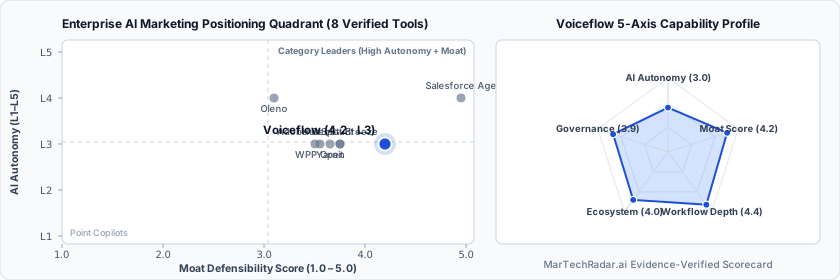
Voiceflow is a Web SaaS tool for Enterprise AI Marketing (Enterprise Marketing OS & Ecosystem Agents) in Agent & Marketing Ops. Pricing: Custom / enterprise pricing. Best suited to DTC / eCommerce and Enterprise Brands. Editor ratings: AI autonomy L3 (conditional automation); moat score 4.2/5.0 (Proprietary moat). Fact-checked by Julie Brot on Oct 14, 2026.
Collaborative conversational AI design and deployment platform that builds, tests, and operates production-grade AI agents across web, mobile, and voice.
Voiceflow buyer fit verdict: when to choose vs. when to walk away
Choose Voiceflow if (Best Fit)
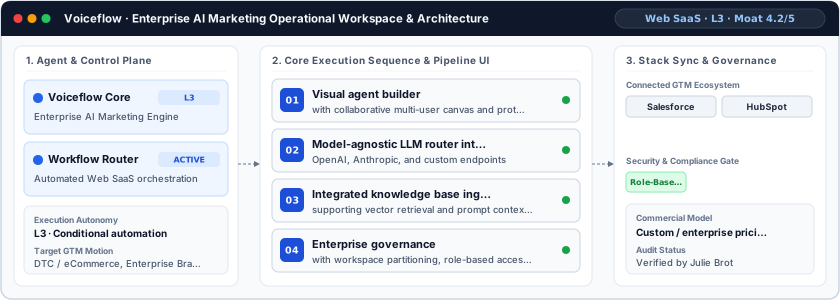
- Target ICP & Stack Fit: You operate as DTC / eCommerce and Enterprise Brands requiring a Web SaaS deployment for Enterprise AI Marketing, with verified ecosystem connectivity for Salesforce, HubSpot.
- L3 Architecture & Defensibility: Combines a visual low-code canvas with model-agnostic LLM routing, modular state management, and multi-tenant workspace governance, creating high developer-designer collaboration stickiness.
- Commercial Model Fit: Your procurement budget aligns with Custom / enterprise pricing.
Walk away from Voiceflow if (Deal-Breakers)
- Walk away if you require transparent self-serve monthly billing or your budget ceiling is under $1,000/mo (Voiceflow requires sales-gated custom quoting).
- Walk away if your workflow cannot tolerate state machine complexity: Large enterprise graphs spanning hundreds of nested decision nodes suffer from canvas rendering lag and complex merge conflict resolution during concurrent multi-user editing.
- Walk away if API rate limits and latency is a deal-breaker for your team: Real-time voice agent deployments face cumulative latency penalties when downstream third-party LLMs or enterprise webhook services experience throttling or response spikes.
Voiceflow key facts & scorecard
| Pricing | Custom / enterprise pricing |
|---|---|
| Free plan | No / not disclosed |
| Delivery | Web SaaS |
| Audience | DTC / eCommerce, Enterprise Brands |
| AI autonomy level | L3 · Conditional automationEditor-verified |
| Moat tier & score | 4.2 / 5.0 · Proprietary moatEditor-verified |
| Funding | Venture-backed |
| Total funding | $39M |
| Founders | Andrew Lawrence, Braden Ream, Michael Hood, Tyler Han |
| Company size | 201-500 employees |
| Ecosystem integrations | Salesforce, HubSpot |
| Governance & docs | Trust & Security ↗ · System Status ↗ · API & Docs ↗ · Changelog ↗ · Terms ↗ · Privacy ↗ |
| Headquarters | San Francisco, California |
| Founded | 2019 |
| Last verified |
Voiceflow pros & cons: strengths vs. operational limitations
Pros: core strengths & capabilities
- Visual agent builder: with collaborative multi-user canvas and prototype simulation
- Model-agnostic LLM router integrating: OpenAI, Anthropic, and custom endpoints
- Integrated knowledge base ingestion: supporting vector retrieval and prompt context injection
- Enterprise governance: with workspace partitioning, role-based access, and client handoff tooling
Cons: operational limitations & risks
- State Machine Complexity: Large enterprise graphs spanning hundreds of nested decision nodes suffer from canvas rendering lag and complex merge conflict resolution during concurrent multi-user editing.
- API Rate Limits and Latency: Real-time voice agent deployments face cumulative latency penalties when downstream third-party LLMs or enterprise webhook services experience throttling or response spikes.
- Schema Maintenance Overhead: External knowledge base synchronizations require strict periodic schema curation, as poorly formatted ingestion feeds produce hallucinated fallback responses in complex conversational branches.
Voiceflow TCO & deal-breaker stress test
Simulate 12-month stepped TCO, hidden cost multipliers, contract lock-in exposure, and stack failure modes using only facts verified by Julie Brot on · Capture SHA fefb2295.
Voiceflow triggers high-severity friction under your 5-seat / $800/mo constraints. Benchmark the verified subtrack alternatives below before committing.
| Plan / Tier | Verified Rate | Scale Fit | Scope & Quota Notes |
|---|---|---|---|
| Enterprise / Custom | Custom quote | 15–50+ seats (Enterprise SLA) | Sales-negotiated annual contract for custom volume, SSO/RBAC governance, and dedicated SLA. |
- Moat Score
- 4.2 / 5.0
- AI Autonomy
- L3
- Free Tier / Trial
- None disclosed
Triggered audit signals & failure modes
- Opaque Enterprise Quoting vs. SMB/Mid-Market BudgetVerified Pricing Ledger
Voiceflow does not disclose a public self-serve floor (Custom / enterprise pricing). Buyers with a $800/mo cap face high sales-qualification friction.
- Sales-Gated Contract TermsFact-checked by Julie Brot
Commercial procurement for Voiceflow operates under custom enterprise pricing available on request through tailored enterprise sales quotes based on organizational scale and seats.
- Primary Operational Bottleneck: State Machine ComplexityAudit by Julie Brot
Large enterprise graphs spanning hundreds of nested decision nodes suffer from canvas rendering lag and complex merge conflict resolution during concurrent multi-user editing.
Hidden TCO Multipliers & Quota Gates
- Credit & Usage Burn Multiplier: Automated workflows consume metered credits/usage quotas; multi-step enrichment, voice minutes, or high-frequency agent runs can trigger mid-cycle top-up packs.
- State Machine Complexity: Large enterprise graphs spanning hundreds of nested decision nodes suffer from canvas rendering lag and complex merge conflict resolution during concurrent multi-user editing.
- API Rate Limits and Latency: Real-time voice agent deployments face cumulative latency penalties when downstream third-party LLMs or enterprise webhook services experience throttling or response spikes.
When to Walk Away & Negotiation Levers
- Walk away if you require transparent self-serve monthly billing or your budget ceiling is under $1,000/mo (Voiceflow requires sales-gated custom quoting).
- Walk away if your workflow cannot tolerate state machine complexity: Large enterprise graphs spanning hundreds of nested decision nodes suffer from canvas rendering lag and complex merge conflict resolution during concurrent multi-user editing.
- Walk away if API rate limits and latency is a deal-breaker for your team: Real-time voice agent deployments face cumulative latency penalties when downstream third-party LLMs or enterprise webhook services experience throttling or response spikes.
- Demand a 30- to 60-day paid pilot opt-out clause in the Voiceflow order form before signing a 12-month enterprise commitment.
- Require a sandbox proof-of-concept testing state machine complexity against your live CRM/data schema before annual sign-off.
Ask a custom procurement or TCO stress-test question about Voiceflow
Lower 5-seat floor (~$299/mo vs. Custom Quote)
Offers a free tier (Free plan · $0/mo · Enterprise plan) · Transparent self-serve entry without mandatory annual lock-in
Voiceflow key entities, modules & ecosystem stack
Voiceflow moat & subtrack positioning
Combines a visual low-code canvas with model-agnostic LLM routing, modular state management, and multi-tenant workspace governance, creating high developer-designer collaboration stickiness.
Editorial review
Fact-checked by Julie Brot (Enterprise SaaS Governance & Procurement Editor) on .
Background
Architectural fragmentation between conversational designers and software engineers often degrades AI assistant rollouts into brittle codebases. Voiceflow addresses this divide as a centralized development environment for conversational systems. Headquartered in San Francisco, California and founded in 2019, the organization has secured $39M in venture funding. Built for conversation architects, product managers, and enterprise CX leaders, the platform bridges visual interface prototyping with production-grade runtime execution, enabling cross-functional teams to design, evaluate, and launch autonomous conversational agents across distributed customer channels.
How Voiceflow works
At its technical core, Voiceflow utilizes a directed graph execution engine that manages conversational state transitions through a modular node architecture. The system ingests natural language utterances, passing dialogue context through a model-agnostic routing layer that connects to major LLM providers alongside proprietary enterprise APIs. Operating at an L3 autonomy profile, the platform executes conditional logic, resolves conversational intents, queries embedded vector stores for retrieval-augmented responses, and triggers external webhook payloads. Runtime telemetry continuously tracks message latency, dialogue path completion, and intent confidence thresholds.
Limitations
Operational considerations and platform boundaries include:
- State Machine Complexity: Large enterprise graphs spanning hundreds of nested decision nodes suffer from canvas rendering lag and complex merge conflict resolution during concurrent multi-user editing.
- API Rate Limits and Latency: Real-time voice agent deployments face cumulative latency penalties when downstream third-party LLMs or enterprise webhook services experience throttling or response spikes.
- Schema Maintenance Overhead: External knowledge base synchronizations require strict periodic schema curation, as poorly formatted ingestion feeds produce hallucinated fallback responses in complex conversational branches.
Voiceflow pricing
Commercial procurement for Voiceflow operates under custom enterprise pricing available on request through tailored enterprise sales quotes based on organizational scale and seats. The commercial framework scales across distinct agency and enterprise tiers, adjusting parameters according to active builder seats, workspace volume, and monthly conversational message consumption. Evaluation options include sandbox environments with self-serve model credits, while full production contracts incorporate enterprise service level agreements, dedicated customer success support, and custom data processing addenda.
How Voiceflow compares
Within the ecosystem of enterprise operational agents, Voiceflow differentiates through model agnosticism and open canvas design compared to closed, stack-specific platforms like Adobe GenStudio, HubSpot Breeze, and Salesforce Agentforce. While Salesforce Agentforce and HubSpot Breeze bind dialogue state directly to proprietary CRM records, Voiceflow offers decoupled cross-platform portability across disparate customer databases. Conversely, Adobe GenStudio concentrates on content pipeline orchestration rather than deep voice interaction. The platform is best suited for digital product and CX organizations requiring custom omni-channel conversational interfaces independent of monolithic vendor ecosystems.
Direct competitors & market radar
Top algorithmic competitors based on category positioning, capability overlap, and ICP alignment.
Frequently asked questions about Voiceflow
How much does Voiceflow cost and does it require a custom enterprise quote?
Published pricing summary for Voiceflow: Custom / enterprise pricing. A permanent free plan is not disclosed for Voiceflow. Commercial procurement for Voiceflow operates under custom enterprise pricing available on request through tailored enterprise sales quotes based on organizational scale and seats.
How does Voiceflow work and how autonomous is its AI architecture?
Collaborative conversational AI design and deployment platform that builds, tests, and operates production-grade AI agents across web, mobile, and voice. Within Enterprise AI Marketing (Enterprise Marketing OS & Ecosystem Agents), MarTechRadar rates its execution architecture at L3 · Conditional automation with a verified Moat Score of 4.2 / 5.0 (Proprietary moat). Combines a visual low-code canvas with model-agnostic LLM routing, modular state management, and multi-tenant workspace governance, creating high developer-designer collaboration stickiness. Corporate profile: Founded by Andrew Lawrence, Braden Ream, Michael Hood, Tyler Han, operating at 201-500 employees scale.
What are the main limitations of Voiceflow and when should buyers walk away?
Based on our editorial technical audit, key operational considerations and boundaries for Voiceflow include: (1) State Machine Complexity: Large enterprise graphs spanning hundreds of nested decision nodes suffer from canvas rendering lag and complex merge conflict resolution during concurrent multi-user editing. (2) API Rate Limits and Latency: Real-time voice agent deployments face cumulative latency penalties when downstream third-party LLMs or enterprise webhook services experience throttling or response spikes. (3) Schema Maintenance Overhead: External knowledge base synchronizations require strict periodic schema curation, as poorly formatted ingestion feeds produce hallucinated fallback responses in complex conversational branches. Primary procurement walk-away rule: Walk away if you require transparent self-serve monthly billing or your budget ceiling is under $1,000/mo (Voiceflow requires sales-gated custom quoting).
What integrations, compliance certifications, and contract terms apply to Voiceflow?
Verified ecosystem and stack integrations include Salesforce, HubSpot. First-party governance and developer endpoints verified on domain include: Trust/Security (https://www.voiceflow.com/compliance/soc-2), Status (https://status.voiceflow.com), API Docs (https://www.voiceflow.com/docs). Key TCO multiplier to watch: Credit & Usage Burn Multiplier (Automated workflows consume metered credits/usage quotas; multi-step enrichment, voice minutes, or high-frequency agent runs can trigger mid-cycle top-up packs.) Before signing a contract, procurement teams should demand a 30- to 60-day paid pilot opt-out clause in the Voiceflow order form before signing a 12-month enterprise commitment.
What are the best Voiceflow alternatives and head-to-head competitors in 2026?
Top fact-checked alternatives to Voiceflow in Enterprise AI Marketing (Enterprise Marketing OS & Ecosystem Agents) include Adobe GenStudio (Custom / enterprise pricing), Oleno (From $299/mo), Sedric AI (Pricing not disclosed), Yarnit (Pricing not disclosed). Within the ecosystem of enterprise operational agents, Voiceflow differentiates through model agnosticism and open canvas design compared to closed, stack-specific platforms like Adobe GenStudio, HubSpot Breeze, and Salesforce Agentforce.
Verified sources & evidence trail
- Official product domain: https://voiceflow.com
- Commercial pricing verification: Verified against official vendor pricing policy (Custom / enterprise pricing)
- Verified corporate entity profiles (
sameAs): LinkedIn Company Profile · Crunchbase Entity Record - First-party governance & documentation links: Trust & Security · System Status · API & Docs · Changelog · Terms · Privacy
- Editorial audit sign-off: Fact-checked by Julie Brot on under the MarTechRadar Evidence-Ledger Protocol.