Typeface Review (2026): AI Content Marketing Pricing, Limits & Alternatives
Bottom line
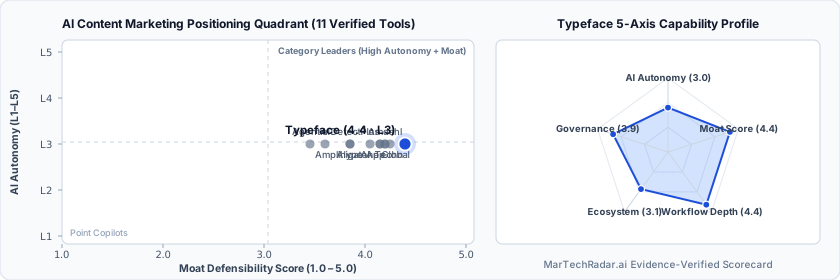
Typeface is a Web SaaS tool for AI Content Marketing (Enterprise & Long-Form Brand Content) in Copy & Content. Pricing: Custom / enterprise pricing. Best suited to B2B SaaS and Enterprise Brands. Editor ratings: AI autonomy L3 (conditional automation); moat score 4.4/5.0 (Proprietary moat (category leader)). Fact-checked by Jiacky Lee on Oct 7, 2026.
Enterprise generative marketing platform using specialized brand knowledge graphs and agentic workflows to produce governed multi-modal assets.
Typeface buyer fit verdict: when to choose vs. when to walk away
Choose Typeface if (Best Fit)
- Target ICP & Stack Fit: You operate as B2B SaaS and Enterprise Brands requiring a Web SaaS deployment for AI Content Marketing.
- L3 Architecture & Defensibility: Defensibility stems from its Arc Graph brand intelligence layer, multi-model orchestration framework, and pre-integrated enterprise governance guardrails for global brands.
- Commercial Model Fit: Your procurement budget aligns with Custom / enterprise pricing.
Walk away from Typeface if (Deal-Breakers)
- Walk away if you require transparent self-serve monthly billing or your budget ceiling is under $1,000/mo (Typeface requires sales-gated custom quoting).
- Walk away if your workflow cannot tolerate ontology cold-start latency: Constructing the initial Arc Graph requires extensive ingestion and vectorization of brand documentation, resulting in prolonged setup windows before cross-functional teams achieve generation accuracy.
- Walk away if multi-modal coherence degradation is a deal-breaker for your team: Complex multi-asset campaigns that span synchronized long-form copy and 3D visual formats occasionally experience compositional drift, necessitating manual editorial corrections.
Typeface key facts & scorecard
| Pricing | Custom / enterprise pricing |
|---|---|
| Free plan | No / not disclosed |
| Delivery | Web SaaS |
| Audience | B2B SaaS, Enterprise Brands |
| AI autonomy level | L3 · Conditional automationEditor-verified |
| Moat tier & score | 4.4 / 5.0 · Proprietary moat (category leader)Editor-verified |
| Funding | Series B |
| Total funding | $165MBacked by Lightspeed Venture Partners, Madrona, Salesforce Ventures, M12 - Microsoft's Venture Fund |
| Founders | Abhay Parasnis |
| Company size | 51-200 employees |
| Governance & docs | API & Docs ↗ · Terms ↗ · Privacy ↗ |
| Headquarters | Palo Alto, CA |
| Founded | 2022 |
| Last verified |
Typeface pros & cons: strengths vs. operational limitations
Pros: core strengths & capabilities
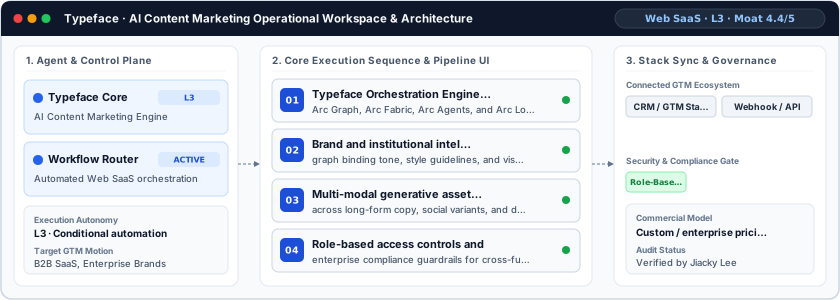
- Typeface Orchestration Engine unifying: Arc Graph, Arc Fabric, Arc Agents, and Arc Loop
- Brand and institutional intelligence: graph binding tone, style guidelines, and visual identity
- Multi-modal generative asset generation: across long-form copy, social variants, and design assets
- Role-based access controls and: enterprise compliance guardrails for cross-functional marketing teams
Cons: operational limitations & risks
- Ontology cold-start latency: Constructing the initial Arc Graph requires extensive ingestion and vectorization of brand documentation, resulting in prolonged setup windows before cross-functional teams achieve generation accuracy.
- Multi-modal coherence degradation: Complex multi-asset campaigns that span synchronized long-form copy and 3D visual formats occasionally experience compositional drift, necessitating manual editorial corrections.
- Enterprise DAM schema synchronization: Bi-directional taxonomy synchronization with legacy digital asset management systems can trigger metadata mismatches during high-volume catalog batch operations.
Typeface TCO & deal-breaker stress test
Simulate 12-month stepped TCO, hidden cost multipliers, contract lock-in exposure, and stack failure modes using only facts verified by Jiacky Lee on · Capture SHA 44c24d2c.
Typeface triggers high-severity friction under your 5-seat / $800/mo constraints. Benchmark the verified subtrack alternatives below before committing.
| Plan / Tier | Verified Rate | Scale Fit | Scope & Quota Notes |
|---|---|---|---|
| Enterprise / Custom | Custom quote | 15–50+ seats (Enterprise SLA) | Sales-negotiated annual contract for custom volume, SSO/RBAC governance, and dedicated SLA. |
- Moat Score
- 4.4 / 5.0
- AI Autonomy
- L3
- Free Tier / Trial
- None disclosed
Triggered audit signals & failure modes
- Opaque Enterprise Quoting vs. SMB/Mid-Market BudgetVerified Pricing Ledger
Typeface does not disclose a public self-serve floor (Custom / enterprise pricing). Buyers with a $800/mo cap face high sales-qualification friction.
- Sales-Gated Contract TermsFact-checked by Jiacky Lee
Commercial pricing is available on request through tailored enterprise sales quotes based on organizational scale and seats.
- Primary Operational Bottleneck: Ontology cold-start latencyAudit by Jiacky Lee
Constructing the initial Arc Graph requires extensive ingestion and vectorization of brand documentation, resulting in prolonged setup windows before cross-functional teams achieve generation accuracy.
Hidden TCO Multipliers & Quota Gates
- Ontology cold-start latency: Constructing the initial Arc Graph requires extensive ingestion and vectorization of brand documentation, resulting in prolonged setup windows before cross-functional teams achieve generation accuracy.
- Multi-modal coherence degradation: Complex multi-asset campaigns that span synchronized long-form copy and 3D visual formats occasionally experience compositional drift, necessitating manual editorial corrections.
When to Walk Away & Negotiation Levers
- Walk away if you require transparent self-serve monthly billing or your budget ceiling is under $1,000/mo (Typeface requires sales-gated custom quoting).
- Walk away if your workflow cannot tolerate ontology cold-start latency: Constructing the initial Arc Graph requires extensive ingestion and vectorization of brand documentation, resulting in prolonged setup windows before cross-functional teams achieve generation accuracy.
- Walk away if multi-modal coherence degradation is a deal-breaker for your team: Complex multi-asset campaigns that span synchronized long-form copy and 3D visual formats occasionally experience compositional drift, necessitating manual editorial corrections.
- Demand a 30- to 60-day paid pilot opt-out clause in the Typeface order form before signing a 12-month enterprise commitment.
- Require a sandbox proof-of-concept testing ontology cold-start latency against your live CRM/data schema before annual sign-off.
Ask a custom procurement or TCO stress-test question about Typeface
Lower 5-seat floor (~$49/mo vs. Custom Quote) · Transparent self-serve entry without mandatory annual lock-in
Lower 5-seat floor (~$50/mo vs. Custom Quote) · Transparent self-serve entry without mandatory annual lock-in
Typeface moat & subtrack positioning
Defensibility stems from its Arc Graph brand intelligence layer, multi-model orchestration framework, and pre-integrated enterprise governance guardrails for global brands.
Editorial review
Fact-checked by Jiacky Lee (Managing Editor, AI Autonomy & Moat Methodology) on .
Background
Architected around structured brand governance, Typeface was established in 2022 in Palo Alto, CA, to solve the challenge of deploying generative intelligence across Fortune 500 content ecosystems. The company secured $165M in venture funding to construct an enterprise-grade layer for multimodal content production. Targeting global CMOs, creative operations directors, and enterprise marketing architectures, the platform provides institutional guardrails that convert raw foundational models into compliant brand assets.
How Typeface works
At its technical core, the platform operates via the Typeface Orchestration Engine, which decouples generation into four coordinated layers: Arc Graph, Arc Fabric, Arc Agents, and Arc Loop. The Arc Graph synthesizes enterprise knowledge graphs, brand guidelines, and historical creative assets into a context repository. When generating campaigns, Arc Agents execute multi-step asset creation through dynamic LLM routing, while Arc Loop provides conditional autonomy by inserting human-in-the-loop review nodes into digital asset management pipelines.
Limitations
Operational considerations and platform boundaries include:
- Ontology cold-start latency: Constructing the initial Arc Graph requires extensive ingestion and vectorization of brand documentation, resulting in prolonged setup windows before cross-functional teams achieve generation accuracy.
- Multi-modal coherence degradation: Complex multi-asset campaigns that span synchronized long-form copy and 3D visual formats occasionally experience compositional drift, necessitating manual editorial corrections.
- Enterprise DAM schema synchronization: Bi-directional taxonomy synchronization with legacy digital asset management systems can trigger metadata mismatches during high-volume catalog batch operations.
Typeface pricing
Commercial pricing is available on request through tailored enterprise sales quotes based on organizational scale and seats. The procurement structure functions on an annual enterprise subscription model that scales with team seat counts, workspace isolation tiers, and asset processing volumes. Engagements incorporate professional service onboarding packages to assist with brand graph indexing, dedicated cloud deployment infrastructure, and customized model tuning.
How Typeface compares
Within the enterprise long-form and brand content subtrack, Typeface competes with vendors such as Agentio, Aha Global, and AIDetectPlus. While Agentio targets creator programmatic ad workflows and AIDetectPlus focuses purely on text provenance validation, Typeface provides a dedicated orchestration pipeline for enterprise brand consistency. The platform is best suited for decentralized Global 2000 marketing organizations that require strict brand compliance and deterministic multimodal asset creation.
Direct competitors & market radar
Top algorithmic competitors based on category positioning, capability overlap, and ICP alignment.
Frequently asked questions about Typeface
How much does Typeface cost and does it require a custom enterprise quote?
Published pricing summary for Typeface: Custom / enterprise pricing. A permanent free plan is not disclosed for Typeface. Commercial pricing is available on request through tailored enterprise sales quotes based on organizational scale and seats. The procurement structure functions on an annual enterprise subscription model that scales with team seat counts, workspace isolation tiers, and asset processing volumes.
How does Typeface work and how autonomous is its AI architecture?
Enterprise generative marketing platform using specialized brand knowledge graphs and agentic workflows to produce governed multi-modal assets. Within AI Content Marketing (Enterprise & Long-Form Brand Content), MarTechRadar rates its execution architecture at L3 · Conditional automation with a verified Moat Score of 4.4 / 5.0 (Proprietary moat (category leader)). Defensibility stems from its Arc Graph brand intelligence layer, multi-model orchestration framework, and pre-integrated enterprise governance guardrails for global brands. Corporate profile: Founded by Abhay Parasnis, operating at 51-200 employees scale.
What are the main limitations of Typeface and when should buyers walk away?
Based on our editorial technical audit, key operational considerations and boundaries for Typeface include: (1) Ontology cold-start latency: Constructing the initial Arc Graph requires extensive ingestion and vectorization of brand documentation, resulting in prolonged setup windows before cross-functional teams achieve generation accuracy. (2) Multi-modal coherence degradation: Complex multi-asset campaigns that span synchronized long-form copy and 3D visual formats occasionally experience compositional drift, necessitating manual editorial corrections. (3) Enterprise DAM schema synchronization: Bi-directional taxonomy synchronization with legacy digital asset management systems can trigger metadata mismatches during high-volume catalog batch operations. Primary procurement walk-away rule: Walk away if you require transparent self-serve monthly billing or your budget ceiling is under $1,000/mo (Typeface requires sales-gated custom quoting).
What integrations, compliance certifications, and contract terms apply to Typeface?
First-party governance and developer endpoints verified on domain include: API Docs (https://developers.typeface.ai/docs/introduction). Key TCO multiplier to watch: Ontology cold-start latency (Constructing the initial Arc Graph requires extensive ingestion and vectorization of brand documentation, resulting in prolonged setup windows before cross-functional teams achieve generation accuracy.) Before signing a contract, procurement teams should demand a 30- to 60-day paid pilot opt-out clause in the Typeface order form before signing a 12-month enterprise commitment.
What are the best Typeface alternatives and head-to-head competitors in 2026?
Top fact-checked alternatives to Typeface in AI Content Marketing (Enterprise & Long-Form Brand Content) include Jasper (Enterprise) ($49–$69/seat/mo), Writer.com (Custom / enterprise pricing), Writesonic (From $50/mo), Searchable ($125–$400/mo). Within the enterprise long-form and brand content subtrack, Typeface competes with vendors such as Agentio, Aha Global, and AIDetectPlus.
Verified sources & evidence trail
- Official product domain: https://typeface.ai
- Commercial pricing verification: Verified against official vendor pricing policy (Custom / enterprise pricing)
- Verified corporate entity profiles (
sameAs): LinkedIn Company Profile · Crunchbase Entity Record - First-party governance & documentation links: API & Docs · Terms · Privacy
- Editorial audit sign-off: Fact-checked by Jiacky Lee on under the MarTechRadar Evidence-Ledger Protocol.