Seventh Sense Review (2026): Email Marketing Pricing, Limits & Alternatives
Bottom line
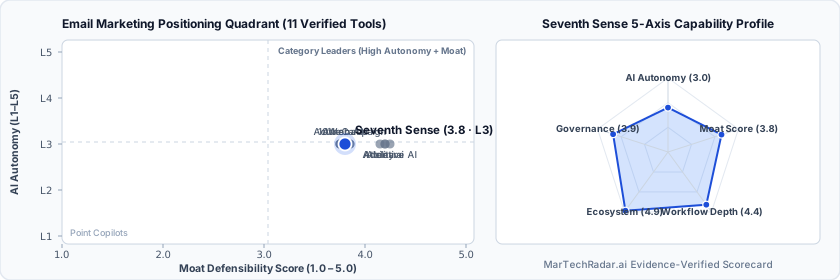
Seventh Sense is a Web SaaS tool for Email Marketing (AI Email Marketing & Lifecycle Journeys) in Lifecycle & CDP. Pricing: Custom / enterprise pricing. Best suited to B2B SaaS, DTC / eCommerce and Enterprise Brands. Editor ratings: AI autonomy L3 (conditional automation); moat score 3.8/5.0 (Proprietary moat). Fact-checked by Julie Brot on Oct 12, 2026.
AI-powered send time optimization and email frequency management engine built natively for HubSpot and Adobe Marketo Engage.
Seventh Sense buyer fit verdict: when to choose vs. when to walk away
Choose Seventh Sense if (Best Fit)
- Target ICP & Stack Fit: You operate as B2B SaaS, DTC / eCommerce and Enterprise Brands requiring a Web SaaS deployment for Email Marketing, with verified ecosystem connectivity for Salesforce, HubSpot, Braze, Adobe Marketo.
- L3 Architecture & Defensibility: Proprietary predictive temporal modeling tuned specifically around HubSpot and Marketo webhook schemas, creating sticky integration dependencies that standard marketing automation suites lack natively.
- Commercial Model Fit: Your procurement budget aligns with Custom / enterprise pricing.
Walk away from Seventh Sense if (Deal-Breakers)
- Walk away if you require transparent self-serve monthly billing or your budget ceiling is under $1,000/mo (Seventh Sense requires sales-gated custom quoting).
- Walk away if your workflow cannot tolerate ecosystem lock-in: Architectural reliance on HubSpot and Marketo prevents organizations on alternative marketing automation platforms like Salesforce Marketing Cloud or Braze from utilizing its algorithmic dispatch pipelines.
- Walk away if cold data sparsity is a deal-breaker for your team: Optimization reliability drops significantly when ingesting novel recipient lists, requiring multi-week historical observation windows before establishing statistically significant predictive open patterns.
Seventh Sense key facts & scorecard
| Pricing | Custom / enterprise pricing |
|---|---|
| Free plan | No / not disclosed |
| Delivery | Web SaaS |
| Audience | B2B SaaS, DTC / eCommerce, Enterprise Brands |
| AI autonomy level | L3 · Conditional automationEditor-verified |
| Moat tier & score | 3.8 / 5.0 · Proprietary moatEditor-verified |
| Funding | Seed |
| Total funding | $281KBacked by Private Investors |
| Founders | Erik LaBianca, Mike Donnelly |
| Company size | 1-10 employees |
| Ecosystem integrations | Salesforce, HubSpot, Braze, Adobe Marketo |
| Governance & docs | Trust & Security ↗ · Changelog ↗ · Terms ↗ · Privacy ↗ |
| Headquarters | Arlington, Virginia, United States |
| Founded | 2013 |
| Last verified |
Seventh Sense pros & cons: strengths vs. operational limitations
Pros: core strengths & capabilities
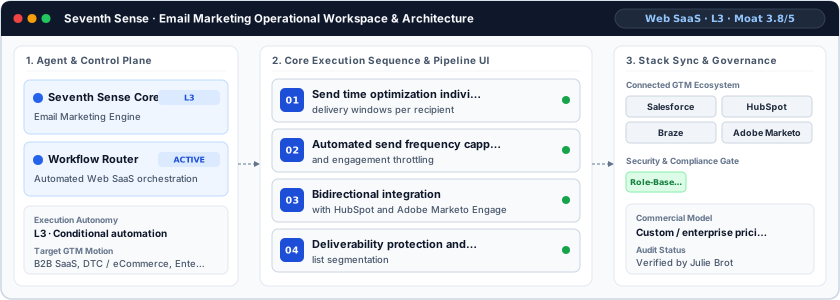
- Send time optimization individualizing: delivery windows per recipient
- Automated send frequency capping: and engagement throttling
- Bidirectional integration: with HubSpot and Adobe Marketo Engage
- Deliverability protection and engagement-based: list segmentation
Cons: operational limitations & risks
- Ecosystem Lock-In: Architectural reliance on HubSpot and Marketo prevents organizations on alternative marketing automation platforms like Salesforce Marketing Cloud or Braze from utilizing its algorithmic dispatch pipelines.
- Cold Data Sparsity: Optimization reliability drops significantly when ingesting novel recipient lists, requiring multi-week historical observation windows before establishing statistically significant predictive open patterns.
- Privacy Signal Distortion: Client-side privacy mechanisms such as Apple Mail Privacy Protection generate synthetic engagement telemetry, requiring manual exclusion filtering to prevent skewed dispatch predictions.
Seventh Sense TCO & deal-breaker stress test
Simulate 12-month stepped TCO, hidden cost multipliers, contract lock-in exposure, and stack failure modes using only facts verified by Julie Brot on · Capture SHA 2005cce6.
Seventh Sense triggers high-severity friction under your 5-seat / $800/mo constraints. Benchmark the verified subtrack alternatives below before committing.
| Plan / Tier | Verified Rate | Scale Fit | Scope & Quota Notes |
|---|---|---|---|
| Entry / Starter | $0.08/mo | Unlimited seats (Entry credits) | Verified $0.08/mo published rate on vendor pricing schedule. |
| Growth / Professional | $180/mo | Unlimited seats (Growth credits) | Verified $180/mo published rate on vendor pricing schedule. |
| Scale / Advanced | $2160/mo | Unlimited seats (Scale credits) | Verified $2160/mo published rate on vendor pricing schedule. |
| Enterprise / Custom | Custom quote | Unlimited seats (Enterprise SLA) | Sales-negotiated annual contract for custom volume, SSO/RBAC governance, and dedicated SLA. |
- Moat Score
- 3.8 / 5.0
- AI Autonomy
- L3
- Free Tier / Trial
- None disclosed
Triggered audit signals & failure modes
- Opaque Enterprise Quoting vs. SMB/Mid-Market BudgetVerified Pricing Ledger
Seventh Sense does not disclose a public self-serve floor (Custom / enterprise pricing). Buyers with a $800/mo cap face high sales-qualification friction.
- Sales-Gated Contract TermsFact-checked by Julie Brot
Seventh Sense structures its commercial model around custom enterprise licensing tiers.
- Tier Fit for 5-Seat Scale: Entry / Starter ($0.08/mo)Verified Tier Schedule
Verified $0.08/mo published rate on vendor pricing schedule.
- Primary Operational Bottleneck: Ecosystem Lock-InAudit by Julie Brot
Architectural reliance on HubSpot and Marketo prevents organizations on alternative marketing automation platforms like Salesforce Marketing Cloud or Braze from utilizing its algorithmic dispatch pipelines.
Hidden TCO Multipliers & Quota Gates
- Per-Seat Linear Scaling: Seventh Sense prices licenses on a per-user/seat basis (Custom / enterprise pricing); expanding from 2 to 15+ operators multiplies base recurring spend linearly.
- Annual Billing Headline vs. Monthly Premium: Headline entry rates reflect annual billing commitments; month-to-month flexibility carries a higher effective monthly rate or requires annual prepayment.
- Credit & Usage Burn Multiplier: Automated workflows consume metered credits/usage quotas; multi-step enrichment, voice minutes, or high-frequency agent runs can trigger mid-cycle top-up packs.
When to Walk Away & Negotiation Levers
- Walk away if you require transparent self-serve monthly billing or your budget ceiling is under $1,000/mo (Seventh Sense requires sales-gated custom quoting).
- Walk away if your workflow cannot tolerate ecosystem lock-in: Architectural reliance on HubSpot and Marketo prevents organizations on alternative marketing automation platforms like Salesforce Marketing Cloud or Braze from utilizing its algorithmic dispatch pipelines.
- Walk away if cold data sparsity is a deal-breaker for your team: Optimization reliability drops significantly when ingesting novel recipient lists, requiring multi-week historical observation windows before establishing statistically significant predictive open patterns.
- Demand a 30- to 60-day paid pilot opt-out clause in the Seventh Sense order form before signing a 12-month enterprise commitment.
- Require a sandbox proof-of-concept testing ecosystem lock-in against your live CRM/data schema before annual sign-off.
Ask a custom procurement or TCO stress-test question about Seventh Sense
Lower 5-seat floor (~$15/mo vs. Custom Quote) · Transparent self-serve entry without mandatory annual lock-in
Lower 5-seat floor (~$16/mo vs. Custom Quote) · Transparent self-serve entry without mandatory annual lock-in
Seventh Sense key entities, modules & ecosystem stack
Seventh Sense moat & subtrack positioning
Proprietary predictive temporal modeling tuned specifically around HubSpot and Marketo webhook schemas, creating sticky integration dependencies that standard marketing automation suites lack natively.
Editorial review
Fact-checked by Julie Brot (Enterprise SaaS Governance & Procurement Editor) on .
Background
Established in 2013 in Arlington, Virginia, United States, with $281K in disclosed funding, Seventh Sense operates as a specialized artificial intelligence deliverability and dispatch layer embedded within existing marketing automation platforms. Purpose-built for enterprise marketing operations leaders and lifecycle managers utilizing HubSpot or Adobe Marketo Engage, the platform bypasses static batch-and-blast tactics. Seventh Sense evaluates recipient interaction telemetry to programmatically compute precise distribution schedules, positioning itself as an algorithmic enhancement layer rather than a standalone email service provider.
How Seventh Sense works
At the architectural layer, the system autonomy, Seventh Sense functions by querying continuous event telemetry directly from connected CRM environments via REST APIs. The system ingests granular engagement artifacts, including historical open timestamps, click frequencies, and activity intervals across individual contacts. Its optimization engine builds individual temporal profiles, calculating the exact probability window during which a prospect interacts with their inbox. During active campaigns, Seventh Sense orchestrates automated dispatch calls, large-scale deliveries over 24-hour cycles while throttling send cadences for decayed contacts to preserve domain reputation.
Limitations
Operational considerations and platform boundaries include:
- Ecosystem Lock-In: Architectural reliance on HubSpot and Marketo prevents organizations on alternative marketing automation platforms like Salesforce Marketing Cloud or Braze from utilizing its algorithmic dispatch pipelines.
- Cold Data Sparsity: Optimization reliability drops significantly when ingesting novel recipient lists, requiring multi-week historical observation windows before establishing statistically significant predictive open patterns.
- Privacy Signal Distortion: Client-side privacy mechanisms such as Apple Mail Privacy Protection generate synthetic engagement telemetry, requiring manual exclusion filtering to prevent skewed dispatch predictions.
Seventh Sense pricing
Seventh Sense structures its commercial model around custom enterprise licensing tiers. Pricing is available on request through tailored enterprise sales quotes based on organizational scale, active marketable contact volume, and connector configurations across Marketo or HubSpot instances. The software avoids seat-based software charges, aligning costs directly with infrastructure load and tracked database capacity without requiring self-serve credit pools.
How Seventh Sense compares
Within algorithmic marketing automation, Seventh Sense occupies an infrastructure-adjacent niche. While tools like 10Web AI address CMS-level layout generation, AB Tasty controls client-side behavioral experimentation, and Ability.ai automates cross-channel acquisition budgets, Seventh Sense isolates its computation strictly on outbound lifecycle timing. Architectural compromises include the absence of native copy generation or multi-channel orchestration engines, making the system ideal primarily for mid-market to enterprise marketing operations teams seeking deliverability stabilization within mature HubSpot or Marketo tech stacks.
Direct competitors & market radar
Top algorithmic competitors based on category positioning, capability overlap, and ICP alignment.
Frequently asked questions about Seventh Sense
How much does Seventh Sense cost and does it require a custom enterprise quote?
Published pricing summary for Seventh Sense: Custom / enterprise pricing. A permanent free plan is not disclosed for Seventh Sense. Verified tier schedule: Entry / Starter ($0.08/mo for Unlimited seats (Entry credits)); Growth / Professional ($180/mo for Unlimited seats (Growth credits)); Scale / Advanced ($2160/mo for Unlimited seats (Scale credits)); Enterprise / Custom (Custom quote for Unlimited seats (Enterprise SLA)). Seventh Sense structures its commercial model around custom enterprise licensing tiers. Pricing is available on request through tailored enterprise sales quotes based on organizational scale, active marketable contact volume, and connector configurations across Marketo or HubSpot instances.
How does Seventh Sense work and how autonomous is its AI architecture?
AI-powered send time optimization and email frequency management engine built natively for HubSpot and Adobe Marketo Engage. Within Email Marketing (AI Email Marketing & Lifecycle Journeys), MarTechRadar rates its execution architecture at L3 · Conditional automation with a verified Moat Score of 3.8 / 5.0 (Proprietary moat). Proprietary predictive temporal modeling tuned specifically around HubSpot and Marketo webhook schemas, creating sticky integration dependencies that standard marketing automation suites lack natively. Corporate profile: Founded by Erik LaBianca, Mike Donnelly, operating at 1-10 employees scale.
What are the main limitations of Seventh Sense and when should buyers walk away?
Based on our editorial technical audit, key operational considerations and boundaries for Seventh Sense include: (1) Ecosystem Lock-In: Architectural reliance on HubSpot and Marketo prevents organizations on alternative marketing automation platforms like Salesforce Marketing Cloud or Braze from utilizing its algorithmic dispatch pipelines. (2) Cold Data Sparsity: Optimization reliability drops significantly when ingesting novel recipient lists, requiring multi-week historical observation windows before establishing statistically significant predictive open patterns. (3) Privacy Signal Distortion: Client-side privacy mechanisms such as Apple Mail Privacy Protection generate synthetic engagement telemetry, requiring manual exclusion filtering to prevent skewed dispatch predictions. Primary procurement walk-away rule: Walk away if you require transparent self-serve monthly billing or your budget ceiling is under $1,000/mo (Seventh Sense requires sales-gated custom quoting).
What integrations, compliance certifications, and contract terms apply to Seventh Sense?
Verified ecosystem and stack integrations include Salesforce, HubSpot, Braze, Adobe Marketo. First-party governance and developer endpoints verified on domain include: Trust/Security (https://www.theseventhsense.com/trust/terms-of-service). Key TCO multiplier to watch: Per-Seat Linear Scaling (Seventh Sense prices licenses on a per-user/seat basis (Custom / enterprise pricing); expanding from 2 to 15+ operators multiplies base recurring spend linearly.) Before signing a contract, procurement teams should demand a 30- to 60-day paid pilot opt-out clause in the Seventh Sense order form before signing a 12-month enterprise commitment.
What are the best Seventh Sense alternatives and head-to-head competitors in 2026?
Top fact-checked alternatives to Seventh Sense in Email Marketing (AI Email Marketing & Lifecycle Journeys) include Backstroke (Custom / enterprise pricing), GetResponse (From $15.58/mo), ActiveCampaign AI (From $15/mo), Athena AI (Custom / enterprise pricing). Within algorithmic marketing automation, Seventh Sense occupies an infrastructure-adjacent niche.
Verified sources & evidence trail
- Official product domain: https://theseventhsense.com
- Commercial pricing verification: Verified against official vendor pricing policy (Custom / enterprise pricing)
- Verified corporate entity profiles (
sameAs): LinkedIn Company Profile · Crunchbase Entity Record - First-party governance & documentation links: Trust & Security · Changelog · Terms · Privacy
- Editorial audit sign-off: Fact-checked by Julie Brot on under the MarTechRadar Evidence-Ledger Protocol.