Moosend Review (2026): Email Marketing Pricing, Limits & Alternatives
Bottom line
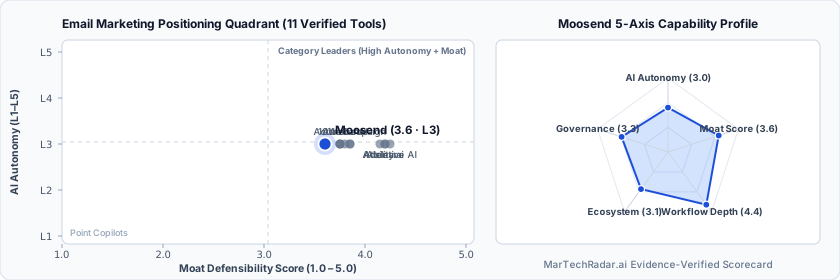
Moosend is a Web SaaS tool for Email Marketing (AI Email Marketing & Lifecycle Journeys) in Lifecycle & CDP. Pricing: From $7/mo. Best suited to B2B SaaS and DTC / eCommerce. Editor ratings: AI autonomy L3 (conditional automation); moat score 3.6/5.0 (Proprietary moat). Fact-checked by Sarah Per on Oct 14, 2026.
Email marketing automation platform offering visual behavioral journey builders, dynamic audience segmentation, and generative campaign copy assistance.
Moosend buyer fit verdict: when to choose vs. when to walk away
Choose Moosend if (Best Fit)
- Target ICP & Stack Fit: You operate as B2B SaaS and DTC / eCommerce requiring a Web SaaS deployment for Email Marketing.
- L3 Architecture & Defensibility: Defensibility stems from its high-throughput transactional delivery infrastructure, robust workflow automation templates, and integration depth within the Constant Contact ecosystem.
- Commercial Model Fit: Your procurement budget aligns with From $7/mo.
Walk away from Moosend if (Deal-Breakers)
- Walk away if your workflow requires uncapped enterprise volume on the From $7/mo entry plan without upgrading tiers.
- Walk away if your workflow cannot tolerate throughput throttling: High-volume data ingestion via REST endpoints encounters rate limits during rapid bulk-event syncs from external customer data platforms.
- Walk away if schema rigidity is a deal-breaker for your team: Custom field configurations require explicit data modeling, causing sync failures when upstream relational sources push nested JSON payloads.
Moosend key facts & scorecard
| Pricing | From $7/moVendor pricing page |
|---|---|
| Free plan | No / not disclosed |
| Delivery | Web SaaS |
| Audience | B2B SaaS, DTC / eCommerce |
| AI autonomy level | L3 · Conditional automationEditor-verified |
| Moat tier & score | 3.6 / 5.0 · Proprietary moatEditor-verified |
| Funding | AcquiredAcquired by Constant Contact |
| Founders | Panos Melissaropoulos |
| Company size | 11-50 employees |
| Governance & docs | Trust & Security ↗ · API & Docs ↗ · Terms ↗ · Privacy ↗ |
| Headquarters | London, England, United Kingdom |
| Founded | 2012 |
| Last verified |
Moosend pros & cons: strengths vs. operational limitations
Pros: core strengths & capabilities
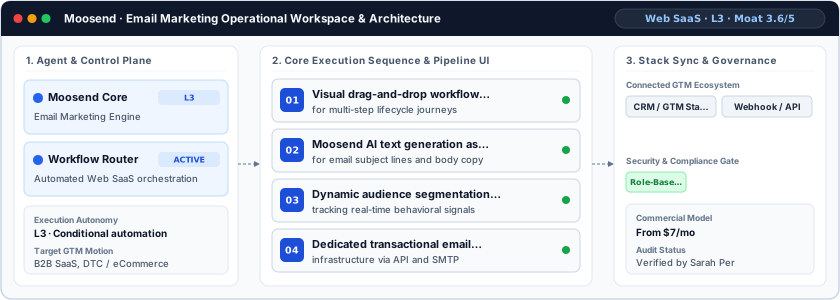
- Visual drag-and-drop workflow designer: for multi-step lifecycle journeys
- Moosend AI text generation assistant: for email subject lines and body copy
- Dynamic audience segmentation engine: tracking real-time behavioral signals
- Dedicated transactional email dispatch: infrastructure via API and SMTP
Cons: operational limitations & risks
- Throughput throttling: High-volume data ingestion via REST endpoints encounters rate limits during rapid bulk-event syncs from external customer data platforms.
- Schema rigidity: Custom field configurations require explicit data modeling, causing sync failures when upstream relational sources push nested JSON payloads.
- Deliverability remediation latency: IP reputation recovery and automated sender authentication monitoring require manual domain configuration intervention during unexpected bounce spikes.
Moosend TCO & deal-breaker stress test
Simulate 12-month stepped TCO, hidden cost multipliers, contract lock-in exposure, and stack failure modes using only facts verified by Sarah Per on · Capture SHA 56230df8.
Moosend aligns with your 5-seat / $800/mo profile. Review the walk-away triggers and contract levers below before deployment.
| Plan / Tier | Verified Rate | Scale Fit | Scope & Quota Notes |
|---|---|---|---|
| Entry / Starter | $7/mo | 1–2 seats | Create your free account |
| Growth / Professional | $9/mo | 5 seats | Create your free account |
- Moat Score
- 3.6 / 5.0
- AI Autonomy
- L3
- Free Tier / Trial
- None disclosed
Triggered audit signals & failure modes
- Published Self-Serve Entry FloorVerified Pricing Ledger
Moosend publishes a transparent entry point (From $7/mo) for initial validation before committing.
- Tier Fit for 5-Seat Scale: Growth / Professional ($9/mo)Verified Tier Schedule
Create your free account
- Primary Operational Bottleneck: Throughput throttlingAudit by Sarah Per
High-volume data ingestion via REST endpoints encounters rate limits during rapid bulk-event syncs from external customer data platforms.
Hidden TCO Multipliers & Quota Gates
- Annual Billing Headline vs. Monthly Premium: Headline entry rates reflect annual billing commitments (Save 15%); month-to-month flexibility carries a higher effective monthly rate or requires annual prepayment.
- Credit & Usage Burn Multiplier: Automated workflows consume metered credits/usage quotas; multi-step enrichment, voice minutes, or high-frequency agent runs can trigger mid-cycle top-up packs.
- Enterprise Governance & Add-On Gating: Advanced capabilities such as Single Sign-On (SSO), custom role permissions, or specialized analytics modules are gated behind upper tiers or paid add-ons.
When to Walk Away & Negotiation Levers
- Walk away if your workflow requires uncapped enterprise volume on the From $7/mo entry plan without upgrading tiers.
- Walk away if your workflow cannot tolerate throughput throttling: High-volume data ingestion via REST endpoints encounters rate limits during rapid bulk-event syncs from external customer data platforms.
- Walk away if schema rigidity is a deal-breaker for your team: Custom field configurations require explicit data modeling, causing sync failures when upstream relational sources push nested JSON payloads.
- Validate exact quota thresholds (seats, credits, or API calls) included in Moosend's From $7/mo tier before converting from monthly to annual billing.
- Require a sandbox proof-of-concept testing throughput throttling against your live CRM/data schema before annual sign-off.
Ask a custom procurement or TCO stress-test question about Moosend
Fits within $800/mo budget (From $19/mo)
Fits within $800/mo budget (From $500/mo)
Moosend moat & subtrack positioning
Defensibility stems from its high-throughput transactional delivery infrastructure, robust workflow automation templates, and integration depth within the Constant Contact ecosystem.
Editorial review
Fact-checked by Sarah Per (Principal Content Systems & Generative Media Editor) on .
Background
Within the marketing automation ecosystem, Moosend serves as an infrastructure layer for behavioral lifecycle messaging and broadcast operations. Headquartered in London, England, United Kingdom and founded in 2012, the platform expanded its market reach following its acquisition by Constant Contact. Targeted at retention marketers, e-commerce operators, and growth practitioners, the software standardizes the execution of trigger-based customer communication.
How Moosend works
Moosend operates on an event-driven automation framework that processes contact state changes through an asynchronous message broker. Inbound subscriber activity—captured via tracking scripts, webhooks, and REST endpoints—populates a dynamic profile store. Journey nodes evaluate conditional logic, time delays, and engagement thresholds to dispatch messages through managed SMTP delivery clusters. Moosend AI provides prompt-driven copy generation directly within the campaign designer, operating at an L3 conditional autonomy tier.
Limitations
Operational considerations and platform boundaries include:
- Throughput throttling: High-volume data ingestion via REST endpoints encounters rate limits during rapid bulk-event syncs from external customer data platforms.
- Schema rigidity: Custom field configurations require explicit data modeling, causing sync failures when upstream relational sources push nested JSON payloads.
- Deliverability remediation latency: IP reputation recovery and automated sender authentication monitoring require manual domain configuration intervention during unexpected bounce spikes.
Moosend pricing
Moosend utilizes a subscription tiering structure indexed against subscriber list volume. Commercial pricing begins from $7 per month on baseline plans, unlocking full access to the workflow designer, transactional SMTP triggers, and AI copywriting assistants as contact tiers scale upward.
How Moosend compares
While adjacent technologies like AB Tasty focus on front-end experimentation and 10Web AI or Ability.ai center on automated site building and operational ad agents, Moosend concentrates strictly on owned-channel lifecycle journeys. It provides mid-market digital brands and growing retail operators with deterministic, rule-based message delivery. Enterprise procurement teams evaluating deployment readiness should assess API webhook throughput, role-based access governance, and bilateral data synchronization latency against existing marketing technology infrastructure before committing to multi-year production rollouts.
Direct competitors & market radar
Top algorithmic competitors based on category positioning, capability overlap, and ICP alignment.
Frequently asked questions about Moosend
How much does Moosend cost and what pricing tiers are available?
Published pricing summary for Moosend: From $7/mo. A permanent free plan is not disclosed for Moosend. Verified tier schedule: Entry / Starter ($7/mo for 1–2 seats); Growth / Professional ($9/mo for 5 seats). Moosend utilizes a subscription tiering structure indexed against subscriber list volume. Commercial pricing begins from $7 per month on baseline plans, unlocking full access to the workflow designer, transactional SMTP triggers, and AI copywriting assistants as contact tiers scale upward.
How does Moosend work and how autonomous is its AI architecture?
Email marketing automation platform offering visual behavioral journey builders, dynamic audience segmentation, and generative campaign copy assistance. Within Email Marketing (AI Email Marketing & Lifecycle Journeys), MarTechRadar rates its execution architecture at L3 · Conditional automation with a verified Moat Score of 3.6 / 5.0 (Proprietary moat). Defensibility stems from its high-throughput transactional delivery infrastructure, robust workflow automation templates, and integration depth within the Constant Contact ecosystem. Corporate profile: Founded by Panos Melissaropoulos, operating at 11-50 employees scale, acquired by Constant Contact.
What are the main limitations of Moosend and when should buyers walk away?
Based on our editorial technical audit, key operational considerations and boundaries for Moosend include: (1) Throughput throttling: High-volume data ingestion via REST endpoints encounters rate limits during rapid bulk-event syncs from external customer data platforms. (2) Schema rigidity: Custom field configurations require explicit data modeling, causing sync failures when upstream relational sources push nested JSON payloads. (3) Deliverability remediation latency: IP reputation recovery and automated sender authentication monitoring require manual domain configuration intervention during unexpected bounce spikes. Primary procurement walk-away rule: Walk away if your workflow requires uncapped enterprise volume on the From $7/mo entry plan without upgrading tiers.
What integrations, compliance certifications, and contract terms apply to Moosend?
First-party governance and developer endpoints verified on domain include: Trust/Security (https://moosend.com/trust), API Docs (https://docs.moosend.com/user-guide/articles/KnowledgeBase/54410-generate-text-using-the-ai-writer). Key TCO multiplier to watch: Annual Billing Headline vs. Monthly Premium (Headline entry rates reflect annual billing commitments (Save 15%); month-to-month flexibility carries a higher effective monthly rate or requires annual prepayment.) Before signing a contract, procurement teams should validate exact quota thresholds (seats, credits, or API calls) included in Moosend's From $7/mo tier before converting from monthly to annual billing.
What are the best Moosend alternatives and head-to-head competitors in 2026?
Top fact-checked alternatives to Moosend in Email Marketing (AI Email Marketing & Lifecycle Journeys) include Constant Contact (From $0/mo), Backstroke (Custom / enterprise pricing), Dynamic Yield (Custom / enterprise pricing), Zendesk AI (From $19/mo). While adjacent technologies like AB Tasty focus on front-end experimentation and 10Web AI or Ability.ai center on automated site building and operational ad agents, Moosend concentrates strictly on owned-channel lifecycle journeys.
Verified sources & evidence trail
- Official product domain: https://moosend.com
- Commercial pricing verification: https://moosend.com/pricing/
- Verified corporate entity profiles (
sameAs): LinkedIn Company Profile · Crunchbase Entity Record - First-party governance & documentation links: Trust & Security · API & Docs · Terms · Privacy
- Editorial audit sign-off: Fact-checked by Sarah Per on under the MarTechRadar Evidence-Ledger Protocol.