Constant Contact Review (2026): Email Marketing Pricing, Limits & Alternatives
Bottom line
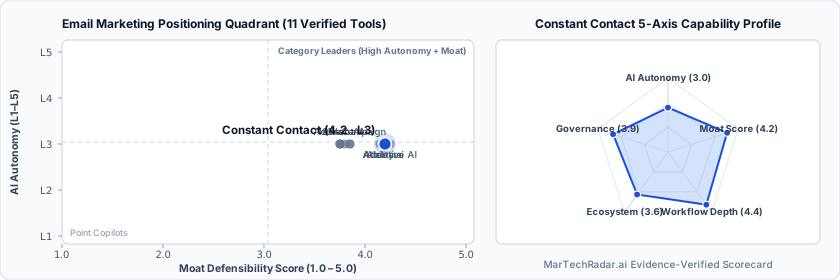
Constant Contact is a Web SaaS tool for Email Marketing (AI Email Marketing & Lifecycle Journeys) in Lifecycle & CDP. Pricing: From $0/mo. Best suited to Creators / Solo. Editor ratings: AI autonomy L3 (conditional automation); moat score 4.2/5.0 (Proprietary moat). Fact-checked by Julie Brot on Oct 12, 2026.
Established email marketing and lifecycle automation platform offering drag-and-drop campaign construction, list segmentation, and event management.
Constant Contact buyer fit verdict: when to choose vs. when to walk away
Choose Constant Contact if (Best Fit)
- Target ICP & Stack Fit: You operate as Creators / Solo requiring a Web SaaS deployment for Email Marketing, with verified ecosystem connectivity for Outreach.
- L3 Architecture & Defensibility: Defensibility stems from long-term sender IP reputation networks, extensive small business footprint, and integrated event registration workflows built over decades.
- Commercial Model Fit: Your procurement budget aligns with From $0/mo.
Walk away from Constant Contact if (Deal-Breakers)
- Walk away if your workflow requires uncapped enterprise volume on the From $0/mo entry plan without upgrading tiers.
- Walk away if your workflow cannot tolerate relational data schema flexibility: The data model enforces flat subscriber attributes, making complex nested entity relationships and real-time behavioral data ingestion difficult without external transformation layers.
- Walk away if automation workflow complexity is a deal-breaker for your team: Conditional logic pipelines remain restricted to linear decision trees, limiting dynamic multi-branch customer journeys triggered by multivariate product-usage events.
Constant Contact key facts & scorecard
| Pricing | From $0/moVendor pricing page |
|---|---|
| Free plan | No / not disclosed |
| Delivery | Web SaaS |
| Audience | Creators / Solo |
| AI autonomy level | L3 · Conditional automationEditor-verified |
| Moat tier & score | 4.2 / 5.0 · Proprietary moatEditor-verified |
| Funding | AcquiredAcquired by Endurance International Group |
| Total funding | $423.2MBacked by Clearlake Capital Group, Morgan Stanley, Greylock, Siris Capital Group, Morgan Stanley Expansion Capital |
| Founders | Randy Parker |
| Company size | 1,001-5,000 employees |
| Ecosystem integrations | Outreach |
| Governance & docs | Changelog ↗ · DPA ↗ · Terms ↗ · Privacy ↗ |
| Headquarters | Waltham, MA |
| Founded | 1996 |
| Last verified |
Constant Contact pros & cons: strengths vs. operational limitations
Pros: core strengths & capabilities
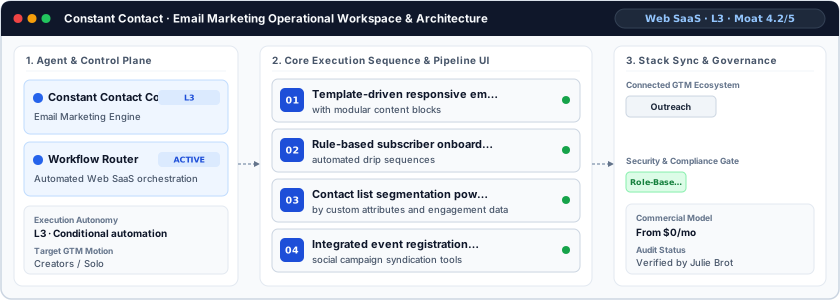
- Template-driven responsive email designer: with modular content blocks
- Rule-based subscriber onboarding and: automated drip sequences
- Contact list segmentation powered: by custom attributes and engagement data
- Integrated event registration and: social campaign syndication tools
Cons: operational limitations & risks
- Relational data schema flexibility: The data model enforces flat subscriber attributes, making complex nested entity relationships and real-time behavioral data ingestion difficult without external transformation layers.
- Automation workflow complexity: Conditional logic pipelines remain restricted to linear decision trees, limiting dynamic multi-branch customer journeys triggered by multivariate product-usage events.
- API throughput and developer extensibility: Strict rate limits on the public REST API restrict continuous bidirectional programmatic synchronizations with enterprise data warehouses and custom event buses.
Constant Contact TCO & deal-breaker stress test
Simulate 12-month stepped TCO, hidden cost multipliers, contract lock-in exposure, and stack failure modes using only facts verified by Julie Brot on · Capture SHA 8eacb0b5.
Constant Contact is viable for 5 seats, but requires commercial or technical verification on the flagged items below.
| Plan / Tier | Verified Rate | Scale Fit | Scope & Quota Notes |
|---|---|---|---|
| Entry / Starter | $2/mo | 1–2 seats | Add-ons like SMS and Inbox Preview also change your monthly price. |
| Growth / Professional | $10/mo | 5 seats | Prepay and save big |
- Moat Score
- 4.2 / 5.0
- AI Autonomy
- L3
- Free Tier / Trial
- None disclosed
Triggered audit signals & failure modes
- Opaque Enterprise Quoting vs. SMB/Mid-Market BudgetVerified Pricing Ledger
Constant Contact does not disclose a public self-serve floor (From $0/mo). Buyers with a $800/mo cap face high sales-qualification friction.
- Published Self-Serve Entry FloorVerified Pricing Ledger
Constant Contact publishes a transparent entry point (From $0/mo) for initial validation before committing.
- Tier Fit for 5-Seat Scale: Entry / Starter ($2/mo)Verified Tier Schedule
Add-ons like SMS and Inbox Preview also change your monthly price.
- Primary Operational Bottleneck: Relational data schema flexibilityAudit by Julie Brot
The data model enforces flat subscriber attributes, making complex nested entity relationships and real-time behavioral data ingestion difficult without external transformation layers.
Hidden TCO Multipliers & Quota Gates
- Annual Billing Headline vs. Monthly Premium: Headline entry rates reflect annual billing commitments (Save 15%); month-to-month flexibility carries a higher effective monthly rate or requires annual prepayment.
- Profile / Workspace Quota Ceilings: Base tiers cap the number of connected profiles, workspaces, or contact records, forcing tier upgrades before seat limits are reached.
- Enterprise Governance & Add-On Gating: Advanced capabilities such as Single Sign-On (SSO), custom role permissions, or specialized analytics modules are gated behind upper tiers or paid add-ons.
When to Walk Away & Negotiation Levers
- Walk away if your workflow requires uncapped enterprise volume on the From $0/mo entry plan without upgrading tiers.
- Walk away if your workflow cannot tolerate relational data schema flexibility: The data model enforces flat subscriber attributes, making complex nested entity relationships and real-time behavioral data ingestion difficult without external transformation layers.
- Walk away if automation workflow complexity is a deal-breaker for your team: Conditional logic pipelines remain restricted to linear decision trees, limiting dynamic multi-branch customer journeys triggered by multivariate product-usage events.
- Validate exact quota thresholds (seats, credits, or API calls) included in Constant Contact's From $0/mo tier before converting from monthly to annual billing.
- Require a sandbox proof-of-concept testing relational data schema flexibility against your live CRM/data schema before annual sign-off.
Ask a custom procurement or TCO stress-test question about Constant Contact
Lower 5-seat floor (~$7/mo vs. Custom Quote)
Lower 5-seat floor (~$15/mo vs. Custom Quote)
Constant Contact key entities, modules & ecosystem stack
Constant Contact moat & subtrack positioning
Defensibility stems from long-term sender IP reputation networks, extensive small business footprint, and integrated event registration workflows built over decades.
Editorial review
Fact-checked by Julie Brot (Enterprise SaaS Governance & Procurement Editor) on .
Background
Backed by $423.2M in capital and established in 1996 in Waltham, MA, Constant Contact functions as an email automation and digital communication engine. Designed primarily for non-technical marketing operators, franchise managers, and small-business teams, the system provides turnkey tools to build, send, and analyze direct subscriber outreach. It anchors commercial messaging workflows around centralized subscriber lists, structured newsletters, and foundational multi-channel promotional sequences.
How Constant Contact works
At its architectural core, Constant Contact relies on a browser-based layout engine coupled with proprietary mail transfer agent delivery pipelines. Subscriber metadata flows into relational contact stores via hosted sign-up forms, CSV batch imports, or third-party CRM webhooks. The application applies heuristic filters to manage list hygiene and process user engagement telemetry such as opens, clicks, and bounce classifications. Automation paths execute through conditional branching logic, qualifying contacts for targeted drip messages at Level 3 autonomy based on event-driven activity triggers.
Limitations
Operational considerations and platform boundaries include:
- Relational data schema flexibility: The data model enforces flat subscriber attributes, making complex nested entity relationships and real-time behavioral data ingestion difficult without external transformation layers.
- Automation workflow complexity: Conditional logic pipelines remain restricted to linear decision trees, limiting dynamic multi-branch customer journeys triggered by multivariate product-usage events.
- API throughput and developer extensibility: Strict rate limits on the public REST API restrict continuous bidirectional programmatic synchronizations with enterprise data warehouses and custom event buses.
Constant Contact pricing
Constant Contact provisions its software through a tiered subscription model indexed to total active contact volume. Platform access begins from $0 for baseline evaluation tiers, moving into paid tiers based on list scale and automation modules. Advanced capabilities, including automated behavioral segmentation and multi-step communication flows, require upward tier migration as database volumes grow.
How Constant Contact compares
While 10Web AI targets algorithmic website generation, AB Tasty focuses on client-side conversion rate optimization, and Ability.ai addresses autonomous performance ad allocation, Constant Contact concentrates squarely on deterministic outbound subscriber messaging. It sacrifices the high-throughput developer primitives of programmatic email engines to provide accessible, operational campaign distribution for resource-constrained growth teams.
Direct competitors & market radar
Top algorithmic competitors based on category positioning, capability overlap, and ICP alignment.
Frequently asked questions about Constant Contact
How much does Constant Contact cost and what pricing tiers are available?
Published pricing summary for Constant Contact: From $0/mo. A permanent free plan is not disclosed for Constant Contact. Verified tier schedule: Entry / Starter ($2/mo for 1–2 seats); Growth / Professional ($10/mo for 5 seats). Constant Contact provisions its software through a tiered subscription model indexed to total active contact volume. Platform access begins from $0 for baseline evaluation tiers, moving into paid tiers based on list scale and automation modules.
How does Constant Contact work and how autonomous is its AI architecture?
Established email marketing and lifecycle automation platform offering drag-and-drop campaign construction, list segmentation, and event management. Within Email Marketing (AI Email Marketing & Lifecycle Journeys), MarTechRadar rates its execution architecture at L3 · Conditional automation with a verified Moat Score of 4.2 / 5.0 (Proprietary moat). Defensibility stems from long-term sender IP reputation networks, extensive small business footprint, and integrated event registration workflows built over decades. Corporate profile: Founded by Randy Parker, operating at 1,001-5,000 employees scale, acquired by Endurance International Group.
What are the main limitations of Constant Contact and when should buyers walk away?
Based on our editorial technical audit, key operational considerations and boundaries for Constant Contact include: (1) Relational data schema flexibility: The data model enforces flat subscriber attributes, making complex nested entity relationships and real-time behavioral data ingestion difficult without external transformation layers. (2) Automation workflow complexity: Conditional logic pipelines remain restricted to linear decision trees, limiting dynamic multi-branch customer journeys triggered by multivariate product-usage events. (3) API throughput and developer extensibility: Strict rate limits on the public REST API restrict continuous bidirectional programmatic synchronizations with enterprise data warehouses and custom event buses. Primary procurement walk-away rule: Walk away if your workflow requires uncapped enterprise volume on the From $0/mo entry plan without upgrading tiers.
What integrations, compliance certifications, and contract terms apply to Constant Contact?
Verified ecosystem and stack integrations include Outreach. First-party governance and developer endpoints verified on domain include: DPA (https://www.constantcontact.com/legal/data-processing-addendum). Key TCO multiplier to watch: Annual Billing Headline vs. Monthly Premium (Headline entry rates reflect annual billing commitments (Save 15%); month-to-month flexibility carries a higher effective monthly rate or requires annual prepayment.) Before signing a contract, procurement teams should validate exact quota thresholds (seats, credits, or API calls) included in Constant Contact's From $0/mo tier before converting from monthly to annual billing.
What are the best Constant Contact alternatives and head-to-head competitors in 2026?
Top fact-checked alternatives to Constant Contact in Email Marketing (AI Email Marketing & Lifecycle Journeys) include Moosend (From $7/mo), SendX (From $1.40/mo), SmartrMail (Free plan · $0/mo · Enterprise plan), Adclear (Custom / enterprise pricing). While 10Web AI targets algorithmic website generation, AB Tasty focuses on client-side conversion rate optimization, and Ability.ai addresses autonomous performance ad allocation, Constant Contact concentrates squarely on deterministic outbound subscriber messaging.
Verified sources & evidence trail
- Official product domain: https://constantcontact.com
- Commercial pricing verification: https://www.constantcontact.com/pricing
- Verified corporate entity profiles (
sameAs): LinkedIn Company Profile · Crunchbase Entity Record - First-party governance & documentation links: Changelog · DPA · Terms · Privacy
- Editorial audit sign-off: Fact-checked by Julie Brot on under the MarTechRadar Evidence-Ledger Protocol.