Emarsys Review (2026): CDP Pricing, Limits & Alternatives
Bottom line
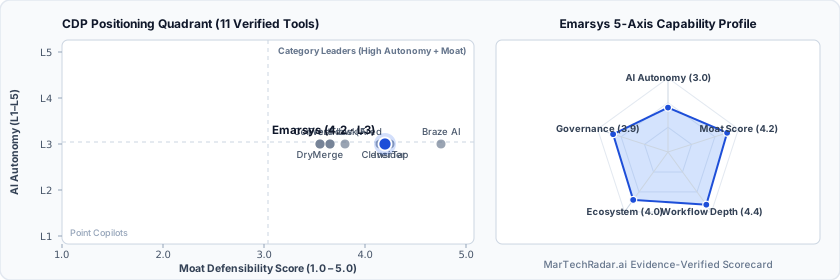
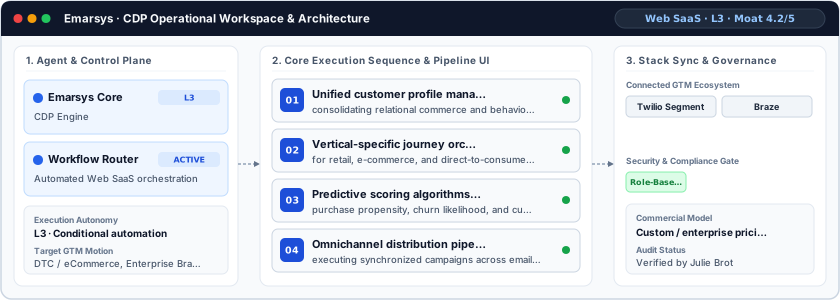
Emarsys is a Web SaaS tool for CDP (Customer Data Platform & Journey Orchestration) in Lifecycle & CDP. Pricing: Custom / enterprise pricing. Best suited to DTC / eCommerce and Enterprise Brands. Editor ratings: AI autonomy L3 (conditional automation); moat score 4.2/5.0 (Proprietary moat). Fact-checked by Julie Brot on Oct 12, 2026.
Omnichannel customer engagement and journey orchestration platform unifying consumer behavioral data, predictive scoring, and multi-channel marketing.
Emarsys buyer fit verdict: when to choose vs. when to walk away
Choose Emarsys if (Best Fit)
- Target ICP & Stack Fit: You operate as DTC / eCommerce and Enterprise Brands requiring a Web SaaS deployment for CDP, with verified ecosystem connectivity for Twilio Segment, Braze.
- L3 Architecture & Defensibility: Deep vertical retail domain blueprints, extensive enterprise integration with SAP Commerce ecosystems, and integrated relational profile stores driving automated cross-channel execution.
- Commercial Model Fit: Your procurement budget aligns with Custom / enterprise pricing.
Walk away from Emarsys if (Deal-Breakers)
- Walk away if you require transparent self-serve monthly billing or your budget ceiling is under $1,000/mo (Emarsys requires sales-gated custom quoting).
- Walk away if your workflow cannot tolerate schema extensibility: Data models are rigidly optimized around direct-to-consumer commerce paradigms, creating architectural friction when mapping non-retail relational entities or complex business-to-business hierarchies.
- Walk away if pipeline latency is a deal-breaker for your team: High-volume external database synchronizations and complex segment recalculations introduce processing queues, occasionally creating execution lags for real-time triggered journeys.
Emarsys key facts & scorecard
| Pricing | Custom / enterprise pricing |
|---|---|
| Free plan | No / not disclosed |
| Delivery | Web SaaS |
| Audience | DTC / eCommerce, Enterprise Brands |
| AI autonomy level | L3 · Conditional automationEditor-verified |
| Moat tier & score | 4.2 / 5.0 · Proprietary moatEditor-verified |
| Funding | AcquiredAcquired by SAP |
| Total funding | $55.3MBacked by Sanabil Investments |
| Founders | Daniel Harari, Hagai Hartman, Josef Ahorner |
| Company size | 501-1000 employees |
| Ecosystem integrations | Twilio Segment, Braze |
| Governance & docs | Trust & Security ↗ |
| Headquarters | Vienna, Austria |
| Founded | 2000 |
| Last verified |
Emarsys pros & cons: strengths vs. operational limitations
Pros: core strengths & capabilities
- Unified customer profile management: consolidating relational commerce and behavioral event streams
- Vertical-specific journey orchestration blueprints: for retail, e-commerce, and direct-to-consumer workflows
- Predictive scoring algorithms evaluating: purchase propensity, churn likelihood, and customer lifetime value
- Omnichannel distribution pipelines: executing synchronized campaigns across email, SMS, mobile push, and paid web channels
Cons: operational limitations & risks
- Schema Extensibility: Data models are rigidly optimized around direct-to-consumer commerce paradigms, creating architectural friction when mapping non-retail relational entities or complex business-to-business hierarchies.
- Pipeline Latency: High-volume external database synchronizations and complex segment recalculations introduce processing queues, occasionally creating execution lags for real-time triggered journeys.
- Ecosystem Coupling: Advanced personalization mechanisms yield diminished functional utility when operated outside SAP-centric infrastructure, demanding substantial custom API integration effort for disjointed technology stacks.
Emarsys TCO & deal-breaker stress test
Simulate 12-month stepped TCO, hidden cost multipliers, contract lock-in exposure, and stack failure modes using only facts verified by Julie Brot on · Capture SHA 39641e09.
Emarsys triggers high-severity friction under your 5-seat / $800/mo constraints. Benchmark the verified subtrack alternatives below before committing.
| Plan / Tier | Verified Rate | Scale Fit | Scope & Quota Notes |
|---|---|---|---|
| Enterprise / Custom | Custom quote | 15–50+ seats (Enterprise SLA) | Sales-negotiated annual contract for custom volume, SSO/RBAC governance, and dedicated SLA. |
- Moat Score
- 4.2 / 5.0
- AI Autonomy
- L3
- Free Tier / Trial
- None disclosed
Triggered audit signals & failure modes
- Opaque Enterprise Quoting vs. SMB/Mid-Market BudgetVerified Pricing Ledger
Emarsys does not disclose a public self-serve floor (Custom / enterprise pricing). Buyers with a $800/mo cap face high sales-qualification friction.
- Sales-Gated Contract TermsFact-checked by Julie Brot
Commercial procurement operates on custom enterprise terms negotiated via sales representatives, with contracts structured around active profile volumes, multi-channel messaging throughput, and tier-specific functional modules.
- Primary Operational Bottleneck: Schema ExtensibilityAudit by Julie Brot
Data models are rigidly optimized around direct-to-consumer commerce paradigms, creating architectural friction when mapping non-retail relational entities or complex business-to-business hierarchies.
Hidden TCO Multipliers & Quota Gates
- Schema Extensibility: Data models are rigidly optimized around direct-to-consumer commerce paradigms, creating architectural friction when mapping non-retail relational entities or complex business-to-business hierarchies.
- Pipeline Latency: High-volume external database synchronizations and complex segment recalculations introduce processing queues, occasionally creating execution lags for real-time triggered journeys.
When to Walk Away & Negotiation Levers
- Walk away if you require transparent self-serve monthly billing or your budget ceiling is under $1,000/mo (Emarsys requires sales-gated custom quoting).
- Walk away if your workflow cannot tolerate schema extensibility: Data models are rigidly optimized around direct-to-consumer commerce paradigms, creating architectural friction when mapping non-retail relational entities or complex business-to-business hierarchies.
- Walk away if pipeline latency is a deal-breaker for your team: High-volume external database synchronizations and complex segment recalculations introduce processing queues, occasionally creating execution lags for real-time triggered journeys.
- Demand a 30- to 60-day paid pilot opt-out clause in the Emarsys order form before signing a 12-month enterprise commitment.
- Require a sandbox proof-of-concept testing schema extensibility against your live CRM/data schema before annual sign-off.
Ask a custom procurement or TCO stress-test question about Emarsys
Lower 5-seat floor (~$85/mo vs. Custom Quote) · Transparent self-serve entry without mandatory annual lock-in
Lower 5-seat floor (~$19/mo vs. Custom Quote) · Transparent self-serve entry without mandatory annual lock-in
Emarsys key entities, modules & ecosystem stack
Emarsys moat & subtrack positioning
Deep vertical retail domain blueprints, extensive enterprise integration with SAP Commerce ecosystems, and integrated relational profile stores driving automated cross-channel execution.
Editorial review
Fact-checked by Julie Brot (Enterprise SaaS Governance & Procurement Editor) on .
Background
Established in 2000 in Vienna, Austria, Emarsys entered enterprise customer engagement after securing $55.3M in venture funding prior to its absorption into SAP Engagement Cloud. Designed for direct-to-consumer enterprises, retail organizations, and consumer packaged goods brands, the platform serves enterprise lifecycle marketing leaders and digital commerce operators. Rather than functioning as a standalone data warehouse, Emarsys anchors itself within transactional retail ecosystems, unifying commerce interactions, catalog taxonomies, and multi-channel touchpoints into an integrated execution layer.
How Emarsys works
The platform functions via a verticalized customer data schema that ingests clickstream events, order histories, and point-of-sale feeds into unified consumer profiles. Its predictive machine-learning engine analyzes behavioral cadences to score customer lifetime value, affinity categories, and churn probability. At an L3 conditional autonomy stage, the journey builder triggers automated multi-channel sequences across email, mobile push, and digital advertising based on algorithmic thresholds, utilizing pre-configured retail blueprints to route communications without requiring manual query construction.
Limitations
Operational considerations and platform boundaries include:
- Schema Extensibility: Data models are rigidly optimized around direct-to-consumer commerce paradigms, creating architectural friction when mapping non-retail relational entities or complex business-to-business hierarchies.
- Pipeline Latency: High-volume external database synchronizations and complex segment recalculations introduce processing queues, occasionally creating execution lags for real-time triggered journeys.
- Ecosystem Coupling: Advanced personalization mechanisms yield diminished functional utility when operated outside SAP-centric infrastructure, demanding substantial custom API integration effort for disjointed technology stacks.
Emarsys pricing
Commercial procurement operates on custom enterprise terms negotiated via sales representatives, with contracts structured around active profile volumes, multi-channel messaging throughput, and tier-specific functional modules. Pricing models do not rely on standard public tiers; enterprises receive customized quotes based on organizational scale, historical data consumption, and dedicated technical support agreements.
How Emarsys compares
Against Braze AI and CleverTap, which excel at low-latency mobile-first event streaming, Emarsys emphasizes out-of-the-box retail journey blueprints linked directly to historical commerce databases. While Bloomreach Loomi provides deep commerce search intelligence, Emarsys leverages tighter native alignment with broad enterprise enterprise-resource-planning architectures. It remains optimized for established omnichannel retailers requiring standardized catalog integrations rather than modern software teams seeking arbitrary event streaming.
Direct competitors & market radar
Top algorithmic competitors based on category positioning, capability overlap, and ICP alignment.
Frequently asked questions about Emarsys
How much does Emarsys cost and does it require a custom enterprise quote?
Published pricing summary for Emarsys: Custom / enterprise pricing. A permanent free plan is not disclosed for Emarsys. Commercial procurement operates on custom enterprise terms negotiated via sales representatives, with contracts structured around active profile volumes, multi-channel messaging throughput, and tier-specific functional modules.
How does Emarsys work and how autonomous is its AI architecture?
Omnichannel customer engagement and journey orchestration platform unifying consumer behavioral data, predictive scoring, and multi-channel marketing. Within CDP (Customer Data Platform & Journey Orchestration), MarTechRadar rates its execution architecture at L3 · Conditional automation with a verified Moat Score of 4.2 / 5.0 (Proprietary moat). Deep vertical retail domain blueprints, extensive enterprise integration with SAP Commerce ecosystems, and integrated relational profile stores driving automated cross-channel execution. Corporate profile: Founded by Daniel Harari, Hagai Hartman, Josef Ahorner, operating at 501-1000 employees scale, acquired by SAP.
What are the main limitations of Emarsys and when should buyers walk away?
Based on our editorial technical audit, key operational considerations and boundaries for Emarsys include: (1) Schema Extensibility: Data models are rigidly optimized around direct-to-consumer commerce paradigms, creating architectural friction when mapping non-retail relational entities or complex business-to-business hierarchies. (2) Pipeline Latency: High-volume external database synchronizations and complex segment recalculations introduce processing queues, occasionally creating execution lags for real-time triggered journeys. (3) Ecosystem Coupling: Advanced personalization mechanisms yield diminished functional utility when operated outside SAP-centric infrastructure, demanding substantial custom API integration effort for disjointed technology stacks. Primary procurement walk-away rule: Walk away if you require transparent self-serve monthly billing or your budget ceiling is under $1,000/mo (Emarsys requires sales-gated custom quoting).
What integrations, compliance certifications, and contract terms apply to Emarsys?
Verified ecosystem and stack integrations include Twilio Segment, Braze. First-party governance and developer endpoints verified on domain include: Trust/Security (https://trust.emarsys.com). Key TCO multiplier to watch: Schema Extensibility (Data models are rigidly optimized around direct-to-consumer commerce paradigms, creating architectural friction when mapping non-retail relational entities or complex business-to-business hierarchies.) Before signing a contract, procurement teams should demand a 30- to 60-day paid pilot opt-out clause in the Emarsys order form before signing a 12-month enterprise commitment.
What are the best Emarsys alternatives and head-to-head competitors in 2026?
Top fact-checked alternatives to Emarsys in CDP (Customer Data Platform & Journey Orchestration) include Braze AI (Custom / enterprise pricing), CleverTap (From $85/mo), Bloomreach Loomi (Custom / enterprise pricing), MoEngage (Custom / enterprise pricing). Against Braze AI and CleverTap, which excel at low-latency mobile-first event streaming, Emarsys emphasizes out-of-the-box retail journey blueprints linked directly to historical commerce databases.
Verified sources & evidence trail
- Official product domain: https://emarsys.com
- Commercial pricing verification: Verified against official vendor pricing policy (Custom / enterprise pricing)
- Verified corporate entity profiles (
sameAs): LinkedIn Company Profile · Crunchbase Entity Record - First-party governance & documentation links: Trust & Security
- Editorial audit sign-off: Fact-checked by Julie Brot on under the MarTechRadar Evidence-Ledger Protocol.