AirOps Review (2026): Programmatic SEO Pricing, Limits & Alternatives
Bottom line
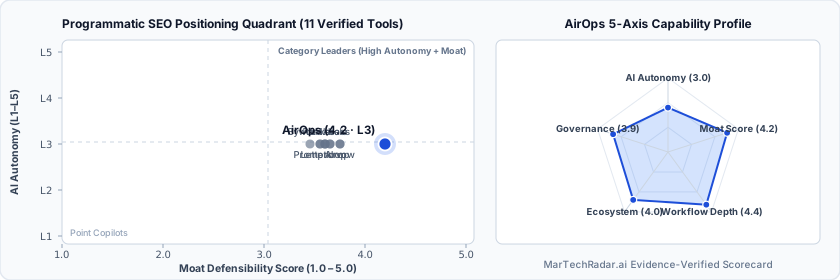
AirOps is a Web SaaS tool for Programmatic SEO (Programmatic SEO & Scaled Page Engines) in GEO & AI SEO. Pricing: Custom / enterprise pricing. Best suited to B2B SaaS and Marketing Agencies. Editor ratings: AI autonomy L3 (conditional automation); moat score 4.2/5.0 (Proprietary moat). Fact-checked by Jagmeet Sine on Oct 6, 2026.
AI workflow orchestration and programmatic content engine enabling growth marketing teams to build automated search pipelines, LLM-driven page generation.
AirOps buyer fit verdict: when to choose vs. when to walk away
Choose AirOps if (Best Fit)
- Target ICP & Stack Fit: You operate as B2B SaaS and Marketing Agencies requiring a Web SaaS deployment for Programmatic SEO, with verified ecosystem connectivity for WordPress, Webflow.
- L3 Architecture & Defensibility: Defensible DAG workflow builder optimized for marketing operations, deep CMS integration hooks, and proprietary orchestration pipelines that combine real-time SERP extraction with multi-model LLM generation.
- Commercial Model Fit: Your procurement budget aligns with Custom / enterprise pricing.
Walk away from AirOps if (Deal-Breakers)
- Walk away if you require transparent self-serve monthly billing or your budget ceiling is under $1,000/mo (AirOps requires sales-gated custom quoting).
- Walk away if your workflow cannot tolerate token latency and rate throttling: High-volume DAG batch runs encounter severe downstream concurrency limits and latency spikes from third-party LLM providers, requiring custom queue backpressure management.
- Walk away if CMS schema synchronization fragility is a deal-breaker for your team: Field mappings between workflow export nodes and headless content structures break when destination collections undergo schema migrations, triggering silent publishing failures.
AirOps key facts & scorecard
| Pricing | Custom / enterprise pricing |
|---|---|
| Free plan | No / not disclosed |
| Delivery | Web SaaS |
| Audience | B2B SaaS, Marketing Agencies |
| AI autonomy level | L3 · Conditional automationEditor-verified |
| Moat tier & score | 4.2 / 5.0 · Proprietary moatEditor-verified |
| Funding | Series B |
| Total funding | $62.5MBacked by Greylock, Unusual Ventures, Wing Venture Capital |
| Founders | Alex Halliday, Berna Gonzalez, Matt Hammel |
| Company size | 51-200 employees |
| Ecosystem integrations | WordPress, Webflow |
| Governance & docs | API & Docs ↗ · Terms ↗ · Privacy ↗ |
| Headquarters | San Francisco, CA, United States |
| Founded | 2021 |
| Last verified |
AirOps pros & cons: strengths vs. operational limitations
Pros: core strengths & capabilities
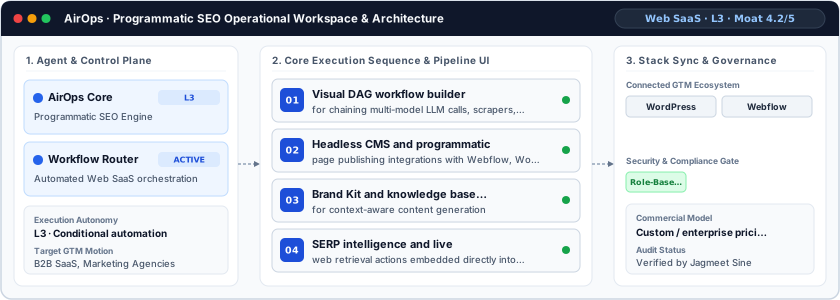
- Visual DAG workflow builder: for chaining multi-model LLM calls, scrapers, and data transformations
- Headless CMS and programmatic: page publishing integrations with Webflow, WordPress, and database endpoints
- Brand Kit and knowledge base grounding modules: for context-aware content generation
- SERP intelligence and live: web retrieval actions embedded directly into generation pipelines
Cons: operational limitations & risks
- Token latency and rate throttling: High-volume DAG batch runs encounter severe downstream concurrency limits and latency spikes from third-party LLM providers, requiring custom queue backpressure management.
- CMS schema synchronization fragility: Field mappings between workflow export nodes and headless content structures break when destination collections undergo schema migrations, triggering silent publishing failures.
- Indexation crawl budget exhaustion: Generating programmatic pages at high velocity can overwhelm site architecture and dilute crawl equity without strict canonicalization and internal linking rules.
AirOps TCO & deal-breaker stress test
Simulate 12-month stepped TCO, hidden cost multipliers, contract lock-in exposure, and stack failure modes using only facts verified by Jagmeet Sine on · Capture SHA e783bcac.
AirOps triggers high-severity friction under your 5-seat / $800/mo constraints. Benchmark the verified subtrack alternatives below before committing.
| Plan / Tier | Verified Rate | Scale Fit | Scope & Quota Notes |
|---|---|---|---|
| Enterprise / Custom | Custom quote | Unlimited seats (Enterprise SLA) | Sales-negotiated annual contract for custom volume, SSO/RBAC governance, and dedicated SLA. |
- Moat Score
- 4.2 / 5.0
- AI Autonomy
- L3
- Free Tier / Trial
- None disclosed
Triggered audit signals & failure modes
- Opaque Enterprise Quoting vs. SMB/Mid-Market BudgetVerified Pricing Ledger
AirOps does not disclose a public self-serve floor (Custom / enterprise pricing). Buyers with a $800/mo cap face high sales-qualification friction.
- Sales-Gated Contract TermsFact-checked by Jagmeet Sine
AirOps operates an enterprise consumption model where commercial pricing is available on request through tailored enterprise sales quotes based on organizational scale and seats.
- Primary Operational Bottleneck: Indexation crawl budget exhaustionAudit by Jagmeet Sine
Generating programmatic pages at high velocity can overwhelm site architecture and dilute crawl equity without strict canonicalization and internal linking rules.
Hidden TCO Multipliers & Quota Gates
- Credit & Usage Burn Multiplier: Automated workflows consume metered credits/usage quotas; multi-step enrichment, voice minutes, or high-frequency agent runs can trigger mid-cycle top-up packs.
- Enterprise Governance & Add-On Gating: Advanced capabilities such as Single Sign-On (SSO), custom role permissions, or specialized analytics modules are gated behind upper tiers or paid add-ons.
When to Walk Away & Negotiation Levers
- Walk away if you require transparent self-serve monthly billing or your budget ceiling is under $1,000/mo (AirOps requires sales-gated custom quoting).
- Walk away if your workflow cannot tolerate token latency and rate throttling: High-volume DAG batch runs encounter severe downstream concurrency limits and latency spikes from third-party LLM providers, requiring custom queue backpressure management.
- Walk away if CMS schema synchronization fragility is a deal-breaker for your team: Field mappings between workflow export nodes and headless content structures break when destination collections undergo schema migrations, triggering silent publishing failures.
- Demand a 30- to 60-day paid pilot opt-out clause in the AirOps order form before signing a 12-month enterprise commitment.
- Require a sandbox proof-of-concept testing token latency and rate throttling against your live CRM/data schema before annual sign-off.
Ask a custom procurement or TCO stress-test question about AirOps
Lower 5-seat floor (~$24/mo vs. Custom Quote) · Transparent self-serve entry without mandatory annual lock-in
Lower 5-seat floor (~$99/mo vs. Custom Quote) · Transparent self-serve entry without mandatory annual lock-in
AirOps key entities, modules & ecosystem stack
AirOps moat & subtrack positioning
Defensible DAG workflow builder optimized for marketing operations, deep CMS integration hooks, and proprietary orchestration pipelines that combine real-time SERP extraction with multi-model LLM generation.
Editorial review
Fact-checked by Jagmeet Sine (Senior MarTech Infrastructure & Agentic Workflow Architect) on .
Background
Architected as a modular execution layer for search and discovery, AirOps was founded in 2021 in San Francisco, CA, United States, to bridge foundational model capabilities with scalable web distribution. Supported by $62.5M in total institutional funding, the platform targets growth engineers, technical SEO directors, and content operations teams seeking to replace bespoke Python scripts with structured orchestration pipelines. Within programmatic SEO and scaled content architectures, the platform functions as an intermediate processing node between live search indexes, enterprise knowledge repositories, and target content management endpoints.
How AirOps works
At its architectural core, AirOps operates as a directed acyclic graph (DAG) workflow engine operating with Level 3 autonomy. Ingestion pipelines extract raw inputs via web scrapers, data warehouse connectors, or manual CSV uploads, routing payloads through multi-step transformations. Execution nodes query external search APIs, execute prompt sequences across frontier LLMs, and ground outputs against vector-indexed brand kits. State management handles conditional branching, automated validation filters, and bulk retries before pushing structured JSON payloads directly into production content management systems or headless webhooks.
Limitations
Operational considerations and platform boundaries include:
- Token latency and rate throttling: High-volume DAG batch runs encounter severe downstream concurrency limits and latency spikes from third-party LLM providers, requiring custom queue backpressure management.
- CMS schema synchronization fragility: Field mappings between workflow export nodes and headless content structures break when destination collections undergo schema migrations, triggering silent publishing failures.
- Indexation crawl budget exhaustion: Generating programmatic pages at high velocity can overwhelm site architecture and dilute crawl equity without strict canonicalization and internal linking rules.
AirOps pricing
AirOps operates an enterprise consumption model where commercial pricing is available on request through tailored enterprise sales quotes based on organizational scale and seats. Licensing structures align with execution task volumes, provisioned knowledge base instances, and integration access limits. Enterprise agreements incorporate dedicated compute concurrency, custom workspace governance, single sign-on authentication, and negotiated task bands for high-throughput programmatic SEO operations.
How AirOps compares
Compared to single-purpose programmatic engines like Byword.ai and Cuppa.sh, which prioritize out-of-the-box template speed over structural configurability, AirOps offers greater pipeline flexibility through raw logic chaining, custom API calls, and data enrichment steps. Relative to Rankscale, which specializes in automated technical page deployments, AirOps demands more operational design effort from technical growth leads. It remains optimized for data-literate marketing teams requiring custom AI pipelines rather than static automated publishers.
Direct competitors & market radar
Top algorithmic competitors based on category positioning, capability overlap, and ICP alignment.
Frequently asked questions about AirOps
How much does AirOps cost and does it require a custom enterprise quote?
Published pricing summary for AirOps: Custom / enterprise pricing. A permanent free plan is not disclosed for AirOps. AirOps operates an enterprise consumption model where commercial pricing is available on request through tailored enterprise sales quotes based on organizational scale and seats. Licensing structures align with execution task volumes, provisioned knowledge base instances, and integration access limits.
How does AirOps work and how autonomous is its AI architecture?
AI workflow orchestration and programmatic content engine enabling growth marketing teams to build automated search pipelines, LLM-driven page generation. Within Programmatic SEO (Programmatic SEO & Scaled Page Engines), MarTechRadar rates its execution architecture at L3 · Conditional automation with a verified Moat Score of 4.2 / 5.0 (Proprietary moat). Defensible DAG workflow builder optimized for marketing operations, deep CMS integration hooks, and proprietary orchestration pipelines that combine real-time SERP extraction with multi-model LLM generation. Corporate profile: Founded by Alex Halliday, Berna Gonzalez, Matt Hammel, operating at 51-200 employees scale.
What are the main limitations of AirOps and when should buyers walk away?
Based on our editorial technical audit, key operational considerations and boundaries for AirOps include: (1) Token latency and rate throttling: High-volume DAG batch runs encounter severe downstream concurrency limits and latency spikes from third-party LLM providers, requiring custom queue backpressure management. (2) CMS schema synchronization fragility: Field mappings between workflow export nodes and headless content structures break when destination collections undergo schema migrations, triggering silent publishing failures. (3) Indexation crawl budget exhaustion: Generating programmatic pages at high velocity can overwhelm site architecture and dilute crawl equity without strict canonicalization and internal linking rules. Primary procurement walk-away rule: Walk away if you require transparent self-serve monthly billing or your budget ceiling is under $1,000/mo (AirOps requires sales-gated custom quoting).
What integrations, compliance certifications, and contract terms apply to AirOps?
Verified ecosystem and stack integrations include WordPress, Webflow. First-party governance and developer endpoints verified on domain include: API Docs (https://docs.airops.com). Key TCO multiplier to watch: Credit & Usage Burn Multiplier (Automated workflows consume metered credits/usage quotas; multi-step enrichment, voice minutes, or high-frequency agent runs can trigger mid-cycle top-up packs.) Before signing a contract, procurement teams should demand a 30- to 60-day paid pilot opt-out clause in the AirOps order form before signing a 12-month enterprise commitment.
What are the best AirOps alternatives and head-to-head competitors in 2026?
Top fact-checked alternatives to AirOps in Programmatic SEO (Programmatic SEO & Scaled Page Engines) include daydream Labs (Custom / enterprise pricing), Byword.ai (From $2.50), CapGo AI (From $24/mo), Citera (From $99/mo). Compared to single-purpose programmatic engines like Byword.ai and Cuppa.sh, which prioritize out-of-the-box template speed over structural configurability, AirOps offers greater pipeline flexibility through raw logic chaining, custom API calls, and data enrichment steps.
Verified sources & evidence trail
- Official product domain: https://airops.com
- Commercial pricing verification: Verified against official vendor pricing policy (Custom / enterprise pricing)
- Verified corporate entity profiles (
sameAs): LinkedIn Company Profile · Crunchbase Entity Record - First-party governance & documentation links: API & Docs · Terms · Privacy
- Editorial audit sign-off: Fact-checked by Jagmeet Sine on under the MarTechRadar Evidence-Ledger Protocol.