daydream Labs Review (2026): Content Optimization Pricing, Limits & Alternatives
Bottom line
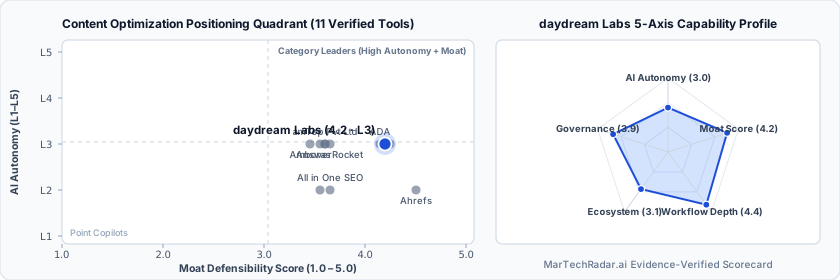
daydream Labs is a Web SaaS tool for Content Optimization (Content Optimization & SERP Intelligence) in GEO & AI SEO. Pricing: Custom / enterprise pricing. Best suited to SEO Directors, Brand Strategy Leaders and Growth Marketers. Editor ratings: AI autonomy L3 (conditional automation); moat score 4.2/5.0 (Proprietary moat). Fact-checked by Julie Brot on Oct 14, 2026.
Autonomous search intelligence and programmatic SEO platform deploying specialized AI agents to drive visibility across search and answer engines.
daydream Labs buyer fit verdict: when to choose vs. when to walk away
Choose daydream Labs if (Best Fit)
- Target ICP & Stack Fit: You operate as SEO Directors, Brand Strategy Leaders and Growth Marketers requiring a Web SaaS deployment for Content Optimization.
- L3 Architecture & Defensibility: Combines continuous generative engine optimization tracking with agentic content generation workflows, fortified by proprietary retrieval-augmented evaluation datasets.
- Commercial Model Fit: Your procurement budget aligns with Custom / enterprise pricing.
Walk away from daydream Labs if (Deal-Breakers)
- Walk away if you require transparent self-serve monthly billing or your budget ceiling is under $1,000/mo (daydream Labs requires sales-gated custom quoting).
- Walk away if your workflow cannot tolerate algorithmic drift vulnerability: Rapid adjustments to answer-engine citation algorithms can trigger volatility in optimization recommendations, requiring ongoing recalibration of underlying scoring heuristics.
- Walk away if editorial review overhead is a deal-breaker for your team: L3 semi-autonomous drafts require domain-expert editorial oversight to maintain distinct brand voice and eliminate synthetic hallucinations prior to CMS publication.
daydream Labs key facts & scorecard
| Pricing | Custom / enterprise pricing |
|---|---|
| Free plan | No / not disclosed |
| Delivery | Web SaaS |
| Audience | SEO Directors, Brand Strategy Leaders, Growth Marketers |
| AI autonomy level | L3 · Conditional automationEditor-verified |
| Moat tier & score | 4.2 / 5.0 · Proprietary moatEditor-verified |
| Funding | Series A |
| Total funding | $23.7M |
| Founders | Shravan Rajinikanth, Thenuka Karunaratne |
| Company size | 11-50 employees |
| Headquarters | San Francisco |
| Founded | 2023 |
| Last verified |
daydream Labs pros & cons: strengths vs. operational limitations
Pros: core strengths & capabilities
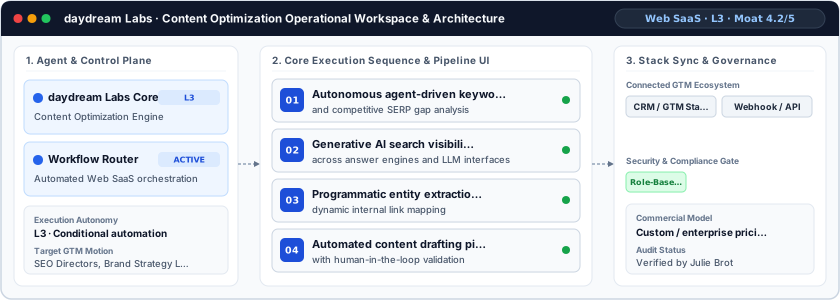
- Autonomous agent-driven keyword clustering: and competitive SERP gap analysis
- Generative AI search visibility tracking: across answer engines and LLM interfaces
- Programmatic entity extraction and: dynamic internal link mapping
- Automated content drafting pipelines paired: with human-in-the-loop validation
Cons: operational limitations & risks
- Algorithmic Drift Vulnerability: Rapid adjustments to answer-engine citation algorithms can trigger volatility in optimization recommendations, requiring ongoing recalibration of underlying scoring heuristics.
- Editorial Review Overhead: L3 semi-autonomous drafts require domain-expert editorial oversight to maintain distinct brand voice and eliminate synthetic hallucinations prior to CMS publication.
- CMS Integration Friction: Automated deployment requires complex webhooks and bespoke API integrations across non-standard headless content management systems, occasionally delaying time-to-value.
daydream Labs TCO & deal-breaker stress test
Simulate 12-month stepped TCO, hidden cost multipliers, contract lock-in exposure, and stack failure modes using only facts verified by Julie Brot on · Capture SHA 68728e77.
daydream Labs triggers high-severity friction under your 5-seat / $800/mo constraints. Benchmark the verified subtrack alternatives below before committing.
| Plan / Tier | Verified Rate | Scale Fit | Scope & Quota Notes |
|---|---|---|---|
| Enterprise / Custom | Custom quote | 15–50+ seats (Enterprise SLA) | Sales-negotiated annual contract for custom volume, SSO/RBAC governance, and dedicated SLA. |
- Moat Score
- 4.2 / 5.0
- AI Autonomy
- L3
- Free Tier / Trial
- None disclosed
Triggered audit signals & failure modes
- Opaque Enterprise Quoting vs. SMB/Mid-Market BudgetVerified Pricing Ledger
daydream Labs does not disclose a public self-serve floor (Custom / enterprise pricing). Buyers with a $800/mo cap face high sales-qualification friction.
- Sales-Gated Contract TermsFact-checked by Julie Brot
Commercial pricing for daydream Labs is available on request through tailored enterprise sales quotes based on organizational scale and seats.
- Primary Operational Bottleneck: Algorithmic Drift VulnerabilityAudit by Julie Brot
Rapid adjustments to answer-engine citation algorithms can trigger volatility in optimization recommendations, requiring ongoing recalibration of underlying scoring heuristics.
Hidden TCO Multipliers & Quota Gates
- Algorithmic Drift Vulnerability: Rapid adjustments to answer-engine citation algorithms can trigger volatility in optimization recommendations, requiring ongoing recalibration of underlying scoring heuristics.
- Editorial Review Overhead: L3 semi-autonomous drafts require domain-expert editorial oversight to maintain distinct brand voice and eliminate synthetic hallucinations prior to CMS publication.
When to Walk Away & Negotiation Levers
- Walk away if you require transparent self-serve monthly billing or your budget ceiling is under $1,000/mo (daydream Labs requires sales-gated custom quoting).
- Walk away if your workflow cannot tolerate algorithmic drift vulnerability: Rapid adjustments to answer-engine citation algorithms can trigger volatility in optimization recommendations, requiring ongoing recalibration of underlying scoring heuristics.
- Walk away if editorial review overhead is a deal-breaker for your team: L3 semi-autonomous drafts require domain-expert editorial oversight to maintain distinct brand voice and eliminate synthetic hallucinations prior to CMS publication.
- Demand a 30- to 60-day paid pilot opt-out clause in the daydream Labs order form before signing a 12-month enterprise commitment.
- Require a sandbox proof-of-concept testing algorithmic drift vulnerability against your live CRM/data schema before annual sign-off.
Ask a custom procurement or TCO stress-test question about daydream Labs
Lower 5-seat floor (~$29/mo vs. Custom Quote) · Transparent self-serve entry without mandatory annual lock-in
Lower 5-seat floor (~$49/mo vs. Custom Quote) · Transparent self-serve entry without mandatory annual lock-in
daydream Labs moat & subtrack positioning
Combines continuous generative engine optimization tracking with agentic content generation workflows, fortified by proprietary retrieval-augmented evaluation datasets.
Editorial review
Fact-checked by Julie Brot (Enterprise SaaS Governance & Procurement Editor) on .
Background
Backed by $23.7M in venture capital funding and headquartered in San Francisco, daydream Labs was founded in 2023 to address structural shifts in digital discovery across algorithmic search engines and emerging conversational answer platforms. The startup targets heads of growth, content directors, and enterprise SEO strategists facing declining organic attribution caused by generative AI overlays. Rather than functioning as a passive keyword research dashboard, the company provides automated workflows combining autonomous software agents with guided analytical methodologies for programmatic content expansion.
How daydream Labs works
At its technical core, daydream Labs operates an L3 autonomous engine designed to orchestrate the content lifecycle from query discovery to generation. The ingestion pipeline extracts dynamic SERP telemetry, competitive semantic coverage maps, and answer-engine citation graphs to calculate topic authority scores. Natural language processing models evaluate indexation coverage against multi-dimensional entity graphs, isolating high-intent information gaps. The agentic system then synthesizes comprehensive content outlines and programmatic drafts, using automated guardrails to verify factual consistency and keyword frequency before human validation.
Limitations
Operational considerations and platform boundaries include:
- Algorithmic Drift Vulnerability: Rapid adjustments to answer-engine citation algorithms can trigger volatility in optimization recommendations, requiring ongoing recalibration of underlying scoring heuristics.
- Editorial Review Overhead: L3 semi-autonomous drafts require domain-expert editorial oversight to maintain distinct brand voice and eliminate synthetic hallucinations prior to CMS publication.
- CMS Integration Friction: Automated deployment requires complex webhooks and bespoke API integrations across non-standard headless content management systems, occasionally delaying time-to-value.
daydream Labs pricing
Commercial pricing for daydream Labs is available on request through tailored enterprise sales quotes based on organizational scale and seats. The licensing model functions as an annual software contract that scales according to tracked domain portfolios, crawl frequencies, and deployed AI agent capacities. Engagements frequently bundle managed technical advisory services to oversee configuration, ensuring platform outputs remain aligned with internal search governance frameworks without exposing organizations to public usage tiers.
How daydream Labs compares
Within the content optimization and SERP intelligence landscape, daydream Labs competes directly against established crawl telemetry databases like Ahrefs and specialized workflow tools such as Amboras. While Ahrefs emphasizes historical index depth, raw backlink data, and manual user exploration, daydream Labs differentiates through agentic execution and generative search optimization. The architecture prioritizes enterprise content organizations requiring automated research and programmatic drafting rather than manual diagnostic reporting, making it suitable for teams prioritizing organic scaling velocity over standalone link audits.
Direct competitors & market radar
Top algorithmic competitors based on category positioning, capability overlap, and ICP alignment.
Frequently asked questions about daydream Labs
How much does daydream Labs cost and does it require a custom enterprise quote?
Published pricing summary for daydream Labs: Custom / enterprise pricing. A permanent free plan is not disclosed for daydream Labs. Commercial pricing for daydream Labs is available on request through tailored enterprise sales quotes based on organizational scale and seats. The licensing model functions as an annual software contract that scales according to tracked domain portfolios, crawl frequencies, and deployed AI agent capacities.
How does daydream Labs work and how autonomous is its AI architecture?
Autonomous search intelligence and programmatic SEO platform deploying specialized AI agents to drive visibility across search and answer engines. Within Content Optimization (Content Optimization & SERP Intelligence), MarTechRadar rates its execution architecture at L3 · Conditional automation with a verified Moat Score of 4.2 / 5.0 (Proprietary moat). Combines continuous generative engine optimization tracking with agentic content generation workflows, fortified by proprietary retrieval-augmented evaluation datasets. Corporate profile: Founded by Shravan Rajinikanth, Thenuka Karunaratne, operating at 11-50 employees scale.
What are the main limitations of daydream Labs and when should buyers walk away?
Based on our editorial technical audit, key operational considerations and boundaries for daydream Labs include: (1) Algorithmic Drift Vulnerability: Rapid adjustments to answer-engine citation algorithms can trigger volatility in optimization recommendations, requiring ongoing recalibration of underlying scoring heuristics. (2) Editorial Review Overhead: L3 semi-autonomous drafts require domain-expert editorial oversight to maintain distinct brand voice and eliminate synthetic hallucinations prior to CMS publication. (3) CMS Integration Friction: Automated deployment requires complex webhooks and bespoke API integrations across non-standard headless content management systems, occasionally delaying time-to-value. Primary procurement walk-away rule: Walk away if you require transparent self-serve monthly billing or your budget ceiling is under $1,000/mo (daydream Labs requires sales-gated custom quoting).
What integrations, compliance certifications, and contract terms apply to daydream Labs?
Key TCO multiplier to watch: Algorithmic Drift Vulnerability (Rapid adjustments to answer-engine citation algorithms can trigger volatility in optimization recommendations, requiring ongoing recalibration of underlying scoring heuristics.) Before signing a contract, procurement teams should demand a 30- to 60-day paid pilot opt-out clause in the daydream Labs order form before signing a 12-month enterprise commitment.
What are the best daydream Labs alternatives and head-to-head competitors in 2026?
Top fact-checked alternatives to daydream Labs in Content Optimization (Content Optimization & SERP Intelligence) include MarketMuse (Custom / enterprise pricing), Surfer SEO ($49–$240/mo), AirOps (Custom / enterprise pricing), Contently (Custom / enterprise pricing). Within the content optimization and SERP intelligence landscape, daydream Labs competes directly against established crawl telemetry databases like Ahrefs and specialized workflow tools such as Amboras.
Verified sources & evidence trail
- Official product domain: https://www.withdaydream.com/
- Commercial pricing verification: Verified against official vendor pricing policy (Custom / enterprise pricing)
- Verified corporate entity profiles (
sameAs): LinkedIn Company Profile · Crunchbase Entity Record - Editorial audit sign-off: Fact-checked by Julie Brot on under the MarTechRadar Evidence-Ledger Protocol.