AnswerRocket Review (2026): Content Optimization Pricing, Limits & Alternatives
Bottom line
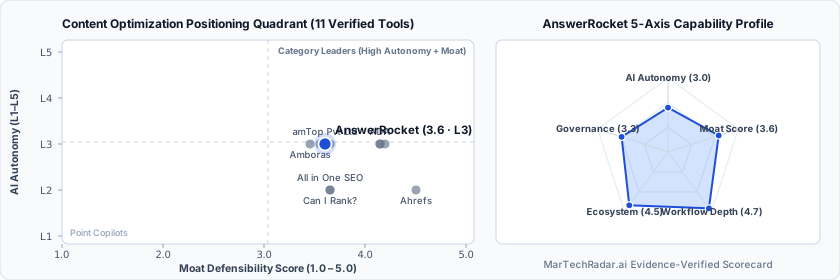
AnswerRocket is a Web SaaS tool for Content Optimization (Content Optimization & SERP Intelligence) in GEO & AI SEO. Pricing: Custom / enterprise pricing. Best suited to DTC / eCommerce and Enterprise Brands. Editor ratings: AI autonomy L3 (conditional automation); moat score 3.6/5.0 (Proprietary moat). Fact-checked by Jiacky Lee on Oct 15, 2026.
Enterprise augmented analytics platform utilizing generative AI and conversational agents to automate complex data analysis and business intelligence.
AnswerRocket buyer fit verdict: when to choose vs. when to walk away
Choose AnswerRocket if (Best Fit)
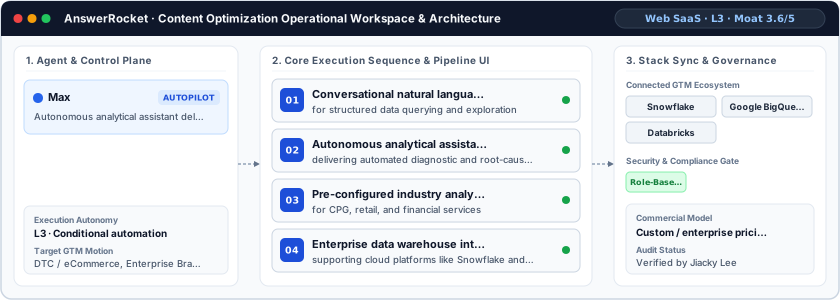
- Target ICP & Stack Fit: You operate as DTC / eCommerce and Enterprise Brands requiring a Web SaaS deployment for Content Optimization, with verified ecosystem connectivity for Snowflake, Google BigQuery, Databricks.
- L3 Architecture & Defensibility: Deep domain-specific semantic models tailored for enterprise CPG, retail, and financial analytics paired with an autonomous diagnostic engine (Max) that translates unstructured business queries into structured analytical computations.
- Commercial Model Fit: Your procurement budget aligns with Custom / enterprise pricing.
Walk away from AnswerRocket if (Deal-Breakers)
- Walk away if you require transparent self-serve monthly billing or your budget ceiling is under $1,000/mo (AnswerRocket requires sales-gated custom quoting).
- Walk away if your workflow cannot tolerate semantic layer maintenance overhead: The system depends heavily on accurate ontology mapping; schema drift or non-standard metric definitions in upstream databases cause inaccurate SQL translations and flawed diagnostic narratives.
- Walk away if warehouse computational latency is a deal-breaker for your team: Multi-dimensional analytical queries triggered by open-ended conversational prompts can cause significant compute overhead and query latency on high-volume enterprise data warehouses.
AnswerRocket key facts & scorecard
| Pricing | Custom / enterprise pricing |
|---|---|
| Free plan | No / not disclosed |
| Delivery | Web SaaS |
| Audience | DTC / eCommerce, Enterprise Brands |
| AI autonomy level | L3 · Conditional automationEditor-verified |
| Moat tier & score | 3.6 / 5.0 · Proprietary moatEditor-verified |
| Funding | Series C+ |
| Founders | Alon Goren, Mike Finley |
| Company size | 51-200 employees |
| Ecosystem integrations | Snowflake, Google BigQuery, Databricks |
| Governance & docs | Trust & Security ↗ · Privacy ↗ |
| Headquarters | Atlanta, Georgia |
| Founded | 2013 |
| Last verified |
AnswerRocket pros & cons: strengths vs. operational limitations
Pros: core strengths & capabilities
- Conversational natural language interface: for structured data querying and exploration
- Autonomous analytical assistant (Max): delivering automated diagnostic and root-cause analysis
- Pre-configured industry analytical accelerators: for CPG, retail, and financial services
- Enterprise data warehouse integration: supporting cloud platforms like Snowflake and BigQuery
Cons: operational limitations & risks
- Semantic Layer Maintenance Overhead: The system depends heavily on accurate ontology mapping; schema drift or non-standard metric definitions in upstream databases cause inaccurate SQL translations and flawed diagnostic narratives.
- Warehouse Computational Latency: Multi-dimensional analytical queries triggered by open-ended conversational prompts can cause significant compute overhead and query latency on high-volume enterprise data warehouses.
- Unstructured Content Blindspots: The core engine evaluates structured warehouse tables and relational metrics, rendering it unable to ingest or contextualize unstructured text, customer review sentiment, or visual asset data directly.
AnswerRocket TCO & deal-breaker stress test
Simulate 12-month stepped TCO, hidden cost multipliers, contract lock-in exposure, and stack failure modes using only facts verified by Jiacky Lee on · Capture SHA 95522587.
AnswerRocket triggers high-severity friction under your 5-seat / $800/mo constraints. Benchmark the verified subtrack alternatives below before committing.
| Plan / Tier | Verified Rate | Scale Fit | Scope & Quota Notes |
|---|---|---|---|
| Enterprise / Custom | Custom quote | 15–50+ seats (Enterprise SLA) | Sales-negotiated annual contract for custom volume, SSO/RBAC governance, and dedicated SLA. |
- Moat Score
- 3.6 / 5.0
- AI Autonomy
- L3
- Free Tier / Trial
- None disclosed
Triggered audit signals & failure modes
- Opaque Enterprise Quoting vs. SMB/Mid-Market BudgetVerified Pricing Ledger
AnswerRocket does not disclose a public self-serve floor (Custom / enterprise pricing). Buyers with a $800/mo cap face high sales-qualification friction.
- Sales-Gated Contract TermsFact-checked by Jiacky Lee
AnswerRocket delivers its software through enterprise licensing tiers. Commercial pricing is available on request through tailored enterprise sales quotes based on organizational scale and seats.
- Primary Operational Bottleneck: Semantic Layer Maintenance OverheadAudit by Jiacky Lee
The system depends heavily on accurate ontology mapping; schema drift or non-standard metric definitions in upstream databases cause inaccurate SQL translations and flawed diagnostic narratives.
Hidden TCO Multipliers & Quota Gates
- Semantic Layer Maintenance Overhead: The system depends heavily on accurate ontology mapping; schema drift or non-standard metric definitions in upstream databases cause inaccurate SQL translations and flawed diagnostic narratives.
- Warehouse Computational Latency: Multi-dimensional analytical queries triggered by open-ended conversational prompts can cause significant compute overhead and query latency on high-volume enterprise data warehouses.
When to Walk Away & Negotiation Levers
- Walk away if you require transparent self-serve monthly billing or your budget ceiling is under $1,000/mo (AnswerRocket requires sales-gated custom quoting).
- Walk away if your workflow cannot tolerate semantic layer maintenance overhead: The system depends heavily on accurate ontology mapping; schema drift or non-standard metric definitions in upstream databases cause inaccurate SQL translations and flawed diagnostic narratives.
- Walk away if warehouse computational latency is a deal-breaker for your team: Multi-dimensional analytical queries triggered by open-ended conversational prompts can cause significant compute overhead and query latency on high-volume enterprise data warehouses.
- Demand a 30- to 60-day paid pilot opt-out clause in the AnswerRocket order form before signing a 12-month enterprise commitment.
- Require a sandbox proof-of-concept testing semantic layer maintenance overhead against your live CRM/data schema before annual sign-off.
Ask a custom procurement or TCO stress-test question about AnswerRocket
Lower 5-seat floor (~$8/mo vs. Custom Quote) · Transparent self-serve entry without mandatory annual lock-in
Lower 5-seat floor (~$29/mo vs. Custom Quote) · Transparent self-serve entry without mandatory annual lock-in
AnswerRocket key entities, modules & ecosystem stack
Autonomous analytical assistant delivering automated diagnostic and root-cause analysis
AnswerRocket moat & subtrack positioning
Deep domain-specific semantic models tailored for enterprise CPG, retail, and financial analytics paired with an autonomous diagnostic engine (Max) that translates unstructured business queries into structured analytical computations.
Editorial review
Fact-checked by Jiacky Lee (Managing Editor, AI Autonomy & Moat Methodology) on .
Background
Established in 2013 in Atlanta, Georgia, AnswerRocket addresses the operational bottleneck between corporate analytics teams and commercial decision-makers who require ad-hoc analytical intelligence. Operating at an L3 autonomy level, the platform provides conversational analytics and automated diagnostics, enabling commercial leaders in enterprise CPG, retail, and financial organizations to investigate performance variations without submitting engineering tickets. Rather than forcing users into static business intelligence dashboards, AnswerRocket allows brand managers and marketing executives to interrogate complex enterprise data through a conversational diagnostic assistant.
How AnswerRocket works
AnswerRocket centers on its AI analytical assistant, Max, which connects directly to enterprise cloud data warehouses like Snowflake and BigQuery. The engine utilizes a proprietary semantic layer that maps business logic, metrics, and dimensional hierarchies. When an operator poses a business question, the conversational layer translates natural language into verified SQL queries, pulls required tables, and computes causal analyses. The framework then structures anomalies and drivers into automated statistical summaries, charts, and natural language explanations, executing multi-step diagnostic reasoning without human-authored scripts, alongside native workflow integrations for Databricks.
Limitations
Operational considerations and platform boundaries include:
- Semantic Layer Maintenance Overhead: The system depends heavily on accurate ontology mapping; schema drift or non-standard metric definitions in upstream databases cause inaccurate SQL translations and flawed diagnostic narratives.
- Warehouse Computational Latency: Multi-dimensional analytical queries triggered by open-ended conversational prompts can cause significant compute overhead and query latency on high-volume enterprise data warehouses.
- Unstructured Content Blindspots: The core engine evaluates structured warehouse tables and relational metrics, rendering it unable to ingest or contextualize unstructured text, customer review sentiment, or visual asset data directly.
AnswerRocket pricing
AnswerRocket delivers its software through enterprise licensing tiers. Commercial pricing is available on request through tailored enterprise sales quotes based on organizational scale and seats. Contracts reflect deployment scope, data warehouse connection volume, specific industry accelerators, and administrative access requirements, typically committed under multi-year service agreements with onboarding implementation packages.
How AnswerRocket compares
Within enterprise intelligence and Content Optimization workflows, AnswerRocket functions as an augmented conversational analytics engine alongside verified subtrack peers such as Ahrefs, Semrush, and ADA. While search-focused platforms like Ahrefs and Semrush concentrate on external SERP crawl indexes and keyword telemetry, AnswerRocket specializes in querying internal Snowflake, BigQuery, and Databricks data warehouses via natural language to automate root-cause diagnostics for enterprise CPG, retail, and marketing analytics teams.
Direct competitors & market radar
Top algorithmic competitors based on category positioning, capability overlap, and ICP alignment.
Frequently asked questions about AnswerRocket
How much does AnswerRocket cost and does it require a custom enterprise quote?
Published pricing summary for AnswerRocket: Custom / enterprise pricing. A permanent free plan is not disclosed for AnswerRocket. AnswerRocket delivers its software through enterprise licensing tiers. Commercial pricing is available on request through tailored enterprise sales quotes based on organizational scale and seats.
How does AnswerRocket work and how autonomous is its AI architecture?
Enterprise augmented analytics platform utilizing generative AI and conversational agents to automate complex data analysis and business intelligence. Within Content Optimization (Content Optimization & SERP Intelligence), MarTechRadar rates its execution architecture at L3 · Conditional automation with a verified Moat Score of 3.6 / 5.0 (Proprietary moat). Deep domain-specific semantic models tailored for enterprise CPG, retail, and financial analytics paired with an autonomous diagnostic engine (Max) that translates unstructured business queries into structured analytical computations. Corporate profile: Founded by Alon Goren, Mike Finley, operating at 51-200 employees scale.
What are the main limitations of AnswerRocket and when should buyers walk away?
Based on our editorial technical audit, key operational considerations and boundaries for AnswerRocket include: (1) Semantic Layer Maintenance Overhead: The system depends heavily on accurate ontology mapping; schema drift or non-standard metric definitions in upstream databases cause inaccurate SQL translations and flawed diagnostic narratives. (2) Warehouse Computational Latency: Multi-dimensional analytical queries triggered by open-ended conversational prompts can cause significant compute overhead and query latency on high-volume enterprise data warehouses. (3) Unstructured Content Blindspots: The core engine evaluates structured warehouse tables and relational metrics, rendering it unable to ingest or contextualize unstructured text, customer review sentiment, or visual asset data directly. Primary procurement walk-away rule: Walk away if you require transparent self-serve monthly billing or your budget ceiling is under $1,000/mo (AnswerRocket requires sales-gated custom quoting).
What integrations, compliance certifications, and contract terms apply to AnswerRocket?
Verified ecosystem and stack integrations include Snowflake, Google BigQuery, Databricks. First-party governance and developer endpoints verified on domain include: Trust/Security (https://answerrocket.com/security). Key TCO multiplier to watch: Semantic Layer Maintenance Overhead (The system depends heavily on accurate ontology mapping; schema drift or non-standard metric definitions in upstream databases cause inaccurate SQL translations and flawed diagnostic narratives.) Before signing a contract, procurement teams should demand a 30- to 60-day paid pilot opt-out clause in the AnswerRocket order form before signing a 12-month enterprise commitment.
What are the best AnswerRocket alternatives and head-to-head competitors in 2026?
Top fact-checked alternatives to AnswerRocket in Content Optimization (Content Optimization & SERP Intelligence) include Case Resolve Tech (Custom / enterprise pricing), ADA (Custom / enterprise pricing), Solara AI (From $29/mo), Woop AI (From $8/mo). Within enterprise intelligence and Content Optimization workflows, AnswerRocket functions as an augmented conversational analytics engine alongside verified subtrack peers such as Ahrefs, Semrush, and ADA.
Verified sources & evidence trail
- Official product domain: https://answerrocket.com
- Commercial pricing verification: Verified against official vendor pricing policy (Custom / enterprise pricing)
- Verified corporate entity profiles (
sameAs): LinkedIn Company Profile · Crunchbase Entity Record - First-party governance & documentation links: Trust & Security · Privacy
- Editorial audit sign-off: Fact-checked by Jiacky Lee on under the MarTechRadar Evidence-Ledger Protocol.