Semrush Review (2026): Content Optimization Pricing, Limits & Alternatives
Bottom line
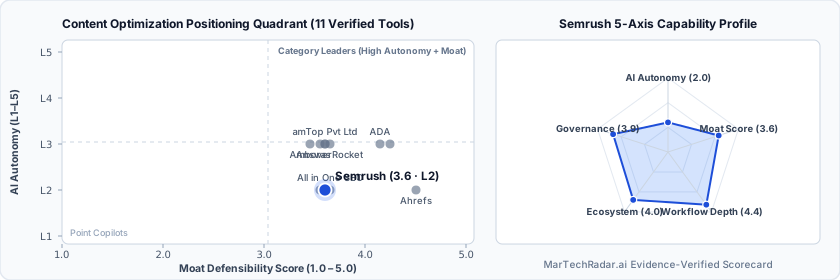
Semrush is a Web SaaS tool for Content Optimization (Content Optimization & SERP Intelligence) in GEO & AI SEO. Pricing: Free plan · $139–$299/mo. Best suited to B2B SaaS, DTC / eCommerce and Enterprise Brands. Editor ratings: AI autonomy L2 (workflow copilot); moat score 3.6/5.0 (Proprietary moat). Fact-checked by Jagmeet Sine on Oct 15, 2026.
Enterprise search marketing platform delivering competitive intelligence, SERP position tracking, keyword discovery, and automated workflow suggestions.
Semrush buyer fit verdict: when to choose vs. when to walk away
Choose Semrush if (Best Fit)
- Target ICP & Stack Fit: You operate as B2B SaaS, DTC / eCommerce and Enterprise Brands requiring a Web SaaS deployment for Content Optimization, with verified ecosystem connectivity for Google Analytics 4 (GA4), Google Search Console.
- L2 Architecture & Defensibility: Extensive historical search engine results index, substantial proprietary backlink database, and integrated anomaly-detection algorithms across cross-channel visibility metrics.
- Commercial Model Fit: Your procurement budget aligns with Free plan · $139–$299/mo and want a self-serve free tier for zero-cost initial validation.
Walk away from Semrush if (Deal-Breakers)
- Walk away if your workflow requires uncapped enterprise volume on the Free plan · $139–$299/mo entry plan without upgrading tiers.
- Walk away if your workflow cannot tolerate API rate caps and quotas: High-volume data exports and external dashboard integrations hit strict daily API unit credit limits, requiring batching discipline.
- Walk away if crawl frequency latency is a deal-breaker for your team: Secondary SERP tracking updates operate on scheduled batch windows, introducing temporal lag during dynamic algorithm rollouts.
Semrush key facts & scorecard
| Pricing | Free plan · $139–$299/moVendor pricing page |
|---|---|
| Free plan | Yes |
| Delivery | Web SaaS |
| Audience | B2B SaaS, DTC / eCommerce, Enterprise Brands |
| AI autonomy level | L2 · Workflow copilotEditor-verified |
| Moat tier & score | 3.6 / 5.0 · Proprietary moatEditor-verified |
| Funding | Public company |
| Total funding | $40M |
| Ecosystem integrations | Google Analytics 4 (GA4), Google Search Console |
| Governance & docs | API & Docs ↗ · Privacy ↗ |
| Headquarters | Boston, Massachusetts |
| Founded | 2008 |
| Last verified |
Semrush pros & cons: strengths vs. operational limitations
Pros: core strengths & capabilities
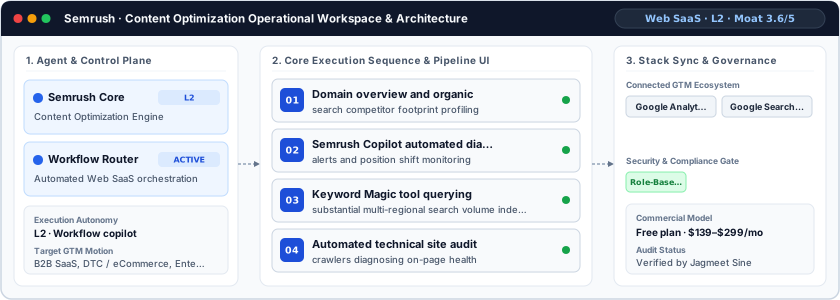
- Domain overview and organic: search competitor footprint profiling
- Semrush Copilot automated diagnostic: alerts and position shift monitoring
- Keyword Magic tool querying: substantial multi-regional search volume indexes
- Automated technical site audit: crawlers diagnosing on-page health
Cons: operational limitations & risks
- API Rate Caps and Quotas: High-volume data exports and external dashboard integrations hit strict daily API unit credit limits, requiring batching discipline.
- Crawl Frequency Latency: Secondary SERP tracking updates operate on scheduled batch windows, introducing temporal lag during dynamic algorithm rollouts.
- SERP Volatility Noise: Automated alert pipelines can over-trigger during minor search layout tests, creating diagnostic notification fatigue for operators.
Semrush TCO & deal-breaker stress test
Simulate 12-month stepped TCO, hidden cost multipliers, contract lock-in exposure, and stack failure modes using only facts verified by Jagmeet Sine on · Capture SHA c833c456.
Semrush aligns with your 5-seat / $800/mo profile. Review the walk-away triggers and contract levers below before deployment.
| Plan / Tier | Verified Rate | Scale Fit | Scope & Quota Notes |
|---|---|---|---|
| Free / Sandbox | $0 | 1–2 seats (Evaluation) | Entry free tier with capped usage or feature quotas for initial workflow testing. |
| Entry / Starter | $139/mo | 1–2 seats | Verified $139/mo tier from vendor pricing schedule. |
| Growth / Professional | $199/mo | 5 seats | Verified $199/mo tier from vendor pricing schedule. |
| Scale / Advanced | $299/mo | 15 seats | All Starter features plus: |
- Moat Score
- 3.6 / 5.0
- AI Autonomy
- L2
- Free Tier / Trial
- Free plan
Triggered audit signals & failure modes
- Published Self-Serve Entry FloorVerified Pricing Ledger
Semrush publishes a transparent entry point (Free plan · $139–$299/mo) with a free tier for initial validation before committing.
- Tier Fit for 5-Seat Scale: Growth / Professional ($199/mo)Verified Tier Schedule
Verified $199/mo tier from vendor pricing schedule.
- Primary Operational Bottleneck: API Rate Caps and QuotasAudit by Jagmeet Sine
High-volume data exports and external dashboard integrations hit strict daily API unit credit limits, requiring batching discipline.
Hidden TCO Multipliers & Quota Gates
- Annual Billing Headline vs. Monthly Premium: Headline entry rates reflect annual billing commitments (save up to 17%); month-to-month flexibility carries a higher effective monthly rate or requires annual prepayment.
- Credit & Usage Burn Multiplier: Automated workflows consume metered credits/usage quotas; multi-step enrichment, voice minutes, or high-frequency agent runs can trigger mid-cycle top-up packs.
- Enterprise Governance & Add-On Gating: Advanced capabilities such as Single Sign-On (SSO), custom role permissions, or specialized analytics modules are gated behind upper tiers or paid add-ons.
When to Walk Away & Negotiation Levers
- Walk away if your workflow requires uncapped enterprise volume on the Free plan · $139–$299/mo entry plan without upgrading tiers.
- Walk away if your workflow cannot tolerate API rate caps and quotas: High-volume data exports and external dashboard integrations hit strict daily API unit credit limits, requiring batching discipline.
- Walk away if crawl frequency latency is a deal-breaker for your team: Secondary SERP tracking updates operate on scheduled batch windows, introducing temporal lag during dynamic algorithm rollouts.
- Validate exact quota thresholds (seats, credits, or API calls) included in Semrush's Free plan · $139–$299/mo tier before converting from monthly to annual billing.
- Require a sandbox proof-of-concept testing API rate caps and quotas against your live CRM/data schema before annual sign-off.
Ask a custom procurement or TCO stress-test question about Semrush
Lower 5-seat floor (~$29/mo vs. $199 / mo)
Lower 5-seat floor (~$15/mo vs. $199 / mo)
Semrush key entities, modules & ecosystem stack
Semrush moat & subtrack positioning
Extensive historical search engine results index, substantial proprietary backlink database, and integrated anomaly-detection algorithms across cross-channel visibility metrics.
Editorial review
Fact-checked by Jagmeet Sine (Senior MarTech Infrastructure & Agentic Workflow Architect) on .
Background
Search engine visibility requires continuous cross-channel surveillance to detect competitive keyword shifts, algorithmic ranking fluctuations, and technical link decay. Founded in 2008 and headquartered in Boston, Massachusetts, Semrush raised $40M in venture capital prior to going public and provides digital marketing directors and enterprise SEO strategists with a centralized visibility suite spanning organic rankings, paid advertising intelligence, and content gap analysis. The software serves organic acquisition leaders needing unified multi-domain oversight across global index footprints.
How Semrush works
At its technical core, the platform operates continuous web crawling clusters and multi-region search index parsers to ingest SERP snapshots. These data streams feed a distributed analytics backend that maps domain-level search footprints, historical ranking deltas, and backlink graphs. Operating at an L2 autonomy rating, Semrush Copilot uses heuristic anomaly detection and automated diagnostic logic to monitor tracked properties, surfacing alerts regarding competitor keyword bids, backlink losses, and technical crawl anomalies without manual user queries, alongside native workflow integrations for Google Search Console and Google Analytics.
Limitations
Operational considerations and platform boundaries include:
- API Rate Caps and Quotas: High-volume data exports and external dashboard integrations hit strict daily API unit credit limits, requiring batching discipline.
- Crawl Frequency Latency: Secondary SERP tracking updates operate on scheduled batch windows, introducing temporal lag during dynamic algorithm rollouts.
- SERP Volatility Noise: Automated alert pipelines can over-trigger during minor search layout tests, creating diagnostic notification fatigue for operators.
Semrush pricing
Semrush offers a limited free tier ($0/month with 1 demo project) alongside tiered SEO and AI search subscriptions spanning from $139 to $299 per month. The Starter plan is priced at $139/month, Pro+ at $199/month (with 50 daily tracked AI prompts), and Advanced at $299/month (with 100 daily tracked AI prompts and API integration, with annual billing discounts available across all tiers), while custom Semrush for Enterprise contracts accommodate multi-brand organizations requiring unlimited projects and custom SLAs.
How Semrush compares
Within the search visibility and Content Optimization landscape, Semrush competes directly against all-in-one SEO suites like Ahrefs, SE Ranking AI, and Moz AI, alongside enterprise search platforms like Conductor AI and Botify. While Ahrefs focuses heavily on independent link-graph granularity and raw web-crawling depth, and specialized editors like Surfer SEO, Clearscope, and MarketMuse concentrate on draft-level semantic optimization, Semrush maintains balanced coverage across organic rankings, technical site auditing, and paid search intelligence. It is best suited for cross-functional enterprise marketing teams and growth practitioners seeking unified multi-channel market intelligence.
Direct competitors & market radar
Top algorithmic competitors based on category positioning, capability overlap, and ICP alignment.
Frequently asked questions about Semrush
How much does Semrush cost and what pricing tiers are available?
Published pricing summary for Semrush: Free plan · $139–$299/mo. Semrush includes a free tier or sandbox entry point. Verified tier schedule: Free / Sandbox ($0 for 1–2 seats (Evaluation)); Entry / Starter ($139/mo for 1–2 seats); Growth / Professional ($199/mo for 5 seats); Scale / Advanced ($299/mo for 15 seats). Semrush offers a limited free tier ($0/month with 1 demo project) alongside tiered SEO and AI search subscriptions spanning from $139 to $299 per month.
How does Semrush work and how autonomous is its AI architecture?
Enterprise search marketing platform delivering competitive intelligence, SERP position tracking, keyword discovery, and automated workflow suggestions. Within Content Optimization (Content Optimization & SERP Intelligence), MarTechRadar rates its execution architecture at L2 · Workflow copilot with a verified Moat Score of 3.6 / 5.0 (Proprietary moat). Extensive historical search engine results index, substantial proprietary backlink database, and integrated anomaly-detection algorithms across cross-channel visibility metrics.
What are the main limitations of Semrush and when should buyers walk away?
Based on our editorial technical audit, key operational considerations and boundaries for Semrush include: (1) API Rate Caps and Quotas: High-volume data exports and external dashboard integrations hit strict daily API unit credit limits, requiring batching discipline. (2) Crawl Frequency Latency: Secondary SERP tracking updates operate on scheduled batch windows, introducing temporal lag during dynamic algorithm rollouts. (3) SERP Volatility Noise: Automated alert pipelines can over-trigger during minor search layout tests, creating diagnostic notification fatigue for operators. Primary procurement walk-away rule: Walk away if your workflow requires uncapped enterprise volume on the Free plan · $139–$299/mo entry plan without upgrading tiers.
What integrations, compliance certifications, and contract terms apply to Semrush?
Verified ecosystem and stack integrations include Google Analytics 4 (GA4), Google Search Console. First-party governance and developer endpoints verified on domain include: API Docs (https://developer.semrush.com/api). Key TCO multiplier to watch: Annual Billing Headline vs. Monthly Premium (Headline entry rates reflect annual billing commitments (save up to 17%); month-to-month flexibility carries a higher effective monthly rate or requires annual prepayment.) Before signing a contract, procurement teams should validate exact quota thresholds (seats, credits, or API calls) included in Semrush's Free plan · $139–$299/mo tier before converting from monthly to annual billing.
What are the best Semrush alternatives and head-to-head competitors in 2026?
Top fact-checked alternatives to Semrush in Content Optimization (Content Optimization & SERP Intelligence) include Ahrefs ($29–$1,499/mo), Botify (Custom / enterprise pricing), Clearscope (From $15/mo), Moz AI (Free plan · $0/mo · Enterprise plan). Within the search visibility and Content Optimization landscape, Semrush competes directly against all-in-one SEO suites like Ahrefs, SE Ranking AI, and Moz AI, alongside enterprise search platforms like Conductor AI and Botify.
Verified sources & evidence trail
- Official product domain: https://semrush.com
- Commercial pricing verification: https://www.semrush.com/pricing/seo-ai-search/
- Verified corporate entity profiles (
sameAs): LinkedIn Company Profile · Crunchbase Entity Record - First-party governance & documentation links: API & Docs · Privacy
- Editorial audit sign-off: Fact-checked by Jagmeet Sine on under the MarTechRadar Evidence-Ledger Protocol.