Moz AI Review (2026): Technical SEO Pricing, Limits & Alternatives
Bottom line
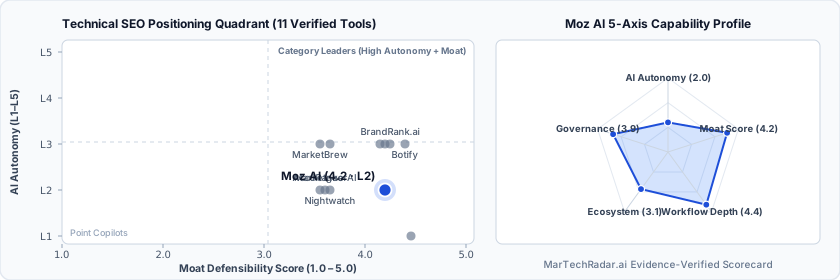
Moz AI is a Web SaaS tool for Technical SEO (Technical SEO Auditing & Indexing) in GEO & AI SEO. Pricing: Free plan · $0/mo · Enterprise plan. Best suited to DTC / eCommerce and Enterprise Brands. Editor ratings: AI autonomy L2 (workflow copilot); moat score 4.2/5.0 (Proprietary moat). Fact-checked by Jiacky Lee on Oct 15, 2026.
SEO analytics and site auditing suite integrating link graph metrics, keyword intent clustering, and technical crawl diagnostics for organic search.
Moz AI buyer fit verdict: when to choose vs. when to walk away
Choose Moz AI if (Best Fit)
- Target ICP & Stack Fit: You operate as DTC / eCommerce and Enterprise Brands requiring a Web SaaS deployment for Technical SEO.
- L2 Architecture & Defensibility: Moz maintains defensibility through its historical backlink index and proprietary metrics like Domain Authority and Page Authority, embedded broadly across SEO reporting ecosystems.
- Commercial Model Fit: Your procurement budget aligns with Free plan · $0/mo · Enterprise plan and want a self-serve free tier for zero-cost initial validation.
Walk away from Moz AI if (Deal-Breakers)
- Walk away if your workflow requires uncapped enterprise volume on the Free plan · $0/mo · Enterprise plan entry plan without upgrading tiers.
- Walk away if your workflow cannot tolerate crawl frequency and scale constraints: The SaaS crawler runs on periodic batched schedules rather than real-time event triggers, making it less responsive for enterprise sites with dynamic, continuous publishing architectures.
- Walk away if client-side rendering execution is a deal-breaker for your team: JavaScript-heavy rendering audits lack the granular, headless browser tuning capabilities necessary to debug complex hydration failures across modern single-page frameworks.
Moz AI key facts & scorecard
| Pricing | Free plan · $0/mo · Enterprise planVendor pricing page |
|---|---|
| Free plan | Yes |
| Delivery | Web SaaS |
| Audience | DTC / eCommerce, Enterprise Brands |
| AI autonomy level | L2 · Workflow copilotEditor-verified |
| Moat tier & score | 4.2 / 5.0 · Proprietary moatEditor-verified |
| Funding | AcquiredAcquired by iContact |
| Total funding | $29.1M |
| Founders | Gillian Muessig, Rand Fishkin |
| Company size | 101-250 employees |
| Governance & docs | API & Docs ↗ · Changelog ↗ · Terms ↗ · Privacy ↗ |
| Headquarters | Seattle, Washington, United States |
| Founded | 2004 |
| Last verified |
Moz AI pros & cons: strengths vs. operational limitations
Pros: core strengths & capabilities
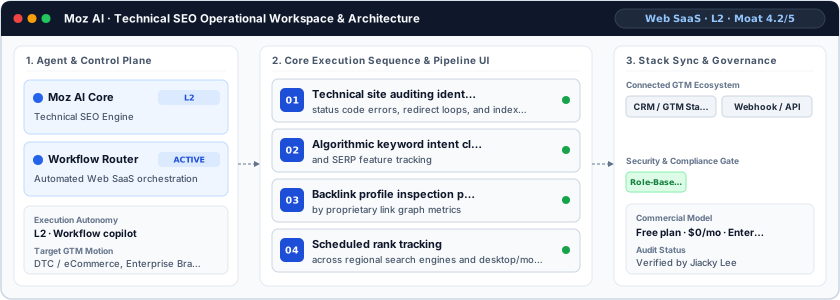
- Technical site auditing identifying: status code errors, redirect loops, and indexing barriers
- Algorithmic keyword intent clustering: and SERP feature tracking
- Backlink profile inspection powered: by proprietary link graph metrics
- Scheduled rank tracking: across regional search engines and desktop/mobile environments
Cons: operational limitations & risks
- Crawl Frequency and Scale Constraints: The SaaS crawler runs on periodic batched schedules rather than real-time event triggers, making it less responsive for enterprise sites with dynamic, continuous publishing architectures.
- Client-Side Rendering Execution: JavaScript-heavy rendering audits lack the granular, headless browser tuning capabilities necessary to debug complex hydration failures across modern single-page frameworks.
- API Rate Governance: Data export pipelines enforce strict API row allocations and concurrency throttles, restricting programmatic ingestion into external enterprise data warehouses.
Moz AI TCO & deal-breaker stress test
Simulate 12-month stepped TCO, hidden cost multipliers, contract lock-in exposure, and stack failure modes using only facts verified by Jiacky Lee on · Capture SHA 84a2588c.
Moz AI is viable for 5 seats, but requires commercial or technical verification on the flagged items below.
| Plan / Tier | Verified Rate | Scale Fit | Scope & Quota Notes |
|---|---|---|---|
| Free / Sandbox | $0 | 1–2 seats (Evaluation) | Entry free tier with capped usage or feature quotas for initial workflow testing. |
| Entry / Starter | $5/mo | 1–2 seats | Beta: +750 rows/mo for beta testing |
| Growth / Professional | $10/mo | 5 seats | Price per +10,000 rows |
| Scale / Advanced | $20/mo | 15 seats | Free access allows for one request every ten seconds, up to 50 rows per month |
- Moat Score
- 4.2 / 5.0
- AI Autonomy
- L2
- Free Tier / Trial
- Free plan
Triggered audit signals & failure modes
- Opaque Enterprise Quoting vs. SMB/Mid-Market BudgetVerified Pricing Ledger
Moz AI does not disclose a public self-serve floor (Free plan · $0/mo · Enterprise plan). Buyers with a $800/mo cap face high sales-qualification friction.
- Published Self-Serve Entry FloorVerified Pricing Ledger
Moz AI publishes a transparent entry point (Free plan · $0/mo · Enterprise plan) with a free tier for initial validation before committing.
- Tier Fit for 5-Seat Scale: Entry / Starter ($5/mo)Verified Tier Schedule
Beta: +750 rows/mo for beta testing
- Primary Operational Bottleneck: Crawl Frequency and Scale ConstraintsAudit by Jiacky Lee
The SaaS crawler runs on periodic batched schedules rather than real-time event triggers, making it less responsive for enterprise sites with dynamic, continuous publishing architectures.
Hidden TCO Multipliers & Quota Gates
- Crawl Frequency and Scale Constraints: The SaaS crawler runs on periodic batched schedules rather than real-time event triggers, making it less responsive for enterprise sites with dynamic, continuous publishing architectures.
- Client-Side Rendering Execution: JavaScript-heavy rendering audits lack the granular, headless browser tuning capabilities necessary to debug complex hydration failures across modern single-page frameworks.
When to Walk Away & Negotiation Levers
- Walk away if your workflow requires uncapped enterprise volume on the Free plan · $0/mo · Enterprise plan entry plan without upgrading tiers.
- Walk away if your workflow cannot tolerate crawl frequency and scale constraints: The SaaS crawler runs on periodic batched schedules rather than real-time event triggers, making it less responsive for enterprise sites with dynamic, continuous publishing architectures.
- Walk away if client-side rendering execution is a deal-breaker for your team: JavaScript-heavy rendering audits lack the granular, headless browser tuning capabilities necessary to debug complex hydration failures across modern single-page frameworks.
- Validate exact quota thresholds (seats, credits, or API calls) included in Moz AI's Free plan · $0/mo · Enterprise plan tier before converting from monthly to annual billing.
- Require a sandbox proof-of-concept testing crawl frequency and scale constraints against your live CRM/data schema before annual sign-off.
Ask a custom procurement or TCO stress-test question about Moz AI
Lower 5-seat floor (~$29/mo vs. Custom Quote)
Lower 5-seat floor (~$139/mo vs. Custom Quote)
Moz AI moat & subtrack positioning
Moz maintains defensibility through its historical backlink index and proprietary metrics like Domain Authority and Page Authority, embedded broadly across SEO reporting ecosystems.
Editorial review
Fact-checked by Jiacky Lee (Managing Editor, AI Autonomy & Moat Methodology) on .
Background
Established in 2004 in Seattle, Washington, Moz secured $29.1M in total funding before its acquisition by iContact. Historically recognized for defining Page Authority and Domain Authority benchmarks, the vendor developed Moz AI to embed machine learning algorithms into its core technical auditing and keyword intelligence workflows. The platform is targeted at digital marketing leads, SEO managers, and in-house growth teams requiring automated diagnostics across site indexing and organic search presence.
How Moz AI works
Operating at an L2 autonomy tier, Moz AI utilizes a scheduled cloud-based web crawler to traverse site architectures and identify technical impediments such as canonical mismatches, redirect chains, and broken assets. Concurrently, incoming query and SERP data passes through NLP classifiers that categorize keywords into transactional, informational, or navigational search intent. The processing pipeline cross-references observed URLs against Moz's proprietary link graph, outputting structured health scorecards and prioritized remediation checklists for engineering teams.
Limitations
Operational considerations and platform boundaries include:
- Crawl Frequency and Scale Constraints: The SaaS crawler runs on periodic batched schedules rather than real-time event triggers, making it less responsive for enterprise sites with dynamic, continuous publishing architectures.
- Client-Side Rendering Execution: JavaScript-heavy rendering audits lack the granular, headless browser tuning capabilities necessary to debug complex hydration failures across modern single-page frameworks.
- API Rate Governance: Data export pipelines enforce strict API row allocations and concurrency throttles, restricting programmatic ingestion into external enterprise data warehouses.
Moz AI pricing
Moz structures monetization around tiered SaaS subscriptions and standalone data integrations. The entry point includes a free tier ($0/month) offering baseline tool access and restricted data rows. Paid programmatic access starts with introductory API tiers at $20/month, scaling into higher subscription commitments and custom enterprise plans based on crawl allowances, keyword tracking volume, and data extraction limits.
How Moz AI compares
Within the Technical SEO and search analytics market, Moz AI competes directly against all-in-one SEO platforms like Ahrefs, Semrush, and SE Ranking AI, alongside specialized rank trackers and crawlers like AccuRanker, Screaming Frog SEO, and Botify. While Ahrefs and Semrush maintain larger crawl clusters and international keyword databases, Moz AI provides accessible Domain Authority link-graph APIs, keyword intent clustering, and baseline site auditing for mid-market marketing teams and SEO practitioners.
Direct competitors & market radar
Top algorithmic competitors based on category positioning, capability overlap, and ICP alignment.
Frequently asked questions about Moz AI
How much does Moz AI cost and what pricing tiers are available?
Published pricing summary for Moz AI: Free plan · $0/mo · Enterprise plan. Moz AI includes a free tier or sandbox entry point. Verified tier schedule: Free / Sandbox ($0 for 1–2 seats (Evaluation)); Entry / Starter ($5/mo for 1–2 seats); Growth / Professional ($10/mo for 5 seats); Scale / Advanced ($20/mo for 15 seats). Moz structures monetization around tiered SaaS subscriptions and standalone data integrations. The entry point includes a free tier ($0/month) offering baseline tool access and restricted data rows.
How does Moz AI work and how autonomous is its AI architecture?
SEO analytics and site auditing suite integrating link graph metrics, keyword intent clustering, and technical crawl diagnostics for organic search. Within Technical SEO (Technical SEO Auditing & Indexing), MarTechRadar rates its execution architecture at L2 · Workflow copilot with a verified Moat Score of 4.2 / 5.0 (Proprietary moat). Moz maintains defensibility through its historical backlink index and proprietary metrics like Domain Authority and Page Authority, embedded broadly across SEO reporting ecosystems. Corporate profile: Founded by Gillian Muessig, Rand Fishkin, operating at 101-250 employees scale, acquired by iContact.
What are the main limitations of Moz AI and when should buyers walk away?
Based on our editorial technical audit, key operational considerations and boundaries for Moz AI include: (1) Crawl Frequency and Scale Constraints: The SaaS crawler runs on periodic batched schedules rather than real-time event triggers, making it less responsive for enterprise sites with dynamic, continuous publishing architectures. (2) Client-Side Rendering Execution: JavaScript-heavy rendering audits lack the granular, headless browser tuning capabilities necessary to debug complex hydration failures across modern single-page frameworks. (3) API Rate Governance: Data export pipelines enforce strict API row allocations and concurrency throttles, restricting programmatic ingestion into external enterprise data warehouses. Primary procurement walk-away rule: Walk away if your workflow requires uncapped enterprise volume on the Free plan · $0/mo · Enterprise plan entry plan without upgrading tiers.
What integrations, compliance certifications, and contract terms apply to Moz AI?
First-party governance and developer endpoints verified on domain include: API Docs (https://moz.com/api/docs). Key TCO multiplier to watch: Crawl Frequency and Scale Constraints (The SaaS crawler runs on periodic batched schedules rather than real-time event triggers, making it less responsive for enterprise sites with dynamic, continuous publishing architectures.) Before signing a contract, procurement teams should validate exact quota thresholds (seats, credits, or API calls) included in Moz AI's Free plan · $0/mo · Enterprise plan tier before converting from monthly to annual billing.
What are the best Moz AI alternatives and head-to-head competitors in 2026?
Top fact-checked alternatives to Moz AI in Technical SEO (Technical SEO Auditing & Indexing) include Semrush (Free plan · $139–$299/mo), Ahrefs ($29–$1,499/mo), Cheers (From $3/mo), AccuRanker (From $224/mo). Within the Technical SEO and search analytics market, Moz AI competes directly against all-in-one SEO platforms like Ahrefs, Semrush, and SE Ranking AI, alongside specialized rank trackers and crawlers like AccuRanker, Screaming Frog SEO, and Botify.
Verified sources & evidence trail
- Official product domain: https://moz.com
- Commercial pricing verification: https://moz.com/products/api/pricing
- Verified corporate entity profiles (
sameAs): Crunchbase Entity Record - First-party governance & documentation links: API & Docs · Changelog · Terms · Privacy
- Editorial audit sign-off: Fact-checked by Jiacky Lee on under the MarTechRadar Evidence-Ledger Protocol.