MarketBrew Review (2026): Technical SEO Pricing, Limits & Alternatives
Bottom line
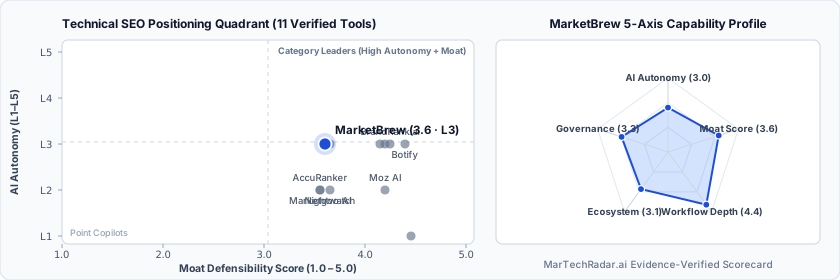
MarketBrew is a Web SaaS tool for Technical SEO (Technical SEO Auditing & Indexing) in GEO & AI SEO. Pricing: Custom / enterprise pricing. Best suited to DTC / eCommerce and Enterprise Brands. Editor ratings: AI autonomy L3 (conditional automation); moat score 3.6/5.0 (Proprietary moat). Fact-checked by Jiacky Lee on Oct 15, 2026.
MarketBrew is an artificial search engine simulation platform that models search engine algorithms and generative AI systems to test structural SEO.
MarketBrew buyer fit verdict: when to choose vs. when to walk away
Choose MarketBrew if (Best Fit)
- Target ICP & Stack Fit: You operate as DTC / eCommerce and Enterprise Brands requiring a Web SaaS deployment for Technical SEO.
- L3 Architecture & Defensibility: Proprietary algorithmic search simulation protected by US Patents 8,447,751 and 9,245,037, enabling calibrated ranking predictions against live SERPs and LLM-driven generative engines without relying solely on post-crawl reporting.
- Commercial Model Fit: Your procurement budget aligns with Custom / enterprise pricing.
Walk away from MarketBrew if (Deal-Breakers)
- Walk away if you require transparent self-serve monthly billing or your budget ceiling is under $1,000/mo (MarketBrew requires sales-gated custom quoting).
- Walk away if your workflow cannot tolerate algorithmic calibration drift: Rapid fluctuations in search engine weights require frequent model recalibration cycles, creating compute overhead and momentary variance between synthetic sandbox predictions and live indexing behavior.
- Walk away if staging environment render parity is a deal-breaker for your team: Simulation accuracy requires precise code, latency, and DOM parity between staging sandboxes and production infrastructure, causing false scoring outputs if staging environments lack complete asset rendering.
MarketBrew key facts & scorecard
| Pricing | Custom / enterprise pricing |
|---|---|
| Free plan | No / not disclosed |
| Delivery | Web SaaS |
| Audience | DTC / eCommerce, Enterprise Brands |
| AI autonomy level | L3 · Conditional automationEditor-verified |
| Moat tier & score | 3.6 / 5.0 · Proprietary moatEditor-verified |
| Funding | Bootstrapped |
| Company size | 11-50 employees |
| Headquarters | Medina, OH |
| Last verified |
MarketBrew pros & cons: strengths vs. operational limitations
Pros: core strengths & capabilities
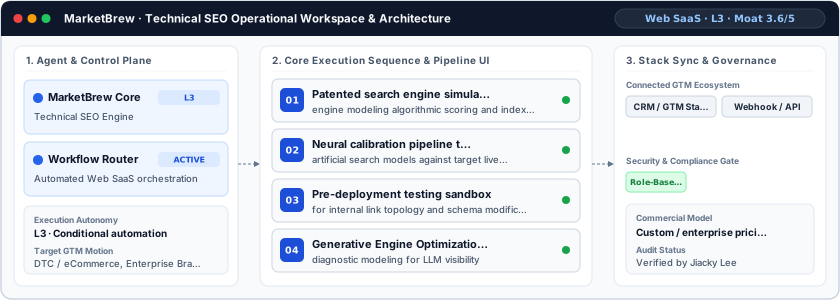
- Patented search engine simulation: engine modeling algorithmic scoring and indexing
- Neural calibration pipeline tuning: artificial search models against target live SERPs
- Pre-deployment testing sandbox: for internal link topology and schema modifications
- Generative Engine Optimization (GEO): diagnostic modeling for LLM visibility
Cons: operational limitations & risks
- Algorithmic Calibration Drift: Rapid fluctuations in search engine weights require frequent model recalibration cycles, creating compute overhead and momentary variance between synthetic sandbox predictions and live indexing behavior.
- Staging Environment Render Parity: Simulation accuracy requires precise code, latency, and DOM parity between staging sandboxes and production infrastructure, causing false scoring outputs if staging environments lack complete asset rendering.
- Complex Enterprise Setup Overhead: Configuring customized algorithmic models across substantial enterprise subdomains requires extensive technical onboarding, schema validation, and dedicated engineering time compared to turnkey crawlers.
MarketBrew TCO & deal-breaker stress test
Simulate 12-month stepped TCO, hidden cost multipliers, contract lock-in exposure, and stack failure modes using only facts verified by Jiacky Lee on · Capture SHA ecc2420f.
MarketBrew triggers high-severity friction under your 5-seat / $800/mo constraints. Benchmark the verified subtrack alternatives below before committing.
| Plan / Tier | Verified Rate | Scale Fit | Scope & Quota Notes |
|---|---|---|---|
| Enterprise / Custom | Custom quote | 15–50+ seats (Enterprise SLA) | Sales-negotiated annual contract for custom volume, SSO/RBAC governance, and dedicated SLA. |
- Moat Score
- 3.6 / 5.0
- AI Autonomy
- L3
- Free Tier / Trial
- None disclosed
Triggered audit signals & failure modes
- Opaque Enterprise Quoting vs. SMB/Mid-Market BudgetVerified Pricing Ledger
MarketBrew does not disclose a public self-serve floor (Custom / enterprise pricing). Buyers with a $800/mo cap face high sales-qualification friction.
- Sales-Gated Contract TermsFact-checked by Jiacky Lee
MarketBrew delivers software access under a direct enterprise procurement framework. Commercial pricing is available on request through tailored enterprise sales quotes based on organizational scale and seats.
- Primary Operational Bottleneck: Algorithmic Calibration DriftAudit by Jiacky Lee
Rapid fluctuations in search engine weights require frequent model recalibration cycles, creating compute overhead and momentary variance between synthetic sandbox predictions and live indexing behavior.
Hidden TCO Multipliers & Quota Gates
- Algorithmic Calibration Drift: Rapid fluctuations in search engine weights require frequent model recalibration cycles, creating compute overhead and momentary variance between synthetic sandbox predictions and live indexing behavior.
- Staging Environment Render Parity: Simulation accuracy requires precise code, latency, and DOM parity between staging sandboxes and production infrastructure, causing false scoring outputs if staging environments lack complete asset rendering.
When to Walk Away & Negotiation Levers
- Walk away if you require transparent self-serve monthly billing or your budget ceiling is under $1,000/mo (MarketBrew requires sales-gated custom quoting).
- Walk away if your workflow cannot tolerate algorithmic calibration drift: Rapid fluctuations in search engine weights require frequent model recalibration cycles, creating compute overhead and momentary variance between synthetic sandbox predictions and live indexing behavior.
- Walk away if staging environment render parity is a deal-breaker for your team: Simulation accuracy requires precise code, latency, and DOM parity between staging sandboxes and production infrastructure, causing false scoring outputs if staging environments lack complete asset rendering.
- Demand a 30- to 60-day paid pilot opt-out clause in the MarketBrew order form before signing a 12-month enterprise commitment.
- Require a sandbox proof-of-concept testing algorithmic calibration drift against your live CRM/data schema before annual sign-off.
Ask a custom procurement or TCO stress-test question about MarketBrew
Lower 5-seat floor (~$45/mo vs. Custom Quote) · Transparent self-serve entry without mandatory annual lock-in
Lower 5-seat floor (~$224/mo vs. Custom Quote) · Transparent self-serve entry without mandatory annual lock-in
MarketBrew moat & subtrack positioning
Proprietary algorithmic search simulation protected by US Patents 8,447,751 and 9,245,037, enabling calibrated ranking predictions against live SERPs and LLM-driven generative engines without relying solely on post-crawl reporting.
Editorial review
Fact-checked by Jiacky Lee (Managing Editor, AI Autonomy & Moat Methodology) on .
Background
Operating out of Medina, Ohio, MarketBrew approaches organic search and retrieval visibility from a simulation-first engineering paradigm rather than post-crawl diagnostics. Protected by United States Patents 8,447,751 and 9,245,037, the platform builds mathematical models of search engine and generative AI algorithms. Targeted at enterprise technical search engineers and organic search directors, the platform replaces reactive production deployments with pre-computational testing, allowing teams to project algorithmic scoring adjustments across search engines and large language model retrieval layers.
How MarketBrew works
At an operational level, MarketBrew runs an artificial search engine instance that continuously calibrates its weights against live target result pages. The pipeline ingests technical site structures, internal linking topologies, and rendered document schemas via a proprietary crawler. Its calibration framework isolates ranking discrepancies against actual search indices, systematically adjusting internal algorithmic weights until the simulated environment mirrors current search results. Users can test staging environments and link architecture variants in an L3-level evaluation loop, generating predictive scoring deltas before releasing code changes to production.
Limitations
Operational considerations and platform boundaries include:
- Algorithmic Calibration Drift: Rapid fluctuations in search engine weights require frequent model recalibration cycles, creating compute overhead and momentary variance between synthetic sandbox predictions and live indexing behavior.
- Staging Environment Render Parity: Simulation accuracy requires precise code, latency, and DOM parity between staging sandboxes and production infrastructure, causing false scoring outputs if staging environments lack complete asset rendering.
- Complex Enterprise Setup Overhead: Configuring customized algorithmic models across substantial enterprise subdomains requires extensive technical onboarding, schema validation, and dedicated engineering time compared to turnkey crawlers.
MarketBrew pricing
MarketBrew delivers software access under a direct enterprise procurement framework. Commercial pricing is available on request through tailored enterprise sales quotes based on organizational scale and seats. Contracts reflect domain size, crawl frequency, and the volume of custom simulated algorithmic models provisioned, encompassing dedicated technical onboarding and modeling support.
How MarketBrew compares
Compared to direct category competitors like Profound and Peec AI, MarketBrew functions as an alternative focused on specialized workflow execution. While desktop crawlers like Screaming Frog SEO and Sitebulb provide diagnostic snapshots of existing technical crawl defects, they lack predictive algorithmic modeling. Enterprise web auditing solutions such as Botify process substantial log files and server-side behavior post-crawl, but they do not simulate algorithmic rank shifts in a sandbox. MarketBrew uniquely serves large web engineering operations requiring pre-deployment algorithmic testing and generative engine signal modeling before staging code touches live production servers. It is best suited for enterprise marketing teams and growth practitioners seeking disciplined workflow orchestration.
Frequently asked questions about MarketBrew
How much does MarketBrew cost and does it require a custom enterprise quote?
Published pricing summary for MarketBrew: Custom / enterprise pricing. A permanent free plan is not disclosed for MarketBrew. MarketBrew delivers software access under a direct enterprise procurement framework. Commercial pricing is available on request through tailored enterprise sales quotes based on organizational scale and seats.
How does MarketBrew work and how autonomous is its AI architecture?
MarketBrew is an artificial search engine simulation platform that models search engine algorithms and generative AI systems to test structural SEO. Within Technical SEO (Technical SEO Auditing & Indexing), MarTechRadar rates its execution architecture at L3 · Conditional automation with a verified Moat Score of 3.6 / 5.0 (Proprietary moat). Proprietary algorithmic search simulation protected by US Patents 8,447,751 and 9,245,037, enabling calibrated ranking predictions against live SERPs and LLM-driven generative engines without relying solely on post-crawl reporting. Corporate profile: operating at 11-50 employees scale.
What are the main limitations of MarketBrew and when should buyers walk away?
Based on our editorial technical audit, key operational considerations and boundaries for MarketBrew include: (1) Algorithmic Calibration Drift: Rapid fluctuations in search engine weights require frequent model recalibration cycles, creating compute overhead and momentary variance between synthetic sandbox predictions and live indexing behavior. (2) Staging Environment Render Parity: Simulation accuracy requires precise code, latency, and DOM parity between staging sandboxes and production infrastructure, causing false scoring outputs if staging environments lack complete asset rendering. (3) Complex Enterprise Setup Overhead: Configuring customized algorithmic models across substantial enterprise subdomains requires extensive technical onboarding, schema validation, and dedicated engineering time compared to turnkey crawlers. Primary procurement walk-away rule: Walk away if you require transparent self-serve monthly billing or your budget ceiling is under $1,000/mo (MarketBrew requires sales-gated custom quoting).
What integrations, compliance certifications, and contract terms apply to MarketBrew?
Key TCO multiplier to watch: Algorithmic Calibration Drift (Rapid fluctuations in search engine weights require frequent model recalibration cycles, creating compute overhead and momentary variance between synthetic sandbox predictions and live indexing behavior.) Before signing a contract, procurement teams should demand a 30- to 60-day paid pilot opt-out clause in the MarketBrew order form before signing a 12-month enterprise commitment.
What are the best MarketBrew alternatives and head-to-head competitors in 2026?
Top fact-checked alternatives to MarketBrew in Technical SEO (Technical SEO Auditing & Indexing) include Ryte (Custom / enterprise pricing), Marketgoo AI (Custom / enterprise pricing), IndexNow Automation (Custom / enterprise pricing), Lumar (DeepCrawl) (Custom / enterprise pricing). Compared to direct category competitors like Profound and Peec AI, MarketBrew functions as an alternative focused on specialized workflow execution. While desktop crawlers like Screaming Frog SEO and Sitebulb provide diagnostic snapshots of existing technical crawl defects, they lack predictive algorithmic modeling.
Verified sources & evidence trail
- Official product domain: https://marketbrew.ai
- Commercial pricing verification: Verified against official vendor pricing policy (Custom / enterprise pricing)
- Verified corporate entity profiles (
sameAs): LinkedIn Company Profile - Editorial audit sign-off: Fact-checked by Jiacky Lee on under the MarTechRadar Evidence-Ledger Protocol.