AccuRanker Review (2026): Technical SEO Pricing, Limits & Alternatives
Bottom line
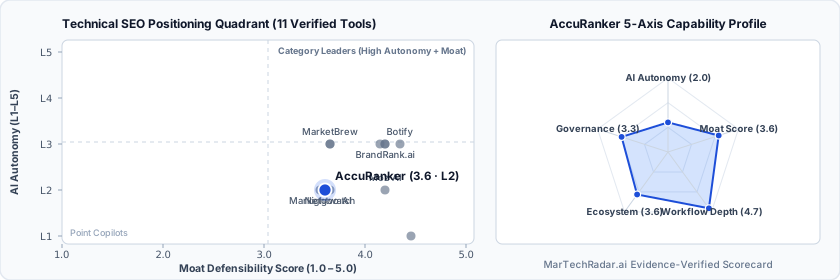
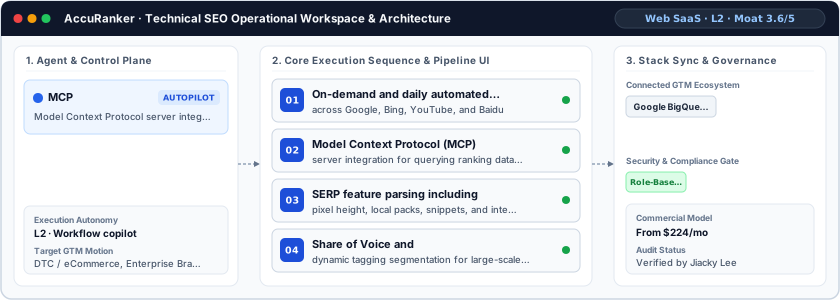
AccuRanker is a Web SaaS tool for Technical SEO (Technical SEO Auditing & Indexing) in GEO & AI SEO. Pricing: From $224/mo. Best suited to DTC / eCommerce and Enterprise Brands. Editor ratings: AI autonomy L2 (workflow copilot); moat score 3.6/5.0 (Proprietary moat). Fact-checked by Jiacky Lee on Oct 15, 2026.
High-velocity SERP rank tracker and LLM visibility platform providing on-demand keyword rank updates, SERP feature analysis, and MCP integration.
AccuRanker buyer fit verdict: when to choose vs. when to walk away
Choose AccuRanker if (Best Fit)
- Target ICP & Stack Fit: You operate as DTC / eCommerce and Enterprise Brands requiring a Web SaaS deployment for Technical SEO, with verified ecosystem connectivity for Google BigQuery.
- L2 Architecture & Defensibility: Maintains an ultra-low-latency SERP scraping infrastructure offering on-demand rank refreshes in seconds, coupled with early Model Context Protocol (MCP) tool interfaces for injecting live search metrics into external LLM workflows.
- Commercial Model Fit: Your procurement budget aligns with From $224/mo.
Walk away from AccuRanker if (Deal-Breakers)
- Walk away if your team is at early validation stage with a <$250/mo tool budget (AccuRanker starts at From $224/mo before seat or usage expansion).
- Walk away if your workflow cannot tolerate scope specialization: The system intentionally omits on-page HTML crawling, log file analysis, and technical site health diagnostics, requiring external systems for root-cause infrastructure audits.
- Walk away if high-volume query latency is a deal-breaker for your team: While ad-hoc on-demand refreshes run rapidly for small clusters, triggering bulk refreshes across portfolios exceeding tens of thousands of keywords introduces queuing delays.
AccuRanker key facts & scorecard
| Pricing | From $224/moVendor pricing page |
|---|---|
| Free plan | No / not disclosed |
| Delivery | Web SaaS |
| Audience | DTC / eCommerce, Enterprise Brands |
| AI autonomy level | L2 · Workflow copilotEditor-verified |
| Moat tier & score | 3.6 / 5.0 · Proprietary moatEditor-verified |
| Funding | Venture-backed |
| Founders | Christian Hedegaard Pedersen, Henrik S. Jørgensen |
| Company size | 11-50 employees |
| Ecosystem integrations | Google BigQuery |
| Governance & docs | Changelog ↗ · Terms ↗ · Privacy ↗ |
| Headquarters | Aarhus C, DK |
| Founded | 2013 |
| Last verified |
AccuRanker pros & cons: strengths vs. operational limitations
Pros: core strengths & capabilities
- On-demand and daily automated rank updates: across Google, Bing, YouTube, and Baidu
- Model Context Protocol (MCP): server integration for querying ranking data directly from AI assistants
- SERP feature parsing including: pixel height, local packs, snippets, and intent categorization
- Share of Voice and: dynamic tagging segmentation for large-scale enterprise keyword portfolios
Cons: operational limitations & risks
- Scope Specialization: The system intentionally omits on-page HTML crawling, log file analysis, and technical site health diagnostics, requiring external systems for root-cause infrastructure audits.
- High-Volume Query Latency: While ad-hoc on-demand refreshes run rapidly for small clusters, triggering bulk refreshes across portfolios exceeding tens of thousands of keywords introduces queuing delays.
- SERP Volatility Noise: Algorithmic search fluctuations and localized layout experiments can trigger false-positive alert spikes without integrated correlation to actual server-side code deployments.
AccuRanker TCO & deal-breaker stress test
Simulate 12-month stepped TCO, hidden cost multipliers, contract lock-in exposure, and stack failure modes using only facts verified by Jiacky Lee on · Capture SHA 62a53133.
AccuRanker is viable for 5 seats, but requires commercial or technical verification on the flagged items below.
| Plan / Tier | Verified Rate | Scale Fit | Scope & Quota Notes |
|---|---|---|---|
| Professional | $224/mo | Unlimited seats (Entry credits) | Ideal for freelancers, consultants, and small agencies. |
| Growth / Professional | $764/mo | Unlimited seats (Growth credits) | Verified $764/mo tier from vendor pricing schedule. |
- Moat Score
- 3.6 / 5.0
- AI Autonomy
- L2
- Free Tier / Trial
- None disclosed
Triggered audit signals & failure modes
- Published Self-Serve Entry FloorVerified Pricing Ledger
AccuRanker publishes a transparent entry point (From $224/mo) for initial validation before committing.
- Usage / Credit Burn VolatilityCommercial Model Audit
AccuRanker uses credit or usage-metered billing (From $224/mo). High-volume automated workflows across 5 seats can trigger mid-cycle overage charges.
- Tier Fit for 5-Seat Scale: Growth / Professional ($764/mo)Verified Tier Schedule
Verified $764/mo tier from vendor pricing schedule.
- Primary Operational Bottleneck: Scope SpecializationAudit by Jiacky Lee
The system intentionally omits on-page HTML crawling, log file analysis, and technical site health diagnostics, requiring external systems for root-cause infrastructure audits.
Hidden TCO Multipliers & Quota Gates
- Enterprise Governance & Add-On Gating: Advanced capabilities such as Single Sign-On (SSO), custom role permissions, or specialized analytics modules are gated behind upper tiers or paid add-ons.
- Scope Specialization: The system intentionally omits on-page HTML crawling, log file analysis, and technical site health diagnostics, requiring external systems for root-cause infrastructure audits.
- High-Volume Query Latency: While ad-hoc on-demand refreshes run rapidly for small clusters, triggering bulk refreshes across portfolios exceeding tens of thousands of keywords introduces queuing delays.
When to Walk Away & Negotiation Levers
- Walk away if your team is at early validation stage with a <$250/mo tool budget (AccuRanker starts at From $224/mo before seat or usage expansion).
- Walk away if your workflow cannot tolerate scope specialization: The system intentionally omits on-page HTML crawling, log file analysis, and technical site health diagnostics, requiring external systems for root-cause infrastructure audits.
- Walk away if high-volume query latency is a deal-breaker for your team: While ad-hoc on-demand refreshes run rapidly for small clusters, triggering bulk refreshes across portfolios exceeding tens of thousands of keywords introduces queuing delays.
- Negotiate price-lock protection on additional seats and overage credits above the From $224/mo entry tier.
- Require a sandbox proof-of-concept testing scope specialization against your live CRM/data schema before annual sign-off.
Ask a custom procurement or TCO stress-test question about AccuRanker
Lower 5-seat floor (~$29/mo vs. $764 / mo)
Lower 5-seat floor (~$139/mo vs. $764 / mo)
AccuRanker key entities, modules & ecosystem stack
Model Context Protocol server integration for querying ranking data directly from AI assistants
AccuRanker moat & subtrack positioning
Maintains an ultra-low-latency SERP scraping infrastructure offering on-demand rank refreshes in seconds, coupled with early Model Context Protocol (MCP) tool interfaces for injecting live search metrics into external LLM workflows.
Editorial review
Fact-checked by Jiacky Lee (Managing Editor, AI Autonomy & Moat Methodology) on .
Background
For organic search teams managing volatile keyword portfolios, stale search engine results page (SERP) monitoring compromises strategic decision-making. AccuRanker, established in 2013 with headquarters in Aarhus C, DK, addresses this challenge by providing rapid rank verification and search visibility analytics. Designed specifically for enterprise search directors, digital marketing agencies, and performance SEO leads, the platform operates as a focused intelligence engine. Rather than offering broad digital marketing suites, AccuRanker concentrates on low-latency rank tracking, accurate SERP feature attribution, and emerging LLM visibility reporting.
How AccuRanker works
At its architectural core, AccuRanker utilizes a distributed query infrastructure capable of executing on-demand and daily scheduled rank scrapes across desktop and mobile indexes. The ingestion pipeline queries search engines across localized geographies down to coordinate and postal-code granularity. Incoming HTML payloads are parsed into structured time-series datasets, isolating ranking positions, pixel depth, and distinct SERP elements such as local packs and featured snippets. Operating at an L2 autonomy level, the platform incorporates a Model Context Protocol (MCP) connector, enabling client-configured LLM assistants to pull live programmatic ranking payloads directly into analytical workflows, alongside native workflow integrations for BigQuery.
Limitations
Operational considerations and platform boundaries include:
- Scope Specialization: The system intentionally omits on-page HTML crawling, log file analysis, and technical site health diagnostics, requiring external systems for root-cause infrastructure audits.
- High-Volume Query Latency: While ad-hoc on-demand refreshes run rapidly for small clusters, triggering bulk refreshes across portfolios exceeding tens of thousands of keywords introduces queuing delays.
- SERP Volatility Noise: Algorithmic search fluctuations and localized layout experiments can trigger false-positive alert spikes without integrated correlation to actual server-side code deployments.
AccuRanker pricing
AccuRanker's commercial model is structured as a usage-based software-as-a-service subscription scaled primarily by tracked keyword volume. Pricing starts from $224/month for baseline tiers encompassing 2,000 keywords with daily updates, unlimited domains, and multiple user seats. Tiers expand incrementally up to enterprise footprints scaling to $764 or custom enterprise contracts based on keyword tracking volume, crawl frequencies, and programmatic API access thresholds.
How AccuRanker compares
Within the Technical SEO and high-frequency SERP rank tracking landscape, AccuRanker competes directly against dedicated rank trackers like ProRankTracker and SE Ranking AI, as well as all-in-one search intelligence suites like Ahrefs, Semrush, and Moz AI. While Screaming Frog SEO and Botify focus on deep technical site crawling and log-file diagnostics, and Ahrefs and Semrush bundle broad backlink and keyword research indexes, AccuRanker specializes in on-demand rank refreshes, granular SERP feature attribution, and programmatic data warehouse exports. It is best suited for enterprise SEO teams and digital agencies requiring real-time keyword telemetry.
Direct competitors & market radar
Top algorithmic competitors based on category positioning, capability overlap, and ICP alignment.
Frequently asked questions about AccuRanker
How much does AccuRanker cost and what pricing tiers are available?
Published pricing summary for AccuRanker: From $224/mo. A permanent free plan is not disclosed for AccuRanker. Verified tier schedule: Professional ($224/mo for Unlimited seats (Entry credits)); Growth / Professional ($764/mo for Unlimited seats (Growth credits)). AccuRanker's commercial model is structured as a usage-based software-as-a-service subscription scaled primarily by tracked keyword volume. Pricing starts from $224/month for baseline tiers encompassing 2,000 keywords with daily updates, unlimited domains, and multiple user seats.
How does AccuRanker work and how autonomous is its AI architecture?
High-velocity SERP rank tracker and LLM visibility platform providing on-demand keyword rank updates, SERP feature analysis, and MCP integration. Within Technical SEO (Technical SEO Auditing & Indexing), MarTechRadar rates its execution architecture at L2 · Workflow copilot with a verified Moat Score of 3.6 / 5.0 (Proprietary moat). Maintains an ultra-low-latency SERP scraping infrastructure offering on-demand rank refreshes in seconds, coupled with early Model Context Protocol (MCP) tool interfaces for injecting live search metrics into external LLM workflows. Corporate profile: Founded by Christian Hedegaard Pedersen, Henrik S. Jørgensen, operating at 11-50 employees scale.
What are the main limitations of AccuRanker and when should buyers walk away?
Based on our editorial technical audit, key operational considerations and boundaries for AccuRanker include: (1) Scope Specialization: The system intentionally omits on-page HTML crawling, log file analysis, and technical site health diagnostics, requiring external systems for root-cause infrastructure audits. (2) High-Volume Query Latency: While ad-hoc on-demand refreshes run rapidly for small clusters, triggering bulk refreshes across portfolios exceeding tens of thousands of keywords introduces queuing delays. (3) SERP Volatility Noise: Algorithmic search fluctuations and localized layout experiments can trigger false-positive alert spikes without integrated correlation to actual server-side code deployments. Primary procurement walk-away rule: Walk away if your team is at early validation stage with a <$250/mo tool budget (AccuRanker starts at From $224/mo before seat or usage expansion).
What integrations, compliance certifications, and contract terms apply to AccuRanker?
Verified ecosystem and stack integrations include Google BigQuery. Key TCO multiplier to watch: Enterprise Governance & Add-On Gating (Advanced capabilities such as Single Sign-On (SSO), custom role permissions, or specialized analytics modules are gated behind upper tiers or paid add-ons.) Before signing a contract, procurement teams should negotiate price-lock protection on additional seats and overage credits above the From $224/mo entry tier.
What are the best AccuRanker alternatives and head-to-head competitors in 2026?
Top fact-checked alternatives to AccuRanker in Technical SEO (Technical SEO Auditing & Indexing) include ProRankTracker (Custom / enterprise pricing), Semrush (Free plan · $139–$299/mo), Ahrefs ($29–$1,499/mo), SE Ranking AI (Custom / enterprise pricing). Within the Technical SEO and high-frequency SERP rank tracking landscape, AccuRanker competes directly against dedicated rank trackers like ProRankTracker and SE Ranking AI, as well as all-in-one search intelligence suites like Ahrefs, Semrush, and Moz AI.
Verified sources & evidence trail
- Official product domain: https://accuranker.com
- Commercial pricing verification: https://www.accuranker.com/pricing/
- Verified corporate entity profiles (
sameAs): LinkedIn Company Profile · Crunchbase Entity Record - First-party governance & documentation links: Changelog · Terms · Privacy
- Editorial audit sign-off: Fact-checked by Jiacky Lee on under the MarTechRadar Evidence-Ledger Protocol.