Nightwatch Review (2026): Technical SEO Pricing, Limits & Alternatives
Bottom line
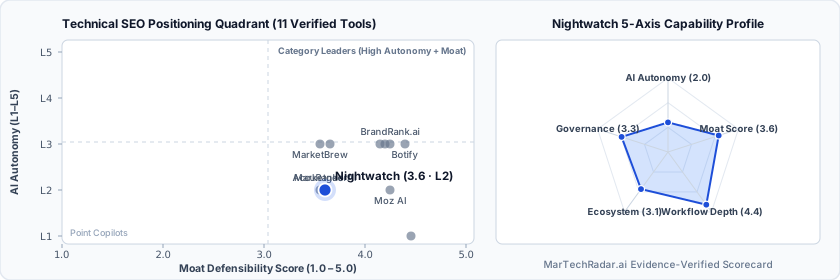
Nightwatch is a Web SaaS tool for Technical SEO (Technical SEO Auditing & Indexing) in GEO & AI SEO. Pricing: From $45/mo. Best suited to DTC / eCommerce and Enterprise Brands. Editor ratings: AI autonomy L2 (workflow copilot); moat score 3.6/5.0 (Proprietary moat). Fact-checked by Jiacky Lee on Oct 15, 2026.
Nightwatch is a rank tracking and site auditing platform engineered for hyper-local search visibility tracking, automated technical crawls.
Nightwatch buyer fit verdict: when to choose vs. when to walk away
Choose Nightwatch if (Best Fit)
- Target ICP & Stack Fit: You operate as DTC / eCommerce and Enterprise Brands requiring a Web SaaS deployment for Technical SEO.
- L2 Architecture & Defensibility: Nightwatch maintains defensibility through a geo-distributed scraping proxy network supporting granular postal-code search validation alongside unified technical site audits and citation tracking without per-seat licensing penalties.
- Commercial Model Fit: Your procurement budget aligns with From $45/mo.
Walk away from Nightwatch if (Deal-Breakers)
- Walk away if your workflow requires uncapped enterprise volume on the From $45/mo entry plan without upgrading tiers.
- Walk away if your workflow cannot tolerate crawl depth velocity: Unlike high-throughput desktop crawlers running on local hardware, its cloud auditing module faces rate-throttling constraints on large domains exceeding hundreds of thousands of dynamic URIs.
- Walk away if log file synthesis gap is a deal-breaker for your team: The system monitors surface-level crawl parameters without native real-time server access log ingestion, limiting real-time search engine bot verification.
Nightwatch key facts & scorecard
| Pricing | From $45/moVendor pricing page |
|---|---|
| Free plan | No / not disclosed |
| Delivery | Web SaaS |
| Audience | DTC / eCommerce, Enterprise Brands |
| AI autonomy level | L2 · Workflow copilotEditor-verified |
| Moat tier & score | 3.6 / 5.0 · Proprietary moatEditor-verified |
| Funding | Bootstrapped |
| Founders | Steve Mingione |
| Company size | 11-50 employees |
| Governance & docs | API & Docs ↗ · Changelog ↗ |
| Headquarters | Ljubljana, Ljubljana Urban Commune, Slovenia |
| Founded | 2016 |
| Last verified |
Nightwatch pros & cons: strengths vs. operational limitations
Pros: core strengths & capabilities
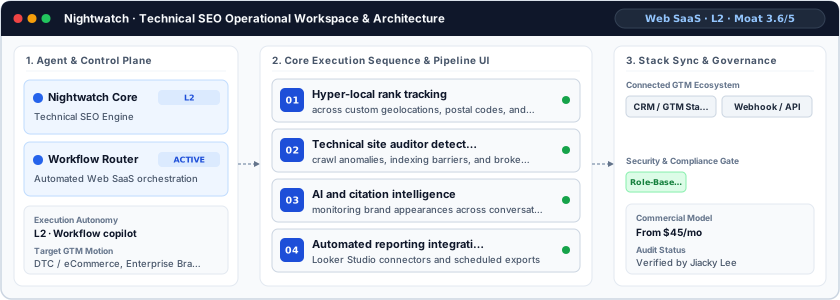
- Hyper-local rank tracking: across custom geolocations, postal codes, and device viewports
- Technical site auditor detecting: crawl anomalies, indexing barriers, and broken link patterns
- AI and citation intelligence: monitoring brand appearances across conversational search interfaces
- Automated reporting integrations supporting: Looker Studio connectors and scheduled exports
Cons: operational limitations & risks
- Crawl Depth Velocity: Unlike high-throughput desktop crawlers running on local hardware, its cloud auditing module faces rate-throttling constraints on large domains exceeding hundreds of thousands of dynamic URIs.
- Log File Synthesis Gap: The system monitors surface-level crawl parameters without native real-time server access log ingestion, limiting real-time search engine bot verification.
- Edge Rendering Latency: Extensive client-side JavaScript execution in heavy single-page applications increases crawl cycle duration compared to specialized raw HTTP scrapers.
Nightwatch TCO & deal-breaker stress test
Simulate 12-month stepped TCO, hidden cost multipliers, contract lock-in exposure, and stack failure modes using only facts verified by Jiacky Lee on · Capture SHA 591e474a.
Nightwatch aligns with your 5-seat / $800/mo profile. Review the walk-away triggers and contract levers below before deployment.
| Plan / Tier | Verified Rate | Scale Fit | Scope & Quota Notes |
|---|---|---|---|
| Unlimited | $45/mo | Unlimited seats (Entry credits) | SOC 2 compliant, encrypted at rest and in transit. SSO on Enterprise. |
- Moat Score
- 3.6 / 5.0
- AI Autonomy
- L2
- Free Tier / Trial
- None disclosed
Triggered audit signals & failure modes
- Published Self-Serve Entry FloorVerified Pricing Ledger
Nightwatch publishes a transparent entry point (From $45/mo) for initial validation before committing.
- Primary Operational Bottleneck: Crawl Depth VelocityAudit by Jiacky Lee
Unlike high-throughput desktop crawlers running on local hardware, its cloud auditing module faces rate-throttling constraints on large domains exceeding hundreds of thousands of dynamic URIs.
Hidden TCO Multipliers & Quota Gates
- Per-Seat Linear Scaling: Nightwatch prices licenses on a per-user/seat basis (From $45/mo); expanding from 2 to 15+ operators multiplies base recurring spend linearly.
- Credit & Usage Burn Multiplier: Automated workflows consume metered credits/usage quotas; multi-step enrichment, voice minutes, or high-frequency agent runs can trigger mid-cycle top-up packs.
- Enterprise Governance & Add-On Gating: Advanced capabilities such as Single Sign-On (SSO), custom role permissions, or specialized analytics modules are gated behind upper tiers or paid add-ons.
When to Walk Away & Negotiation Levers
- Walk away if your workflow requires uncapped enterprise volume on the From $45/mo entry plan without upgrading tiers.
- Walk away if your workflow cannot tolerate crawl depth velocity: Unlike high-throughput desktop crawlers running on local hardware, its cloud auditing module faces rate-throttling constraints on large domains exceeding hundreds of thousands of dynamic URIs.
- Walk away if log file synthesis gap is a deal-breaker for your team: The system monitors surface-level crawl parameters without native real-time server access log ingestion, limiting real-time search engine bot verification.
- Validate exact quota thresholds (seats, credits, or API calls) included in Nightwatch's From $45/mo tier before converting from monthly to annual billing.
- Require a sandbox proof-of-concept testing crawl depth velocity against your live CRM/data schema before annual sign-off.
Ask a custom procurement or TCO stress-test question about Nightwatch
Lower 5-seat floor (~$11/mo vs. From $45 / mo)
Fits within $800/mo budget (From $224/mo)
Nightwatch moat & subtrack positioning
Nightwatch maintains defensibility through a geo-distributed scraping proxy network supporting granular postal-code search validation alongside unified technical site audits and citation tracking without per-seat licensing penalties.
Editorial review
Fact-checked by Jiacky Lee (Managing Editor, AI Autonomy & Moat Methodology) on .
Background
Architectured around distributed search observation infrastructure, Nightwatch was established in 2016 in Ljubljana, Ljubljana Urban Commune, Slovenia, to resolve geo-sampling degradation in search indexing analytics. Geared toward technical SEO directors, digital agencies, and enterprise search strategists, the platform decouples rank tracking from aggregated national indexes. It captures hyper-localized search engine results pages across diverse device viewports and localized map layers.
How Nightwatch works
Nightwatch executes data collection through a distributed proxy architecture simulating browser requests across tens of thousands of geographic endpoints. The ingestion engine queries targets across Google, Bing, YouTube, and DuckDuckGo, parsing structured snippet features, local packs, and organic placements. Concurrently, its site audit subsystem operates as an asynchronous technical web crawler evaluating internal link topology, response codes, and core web vital tags. The platform operates under Level 2 autonomy, orchestrating recurring diagnostic scans and rank telemetry updates based on predefined user schedules.
Limitations
Operational considerations and platform boundaries include:
- Crawl Depth Velocity: Unlike high-throughput desktop crawlers running on local hardware, its cloud auditing module faces rate-throttling constraints on large domains exceeding hundreds of thousands of dynamic URIs.
- Log File Synthesis Gap: The system monitors surface-level crawl parameters without native real-time server access log ingestion, limiting real-time search engine bot verification.
- Edge Rendering Latency: Extensive client-side JavaScript execution in heavy single-page applications increases crawl cycle duration compared to specialized raw HTTP scrapers.
Nightwatch pricing
The commercial model operates on keyword tracking volume and crawl quotas rather than seat monetization. Tiered subscriptions start from $45 per month when billed on entry configurations, extending to higher-volume packages such as $79, $159, or $399 per month. All subscription tiers grant unlimited user seats and encompass the site audit engine, Looker Studio connectors, and citation reporting tools without requiring separate per-seat add-ons.
How Nightwatch compares
Within the technical optimization landscape, Nightwatch occupies a distinct operational profile compared to Botify, Screaming Frog SEO, and Sitebulb. While Screaming Frog SEO and Sitebulb deliver deep offline desktop extraction with granular raw crawl manipulation, they lack Nightwatch's geo-distributed SERP tracking array. Conversely, Botify offers complete log-file data warehouse integrations for vast enterprise catalogs, but Nightwatch serves mid-market and agency teams prioritizing combined rank tracking and cloud audits. It is best suited for enterprise marketing teams and growth practitioners seeking disciplined workflow orchestration.
Direct competitors & market radar
Top algorithmic competitors based on category positioning, capability overlap, and ICP alignment.
Frequently asked questions about Nightwatch
How much does Nightwatch cost and what pricing tiers are available?
Published pricing summary for Nightwatch: From $45/mo. A permanent free plan is not disclosed for Nightwatch. The commercial model operates on keyword tracking volume and crawl quotas rather than seat monetization. Tiered subscriptions start from $45 per month when billed on entry configurations, extending to higher-volume packages such as $79, $159, or $399 per month.
How does Nightwatch work and how autonomous is its AI architecture?
Nightwatch is a rank tracking and site auditing platform engineered for hyper-local search visibility tracking, automated technical crawls. Within Technical SEO (Technical SEO Auditing & Indexing), MarTechRadar rates its execution architecture at L2 · Workflow copilot with a verified Moat Score of 3.6 / 5.0 (Proprietary moat). Nightwatch maintains defensibility through a geo-distributed scraping proxy network supporting granular postal-code search validation alongside unified technical site audits and citation tracking without per-seat licensing penalties. Corporate profile: Founded by Steve Mingione, operating at 11-50 employees scale.
What are the main limitations of Nightwatch and when should buyers walk away?
Based on our editorial technical audit, key operational considerations and boundaries for Nightwatch include: (1) Crawl Depth Velocity: Unlike high-throughput desktop crawlers running on local hardware, its cloud auditing module faces rate-throttling constraints on large domains exceeding hundreds of thousands of dynamic URIs. (2) Log File Synthesis Gap: The system monitors surface-level crawl parameters without native real-time server access log ingestion, limiting real-time search engine bot verification. (3) Edge Rendering Latency: Extensive client-side JavaScript execution in heavy single-page applications increases crawl cycle duration compared to specialized raw HTTP scrapers. Primary procurement walk-away rule: Walk away if your workflow requires uncapped enterprise volume on the From $45/mo entry plan without upgrading tiers.
What integrations, compliance certifications, and contract terms apply to Nightwatch?
First-party governance and developer endpoints verified on domain include: API Docs (https://docs.nightwatch.io). Key TCO multiplier to watch: Per-Seat Linear Scaling (Nightwatch prices licenses on a per-user/seat basis (From $45/mo); expanding from 2 to 15+ operators multiplies base recurring spend linearly.) Before signing a contract, procurement teams should validate exact quota thresholds (seats, credits, or API calls) included in Nightwatch's From $45/mo tier before converting from monthly to annual billing.
What are the best Nightwatch alternatives and head-to-head competitors in 2026?
Top fact-checked alternatives to Nightwatch in Technical SEO (Technical SEO Auditing & Indexing) include Sitebulb ($11–$125/mo), SE Ranking AI (Custom / enterprise pricing), BrandRank.ai (Custom / enterprise pricing), Wincher (Custom / enterprise pricing). Within the technical optimization landscape, Nightwatch occupies a distinct operational profile compared to Botify, Screaming Frog SEO, and Sitebulb.
Verified sources & evidence trail
- Official product domain: https://nightwatch.io
- Commercial pricing verification: https://nightwatch.io/pricing/
- Verified corporate entity profiles (
sameAs): LinkedIn Company Profile · Crunchbase Entity Record - First-party governance & documentation links: API & Docs · Changelog
- Editorial audit sign-off: Fact-checked by Jiacky Lee on under the MarTechRadar Evidence-Ledger Protocol.