Commune Review (2026): Social Media Scheduling Pricing, Limits & Alternatives
Bottom line
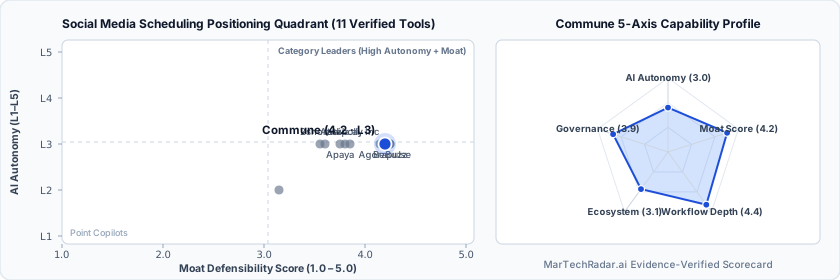
Commune is a Web SaaS tool for Social Media Scheduling (Social Media Scheduling & Auto-Publishing) in Social & Influencer. Pricing: Custom / enterprise pricing. Best suited to Social Media Managers, Creator & Influencer Agencies and Brand Community Ops. Editor ratings: AI autonomy L3 (conditional automation); moat score 4.2/5.0 (Proprietary moat). Fact-checked by Tim Fenolz on Oct 14, 2026.
AI-powered advocacy community and social publishing platform enabling enterprise marketing teams to turn loyal customers into brand advocates.
Commune buyer fit verdict: when to choose vs. when to walk away
Choose Commune if (Best Fit)
- Target ICP & Stack Fit: You operate as Social Media Managers, Creator & Influencer Agencies and Brand Community Ops requiring a Web SaaS deployment for Social Media Scheduling.
- L3 Architecture & Defensibility: Combines community engagement analytics with social amplification mechanics backed by $59.4M in institutional capital, creating retention moats around proprietary advocacy data.
- Commercial Model Fit: Your procurement budget aligns with Custom / enterprise pricing.
Walk away from Commune if (Deal-Breakers)
- Walk away if you require transparent self-serve monthly billing or your budget ceiling is under $1,000/mo (Commune requires sales-gated custom quoting).
- Walk away if your workflow cannot tolerate social network API rate throttling: Automated cross-posting and bulk audience metric queries are constrained by strict upstream network API rate limits, which can delay multi-account synchronization during peak engagement windows.
- Walk away if community onboarding overhead is a deal-breaker for your team: Achieving predictable advocacy output requires prolonged initial customer onboarding, profile verification, and ongoing community management before social amplification pipelines deliver statistically significant reach.
Commune key facts & scorecard
| Pricing | Custom / enterprise pricing |
|---|---|
| Free plan | No / not disclosed |
| Delivery | Web SaaS |
| Audience | Social Media Managers, Creator & Influencer Agencies, Brand Community Ops |
| AI autonomy level | L3 · Conditional automationEditor-verified |
| Moat tier & score | 4.2 / 5.0 · Proprietary moatEditor-verified |
| Funding | Series C+ |
| Total funding | $59.4M |
| Founders | Akihiro Yamamoto, Shota Hashimoto, Yuya Takada |
| Company size | 51-200 employees |
| Headquarters | Shinagawa, Tokyo |
| Founded | 2018 |
| Last verified |
Commune pros & cons: strengths vs. operational limitations
Pros: core strengths & capabilities
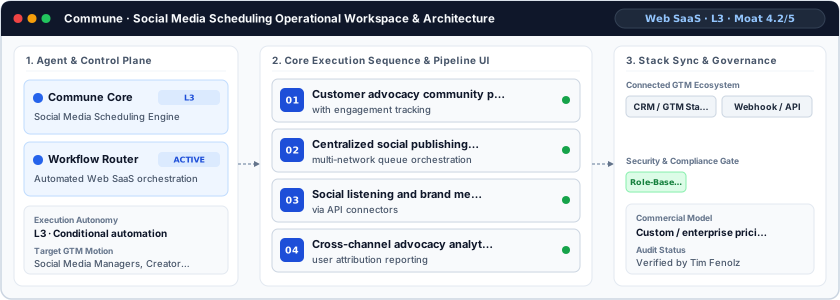
- Customer advocacy community portal: with engagement tracking
- Centralized social publishing and: multi-network queue orchestration
- Social listening and brand mention triage: via API connectors
- Cross-channel advocacy analytics and: user attribution reporting
Cons: operational limitations & risks
- Social Network API Rate Throttling: Automated cross-posting and bulk audience metric queries are constrained by strict upstream network API rate limits, which can delay multi-account synchronization during peak engagement windows.
- Community Onboarding Overhead: Achieving predictable advocacy output requires prolonged initial customer onboarding, profile verification, and ongoing community management before social amplification pipelines deliver statistically significant reach.
- Custom Taxonomy Maintenance: Tracking advocacy touchpoints back to pipeline metrics demands continuous maintenance of tracking schemas, as changes to social network payload parameters can break downstream attribution mappings.
Commune TCO & deal-breaker stress test
Simulate 12-month stepped TCO, hidden cost multipliers, contract lock-in exposure, and stack failure modes using only facts verified by Tim Fenolz on · Capture SHA 9b617505.
Commune triggers high-severity friction under your 5-seat / $800/mo constraints. Benchmark the verified subtrack alternatives below before committing.
| Plan / Tier | Verified Rate | Scale Fit | Scope & Quota Notes |
|---|---|---|---|
| Enterprise / Custom | Custom quote | 15–50+ seats (Enterprise SLA) | Sales-negotiated annual contract for custom volume, SSO/RBAC governance, and dedicated SLA. |
- Moat Score
- 4.2 / 5.0
- AI Autonomy
- L3
- Free Tier / Trial
- None disclosed
Triggered audit signals & failure modes
- Opaque Enterprise Quoting vs. SMB/Mid-Market BudgetVerified Pricing Ledger
Commune does not disclose a public self-serve floor (Custom / enterprise pricing). Buyers with a $800/mo cap face high sales-qualification friction.
- Sales-Gated Contract TermsFact-checked by Tim Fenolz
Commune delivers its platform through an enterprise SaaS model where commercial pricing is available on request through tailored enterprise sales quotes based on organizational scale and seats.
- Primary Operational Bottleneck: Social Network API Rate ThrottlingAudit by Tim Fenolz
Automated cross-posting and bulk audience metric queries are constrained by strict upstream network API rate limits, which can delay multi-account synchronization during peak engagement windows.
Hidden TCO Multipliers & Quota Gates
- Social Network API Rate Throttling: Automated cross-posting and bulk audience metric queries are constrained by strict upstream network API rate limits, which can delay multi-account synchronization during peak engagement windows.
- Community Onboarding Overhead: Achieving predictable advocacy output requires prolonged initial customer onboarding, profile verification, and ongoing community management before social amplification pipelines deliver statistically significant reach.
When to Walk Away & Negotiation Levers
- Walk away if you require transparent self-serve monthly billing or your budget ceiling is under $1,000/mo (Commune requires sales-gated custom quoting).
- Walk away if your workflow cannot tolerate social network API rate throttling: Automated cross-posting and bulk audience metric queries are constrained by strict upstream network API rate limits, which can delay multi-account synchronization during peak engagement windows.
- Walk away if community onboarding overhead is a deal-breaker for your team: Achieving predictable advocacy output requires prolonged initial customer onboarding, profile verification, and ongoing community management before social amplification pipelines deliver statistically significant reach.
- Demand a 30- to 60-day paid pilot opt-out clause in the Commune order form before signing a 12-month enterprise commitment.
- Require a sandbox proof-of-concept testing social network API rate throttling against your live CRM/data schema before annual sign-off.
Ask a custom procurement or TCO stress-test question about Commune
Lower 5-seat floor (~$395/mo vs. Custom Quote) · Transparent self-serve entry without mandatory annual lock-in
Lower 5-seat floor (~$10/mo vs. Custom Quote) · Transparent self-serve entry without mandatory annual lock-in
Commune moat & subtrack positioning
Combines community engagement analytics with social amplification mechanics backed by $59.4M in institutional capital, creating retention moats around proprietary advocacy data.
Editorial review
Fact-checked by Tim Fenolz (Lead AdTech, Programmatic & Attribution Analyst) on .
Background
Capitalized with $59.4M in venture financing, Commune was established in 2018 in Shinagawa, Tokyo, to solve customer retention friction and counter escalating digital advertising costs. Directed at enterprise marketing leaders and customer marketing teams, the platform aligns advocacy management with programmatic social amplification. Commune establishes a centralized environment where customer brand affinity converts into structured social advocacy and measurable organic distribution.
How Commune works
Commune operates a unified ingestion engine connecting community engagement data with social media distribution endpoints. Through official social network APIs and bidirectional webhooks, the software ingests user activity, mentions, and interaction telemetry. Content queues are orchestrated via automated scheduling pipelines that trigger multi-network publishing actions upon predetermined governance conditions. Analytical microservices compute member advocacy scores, aggregating conversation signals into unified reporting dashboards.
Limitations
Operational considerations and platform boundaries include:
- Social Network API Rate Throttling: Automated cross-posting and bulk audience metric queries are constrained by strict upstream network API rate limits, which can delay multi-account synchronization during peak engagement windows.
- Community Onboarding Overhead: Achieving predictable advocacy output requires prolonged initial customer onboarding, profile verification, and ongoing community management before social amplification pipelines deliver statistically significant reach.
- Custom Taxonomy Maintenance: Tracking advocacy touchpoints back to pipeline metrics demands continuous maintenance of tracking schemas, as changes to social network payload parameters can break downstream attribution mappings.
Commune pricing
Commune delivers its platform through an enterprise SaaS model where commercial pricing is available on request through tailored enterprise sales quotes based on organizational scale and seats. Contracts are customized around active community members, administrative user licenses, connected social profile volume, and dedicated technical integration support tiers.
How Commune compares
Within social media management and advocacy workflows, Commune competes against solutions like Agorapulse, Antela.ai, Inc., and Apaya. Whereas Agorapulse prioritizes classic agency social inbox triage and social scheduling, Commune prioritizes closed-loop customer advocacy integrated into social pipelines. Compared to lightweight automation wrappers such as Apaya or Antela.ai, Inc., Commune targets mid-market and enterprise organizations requiring bespoke community hubs alongside multi-network distribution controls.
Direct competitors & market radar
Top algorithmic competitors based on category positioning, capability overlap, and ICP alignment.
Frequently asked questions about Commune
How much does Commune cost and does it require a custom enterprise quote?
Published pricing summary for Commune: Custom / enterprise pricing. A permanent free plan is not disclosed for Commune. Commune delivers its platform through an enterprise SaaS model where commercial pricing is available on request through tailored enterprise sales quotes based on organizational scale and seats.
How does Commune work and how autonomous is its AI architecture?
AI-powered advocacy community and social publishing platform enabling enterprise marketing teams to turn loyal customers into brand advocates. Within Social Media Scheduling (Social Media Scheduling & Auto-Publishing), MarTechRadar rates its execution architecture at L3 · Conditional automation with a verified Moat Score of 4.2 / 5.0 (Proprietary moat). Combines community engagement analytics with social amplification mechanics backed by $59.4M in institutional capital, creating retention moats around proprietary advocacy data. Corporate profile: Founded by Akihiro Yamamoto, Shota Hashimoto, Yuya Takada, operating at 51-200 employees scale.
What are the main limitations of Commune and when should buyers walk away?
Based on our editorial technical audit, key operational considerations and boundaries for Commune include: (1) Social Network API Rate Throttling: Automated cross-posting and bulk audience metric queries are constrained by strict upstream network API rate limits, which can delay multi-account synchronization during peak engagement windows. (2) Community Onboarding Overhead: Achieving predictable advocacy output requires prolonged initial customer onboarding, profile verification, and ongoing community management before social amplification pipelines deliver statistically significant reach. (3) Custom Taxonomy Maintenance: Tracking advocacy touchpoints back to pipeline metrics demands continuous maintenance of tracking schemas, as changes to social network payload parameters can break downstream attribution mappings. Primary procurement walk-away rule: Walk away if you require transparent self-serve monthly billing or your budget ceiling is under $1,000/mo (Commune requires sales-gated custom quoting).
What integrations, compliance certifications, and contract terms apply to Commune?
Key TCO multiplier to watch: Social Network API Rate Throttling (Automated cross-posting and bulk audience metric queries are constrained by strict upstream network API rate limits, which can delay multi-account synchronization during peak engagement windows.) Before signing a contract, procurement teams should demand a 30- to 60-day paid pilot opt-out clause in the Commune order form before signing a 12-month enterprise commitment.
What are the best Commune alternatives and head-to-head competitors in 2026?
Top fact-checked alternatives to Commune in Social Media Scheduling (Social Media Scheduling & Auto-Publishing) include DaisySocial (Custom / enterprise pricing), EatFuti (Free plan · $0/mo · Enterprise plan), BeBuzz (Custom / enterprise pricing), Dash Hudson (Custom / enterprise pricing). Within social media management and advocacy workflows, Commune competes against solutions like Agorapulse, Antela.ai, Inc., and Apaya. Whereas Agorapulse prioritizes classic agency social inbox triage and social scheduling, Commune prioritizes closed-loop customer advocacy integrated into social pipelines.
Verified sources & evidence trail
- Official product domain: https://commune.us
- Commercial pricing verification: Verified against official vendor pricing policy (Custom / enterprise pricing)
- Verified corporate entity profiles (
sameAs): LinkedIn Company Profile · Crunchbase Entity Record - Editorial audit sign-off: Fact-checked by Tim Fenolz on under the MarTechRadar Evidence-Ledger Protocol.