Apaya Review (2026): Social Media Scheduling Pricing, Limits & Alternatives
Bottom line
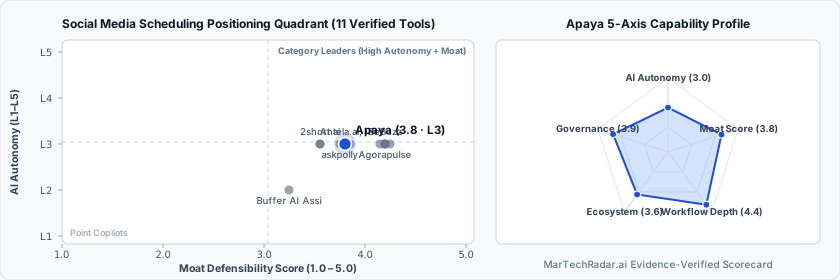
Apaya is a Web SaaS tool for Social Media Scheduling (Social Media Scheduling & Auto-Publishing) in Social & Influencer. Pricing: Free plan · $0/mo · Enterprise plan. Best suited to Social Media Managers, Creator & Influencer Agencies and Brand Community Ops. Editor ratings: AI autonomy L3 (conditional automation); moat score 3.8/5.0 (Proprietary moat). Fact-checked by Anthony Hay on Oct 11, 2026.
AI-driven social media management software that automatically extracts website assets, generates branded copy and visual creatives, and schedules.
Apaya buyer fit verdict: when to choose vs. when to walk away
Choose Apaya if (Best Fit)
- Target ICP & Stack Fit: You operate as Social Media Managers, Creator & Influencer Agencies and Brand Community Ops requiring a Web SaaS deployment for Social Media Scheduling, with verified ecosystem connectivity for Twilio Segment.
- L3 Architecture & Defensibility: Apaya's defensibility centers on its automated ingestion pipeline, which translates unstructured website assets and product imagery into platform-optimized creative batches with minimal human configuration.
- Commercial Model Fit: Your procurement budget aligns with Free plan · $0/mo · Enterprise plan and want a self-serve free tier for zero-cost initial validation.
Walk away from Apaya if (Deal-Breakers)
- Walk away if your workflow requires uncapped enterprise volume on the Free plan · $0/mo · Enterprise plan entry plan without upgrading tiers.
- Walk away if your workflow cannot tolerate API rate limits and token expirations: Direct social platform integrations remain vulnerable to sudden OAuth token invalidation and strict third-party rate limits, which can interrupt scheduled publishing pipelines without immediate operator intervention.
- Walk away if template homogeneity is a deal-breaker for your team: Algorithmic visual generation relies on deterministic styling parameters, risking visual fatigue and repetitive layouts across high-volume, multi-week posting schedules.
Apaya key facts & scorecard
| Pricing | Free plan · $0/mo · Enterprise planVendor pricing page |
|---|---|
| Free plan | Yes |
| Delivery | Web SaaS |
| Audience | Social Media Managers, Creator & Influencer Agencies, Brand Community Ops |
| AI autonomy level | L3 · Conditional automationEditor-verified |
| Moat tier & score | 3.8 / 5.0 · Proprietary moatEditor-verified |
| Funding | Pre-seed |
| Total funding | $1MBacked by LoftyInc Capital, Microsoft for Startups, GreenHouse Capital, Iktomi |
| Founders | Tim Eisenhauer, Vivek Thakur |
| Company size | 2-10 employees |
| Ecosystem integrations | Twilio Segment |
| Governance & docs | Terms ↗ · Privacy ↗ |
| Headquarters | Wilmington, DE |
| Founded | 2025 |
| Last verified |
Apaya pros & cons: strengths vs. operational limitations
Pros: core strengths & capabilities
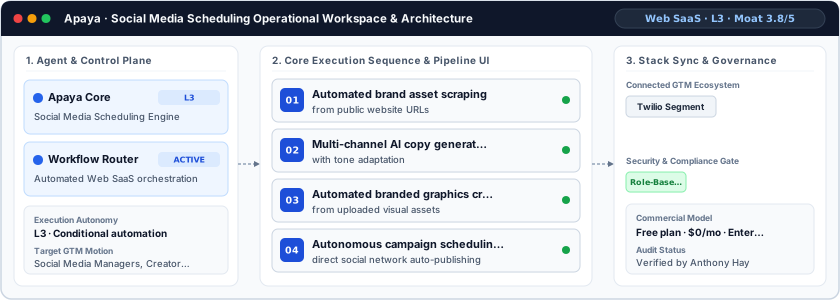
- Automated brand asset scraping: from public website URLs
- Multi-channel AI copy generation: with tone adaptation
- Automated branded graphics creation: from uploaded visual assets
- Autonomous campaign scheduling and: direct social network auto-publishing
Cons: operational limitations & risks
- API Rate Limits and Token Expirations: Direct social platform integrations remain vulnerable to sudden OAuth token invalidation and strict third-party rate limits, which can interrupt scheduled publishing pipelines without immediate operator intervention.
- Template Homogeneity: Algorithmic visual generation relies on deterministic styling parameters, risking visual fatigue and repetitive layouts across high-volume, multi-week posting schedules.
- Downstream Context Drift: Automated ingestion directly from public URLs lacks deep enterprise knowledge base integration, occasionally misinterpreting technical nuances or recent product deprecations when operating without human review.
Apaya TCO & deal-breaker stress test
Simulate 12-month stepped TCO, hidden cost multipliers, contract lock-in exposure, and stack failure modes using only facts verified by Anthony Hay on · Capture SHA 5f418dab.
Apaya is viable for 5 seats, but requires commercial or technical verification on the flagged items below.
| Plan / Tier | Verified Rate | Scale Fit | Scope & Quota Notes |
|---|---|---|---|
| Free / Sandbox | $0 | 1–2 seats (Evaluation) | Entry free tier with capped usage or feature quotas for initial workflow testing. |
| Essential | $55/mo | 1–2 seats | 20% off, $662 billed annually |
| Basic | $59/mo | 5 seats | Start Free Trial |
| Essential | $69/mo | 15 seats | 20% off, $662 billed annually |
- Moat Score
- 3.8 / 5.0
- AI Autonomy
- L3
- Free Tier / Trial
- Free plan
Triggered audit signals & failure modes
- Opaque Enterprise Quoting vs. SMB/Mid-Market BudgetVerified Pricing Ledger
Apaya does not disclose a public self-serve floor (Free plan · $0/mo · Enterprise plan). Buyers with a $800/mo cap face high sales-qualification friction.
- Published Self-Serve Entry FloorVerified Pricing Ledger
Apaya publishes a transparent entry point (Free plan · $0/mo · Enterprise plan) with a free tier for initial validation before committing.
- Tier Fit for 5-Seat Scale: Essential ($55/mo)Verified Tier Schedule
20% off, $662 billed annually
- Primary Operational Bottleneck: API Rate Limits and Token ExpirationsAudit by Anthony Hay
Direct social platform integrations remain vulnerable to sudden OAuth token invalidation and strict third-party rate limits, which can interrupt scheduled publishing pipelines without immediate operator intervention.
Hidden TCO Multipliers & Quota Gates
- Annual Billing Headline vs. Monthly Premium: Headline entry rates reflect annual billing commitments; month-to-month flexibility carries a higher effective monthly rate or requires annual prepayment.
- Credit & Usage Burn Multiplier: Automated workflows consume metered credits/usage quotas; multi-step enrichment, voice minutes, or high-frequency agent runs can trigger mid-cycle top-up packs.
- Enterprise Governance & Add-On Gating: Advanced capabilities such as Single Sign-On (SSO), custom role permissions, or specialized analytics modules are gated behind upper tiers or paid add-ons.
When to Walk Away & Negotiation Levers
- Walk away if your workflow requires uncapped enterprise volume on the Free plan · $0/mo · Enterprise plan entry plan without upgrading tiers.
- Walk away if your workflow cannot tolerate API rate limits and token expirations: Direct social platform integrations remain vulnerable to sudden OAuth token invalidation and strict third-party rate limits, which can interrupt scheduled publishing pipelines without immediate operator intervention.
- Walk away if template homogeneity is a deal-breaker for your team: Algorithmic visual generation relies on deterministic styling parameters, risking visual fatigue and repetitive layouts across high-volume, multi-week posting schedules.
- Validate exact quota thresholds (seats, credits, or API calls) included in Apaya's Free plan · $0/mo · Enterprise plan tier before converting from monthly to annual billing.
- Require a sandbox proof-of-concept testing API rate limits and token expirations against your live CRM/data schema before annual sign-off.
Ask a custom procurement or TCO stress-test question about Apaya
Lower 5-seat floor (~$395/mo vs. Custom Quote)
Lower 5-seat floor (~$10/mo vs. Custom Quote)
Apaya key entities, modules & ecosystem stack
Apaya moat & subtrack positioning
Apaya's defensibility centers on its automated ingestion pipeline, which translates unstructured website assets and product imagery into platform-optimized creative batches with minimal human configuration.
Editorial review
Fact-checked by Anthony Hay (Senior SEO, Search Intelligence & Content Operations Editor) on .
Background
Architected to automate creative production and multi-network syndication from raw web assets, Apaya was established in 2025 in Wilmington, DE. Backed by $1M in seed funding, the company targets growth marketers, agency operators, and resource-constrained digital teams seeking continuous cross-platform distribution. Rather than requiring teams to draft copy and format graphics manually in external design tools, the platform continuously converts raw website content, product photographs, and text prompts into ready-to-publish social assets.
How Apaya works
Apaya operates an automated workflow pipeline that begins with DOM parsing of client URLs alongside multi-modal asset ingestion. The platform's language layer processes input themes and existing site copy to generate contextually aligned text tailored to each target platform's formatting constraints. Concurrently, an automated graphics engine composites brand assets and imagery into visual templates. Working at an autonomous Level 3 execution model, the platform allows operators to either manually approve generated campaign batches or route them directly into its scheduling queue for programmatic API dispatch across connected networks.
Limitations
Operational considerations and platform boundaries include:
- API Rate Limits and Token Expirations: Direct social platform integrations remain vulnerable to sudden OAuth token invalidation and strict third-party rate limits, which can interrupt scheduled publishing pipelines without immediate operator intervention.
- Template Homogeneity: Algorithmic visual generation relies on deterministic styling parameters, risking visual fatigue and repetitive layouts across high-volume, multi-week posting schedules.
- Downstream Context Drift: Automated ingestion directly from public URLs lacks deep enterprise knowledge base integration, occasionally misinterpreting technical nuances or recent product deprecations when operating without human review.
Apaya pricing
Apaya utilizes a tiered subscription framework beginning with a free trial entry tier priced at $0. Paid entry starts with the Spark plan at $69 per month, which discounts to $55 per month when billed annually at $662. Upper tiers scale according to brand workspace capacity, connected channel volume, seat allocations, approval workflows, and enterprise API access.
How Apaya compares
Within the auto-publishing subtrack, Apaya competes against established social management suites such as Agorapulse, as well as AI-native engines like Antela.ai, Inc. and askpolly within the Social Media Scheduling segment. While Agorapulse prioritizes unified team inbox governance and granular social listening for enterprise teams, Apaya focuses on end-to-end creative generation from raw web endpoints. It provides an agile alternative for lean organizations that prioritize automated visual production over complex social monitoring infrastructure.
Direct competitors & market radar
Top algorithmic competitors based on category positioning, capability overlap, and ICP alignment.
Frequently asked questions about Apaya
How much does Apaya cost and what pricing tiers are available?
Published pricing summary for Apaya: Free plan · $0/mo · Enterprise plan. Apaya includes a free tier or sandbox entry point. Verified tier schedule: Free / Sandbox ($0 for 1–2 seats (Evaluation)); Essential ($55/mo for 1–2 seats); Basic ($59/mo for 5 seats); Essential ($69/mo for 15 seats). Apaya utilizes a tiered subscription framework beginning with a free trial entry tier priced at $0. Paid entry starts with the Spark plan at $69 per month, which discounts to $55 per month when billed annually at $662.
How does Apaya work and how autonomous is its AI architecture?
AI-driven social media management software that automatically extracts website assets, generates branded copy and visual creatives, and schedules. Within Social Media Scheduling (Social Media Scheduling & Auto-Publishing), MarTechRadar rates its execution architecture at L3 · Conditional automation with a verified Moat Score of 3.8 / 5.0 (Proprietary moat). Apaya's defensibility centers on its automated ingestion pipeline, which translates unstructured website assets and product imagery into platform-optimized creative batches with minimal human configuration. Corporate profile: Founded by Tim Eisenhauer, Vivek Thakur, operating at 2-10 employees scale.
What are the main limitations of Apaya and when should buyers walk away?
Based on our editorial technical audit, key operational considerations and boundaries for Apaya include: (1) API Rate Limits and Token Expirations: Direct social platform integrations remain vulnerable to sudden OAuth token invalidation and strict third-party rate limits, which can interrupt scheduled publishing pipelines without immediate operator intervention. (2) Template Homogeneity: Algorithmic visual generation relies on deterministic styling parameters, risking visual fatigue and repetitive layouts across high-volume, multi-week posting schedules. (3) Downstream Context Drift: Automated ingestion directly from public URLs lacks deep enterprise knowledge base integration, occasionally misinterpreting technical nuances or recent product deprecations when operating without human review. Primary procurement walk-away rule: Walk away if your workflow requires uncapped enterprise volume on the Free plan · $0/mo · Enterprise plan entry plan without upgrading tiers.
What integrations, compliance certifications, and contract terms apply to Apaya?
Verified ecosystem and stack integrations include Twilio Segment. Key TCO multiplier to watch: Annual Billing Headline vs. Monthly Premium (Headline entry rates reflect annual billing commitments; month-to-month flexibility carries a higher effective monthly rate or requires annual prepayment.) Before signing a contract, procurement teams should validate exact quota thresholds (seats, credits, or API calls) included in Apaya's Free plan · $0/mo · Enterprise plan tier before converting from monthly to annual billing.
What are the best Apaya alternatives and head-to-head competitors in 2026?
Top fact-checked alternatives to Apaya in Social Media Scheduling (Social Media Scheduling & Auto-Publishing) include Sprout Social AI ($199–$399/seat/mo), Agorapulse (From $79/seat/mo), askpolly (Custom / enterprise pricing), Antela.ai, Inc. (Custom / enterprise pricing). Within the auto-publishing subtrack, Apaya competes against established social management suites such as Agorapulse, as well as AI-native engines like Antela.ai, Inc. and askpolly within the Social Media Scheduling segment.
Verified sources & evidence trail
- Official product domain: https://apaya.com
- Commercial pricing verification: https://apaya.com/pricing
- Verified corporate entity profiles (
sameAs): LinkedIn Company Profile · Crunchbase Entity Record - First-party governance & documentation links: Terms · Privacy
- Editorial audit sign-off: Fact-checked by Anthony Hay on under the MarTechRadar Evidence-Ledger Protocol.