Ocoya Review (2026): Social Media Scheduling Pricing, Limits & Alternatives
Bottom line
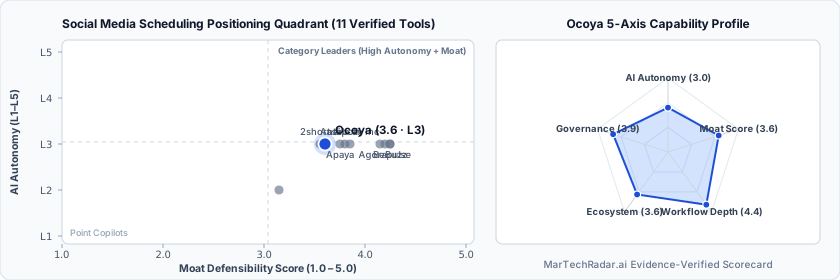
Ocoya is a Web SaaS tool for Social Media Scheduling (Social Media Scheduling & Auto-Publishing) in Social & Influencer. Pricing: From $29/mo. Best suited to DTC / eCommerce and Creators / Solo. Editor ratings: AI autonomy L3 (conditional automation); moat score 3.6/5.0 (Proprietary moat). Fact-checked by Jagmeet Sine on Oct 15, 2026.
AI-powered social media management platform uniting generative content creation, cross-platform post scheduling, and workflow automation in a centralized.
Ocoya buyer fit verdict: when to choose vs. when to walk away
Choose Ocoya if (Best Fit)
- Target ICP & Stack Fit: You operate as DTC / eCommerce and Creators / Solo requiring a Web SaaS deployment for Social Media Scheduling, with verified ecosystem connectivity for LinkedIn.
- L3 Architecture & Defensibility: Proprietary workflow combining generative copywriting, visual asset orchestration, and multi-network API scheduling into automated micro-campaign pipelines.
- Commercial Model Fit: Your procurement budget aligns with From $29/mo.
Walk away from Ocoya if (Deal-Breakers)
- Walk away if your workflow requires uncapped enterprise volume on the From $29/mo entry plan without upgrading tiers.
- Walk away if your workflow cannot tolerate API rate limits and token volatility: External network API shifts frequently disrupt scheduled publishing queues, requiring manual credential refreshes when third-party OAuth access tokens expire unexpectedly.
- Walk away if credit consumption friction is a deal-breaker for your team: Generative operations rely on shared credit pools that deplete rapidly during multi-variant visual and copy tests, causing automated workflows to stall mid-queue.
Ocoya key facts & scorecard
| Pricing | From $29/moVendor pricing page |
|---|---|
| Free plan | No / not disclosed |
| Delivery | Web SaaS |
| Audience | DTC / eCommerce, Creators / Solo |
| AI autonomy level | L3 · Conditional automationEditor-verified |
| Moat tier & score | 3.6 / 5.0 · Proprietary moatEditor-verified |
| Funding | Seed |
| Total funding | €55K |
| Founders | Aivaras Tumas, Joe Sutcliffe |
| Company size | 2-10 employees |
| Ecosystem integrations | |
| Governance & docs | System Status ↗ · API & Docs ↗ · Terms ↗ · Privacy ↗ |
| Headquarters | Vilnius, Vilniaus Apskritis, Lithuania |
| Founded | 2021 |
| Last verified |
Ocoya pros & cons: strengths vs. operational limitations
Pros: core strengths & capabilities
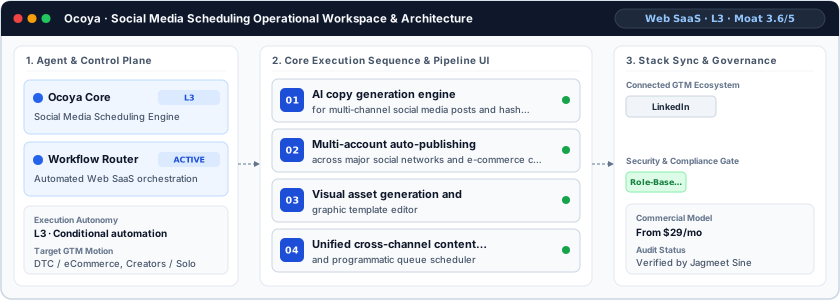
- AI copy generation engine: for multi-channel social media posts and hashtags
- Multi-account auto-publishing: across major social networks and e-commerce channels
- Visual asset generation and: graphic template editor
- Unified cross-channel content calendar: and programmatic queue scheduler
Cons: operational limitations & risks
- API Rate Limits and Token Volatility: External network API shifts frequently disrupt scheduled publishing queues, requiring manual credential refreshes when third-party OAuth access tokens expire unexpectedly.
- Credit Consumption Friction: Generative operations rely on shared credit pools that deplete rapidly during multi-variant visual and copy tests, causing automated workflows to stall mid-queue.
- Enterprise Governance Constraints: The system lacks advanced role-based access controls and hierarchical compliance audit logs required by regulated enterprise marketing departments.
Ocoya TCO & deal-breaker stress test
Simulate 12-month stepped TCO, hidden cost multipliers, contract lock-in exposure, and stack failure modes using only facts verified by Jagmeet Sine on · Capture SHA 1b776d44.
Ocoya aligns with your 5-seat / $800/mo profile. Review the walk-away triggers and contract levers below before deployment.
| Plan / Tier | Verified Rate | Scale Fit | Scope & Quota Notes |
|---|---|---|---|
| Free | $29/mo | 1–2 seats | Verified $29/mo tier from vendor pricing schedule. |
| Team | $79/mo | 5 seats | For growing teams managing a few brands. |
| Agency | $199/mo | 15 seats | For agencies managing many client brands. |
- Moat Score
- 3.6 / 5.0
- AI Autonomy
- L3
- Free Tier / Trial
- None disclosed
Triggered audit signals & failure modes
- Published Self-Serve Entry FloorVerified Pricing Ledger
Ocoya publishes a transparent entry point (From $29/mo) for initial validation before committing.
- Tier Fit for 5-Seat Scale: Team ($79/mo)Verified Tier Schedule
For growing teams managing a few brands.
- Primary Operational Bottleneck: Credit Consumption FrictionAudit by Jagmeet Sine
Generative operations rely on shared credit pools that deplete rapidly during multi-variant visual and copy tests, causing automated workflows to stall mid-queue.
Hidden TCO Multipliers & Quota Gates
- Credit & Usage Burn Multiplier: Automated workflows consume metered credits/usage quotas; multi-step enrichment, voice minutes, or high-frequency agent runs can trigger mid-cycle top-up packs.
- API Rate Limits and Token Volatility: External network API shifts frequently disrupt scheduled publishing queues, requiring manual credential refreshes when third-party OAuth access tokens expire unexpectedly.
- Credit Consumption Friction: Generative operations rely on shared credit pools that deplete rapidly during multi-variant visual and copy tests, causing automated workflows to stall mid-queue.
When to Walk Away & Negotiation Levers
- Walk away if your workflow requires uncapped enterprise volume on the From $29/mo entry plan without upgrading tiers.
- Walk away if your workflow cannot tolerate API rate limits and token volatility: External network API shifts frequently disrupt scheduled publishing queues, requiring manual credential refreshes when third-party OAuth access tokens expire unexpectedly.
- Walk away if credit consumption friction is a deal-breaker for your team: Generative operations rely on shared credit pools that deplete rapidly during multi-variant visual and copy tests, causing automated workflows to stall mid-queue.
- Validate exact quota thresholds (seats, credits, or API calls) included in Ocoya's From $29/mo tier before converting from monthly to annual billing.
- Require a sandbox proof-of-concept testing API rate limits and token volatility against your live CRM/data schema before annual sign-off.
Ask a custom procurement or TCO stress-test question about Ocoya
Lower 5-seat floor (~$10/mo vs. $79 / mo)
Lower 5-seat floor (~$5/mo vs. $79 / mo)
Ocoya key entities, modules & ecosystem stack
Ocoya moat & subtrack positioning
Proprietary workflow combining generative copywriting, visual asset orchestration, and multi-network API scheduling into automated micro-campaign pipelines.
Editorial review
Fact-checked by Jagmeet Sine (Senior MarTech Infrastructure & Agentic Workflow Architect) on .
Background
Ocoya addresses the operational bottleneck of multi-channel social campaign execution by unifying asset generation, copywriting, and queue dispatching within a single console. Headquartered in Vilnius, Vilniaus Apskritis, Lithuania and founded in 2021, the company has raised €55K in venture funding. Built primarily for growth marketers, boutique agencies, and e-commerce operators, the platform positions itself as an automated alternative to traditional agency workflows by combining generative AI authoring directly with social publishing pipelines.
How Ocoya works
Operating at an L3 autonomy profile, Ocoya structures content distribution through a centralized ingestion and composition engine. The platform queries social network endpoints—including Meta Graph, LinkedIn, and X APIs—using secure OAuth integrations. Users configure brand profiles, product catalogs, and style parameters, which an LLM-assisted generation layer converts into targeted captions, hashtags, and visual compositions. Queued assets transition through an automated scheduling pipeline that handles cron-based batch dispatches, rate-limit governance, and channel-specific payload formatting without requiring manual per-network reformatting.
Limitations
Operational considerations and platform boundaries include:
- API Rate Limits and Token Volatility: External network API shifts frequently disrupt scheduled publishing queues, requiring manual credential refreshes when third-party OAuth access tokens expire unexpectedly.
- Credit Consumption Friction: Generative operations rely on shared credit pools that deplete rapidly during multi-variant visual and copy tests, causing automated workflows to stall mid-queue.
- Enterprise Governance Constraints: The system lacks advanced role-based access controls and hierarchical compliance audit logs required by regulated enterprise marketing departments.
Ocoya pricing
Commercial licensing follows a tiered software-as-a-service model partitioned by seat count, linked social profiles, and monthly AI generation credits. Entry tiers begin at $29 per month for single users managing up to five profiles with three hundred credits. Mid-market tiers scale to $79 per month for five seats and twenty profiles, while agency packages reach $199 per month to accommodate expanded profile volumes. Every tier includes a seven-day trial period prior to recurring billing.
How Ocoya compares
Within the social publishing category, Ocoya competes against established management suites like Agorapulse, as well as AI-native entrants such as Antela.ai, Inc. and Apaya. Whereas Agorapulse emphasizes deep social listening, unified social inbox governance, and complex multi-stakeholder SLA tracking, Ocoya optimizes for rapid, end-to-end asset generation and programmatic syndication. It remains ideal for agile mid-market brands seeking consolidated generative workflows rather than deep enterprise compliance suites.
Direct competitors & market radar
Top algorithmic competitors based on category positioning, capability overlap, and ICP alignment.
Frequently asked questions about Ocoya
How much does Ocoya cost and what pricing tiers are available?
Published pricing summary for Ocoya: From $29/mo. A permanent free plan is not disclosed for Ocoya. Verified tier schedule: Free ($29/mo for 1–2 seats); Team ($79/mo for 5 seats); Agency ($199/mo for 15 seats). Commercial licensing follows a tiered software-as-a-service model partitioned by seat count, linked social profiles, and monthly AI generation credits. Entry tiers begin at $29 per month for single users managing up to five profiles with three hundred credits.
How does Ocoya work and how autonomous is its AI architecture?
AI-powered social media management platform uniting generative content creation, cross-platform post scheduling, and workflow automation in a centralized. Within Social Media Scheduling (Social Media Scheduling & Auto-Publishing), MarTechRadar rates its execution architecture at L3 · Conditional automation with a verified Moat Score of 3.6 / 5.0 (Proprietary moat). Proprietary workflow combining generative copywriting, visual asset orchestration, and multi-network API scheduling into automated micro-campaign pipelines. Corporate profile: Founded by Aivaras Tumas, Joe Sutcliffe, operating at 2-10 employees scale.
What are the main limitations of Ocoya and when should buyers walk away?
Based on our editorial technical audit, key operational considerations and boundaries for Ocoya include: (1) API Rate Limits and Token Volatility: External network API shifts frequently disrupt scheduled publishing queues, requiring manual credential refreshes when third-party OAuth access tokens expire unexpectedly. (2) Credit Consumption Friction: Generative operations rely on shared credit pools that deplete rapidly during multi-variant visual and copy tests, causing automated workflows to stall mid-queue. (3) Enterprise Governance Constraints: The system lacks advanced role-based access controls and hierarchical compliance audit logs required by regulated enterprise marketing departments. Primary procurement walk-away rule: Walk away if your workflow requires uncapped enterprise volume on the From $29/mo entry plan without upgrading tiers.
What integrations, compliance certifications, and contract terms apply to Ocoya?
Verified ecosystem and stack integrations include LinkedIn. First-party governance and developer endpoints verified on domain include: Status (https://status.ocoya.com), API Docs (https://docs.ocoya.com/welcome). Key TCO multiplier to watch: Credit & Usage Burn Multiplier (Automated workflows consume metered credits/usage quotas; multi-step enrichment, voice minutes, or high-frequency agent runs can trigger mid-cycle top-up packs.) Before signing a contract, procurement teams should validate exact quota thresholds (seats, credits, or API calls) included in Ocoya's From $29/mo tier before converting from monthly to annual billing.
What are the best Ocoya alternatives and head-to-head competitors in 2026?
Top fact-checked alternatives to Ocoya in Social Media Scheduling (Social Media Scheduling & Auto-Publishing) include Hootsuite OwlyWriter (Custom / enterprise pricing), Buffer AI Assistant (Free plan · $5–$10/mo), Mora AI (Custom / enterprise pricing), Metricool (Free plan · $10–$45/mo). Within the social publishing category, Ocoya competes against established management suites like Agorapulse, as well as AI-native entrants such as Antela.ai, Inc. and Apaya.
Verified sources & evidence trail
- Official product domain: https://ocoya.com
- Commercial pricing verification: https://www.ocoya.com/pricing
- Verified corporate entity profiles (
sameAs): LinkedIn Company Profile · Crunchbase Entity Record - First-party governance & documentation links: System Status · API & Docs · Terms · Privacy
- Editorial audit sign-off: Fact-checked by Jagmeet Sine on under the MarTechRadar Evidence-Ledger Protocol.